




Introduction
Whenever a Job notification is out the first thing we do is go to the salary section and check what is the remuneration for that particular job. In order to apply for that particular job and later put all the effort and hard-work to get selected, is a long and tiring process. If our efforts are not compensated satisfactorily, we might not really like to get into the long time consuming process.
When we go through the salary section we often see words like Pay Scale, Grade Pay, or even level one or two salary and it is common to get confused between these jargons and to know the perfect amount of salary that we are going to receive.
To understand what pay scale, grade pay, various numbers of levels and other technical terms, we first need to know what pay commission is and how it functions.
Pay Commission
The Constitution of India under Article 309 empowers the Parliament and State Government to regulate the recruitment and conditions of service of persons appointed to public services and posts in connection with the affairs of the Union or any State.
The Pay Commission was established by the Indian government to make recommendations regarding the compensation of central government employees. Since India gained its independence, seven pay commissions have been established to examine and suggest changes to the pay structures of all civil and military employees of the Indian government.
The main objective of these various Pay Commissions was to improve the pay structure of its employees so that they can attract better talent to public service. In this 21st century, the global economy has undergone a vast change and it has seriously impacted the living conditions of the salaried class. The economic value of the salaries paid to them earlier has diminished. The economy has become more and more consumerized. Therefore, to keep the salary structure of the employees viable, it has become necessary to improve the pay structure of their employees so that better, more competent and talented people could be attracted to governance.
In this background, the Seventh Central Pay Commission was constituted and the government framed certain Terms of Reference for this Commission. The salient features of the terms are to examine and review the existing pay structure and to recommend changes in the pay, allowances and other facilities as are desirable and feasible for civil employees as well as for the Defence Forces, having due regard to the historical and traditional parities.
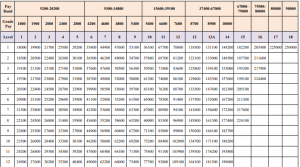
The Ministry of finance vide notification dated 25th July 2016 issued rules for 7th pay commission. The rules include a Schedule which shows categorically what payment has to be made to different positions. The said schedule is called 7th pay matrix
For the reference the table(7th pay matrix) is attached below.
Pay Band & Grade Pay
According to the table given above the first column shows the Pay band.
Pay Band is a pay scale according to the pay grades. It is a part of the salary process as it is used to rank different jobs by education, responsibility, location, and other multiple factors. The pay band structure is based on multiple factors and assigned pay grades should correlate with the salary range for the position with a minimum and maximum. Pay Band is used to define the compensation range for certain job profiles.
Here, Pay band is a part of an organized salary compensation plan, program or system. The Central and State Government has defined jobs, pay bands are used to distinguish the level of compensation given to certain ranges of jobs to have fewer levels of pay, alternative career tracks other than management, and barriers to hierarchy to motivate unconventional career moves. For example, entry-level positions might include security guard or karkoon. Those jobs and those of similar levels of responsibility might all be included in a named or numbered pay band that prescribed a range of pay.
The detailed calculation process of salary according to the pay matrix table is given under Rule 7 of the Central Civil Services (Revised Pay) Rules, 2016.
As per Rule 7A(i), the pay in the applicable Level in the Pay Matrix shall be the pay obtained by multiplying the existing basic pay by a factor of 2.57, rounded off to the nearest rupee and the figure so arrived at will be located in that Level in the Pay Matrix and if such an identical figure corresponds to any Cell in the applicable Level of the Pay Matrix, the same shall be the pay, and if no such Cell is available in the applicable Level, the pay shall be fixed at the immediate next higher Cell in that applicable Level of the Pay Matrix.
The detailed table as mentioned in the Rules showing the calculation:
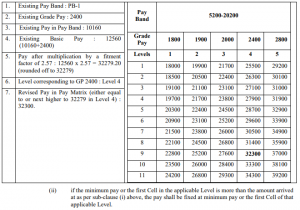
For example if your pay in Pay Band is 5200 (initial pay in pay band) and Grade Pay of 1800 then 5200+1800= 7000, now the said amount of 7000 would be multiplied to 2.57 as mentioned in the Rules. 7000 x 2.57= 17,990 so as per the rules the nearest amount the figure shall be fixed as pay level. Which in this case would be 18000/-.
The basic pay would increase as your experience at that job would increase as specified in vertical cells. For example if you continue to serve in the Basic Pay of 18000/- for 4 years then your basic pay would be 19700/- as mentioned in the table.
Dearness Allowance
However, the basic pay mentioned in the table is not the only amount of remuneration an employee receives. There are catena of benefits and further additions in the salary such as dearness allowance, HRA, TADA.
According to the Notification No. 1/1/2023-E.II(B) from the Ministry of Finance and Department of Expenditure, the Dearness Allowance payable to Central Government employees was enhanced from rate of 38% to 42% of Basic pay with effect from 1st January 2023.
Here, DA would be calculated on the basic salary. For example if your basic salary is of 18,000/- then 42% DA would be of 7,560/-
House Rent Allowance
Apart from that the HRA (House Rent Allowance) is also provided to employees according to their place of duties. Currently cities are classified into three categories as ‘X’ ‘Y’ ‘Z’ on the basis of the population.
According to the Compendium released by the Ministry of Finance and Department of Expenditure in Notification No. 2/4/2022-E.II B, the classification of cities and rates of HRA as per 7th CPC was introduced.
See the table for reference
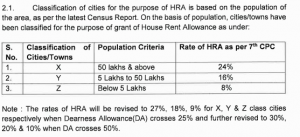
However, after enhancement of DA from 38% to 42% the HRA would be revised to 27%, 18%, and 9% respectively.
As above calculated the DA on Basic Salary, in the same manner HRA would also be calculated on the Basic Salary. Now considering that the duty of an employee’s Job is at ‘X’ category of city then HRA will be calculated at 27% of basic salary.
Here, continuing with the same example of calculation with a basic salary of 18000/-, the amount of HRA would be 4,840/-
Transport Allowance
After calculation of DA and HRA, Central government employees are also provided with Transport Allowance (TA). After the 7th CPC the revised rates of Transport Allowance were released by the Ministry of Finance and Department of Expenditure in the Notification No. 21/5/2017-EII(B) wherein, a table giving detailed rates were produced.
The same table is reproduced hereinafter.
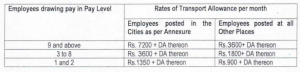
As mentioned above in the table, all the employees are given Transport Allowance according to their pay level and place of their duties. The list of annexed cities are given in the same Notification No. 21/5/2017-EII(B).
Again, continuing with the same example of calculation with a Basic Salary of 18000/- and assuming place of duty at the city mentioned in the annexure, the rate of Transport Allowance would be 1350/-
Apart from that, DA on TA is also provided as per the ongoing rate of DA. For example, if TA is 1350/- and rate of current DA on basic Salary is 42% then 42% of TA would be added to the calculation of gross salary. Here, DA on TA would be 567/-.
Calculation of Gross Salary
After calculating all the above benefits the Gross Salary is calculated.
Here, after calculating Basic Salary+DA+HRA+TA the gross salary would be 32,317/-
However, the Gross Salary is subject to few deductions such as NPS, Professional Tax, Medical as subject to the rules and directions by the Central Government. After the deductions from the Gross Salary an employee gets the Net Salary on hand.
However, it is pertinent to note that benefits such as HRA and TA are not absolute, these allowances are only admissible if an employee is not provided with a residence by the Central Government or facility of government transport.
Conclusion
Government service is not a contract. It is a status. The employees expect fair treatment from the government. The States should play a role model for the services. The Apex Court in the case of Bhupendra Nath Hazarika and another vs. State of Assam and others (reported in 2013(2)Sec 516) has observed as follows:
“………It should always be borne in mind that legitimate aspirations of the employees are not guillotined and a situation is not created where hopes end in despair. Hope for everyone is gloriously precious and that a model employer should not convert it to be deceitful and treacherous by playing a game of chess with their seniority. A sense of calm sensibility and concerned sincerity should be reflected in every step. An atmosphere of trust has to prevail and when the employees are absolutely sure that their trust shall not be betrayed and they shall be treated with dignified fairness then only the concept of good governance can be concretized. We say no more.”
The consideration while framing Rules and Laws on payment of wages, it should be ensured that employees do not suffer economic hardship so that they can deliver and render the best possible service to the country and make the governance vibrant and effective.
Written by Husain Trivedi Advocate

Arbitration Proceedings and Section 138 NI Act: Comprehensive Guide to Simultaneous Proceedings and Injunctive Relief
A detailed analysis of the intersection between arbitration proceedings and cheque bounce cases under the Negotiable Instruments Act, including recent Supreme Court developments and practical strategies for legal practitioners

Executive Summary
The complex interplay between arbitration proceedings and Section 138 of the Negotiable Instruments Act presents unique challenges for legal practitioners and commercial entities. Recent developments in 2024-2025, including landmark Supreme Court judgments on directorial liability in Rajesh Viren Shah v. Redington (India) Limited (2024) 4 SCC 305 and evolving jurisprudence on settlement and compounding procedures, have significantly shaped the legal landscape.
This comprehensive analysis examines when arbitration and criminal proceedings can run simultaneously, the parameters for granting injunctive relief in cheque-related matters, and the strategic considerations for effective legal practice in this evolving area of law.
Legal Framework: Arbitration and Section 138 of the Negotiable Instruments Act
The Arbitration and Conciliation Act, 1996
The Arbitration Act provides robust interim relief mechanisms that often intersect with negotiable instrument disputes. Section 9 empowers courts to grant interim measures before or during arbitral proceedings:
“A party may, before or during arbitral proceedings, apply to the court for interim measures of protection in respect of any matter concerning the subject-matter of the arbitration.”
Section 17 grants similar powers to arbitral tribunals:
“A party may, during the arbitral proceedings, apply to the arbitral tribunal for an interim measure of protection… including interim injunction…”
The Negotiable Instruments Act: Criminal Liability Framework
Section 138 of the Negotiable Instruments Act creates criminal liability for dishonour of cheques for insufficient funds, establishing a unique intersection between commercial disputes and criminal law. The provision states:
“Where any cheque drawn by a person on an account maintained by him with a banker for payment of any amount of money to another person from out of that account for the discharge, in whole or in part, of any debt or other liability, is returned by the bank unpaid…”
The supporting Section 139 creates a rebuttable presumption:
“It shall be presumed, unless the contrary is proved, that the holder of a cheque received the cheque of the nature referred to in section 138 for the discharge, in whole or in part, of any debt or other liability.”
Recent Developments in 2024-2025
The Supreme Court’s 2024 ruling on settlement and compounding emphasized that “compounding under Section 138 requires the consent of both the drawer and the payee. Even if a settlement is reached and the cheque amount is paid, the criminal proceedings can continue if the payee does not consent” to compound the offense.
This development significantly impacts arbitration strategies where parties seek to resolve underlying disputes while criminal proceedings remain pending.
Simultaneous Proceedings: Separate Causes of Action Doctrine
The Supreme Court’s Foundational Principle
The landmark decision in M/s Sri Krishna Agencies vs State of A.P. & Anr. (Criminal Appeal No. 1792 of 2008) established the cornerstone principle for simultaneous proceedings:
“We are also of the view that there can be no bar to the simultaneous continuance of a criminal proceeding and a civil proceeding if the two arise from separate causes of action. The decision in Trisuns Chemical Industry case appears to squarely cover this case as well.”
Section 138 and Arbitration Proceedings: Legal Rationale
The courts recognize distinct characteristics of each proceeding type:
- Arbitration proceedings arise from contractual disputes involving breach of agreement terms, interpretation of commercial obligations, and civil remedies for contractual violations.
- Section 138 proceedings arise from dishonour of negotiable instruments, creating statutory criminal liability independent of underlying contractual relationships.
This separation allows arbitration proceedings and section 138 cases to continue simultaneously without conflict, as they address different legal questions with different standards of proof and remedial frameworks.
Contemporary Judicial Approach
Recent Supreme Court decisions have reinforced this approach while emphasizing the need for careful case management. In 2024 judgments, the Supreme Court has consistently held that “the trial court’s dismissal of the complaint was primarily based on the absence of evidence”, highlighting the importance of maintaining proper evidentiary standards in both criminal and arbitration proceedings.
Rights and Obligations: Negotiable Instruments in Commercial Context
Holder in Due Course Doctrine
The concept of “holder in due course” under Section 9 of the Negotiable Instruments Act provides significant protection to legitimate payees. A holder in due course must:
- Take the cheque for valuable consideration
- Act in good faith without notice of any defect in title
- Obtain the instrument before its apparent or actual maturity
Superior Rights and Legal Protections
Holders in due course enjoy enhanced legal protections including immunity from prior defects in title, independent rights to enforce payment regardless of underlying contract disputes, and the benefit of legal presumptions under Sections 118(g) and 139 of the Act.
Landmark Analysis: Commercial Liability Principles
The Supreme Court in M.M.T.C. Ltd. and Anr. v. Medchl Chemicals and Pharma (P) Ltd. (2001) established important precedent:
“There is therefore no requirement that the complainant must specifically allege in the complaint that there was a subsisting liability. The burden of proving that there was no existing debt or liability was on the Respondents.”
This shifting of burden of proof significantly impacts arbitration strategies, as parties challenging cheque validity must provide positive evidence of the absence of underlying liability.
Recent Directorial Liability Developments
The 2024 Supreme Court decision in Rajesh Viren Shah v. Redington (India) Limited clarified that “a director who had resigned before the issuance of a bounced cheque cannot be prosecuted under Section 138 and 141 of the Negotiable Instruments Act”. This ruling provides important clarity for corporate governance and liability issues in commercial arbitration contexts.
Injunctive Relief: Timing and Jurisdictional Considerations
The Critical Pre-Deposit vs Post-Deposit Distinction
Courts have consistently distinguished between applications filed before cheque deposit versus those filed after dishonour has occurred. This timing distinction proves crucial for determining available relief and applicable legal standards.
Pre-Deposit Stage: Equitable Intervention
Before a cheque is deposited and dishonoured, no criminal cause of action exists under Section 138. Courts retain broad equitable jurisdiction to examine:
- Underlying contractual validity and performance
- Good faith obligations of parties
- Balance of convenience in commercial relationships
- Prevention of instrument misuse or coercion
Post-Deposit Stage: Limited Intervention Scope
Once a cheque has been deposited and dishonoured, the criminal machinery under Section 138 activates. Section 41(d) of the Specific Relief Act creates significant limitations:
“The court shall not grant an injunction… to restrain any person from instituting or prosecuting any proceeding in any criminal matter.”
Judicial Analysis: Madras High Court Precedent
The Madras High Court in M/s. SBQ Steels Limited vs M/s. Goyal Gases (O.A. No. 813 of 2013) provided definitive guidance on pre-deposit applications:
“The relief sought by the applicant is only to restrain the respondent from presenting the cheques for payment… When the very cause of action for instituting a proceeding in a criminal matter had not arisen, it is impossible to hold that the application is barred by Section 41(d).”
This decision established key principles including the requirement that criminal proceedings need completed dishonour, the relevance of timing in determining available relief, the court’s authority to examine underlying transaction validity, and recognition that cheques might be honoured, negating criminal liability.
Strategic Framework for Legal Practice
Pre-Litigation Risk Assessment
Effective legal strategy begins with comprehensive risk assessment considering multiple factors:
- Contract Analysis: Examination of arbitration clauses, cheque security provisions, termination and return mechanisms, and dispute resolution procedures.
- Timing Considerations: Assessment of cheque deposit schedules, contract performance timelines, limitation periods, and statutory notice requirements.
- Evidence Evaluation: Analysis of documentary evidence supporting contract breach claims, witness availability and credibility, financial records and transaction histories, and correspondence establishing party intentions.
Multi-Phase Litigation Strategy
Phase 1: Immediate Response (0-15 days)
- Emergency applications under Section 9 of the Arbitration Act
- Stop payment instructions to relevant banking institutions
- Evidence preservation measures including document security
- Compliance with statutory notice requirements
Phase 2: Interim Relief Proceedings (15-60 days)
- Detailed affidavits supporting injunctive relief applications
- Comprehensive contract documentation and analysis
- Counter-strategy development and risk mitigation
- Settlement negotiation initiation and management
Phase 3: Final Adjudication (60+ days)
- Arbitration proceedings management and coordination
- Criminal defense strategy coordination where applicable
- Appeal preparation and strategic planning
- Enforcement mechanism development and implementation
Common Practice Pitfalls and Prevention Strategies
- Delayed Action: The most critical error involves waiting until after cheque deposit to seek relief. Immediate Section 9 applications upon contract dispute identification provide the best protection.
- Inadequate Documentation: Insufficient proof of contract breach or cheque misuse undermines relief applications. Comprehensive record-keeping and witness statement preparation prove essential.
- Jurisdictional Confusion: Filing applications in incorrect courts or tribunals wastes time and resources. Clear jurisdictional analysis and proper venue selection require careful attention.
- Procedural Violations: Missing statutory timelines or procedural requirements can invalidate otherwise meritorious applications. Systematic compliance monitoring and expert consultation prevent such errors.
Recent Case Law Developments and Trends
Supreme Court Jurisprudence Evolution (2024-2025)
Recent Supreme Court decisions have refined the legal framework governing arbitration proceedings and Section 138 intersections. Key trends include:
- Enhanced Scrutiny of Frivolous Applications: Courts increasingly examine whether applications represent genuine contract disputes or mere delaying tactics.
- Evidence Quality Requirements: Higher standards for documentary evidence supporting injunction claims and contractual breach allegations.
- Commercial Reality Focus: Greater attention to actual commercial relationships and business practices versus formal contractual terms.
- Procedural Efficiency Emphasis: Streamlined procedures for legitimate relief while preventing abuse of process.
High Court Contributions
Various High Courts have contributed to jurisprudential development through specialized commercial court decisions, establishing precedents on emergency arbitrator provisions, digital evidence standards in contract interpretation, and alternative dispute resolution integration.
Emerging Technology Impact
The legal framework increasingly addresses digital payment systems, electronic signatures on legal documents, online hearing procedures for interim relief, and blockchain technology in commercial transactions.
Practical Applications and Case Studies
Case Study 1: Manufacturing Agreement Dispute
Factual Background: A manufacturing agreement included post-dated cheques as performance security. When the principal contract faced performance disputes, the manufacturer sought to prevent cheque deposit while pursuing arbitration for the underlying commercial disagreement.
Legal Strategy Applied:
- Immediate Section 9 application citing material contract breach
- Pre-deposit injunction application with comprehensive evidence
- Parallel arbitration proceedings for main contract resolution
- Documentary evidence establishing cheque misuse beyond contractual terms
Judicial Outcome: The court granted pre-deposit injunction recognizing legitimate contract dispute, allowed arbitration proceedings to continue independently, and required final resolution through proper arbitration procedures with interim protection maintained.
Case Study 2: Real Estate Development Disputes
Commercial Context: A real estate development agreement included milestone payment cheques. When the developer failed to obtain necessary regulatory approvals, the investor sought contract rescission and cheque return while the developer attempted to deposit the security cheques.
Strategic Approach:
- Contract validity examination through arbitration proceedings
- Cheque characterization analysis (security versus consideration)
- Timing considerations for relief applications
- Balance of convenience analysis in commercial context
Legal Resolution: The dispute resolution involved separate tracks for contractual performance issues through arbitration and cheque validity determination through civil courts, with coordinated case management preventing conflicting outcomes.
Comparative Jurisdictional Analysis
Common Law Systems
- United Kingdom: The Bills of Exchange Act 1882 provides similar holder protections with enhanced arbitration framework through the Arbitration Act 1996. Criminal law separation remains more pronounced than in Indian jurisprudence.
- Singapore: Enhanced arbitration framework includes emergency arbitrator provisions, specialized commercial courts for complex disputes, and hybrid enforcement mechanisms for international arbitration with streamlined procedures.
- Australia: Specialized commercial court systems handle complex disputes with arbitration-friendly legal frameworks and limited criminal law intersection with commercial disputes.
Civil Law Jurisdictions
- Germany: Specialized commercial courts efficiently handle complex disputes with comprehensive arbitration-friendly legal frameworks and minimal criminal law intersection in commercial contexts.
- France: Enhanced alternative dispute resolution mechanisms integrate with traditional court systems, providing comprehensive commercial dispute resolution with international arbitration support.
Key Insights for Indian Practice
International best practices suggest several areas for potential improvement in Indian jurisprudence including enhanced emergency arbitrator procedures, streamlined commercial court operations, standardized documentation requirements, and improved coordination between criminal and civil proceedings.
Future Outlook and Recommendations
Anticipated Legal Developments
The legal landscape continues evolving with several anticipated changes:
- Digital Payment Integration: Reduced dependence on traditional cheques through blockchain and cryptocurrency dispute mechanisms, requiring updated legal frameworks.
- Artificial Intelligence Applications: AI-powered contract analysis and dispute prediction systems, automated document review processes, and predictive litigation outcome analysis.
- International Arbitration Growth: Enhanced cross-border enforcement mechanisms, standardized international commercial dispute procedures, and improved coordination with domestic court systems.
Legislative Reform Considerations
Potential amendments under consideration include enhanced Arbitration Act provisions for emergency arbitrator procedures, updated Negotiable Instruments Act provisions for digital payment instruments, modified Specific Relief Act standards for injunctive relief, and expanded Commercial Courts Act coverage for specialized disputes.
Professional Development Requirements
The evolving legal landscape requires enhanced training in commercial dispute resolution, specialized expertise in arbitration proceedings, technology integration in legal practice, and international commercial law understanding.
Practical Recommendations
For Legal Practitioners
- Early Intervention Strategy: Develop systematic approaches for immediate client protection upon dispute identification, including standardized emergency application procedures and comprehensive evidence preservation protocols.
- Multi-Forum Coordination: Master the coordination of simultaneous proceedings across different forums, including timeline management, evidence coordination, and strategic decision-making across multiple cases.
- Technology Integration: Embrace digital tools for case management, evidence presentation, and client communication while maintaining traditional legal analysis skills.
- Continuing Education: Stay current with rapidly evolving jurisprudence through regular case law updates, specialized training programs, and professional development opportunities.
For Commercial Entities
- Contract Design: Develop sophisticated contract drafting practices that anticipate potential dispute scenarios, including clear arbitration provisions, appropriate security mechanisms, and comprehensive dispute resolution procedures.
- Risk Management: Implement systematic risk assessment procedures for commercial transactions, including credit evaluation, security adequacy analysis, and legal compliance verification.
- Documentation Standards: Maintain comprehensive transaction records that support potential legal proceedings, including correspondence preservation, financial record maintenance, and decision documentation.
- Legal Relationship Management: Establish ongoing relationships with qualified legal counsel for proactive advice rather than reactive crisis management.
For the Judicial System
- Specialized Training: Enhanced judicial education on commercial law complexities, arbitration procedure coordination, and technology integration in legal proceedings.
- Case Management Innovation: Develop improved systems for coordinating simultaneous proceedings, including information sharing protocols, timeline coordination, and outcome consistency measures.
- Technology Adoption: Integrate modern technology for case management, evidence presentation, and remote hearing capabilities while maintaining procedural integrity.
- International Coordination: Enhance cooperation with international arbitration institutions and foreign court systems for cross-border dispute resolution.
Conclusion
The intersection of arbitration proceedings and Section 138 of the Negotiable Instruments Act represents one of the most dynamic areas of contemporary Indian commercial law. Recent Supreme Court developments, including the 2024 emphasis on settlement consent requirements, have added new dimensions to strategic planning for legal practitioners.
The legal framework recognizing simultaneous proceedings for separate causes of action, combined with the availability of pre-deposit injunctive relief under specific circumstances, provides a sophisticated toolkit for protecting client interests. In matters involving arbitration proceedings and section 138, success requires careful attention to procedural requirements, timing considerations, and evidence quality standards.
The clarification of directorial liability in the Rajesh Viren Shah case and ongoing evolution of judicial approaches to settlement and compounding demonstrate the importance of staying current with legal developments. As commercial practices continue evolving with digital payment systems and international transaction growth, the fundamental principles governing arbitration and negotiable instrument intersections will remain crucial for effective legal practice.
Legal practitioners must develop comprehensive strategies that address both civil and criminal law dimensions while maintaining procedural compliance and evidence quality standards. The future success in this area depends on embracing technological innovations while maintaining traditional legal analysis skills and staying current with rapidly evolving jurisprudence.
For commercial entities, proactive legal planning and professional relationship management provide the foundation for effective dispute prevention and resolution. The investment in proper contract design, risk management systems, and ongoing legal counsel relationships significantly reduces exposure to complex litigation scenarios.
The judicial system’s continued development of specialized procedures and coordination mechanisms will enhance the effectiveness of this dual-track approach to commercial dispute resolution. As the legal landscape continues evolving, all stakeholders must remain adaptive while maintaining core principles of procedural fairness and substantive justice.
Key Takeaways
- Simultaneous proceedings between arbitration proceedings and Section 138 cases are legally permissible for separate causes of action
- Pre-deposit injunctions can be granted under specific circumstances without violating Section 41(d) restrictions
- Recent 2024 Supreme Court developments have clarified directorial liability and settlement consent requirements
- Timing considerations prove crucial for determining available relief and strategic options
- Evidence quality and procedural compliance remain fundamental to successful outcomes
- Technology integration and international best practices offer opportunities for enhanced legal practice
- Proactive planning and professional legal relationships provide the best protection for commercial entities
This comprehensive analysis reflects current legal developments as of September 2025. Legal practitioners should verify the most recent case law and regulatory changes before advising clients on specific matters involving arbitration proceedings and Section 138 of the Negotiable Instruments Act.
References and Citations
[1] Arbitration and Conciliation Act, 1996, Sections 9 and 17
[2] Negotiable Instruments Act, 1881, Sections 138 and 139
[3] Specific Relief Act, 1963, Section 41(d)
[4] M/s Sri Krishna Agencies vs State of A.P. & Anr., Criminal Appeal No. 1792 of 2008
[5] Rajesh Viren Shah v. Redington (India) Limited, (2024) 4 SCC 305
[6] M.M.T.C. Ltd. and Anr. v. Medchl Chemicals and Pharma (P) Ltd., MANU/SC/0728/2001
[7] M/s. SBQ Steels Limited vs M/s. Goyal Gases, O.A. No. 813 of 2013, Madras High Court
[8] Supreme Court developments on settlement and compounding, 2024
[9] Various High Court decisions on commercial arbitration and Section 138 intersections, 2024-2025

Section 86 Gujarat Co-operative Societies Act: Delegation of Inquiry Powers to Subordinate Officers
A comprehensive analysis of the legal framework governing delegation of inquiry powers under the Gujarat Co-operative Societies Act, 1961

Executive Summary
Under Section 86 of the Gujarat Co-operative Societies Act, 1961, the Registrar possesses significant inquiry powers that can be lawfully delegated to subordinate officers. The recent Gujarat Co-operative Societies (Amendment) Act, 2024, has introduced several reforms while maintaining the core delegation framework. However, such delegation must comply with strict procedural safeguards, including mandatory written authorization and adherence to natural justice principles. The Gujarat High Court has consistently held that natural justice and proper procedure must be observed in any inquiry by the Registrar, and unauthorized delegation of powers is impermissible.
This analysis examines when and how a superior authority can validly hand over Section 86 inquiries to subordinate officers, the legal doctrines governing such delegation, and the practical implications for cooperative societies, legal practitioners, and regulatory authorities.
The Statutory Framework Under Section 86 of the Gujarat Co-operative Societies Act
Core Provisions of Section 86
Section 86 of the Gujarat Co-operative Societies Act, 1961, empowers the Registrar to conduct inquiries in the following terms:
“86. Inquiry by Registrar:- (1) The Registrar may of his own motion himself, or by a person duly authorised by him in writing in this behalf…” [1][2][3]
This statutory language explicitly contemplates delegation through the phrase “by a person duly authorised by him in writing,” establishing the legal foundation for transferring inquiry powers to subordinate officers.
Complementary Provisions Supporting Delegation
The delegation framework is reinforced by several interconnected provisions:
Section 3(3) provides the structural foundation: “The State Government may, by general or special order, confer on a person or persons appointed under sub-section (2) all or any of the powers of the Registrar under this Act.” This provision establishes the hierarchical framework within which delegation operates.[1]
Section 155 ensures supervisory accountability by providing revisional jurisdiction over “proceedings of subordinate officers,” maintaining the superior authority’s ultimate responsibility for the inquiry’s conduct and outcomes.[1]
Legal Doctrines Governing Delegation
The “Particular Manner” Principle
The Supreme Court’s jurisprudence establishes that when a statute prescribes a specific method for exercising power, that method must be followed strictly. In State of U.P. v. Singhara Singh, the Court applied the foundational Nazir Ahmad/Taylor principle, holding that “where a statute provides for a thing to be done in a particular manner, then it has to be done in that manner and in no other manner.”[4][5]
This doctrine requires that Section 86 delegations must include express written authorization, as anything less would violate the statutory mandate.
Natural Justice and Procedural Fairness
Recent Gujarat High Court decisions emphasize that natural justice and proper procedure must be observed in any inquiry by the Registrar, and unauthorized delegation of powers is impermissible. This judicial stance reinforces that delegation cannot be used to circumvent procedural safeguards or fundamental fairness requirements.
Supervisory Responsibility Doctrine
Even when inquiry powers are properly delegated, the Registrar retains ultimate supervisory responsibility. This includes ensuring compliance with Section 92 requirements for communicating defects to societies and making decisions regarding subsequent enforcement action under Section 93.
Recent Judicial Developments
Gujarat High Court Precedents
The Gujarat High Court has developed a comprehensive jurisprudence on Section 86 inquiries and delegation:
Natvarlal Pitamberdas Patel v. State of Gujarat established that “Section 86 of the Act merely provides for inquiry by the Registrar himself or by any person duly authorised by him ‘into the constitution, working and…'” confirming that statutory authorization to subordinates is expressly contemplated.[8]
Chhani Nagrik Sahakari Bank Ltd. v. Gujarat State (LPA) addressed the critical interplay between Section 86 inquiries and Section 93 proceedings. The Gujarat High Court held that show cause notices under Section 93 cannot be issued for transactions occurring more than five years prior to the date of inquiry, establishing important limitation principles.[7]
Aadhunik Patel Park Coop. Housing Society clarified the statutory chain linking Section 86 inquiries to downstream enforcement actions, emphasizing that the inquiry serves as the jurisdictional foundation for subsequent proceedings.[6]
Cross-Jurisdictional Insights
Recent developments in Karnataka, where the High Court ruled that the Registrar of Cooperative Societies can order an inquiry into the functioning of a cooperative society which cannot be interdicted by a pending re-audit, provide valuable comparative insights into the scope and timing of inquiry powers across different state cooperative legislation.
Practical Requirements for Valid Delegation
Essential Elements of Written Authorization
For a Section 86 delegation to be legally valid, the written authorization must include:
- Explicit Reference to Section 86: The authorization document must clearly invoke Section 86 and specify the scope of inquiry (constitution, working, or financial condition).
- Competence Verification: The document should establish the appointed officer’s competence under Section 3(3) or applicable government orders conferring Registrar’s powers on subordinate officers.
- Terms of Reference: Clear specification of the inquiry’s scope, methodology, and reporting requirements to prevent ultra vires actions.
- Timeline and Accountability Measures: Specific deadlines for completion and protocols for reporting findings to the Registrar.
Documentation and Record-Keeping Requirements
Valid delegation requires maintaining comprehensive documentation including:
- Name and credentials of the informant or source triggering the inquiry
- Nature and specificity of information received justifying the inquiry
- Detailed chronology of investigation steps and evidence collection
- Statements recorded during the inquiry process with proper attestation
- Paginated investigation diary maintaining chain of custody for all documents and evidence
Compliance Framework and Best Practices
For Regulatory Authorities
- Pre-Delegation Assessment: Before delegating inquiry powers, the Registrar should evaluate the complexity of the matter, the competence of available subordinate officers, and the potential need for specialized expertise.
- Standardized Authorization Templates: Development and use of standardized written authorization formats ensures consistency and legal compliance across all delegations.
- Training and Capacity Building: Regular training programs for subordinate officers on Section 86 inquiry procedures, natural justice requirements, and documentation standards.
- Quality Assurance Mechanisms: Implementation of review processes to ensure delegated inquiries meet statutory standards and procedural requirements.
For Cooperative Societies
- Proactive Compliance: Maintaining comprehensive records of governance decisions, financial transactions, and operational activities to facilitate any potential inquiry.
- Legal Preparedness: Establishing protocols for responding to Section 86 inquiries, including designation of responsible officers and legal counsel engagement procedures.
- Rights Awareness: Training society officials on their rights during inquiry proceedings, including the right to be heard and to receive copies of relevant documents.
For Legal Practitioners
- Authorization Verification: When representing societies subject to Section 86 inquiries, practitioners should immediately verify the validity of the delegation through examination of the written authorization.
- Limitation Monitoring: Given the five-year limitation period for Section 93 proceedings, practitioners must carefully track inquiry dates and potential enforcement timelines.
- Procedural Challenge Strategies: Developing comprehensive checklists for identifying potential procedural violations that could invalidate inquiry findings.
Challenging Invalid Delegations
Grounds for Legal Challenge
- Absence of Written Authorization: The most fundamental challenge ground is the complete absence of written authorization or authorization that fails to meet statutory requirements.
- Lack of Competence: Challenging the appointed officer’s legal authority to conduct the inquiry based on gaps in the Section 3(3) conferment chain.
- Ultra Vires Actions: Where the delegated officer exceeds the scope of authorization or fails to comply with natural justice requirements.
- Procedural Violations: Systematic failures in documentation, notice requirements, or opportunity to be heard during the inquiry process.
Strategic Litigation Approaches
- Preemptive Relief: Filing writ petitions under Article 226 seeking to quash invalid delegations before inquiry completion.
- Post-Inquiry Challenges: Challenging inquiry reports on grounds of procedural violations or jurisdictional defects.
- Limitation-Based Defenses: Utilizing the Gujarat High Court’s ruling that Section 93 proceedings cannot be initiated for transactions beyond the five-year limitation period as a defense strategy.
Impact of Recent Legislative Changes
Gujarat Co-operative Societies (Amendment) Act, 2024
The 2024 Amendment Act has introduced significant changes including reduction of minimum membership requirements for society registration from 10 to 8 members and enhanced fee collection powers for cooperative societies. While these changes do not directly affect Section 86 delegation powers, they reflect the evolving regulatory landscape that may influence inquiry priorities and scope.
Implications for Inquiry Practice
The recent amendments suggest a trend toward modernization and efficiency in cooperative governance, which may lead to:
- Enhanced scrutiny of society compliance with new membership and governance requirements
- Increased delegation of routine inquiries to accommodate expanded regulatory oversight
- Greater emphasis on digital documentation and electronic record-keeping during inquiries
Comparative Analysis with Other States
Cross-Jurisdictional Variations
While the basic framework of registrar inquiry powers remains consistent across state cooperative legislation, there are notable variations in delegation procedures and limitations. Recent legal precedents from various jurisdictions emphasize that inquiries cannot be initiated based on external instructions from political figures and must adhere to principles of natural justice.
Best Practices from Other Jurisdictions
Several states have developed enhanced procedural safeguards that Gujarat practitioners should consider:
- Mandatory preliminary assessment procedures before authorizing inquiries
- Standardized reporting formats for delegated inquiries
- Regular judicial review mechanisms for inquiry procedures
- Enhanced rights of representation during inquiry proceedings
Future Outlook and Recommendations
Evolving Legal Landscape
The cooperative sector’s increasing complexity requires adaptive inquiry procedures that balance regulatory effectiveness with procedural fairness. Future developments may include:
- Digital authorization and documentation systems for Section 86 delegations
- Enhanced training requirements for officers conducting delegated inquiries
- Standardized timelines and performance metrics for inquiry completion
- Greater integration with other regulatory oversight mechanisms
Recommendations for Stakeholders
- For Policymakers: Consider developing comprehensive rules under Section 86 Gujarat Co-operative Societies Act that provide detailed guidance on delegation procedures, documentation requirements, and quality assurance mechanisms.
- For Registrars: Implement robust internal procedures for delegation decisions, including regular review of subordinate officer competencies and performance.
- For Societies: Develop proactive compliance frameworks that anticipate potential inquiry areas and maintain comprehensive documentation standards.
- For Legal Practitioners: Stay updated with evolving judicial interpretations of Section 86 requirements and develop specialized expertise in cooperative law litigation strategies.
Conclusion
The power to delegate Section 86 inquiry functions represents a critical balance between regulatory efficiency and procedural fairness in cooperative governance. While the Gujarat Co-operative Societies Act clearly contemplates such delegation through its “in writing” authorization requirement, the practical exercise of this power demands strict adherence to established legal principles and procedural safeguards.
The Gujarat High Court’s emphasis that natural justice and proper procedure must be observed, and that unauthorized delegation is impermissible, underscores the importance of meticulous compliance with statutory requirements. Success in navigating Section 86 delegation issues depends on understanding the intricate interplay between statutory authority, judicial interpretation, and practical procedural requirements.
For regulatory authorities, the key lies in developing robust delegation frameworks that enhance investigative capacity while maintaining legal validity. For societies and their advisors, vigilant monitoring of delegation compliance and procedural fairness provides the foundation for effective legal defense strategies.
As the cooperative sector continues evolving under recent legislative reforms, the principles governing Section 86 delegation will remain fundamental to ensuring both effective regulation and protection of society rights. Continuous monitoring of judicial developments and regulatory practices will be essential for all stakeholders in this dynamic legal landscape.
This analysis is based on current statutory provisions and judicial interpretations as of September 2025. Legal practitioners should verify the most recent case law developments and regulatory guidelines before advising clients on specific Section 86 matters.
References
[1] Gujarat Co-operative Societies Act, 1961, available at https://www.cooperation.gov.in/sites/default/files/inline-files/The-Gujarat-Co-operative-Societies-Act-1961.pdf
[2] India Code: Gujarat Cooperative societies Act-1961, available at https://www.indiacode.nic.in/bitstream/123456789/3214/1/Gujarat%20Co%20Op%20Soc%20Act-1962.pdf
[3] Natvarlal Pitamberdas Patel v. State of Gujarat, available at https://www.casemine.com/judgement/in/560911c8e4b0149711185061
[4] State of U.P. v. Singhara Singh, available at https://jajharkhand.in/wp/wp-content/judicial_updates_files/07_Criminal_Law/26_section_164_of_crpc/State_Of_Uttar_Pradesh_vs_Singhara_Singh_And_Others_on_16_August,_1963.PDF
[5] Chandra Kishore Jha v. Mahavir Prasad, available at https://api.sci.gov.in/supremecourt/2019/24781/24781_2019_9_1501_36652_Judgement_25-Jul-2022.pdf
[6] Aadhunik Patel Park Coop. Housing Society, available at https://www.casemine.com/judgement/in/56e66aad607dba6b5343691e
[7] Chhani Nagrik Sahakari Bank Ltd. v. Gujarat State (LPA), available at https://www.casemine.com/judgement/in/5ac5e3ef4a93261a672cae27
[8] Natvarlal Pitamberdas Patel v. State of Gujarat and Others, available at https://www.courtkutchehry.com/judgements/445349/natvarlal-pitamberdas-patel-vs-state-of-gujarat-and-others/

Arrest Powers Under Customs Act & GST Law: Can Customs Officers Arrest You? Understanding ‘Reason to Believe’ vs ‘Reason to Suspect’ After Supreme Court’s Landmark Ruling

Executive Summary
The Supreme Court’s groundbreaking judgment in Radhika Agarwal v. Union of India (2025) has fundamentally reshaped arrest powers under the Customs Act 1962 and GST laws. While upholding the constitutional validity of these provisions, the Court has established a higher threshold of “reason to believe” for customs arrests compared to the “reason to suspect” standard used by police under CrPC. This analysis examines the practical implications for taxpayers, legal practitioners, and enforcement agencies.[1][2]
The Legal Framework: What Changed After Radhika Agarwal
Constitutional Validity Upheld with Conditions
The Supreme Court rejected challenges to arrest provisions in 281 petitions, confirming that Parliament has the legislative competence to create criminal sanctions for indirect tax offences. However, the Court imposed stringent procedural safeguards that fundamentally alter how arrests can be conducted.[3][4][1]
Key Statutory Provisions
| Law | Section | Threshold | Nature of Offence | Monetary Limit |
|---|---|---|---|---|
| Customs Act 1962 | Section 104 | “Reason to believe” | Cognisable/non-bailable for duty evasion > ₹50 lakh | ₹50 lakh |
| CGST Act 2017 | Section 69 | “Reason to believe” | Cognisable/non-bailable for tax evasion > ₹5 crore | ₹5 crore |
| CrPC 1973 | Section 41 | “Reason to suspect” | Varies by offence | No specific limit |
“Reason to Believe” vs “Reason to Suspect”: The Critical Distinction
The Higher Threshold Explained
The Supreme Court established that “reason to believe” represents a more stringent standard than “mere suspicion”. Under Section 41 CrPC, police can arrest based on reasonable complaint, credible information, or reasonable suspicion.[2][5][1]
In contrast, customs officers under Section 104 must have “sufficient cause to believe” – meaning they must possess credible material evidence, not just suspicion.[6][7][1]
What “Reason to Believe” Requires
The Court clarified that customs officers cannot “conclude that an offence has been committed out of thin air or mere suspicion”. The “reason to believe” must include written computation showing tax evasion amount, explanation based on seized goods or documents, material evidence supporting guilt conclusion, justification for arrest rather than summons, and compliance with monetary thresholds under the Act.[7][8][3][6]
Mandatory Procedural Safeguards
CrPC Provisions Now Apply
The Supreme Court held that Sections 41-B, 41-D, 50-A(2)-(3), and 55-A of CrPC apply to customs arrests, requiring right to counsel during interrogation, family notification of arrest and detention location, medical examination and health safety measures, written grounds of arrest provided to arrestee, and accurate identification of arresting officer.[4][8][1]
Documentation Requirements
Customs officers must maintain detailed records including name of informant, nature of information received, time of arrest and seizure details, statements recorded during investigation, and paginated diary of investigation process.[8]
CBIC Guidelines Compliance
The revised CBIC Instruction 06/2024 mandates uniform arrest report formats with strict timelines and verification procedures.[9]
Grounds for Challenging Customs Arrests
Procedural Violations
High Courts can quash arrests under Article 226 or Section 482 CrPC for absence of written “reason to believe”, failure to provide arrest grounds in writing, non-compliance with CrPC safeguards, improper monetary threshold computation, and use of arrest threats for tax recovery.[10][11][1][3]
Substantive Challenges
Courts may intervene when arrest is mala fide or arbitrary, no prima facie case exists, proceedings amount to abuse of process, or material procedural breaches occurred.[12][4]
Anticipatory Bail and Legal Remedies
Anticipatory Bail Available
The Supreme Court confirmed that anticipatory bail under Section 438 CrPC is available for customs and GST offences, even before FIR registration if apprehension is reasonable.[13][14][15]
Refund Rights for Coerced Payments
The Court held that taxpayers forced to pay under threat of arrest can approach courts for refund. Officers engaging in such coercion face departmental action.[3][1]
Strategic Guidance for Legal Practitioners
Pre-Arrest Strategy
Legal practitioners should file anticipatory bail if arrest appears imminent, document any coercion for tax payments, challenge search/seizure if procedurally defective, and maintain comprehensive records of all interactions.
Post-Arrest Action Plan
| Timeline | Action Required | Legal Basis |
|---|---|---|
| Immediately | Demand written arrest grounds | Section 50 CrPC, Radhika Agarwal[8] |
| Within 24 hours | File habeas corpus if procedural violations | Article 226 Constitution |
| Within 7 days | Apply for regular bail with procedural challenge | Section 437/439 CrPC |
| Within 30 days | File quashing petition if strong grounds exist | Section 482 CrPC |
Documentation Checklist for Defence
Essential documents include arrest memo with written grounds, CBIC format compliance verification, CrPC safeguards implementation record, “reason to believe” computation analysis, evidence of coercion if any, and monetary threshold verification.
Compliance Framework for Businesses
Preventive Measures
Businesses should maintain comprehensive transaction records, implement robust valuation documentation, train staff on customs procedures and rights, establish legal response protocols, and conduct regular compliance audits.
If Facing Investigation
When under investigation, businesses should cooperate while asserting rights, document all interactions, avoid voluntary payments under pressure, engage legal counsel immediately, and challenge procedural violations promptly.
Implications for Enforcement Agencies
Enhanced Accountability
Customs and GST officers must now justify arrests with material evidence, follow strict documentation protocols, respect constitutional rights consistently, and face potential legal consequences for violations.
Training Requirements
Agencies need comprehensive training on “reason to believe” threshold application, CrPC procedural compliance, CBIC format requirements, and constitutional safeguards implementation.
Conclusion
The Supreme Court’s decision in Radhika Agarwal represents a paradigm shift in customs and GST enforcement. While arrest powers remain constitutionally valid, the elevated “reason to believe” standard and mandatory CrPC safeguards provide robust protection against arbitrary detention.
For taxpayers and legal practitioners, success now depends on meticulous examination of procedural compliance rather than challenging the validity of arrest powers under Customs Act and GST provisions themselves. Every arrest must be scrutinised against the new standards – from the adequacy of written grounds to compliance with constitutional safeguards.
For enforcement agencies, the judgment demands a fundamental recalibration of arrest practices, emphasising evidence-based decision making over suspicion-driven actions. The era of using arrest threats for tax recovery has definitively ended.
The judgment strikes a careful balance between effective tax enforcement and constitutional protection of individual liberty. As this new framework evolves through implementation, continuous monitoring of judicial interpretations and departmental practices will be essential for all stakeholders in the customs and GST ecosystem.
This analysis is based on the Supreme Court’s judgment in Radhika Agarwal v. Union of India (2025) and subsequent developments. Legal practitioners should verify current procedural requirements and judicial interpretations before advising clients.
References
[1] Constitutional Validity of Arrest Provisions Under Customs Law & GST Law Available at: https://acuitylaw.co.in/constitutional-validity-of-arrest-provisions-under-customs-law-gst-law/
[2] ‘Customs Officers’ Are Not ‘Police Officers’, Must Satisfy Higher Threshold Of ‘Reasons To Believe’ Before Arrest Available at: https://www.livelaw.in/top-stories/supreme-court-ruling-customs-officers-not-police-officers-must-satisfy-higher-threshold-of-reasons-to-believe-before-arrest-285165
[3] Arrest under Customs Act, GST Acts: How Supreme Court aim to balance powers with rights Available at: https://taxonation.com/index.php/show-detail-news/2344524/arrest-under-customs-act-gst-acts-how-supreme-court-aim-to-balance-powers-with-rights
[4] SC calls for stricter regulation of warrantless arrests by revenue officers Available at: https://www.scobserver.in/journal/sc-calls-for-stricter-regulation-of-warrantless-arrests-by-revenue-officers/
[5] Supreme Court Rules: Customs Officers Must Meet Stricter ‘Reasons to Believe’ Standard Before Arresting Suspects Available at: https://legal-wires.com/buzz/supreme-court-rules-customs-officers-must-meet-stricter-reasons-to-believe-standard-before-arresting-suspects/
[6] SUPREME COURT ON ARREST POWERS UNDER GST AND CUSTOMS LAW Available at: https://www.taxtmi.com/article/detailed?id=14307
[7] Supreme Court’s verdict on constitutional validity of “power to arrest” provisions under Customs and GST Acts Available at: https://www.scconline.com/blog/post/2025/03/03/supreme-court-verdict-constitutional-validity-arrest-provisions-customs-gst-acts/
[8] Arrest powers under Customs and GST laws – Supreme Court clarifies Available at: https://lakshmisri.com/newsroom/news-briefings/arrest-powers-under-customs-and-gst-laws-supreme-court-clarifies/
[9] Revised Customs Arrest Report Format CBIC’s Latest Update Available at: https://www.efiletax.in/blog/revised-customs-arrest-report-format-cbics-latest-update/
[10] Section 482 CRPC Available at: https://blog.ipleaders.in/section-482-crpc/
[11] Power High Court Under Section 482 CRPC Available at: https://ssrana.in/articles/power-high-courts-section-482-crpc/
[12] Apex Court Upholds The Arrest Provisions Under Customs And GST With Emphasis On The Need For Procedural Rigor And Fairness To Exercise Such Powers Available at: https://www.mondaq.com/india/tax-authorities/1594802/apex-court-upholds-the-arrest-provisions-under-customs-and-gst-with-emphasis-on-the-need-for-procedural-rigor-and-fairness-to-exercise-such-powers
[13] SC Upholds Power of Arrest Under Customs, GST Acts Available at: https://lawbeat.in/supreme-court-judgments/supreme-court-upholds-power-arrests-under-custom-gst-acts
[14] Anticipatory bail applicable to GST, customs law even in absence of FIR: Supreme Court [27.2.2025] Available at: https://gojuris.in/newsdetail.aspx?newsid=8085
[15] Persons can seek anticipatory bail in cases related to GST, Customs even in absence of FIR:SC Available at: https://www.taxtmi.com/news?id=35423

Section 96 of the LAAR Act, 2013: Comprehensive Analysis of Tax Exemption for Railway Land Acquisition and Fourth Schedule Enactments

Executive Summary
The application of Section 96 of the Right to Fair Compensation and Transparency in Land Acquisition, Rehabilitation and Resettlement Act, 2013 (LAAR Act) to railway acquisitions and other Fourth Schedule enactments represents a critical intersection of tax law, constitutional principles, and infrastructure development policy. This analysis establishes that railway land acquisitions qualify for complete income tax and stamp duty exemption under Section 96, based on the Central Government’s August 28, 2015 notification and established incorporation doctrines.
The Central Board of Direct Taxes (CBDT) Circular 36/2016 provides definitive clarification that compensation received under Section 96 is exempt from all income tax provisions, while the 2017 amendment to Section 194LA exempts such compensation from TDS obligations. This creates a unified tax treatment framework ensuring constitutional compliance and policy coherence across all infrastructure acquisition modalities.
I. Legislative Framework: Section 96 of the LAAR Act and Its Constitutional Foundation
Understanding Section 96’s Tax Exemption Provision
Section 96 of the LAAR Act provides unambiguous tax relief:
“No income tax or stamp duty shall be levied on any award or agreement made under this Act, except under section 46 and no person claiming under any such award or agreement shall be liable to pay any fee for a copy of the same.”
This provision represents a fundamental shift in land acquisition taxation philosophy, moving from a regime where landowners bore hidden fiscal costs to one ensuring complete compensation without tax erosion.
CBDT Circular 36/2016: Administrative Recognition of Broader Application
The CBDT Circular 36/2016 significantly clarifies the exemption’s scope:
“The exemption provided under section 96 of the RFCTLARR Act is wider in scope than the tax-exemption provided under the existing provisions of Income-tax Act, 1961… compensation received in respect of award or agreement which has been exempted from levy of income-tax vide section 96 of the RFCTLARR Act shall also not be taxable under the provisions of Income-tax Act, 1961.”
This administrative recognition demonstrates the Government’s intent to ensure comprehensive tax relief for land acquisition compensation across all applicable scenarios.
II. The Central Government’s 2015 Notification: Extending Benefits to Fourth Schedule Acts
Comprehensive Extension Through Section 113 Powers
The Central Government’s notification dated August 28, 2015, issued under Section 113(1) of the LAAR Act, represents a watershed moment for infrastructure acquisition taxation:
“The provisions of the Right to Fair Compensation and Transparency in Land Acquisition, Rehabilitation and Resettlement Act, 2013, relating to the determination of compensation in accordance with the First Schedule, rehabilitation and resettlement in accordance with the Second Schedule and infrastructure amenities in accordance with the Third Schedule shall apply to all cases of land acquisition under the enactments specified in the Fourth Schedule to the said Act.”
The Railways Act, 1989 occupies item 13 in the Fourth Schedule, making it directly subject to this comprehensive extension of LAAR Act benefits.
Constitutional Imperative Behind the 2015 Notification
The notification’s preamble reveals the constitutional concerns driving the extension:
“…the Central Government considers it necessary to extend the benefits available to the land owners under the RFCTLARR Act to similarly placed land owners whose lands are acquired under the 13 enactments specified in the Fourth Schedule… uniformly apply the beneficial provisions of the RFCTLARR Act, relating to the determination of compensation and rehabilitation and resettlement.”
This language demonstrates legislative intent to prevent discriminatory treatment between different categories of land acquisition, addressing potential Article 14 violations.
III. Railway Act Acquisition Framework and the Tax Gap Analysis
Chapter IVA: Special Railway Projects Structure
The Railways Act, 1989, provides sophisticated land acquisition mechanisms through Chapter IVA, covering Special Railway Projects under Section 20A. The key provisions include:
Section 20E: Declaration of Acquisition – Establishes the procedural framework for declaring railway land acquisition
Section 20F: Determination of Compensation – Provides comprehensive compensation calculation methodology, including market value assessment, severance damages, and 60% solatium for compulsory acquisition
Section 20G: Market Value Criteria – Establishes specific criteria for market value determination
Section 20-O: Rehabilitation Framework – Critically, this section states:
“The provisions of the National Rehabilitation and Resettlement Policy, 2007 for project affected families, notified by the Government of India in the Ministry of Rural Development vide number F. 26/01/14/2007-LRD dated the 31st October, 2007, shall apply in respect of acquisition of land by the Central Government under this Act.”
NRRP-2007: The Critical Tax Gap
The comprehensive examination of the NRRP-2007 reveals a critical gap—the policy contains no provisions regarding taxation of compensation. The NRRP-2007 focuses exclusively on:
- Substantive rehabilitation benefits
- Procedural implementation frameworks
- Administrative oversight mechanisms
- Grievance redressal systems
This silence on tax matters actually strengthens the argument for Section 96 application, as it demonstrates that without LAAR Act benefits, railway project-affected persons would receive inferior treatment compared to direct LAAR Act beneficiaries.
IV. The Girnar Traders Doctrine: Selective Incorporation Framework
Supreme Court’s Incorporation Principles
The Supreme Court’s landmark decision in Girnar Traders (3) v. State of Maharashtra (2011) 3 SCC 1 established fundamental principles for determining when provisions of general acquisition laws are incorporated into specialized statutes.
The Court held that the MRTP Act incorporates Land Acquisition Act provisions:
“limited to the extent of acquisition of land, payment of compensation and recourse to legal remedies while excluding procedural time limits that would frustrate the specialized scheme.”
Application to Railway Acquisitions
The Girnar Traders doctrine applies with enhanced force to railway acquisitions because:
- Express Legislative Recognition: The 2015 notification explicitly extends LAAR Act benefits to Fourth Schedule enactments
- Constitutional Necessity: Equal protection demands uniform treatment of landowners facing compulsory acquisition
- Policy Coherence: Infrastructure development cannot justify discriminatory taxation
The recent Supreme Court decision in Nirmiti Developers v. State of Maharashtra (2025) reinforces these principles, emphasizing that:
“property rights are now considered to be not only a constitutional right but also a human right.”
V. Section 194LA and TDS Implications: The 2017 Amendment
Legislative Clarification on TDS Exemption
The Finance Act, 2017 amended Section 194LA to include a specific proviso:
“Provided further that no deduction shall be made under this section where such payment is made in respect of any award or agreement which has been exempted from levy of income-tax under section 96 of the Right to Fair Compensation and Transparency in Land Acquisition, Rehabilitation and Resettlement Act, 2013.”
This amendment followed conflicting High Court decisions and represents legislative clarification that Section 96 exemptions override TDS requirements.
Current TDS Framework
Under the amended Section 194LA:
- Standard TDS Rate: 10% on compensation exceeding ₹5 lakh (increased from ₹2.5 lakh)
- Section 96 Exemption: Complete TDS exemption for awards covered by Section 96
- Railway Applications: Railway compensation qualifies for TDS exemption through 2015 notification extension
VI. Judicial Precedents: Strengthening the Foundation
Chhattisgarh High Court: Direct Precedent
The Chhattisgarh High Court in Sanjay Kumar Baid v. ITO directly addressed Section 96 application to Fourth Schedule enactments, specifically the National Highways Act, 1956. The Court held:
“The denial of the benefit of Section 96 would defeat the legislative intention and would be discriminatory and violative of Article 14 of the Constitution.”
This precedent directly supports railway acquisition tax exemption, as both the National Highways Act and Railways Act occupy identical positions in the Fourth Schedule.
Supreme Court: Emphasis on Uniform Treatment
Recent Supreme Court decisions consistently emphasize uniform treatment principles:
- Union of India v. Tarsem Singh: Stressed equal compensation treatment across acquisition frameworks
- NHAI v. P. Nagaraju: Reinforced non-discriminatory application of beneficial provisions
These precedents create strong jurisprudential foundation for Section 96 application to railway acquisitions.
VII. Constitutional and Policy Analysis
Article 14: Equal Protection Imperative
The constitutional analysis reveals multiple layers supporting Section 96 application:
Formal Equality: Both railway and direct LAAR Act acquisitions involve identical governmental taking of private property for public purposes
Substantive Equality: The involuntary nature and public benefit character remain constant regardless of procedural statute
Remedial Equality: Tax exemption serves identical purposes—ensuring full compensation without fiscal erosion
Article 300A: Property Rights Protection
The Supreme Court’s recognition of property as a fundamental human right in recent decisions elevates the importance of complete compensation. Tax exemption becomes not merely a policy choice but a constitutional imperative ensuring meaningful property protection.
Policy Coherence in Infrastructure Development
India’s infrastructure development strategy requires consistent legal frameworks across sectors. Railway expansion, highway construction, and port development all serve similar national objectives and should receive uniform tax treatment.
VIII. Practical Application Framework
For Railway Acquisitions
Section 96 exemption applies in these scenarios:
- Direct Chapter IVA Acquisitions: Land acquired through Sections 20E-20F procedures qualifies for exemption based on 2015 notification extension
- Hybrid LAAR Act Procedures: Where railways utilize direct LAAR Act procedures, Section 96 applies automatically
- Special Railway Projects: All notified Special Railway Projects under Section 37A receive exemption benefits
For Other Fourth Schedule Enactments
The analysis extends to all thirteen Fourth Schedule enactments, each receiving identical Section 96 benefits through the 2015 notification, including:
- Coal Bearing Areas (Acquisition and Development) Act, 1957
- Atomic Energy Act, 1962
- National Highways Act, 1956
- Metro Railways (Construction of Works) Act, 1978
- Major Port Trusts Act, 1963
- And eight other specialized acquisition statutes
IX. Counter-Arguments and Responses
Restrictive Construction Argument
Counter-Position: Section 96 applies only to “awards made under this Act” meaning the LAAR Act directly, excluding specialized statute awards.
Response: This interpretation ignores:
- The comprehensive 2015 notification extending all LAAR Act benefits
- The Girnar Traders incorporation doctrine
- Constitutional equal protection requirements
- CBDT administrative recognition of broader application
Procedural Distinction Argument
Counter-Position: Different procedural frameworks justify different tax treatment.
Response: The Chhattisgarh High Court in Sanjay Kumar Baid explicitly rejected this approach, holding that the underlying nature of acquisition—compulsory taking for public purpose—determines tax treatment, not the specific procedural statute.
X. Recommendations and Future Implications
For Legal Practitioners
Landowner Representation: Develop comprehensive argumentation combining the 2015 notification, constitutional principles, and supporting precedents.
Government Counsel: Proactively apply Section 96 exemption to avoid litigation costs exceeding revenue benefits.
Corporate Legal Teams: Structure infrastructure acquisitions with full awareness of tax exemption availability.
For Policy Development
Legislative Clarification: Consider explicit amendment to Section 96 listing Fourth Schedule applicability to prevent future disputes.
Administrative Guidelines: Develop comprehensive implementation guidelines for acquiring authorities.
Judicial Training: Ensure consistent interpretation across High Courts through judicial education programs.
Conclusion: Toward Unified Infrastructure Acquisition Taxation
The application of Section 96 to railway acquisitions and other Fourth Schedule enactments represents more than technical legal interpretation—it reflects fundamental principles of constitutional equality, policy coherence, and infrastructure development strategy. The Central Government’s 2015 notification, combined with established incorporation doctrines from Girnar Traders and constitutional imperatives under Articles 14 and 300A, creates compelling legal foundation for comprehensive tax exemption application.
The CBDT’s administrative recognition through Circular 36/2016, the 2017 Section 194LA amendment, and supportive High Court precedents demonstrate convergent legal authorities supporting broad Section 96 application. As India’s infrastructure development accelerates, uniform tax treatment across acquisition modalities becomes essential for both constitutional compliance and sound public policy.
The legal framework supports this uniformity, ensuring that landowners receive fair compensation without discriminatory fiscal burdens, regardless of whether their land is acquired for railways, highways, ports, or other infrastructure projects. The path forward requires recognition that Section 96’s tax exemption serves the broader constitutional purpose of ensuring fair compensation for involuntary property surrender, making it applicable across all Fourth Schedule enactments through the comprehensive framework established by the 2015 notification and supporting jurisprudence.
About Bhatt & Joshi Associates: Leading legal consultancy specializing in land acquisition, infrastructure law, and constitutional litigation, providing comprehensive legal services across India’s major commercial centers.
References:
- Central Government Notification S.O. 2368(E) dated August 28, 2015;
- Girnar Traders (3) v. State of Maharashtra, (2011) 3 SCC 1;
- CBDT Circular No. 36/2016 dated October 25, 2016;
- Sanjay Kumar Baid v. ITO (Chhattisgarh High Court, 2025);
- Railways Act, 1989;
- LAAR Act, 2013;