




Introduction
Whenever a Job notification is out the first thing we do is go to the salary section and check what is the remuneration for that particular job. In order to apply for that particular job and later put all the effort and hard-work to get selected, is a long and tiring process. If our efforts are not compensated satisfactorily, we might not really like to get into the long time consuming process.
When we go through the salary section we often see words like Pay Scale, Grade Pay, or even level one or two salary and it is common to get confused between these jargons and to know the perfect amount of salary that we are going to receive.
To understand what pay scale, grade pay, various numbers of levels and other technical terms, we first need to know what pay commission is and how it functions.
Pay Commission
The Constitution of India under Article 309 empowers the Parliament and State Government to regulate the recruitment and conditions of service of persons appointed to public services and posts in connection with the affairs of the Union or any State.
The Pay Commission was established by the Indian government to make recommendations regarding the compensation of central government employees. Since India gained its independence, seven pay commissions have been established to examine and suggest changes to the pay structures of all civil and military employees of the Indian government.
The main objective of these various Pay Commissions was to improve the pay structure of its employees so that they can attract better talent to public service. In this 21st century, the global economy has undergone a vast change and it has seriously impacted the living conditions of the salaried class. The economic value of the salaries paid to them earlier has diminished. The economy has become more and more consumerized. Therefore, to keep the salary structure of the employees viable, it has become necessary to improve the pay structure of their employees so that better, more competent and talented people could be attracted to governance.
In this background, the Seventh Central Pay Commission was constituted and the government framed certain Terms of Reference for this Commission. The salient features of the terms are to examine and review the existing pay structure and to recommend changes in the pay, allowances and other facilities as are desirable and feasible for civil employees as well as for the Defence Forces, having due regard to the historical and traditional parities.
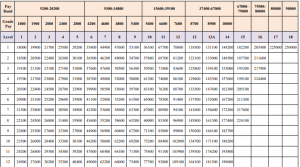
The Ministry of finance vide notification dated 25th July 2016 issued rules for 7th pay commission. The rules include a Schedule which shows categorically what payment has to be made to different positions. The said schedule is called 7th pay matrix
For the reference the table(7th pay matrix) is attached below.
Pay Band & Grade Pay
According to the table given above the first column shows the Pay band.
Pay Band is a pay scale according to the pay grades. It is a part of the salary process as it is used to rank different jobs by education, responsibility, location, and other multiple factors. The pay band structure is based on multiple factors and assigned pay grades should correlate with the salary range for the position with a minimum and maximum. Pay Band is used to define the compensation range for certain job profiles.
Here, Pay band is a part of an organized salary compensation plan, program or system. The Central and State Government has defined jobs, pay bands are used to distinguish the level of compensation given to certain ranges of jobs to have fewer levels of pay, alternative career tracks other than management, and barriers to hierarchy to motivate unconventional career moves. For example, entry-level positions might include security guard or karkoon. Those jobs and those of similar levels of responsibility might all be included in a named or numbered pay band that prescribed a range of pay.
The detailed calculation process of salary according to the pay matrix table is given under Rule 7 of the Central Civil Services (Revised Pay) Rules, 2016.
As per Rule 7A(i), the pay in the applicable Level in the Pay Matrix shall be the pay obtained by multiplying the existing basic pay by a factor of 2.57, rounded off to the nearest rupee and the figure so arrived at will be located in that Level in the Pay Matrix and if such an identical figure corresponds to any Cell in the applicable Level of the Pay Matrix, the same shall be the pay, and if no such Cell is available in the applicable Level, the pay shall be fixed at the immediate next higher Cell in that applicable Level of the Pay Matrix.
The detailed table as mentioned in the Rules showing the calculation:
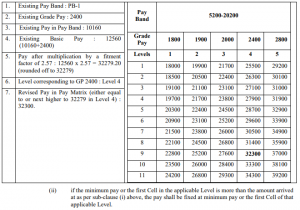
For example if your pay in Pay Band is 5200 (initial pay in pay band) and Grade Pay of 1800 then 5200+1800= 7000, now the said amount of 7000 would be multiplied to 2.57 as mentioned in the Rules. 7000 x 2.57= 17,990 so as per the rules the nearest amount the figure shall be fixed as pay level. Which in this case would be 18000/-.
The basic pay would increase as your experience at that job would increase as specified in vertical cells. For example if you continue to serve in the Basic Pay of 18000/- for 4 years then your basic pay would be 19700/- as mentioned in the table.
Dearness Allowance
However, the basic pay mentioned in the table is not the only amount of remuneration an employee receives. There are catena of benefits and further additions in the salary such as dearness allowance, HRA, TADA.
According to the Notification No. 1/1/2023-E.II(B) from the Ministry of Finance and Department of Expenditure, the Dearness Allowance payable to Central Government employees was enhanced from rate of 38% to 42% of Basic pay with effect from 1st January 2023.
Here, DA would be calculated on the basic salary. For example if your basic salary is of 18,000/- then 42% DA would be of 7,560/-
House Rent Allowance
Apart from that the HRA (House Rent Allowance) is also provided to employees according to their place of duties. Currently cities are classified into three categories as ‘X’ ‘Y’ ‘Z’ on the basis of the population.
According to the Compendium released by the Ministry of Finance and Department of Expenditure in Notification No. 2/4/2022-E.II B, the classification of cities and rates of HRA as per 7th CPC was introduced.
See the table for reference
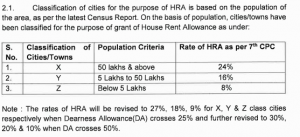
However, after enhancement of DA from 38% to 42% the HRA would be revised to 27%, 18%, and 9% respectively.
As above calculated the DA on Basic Salary, in the same manner HRA would also be calculated on the Basic Salary. Now considering that the duty of an employee’s Job is at ‘X’ category of city then HRA will be calculated at 27% of basic salary.
Here, continuing with the same example of calculation with a basic salary of 18000/-, the amount of HRA would be 4,840/-
Transport Allowance
After calculation of DA and HRA, Central government employees are also provided with Transport Allowance (TA). After the 7th CPC the revised rates of Transport Allowance were released by the Ministry of Finance and Department of Expenditure in the Notification No. 21/5/2017-EII(B) wherein, a table giving detailed rates were produced.
The same table is reproduced hereinafter.

As mentioned above in the table, all the employees are given Transport Allowance according to their pay level and place of their duties. The list of annexed cities are given in the same Notification No. 21/5/2017-EII(B).
Again, continuing with the same example of calculation with a Basic Salary of 18000/- and assuming place of duty at the city mentioned in the annexure, the rate of Transport Allowance would be 1350/-
Apart from that, DA on TA is also provided as per the ongoing rate of DA. For example, if TA is 1350/- and rate of current DA on basic Salary is 42% then 42% of TA would be added to the calculation of gross salary. Here, DA on TA would be 567/-.
Calculation of Gross Salary
After calculating all the above benefits the Gross Salary is calculated.
Here, after calculating Basic Salary+DA+HRA+TA the gross salary would be 32,317/-
However, the Gross Salary is subject to few deductions such as NPS, Professional Tax, Medical as subject to the rules and directions by the Central Government. After the deductions from the Gross Salary an employee gets the Net Salary on hand.
However, it is pertinent to note that benefits such as HRA and TA are not absolute, these allowances are only admissible if an employee is not provided with a residence by the Central Government or facility of government transport.
Conclusion
Government service is not a contract. It is a status. The employees expect fair treatment from the government. The States should play a role model for the services. The Apex Court in the case of Bhupendra Nath Hazarika and another vs. State of Assam and others (reported in 2013(2)Sec 516) has observed as follows:
“………It should always be borne in mind that legitimate aspirations of the employees are not guillotined and a situation is not created where hopes end in despair. Hope for everyone is gloriously precious and that a model employer should not convert it to be deceitful and treacherous by playing a game of chess with their seniority. A sense of calm sensibility and concerned sincerity should be reflected in every step. An atmosphere of trust has to prevail and when the employees are absolutely sure that their trust shall not be betrayed and they shall be treated with dignified fairness then only the concept of good governance can be concretized. We say no more.”
The consideration while framing Rules and Laws on payment of wages, it should be ensured that employees do not suffer economic hardship so that they can deliver and render the best possible service to the country and make the governance vibrant and effective.
Written by Husain Trivedi Advocate

Attorney-Client Privilege in India: Scope and Limitations for Corporate and Criminal Matters
Introduction to Attorney-Client Privilege in India
The relationship between a lawyer and client stands as one of the most sacred bonds in any legal system, built upon the foundation of trust, confidentiality, and professional duty. In India, this relationship finds its legal protection through the doctrine of attorney-client privilege, which ensures that communications between legal advisors and their clients remain confidential and protected from compelled disclosure in judicial proceedings. This privilege serves not merely as a procedural shield but as an essential pillar supporting the administration of justice itself, enabling clients to seek legal advice without fear that their candid disclosures might later be used against them.
The legal framework governing attorney-client privilege in India derives primarily from the Indian Evidence Act, 1872, which codifies the circumstances under which communications between lawyers and clients enjoy protection from disclosure. The privilege recognizes that effective legal representation requires complete honesty from clients, which can only be achieved when they trust that their communications will remain confidential. This principle applies equally whether the legal matter involves complex corporate transactions, criminal prosecutions, civil disputes, or regulatory investigations. The doctrine has evolved through statutory provisions and judicial interpretations to balance the competing interests of confidentiality and the pursuit of truth in legal proceedings [1].
Statutory Framework Under the Indian Evidence Act, 1872
Section 126: Protection of Professional Communications
Section 126 of the Indian Evidence Act forms the cornerstone of attorney-client privilege in India. This provision states that “No barrister, attorney, pleader or vakil shall at any time be permitted, unless with his client’s express consent, to disclose any communication made to him in the course and for the purpose of his employment as such barrister, pleader, attorney or vakil, by or on behalf of his client, or to state the contents or condition of any document with which he has become acquainted in the course and for the purpose of his professional employment, or to disclose any advice given by him to his client in the course and for the purpose of such employment.” The language of this section makes clear that the prohibition on disclosure operates at all times, not merely during the pendency of particular proceedings [2].
The protection afforded by Section 126 extends beyond mere oral communications to encompass documents, written advice, and any information that comes to the legal advisor’s knowledge during the professional relationship. The phrase “in the course and for the purpose of his employment” establishes two essential criteria that must be satisfied for the privilege to attach. First, the communication must occur during the existence of the professional relationship. Second, the communication must relate to legal advice or assistance being sought or provided. Casual conversations between a lawyer and client that have no connection to legal matters would not attract the privilege. Similarly, communications made before the professional relationship commences or after it has terminated may not receive protection, though courts have sometimes extended the privilege to pre-retainer consultations when they directly relate to the subsequent representation.
The statute explicitly requires the client’s express consent before a lawyer may disclose privileged communications. This requirement underscores that the privilege belongs to the client, not the lawyer. While the lawyer has a duty to maintain confidentiality and assert the privilege on behalf of the client, the client retains the ultimate authority to waive it. The express consent requirement means that implied consent or tacit approval generally will not suffice to authorize disclosure. Courts have interpreted this provision to mean that clients must affirmatively and knowingly waive the privilege, understanding the consequences of such waiver [3].
Section 127: Extension to Interpreters and Intermediaries
Section 127 extends the protections of Section 126 to interpreters and other persons who assist in facilitating communications between lawyers and clients. This provision recognizes the practical reality that modern legal practice often involves third parties who become privy to privileged communications by necessity. The section states that “Section 126 shall apply to interpreters, and to the clerks or servants of barristers, pleaders, attorneys and vakils.” By including these individuals within the scope of privilege, the law acknowledges that the purpose of protecting client confidences would be defeated if interpreters, translators, paralegals, legal assistants, or other support staff could be compelled to testify about matters they learned while assisting in the provision of legal services.
The rationale behind extending privilege to these intermediaries stems from the understanding that contemporary legal practice involves collaborative work environments where multiple individuals may have access to confidential information. In complex corporate matters, for instance, teams of lawyers and support staff may work on transactions or disputes, all of whom gain knowledge of privileged communications. Similarly, when clients speak languages other than those spoken by their lawyers, interpreters become essential conduits of communication. Without the protection offered by Section 127, the entire framework of attorney-client privilege could be circumvented simply by calling these intermediaries as witnesses.
Section 128: Privilege Not Waived by Volunteering Evidence
Section 128 addresses a specific scenario where a lawyer might voluntarily testify about certain matters but wishes to maintain privilege over other communications. The section provides that “If any party to a suit gives evidence therein at his own instance or otherwise, he shall not be deemed to have consented to such disclosure as is mentioned in section 126; and, if any party to a suit or proceeding calls any such barrister, pleader, attorney or vakil as a witness, he shall be deemed to have consented to such disclosure only if he questions such barrister, pleader, attorney or vakil on matters which, but for such question, he would not be at liberty to disclose.”
This provision establishes an important principle: merely giving evidence in a proceeding does not automatically waive attorney-client privilege over all communications with one’s lawyer. The waiver of privilege must be specific and intentional, not merely incidental to participation in litigation. For example, if a party testifies about the events leading to a dispute, this testimony does not open the door to questions about what the party told their lawyer about those events or what advice the lawyer gave. The privilege remains intact unless the party specifically introduces evidence about privileged communications or asks questions that can only be answered by disclosing such communications.
Section 129: Confidential Communications with Legal Advisers
Section 129 complements Section 126 by addressing the compellability of witnesses to disclose privileged communications. The section states “No one shall be compelled to disclose to the Court any confidential communication which has taken place between him and his legal professional adviser, unless he offers himself as a witness, in which case he may be compelled to disclose any such communications as may appear to the Court necessary to be known in order to explain any evidence which he has given, but no others.” This provision establishes that while privilege generally protects confidential communications from forced disclosure, a party who chooses to testify may be required to disclose communications necessary to explain their testimony [4].
The qualification contained in Section 129 reflects a balance between protecting privilege and preventing its misuse as a sword rather than a shield. If a party could testify selectively about favorable matters while using privilege to block examination on related privileged communications, it would create an unfair advantage and impede the search for truth. Therefore, when a party voluntarily takes the witness stand, they may be compelled to disclose privileged communications to the extent necessary to provide context and completeness to their testimony. However, this waiver remains limited in scope—the court may only require disclosure of communications directly relevant to explaining the evidence given, not all privileged communications generally.
Application of Attorney-Client Privilege in Corporate Matters
In-House Counsel and Corporate Legal Departments
The application of attorney-client privilege in the corporate context presents unique challenges that differ substantially from individual client representations. Corporations, as artificial legal persons, must necessarily act through human agents—directors, officers, employees, and other representatives. When in-house counsel or corporate legal departments provide advice to these individuals acting in their corporate capacity, questions arise about who constitutes the client for privilege purposes and what communications qualify for protection. Courts in India have generally recognized that corporations can claim attorney-client privilege for communications between their legal advisors and corporate representatives, provided these communications relate to seeking or providing legal advice in connection with corporate matters [5].
The determination of which corporate employees’ communications with counsel attract privilege has been subject to judicial scrutiny. Not every employee who communicates with corporate counsel can claim privilege for those communications. Generally, privilege extends to communications between counsel and employees who have authority to act on behalf of the corporation in the matter at hand or whose responsibilities place them in a position where their communications with counsel are necessary for the lawyer to provide effective legal advice to the corporation. This includes senior management, officers, directors, and employees specifically tasked with handling the legal issues in question. However, communications with employees who merely possess relevant information but lack decision-making authority may not always receive protection, particularly if those communications involve investigation of facts rather than provision of legal advice.
In-house counsel face a particular challenge in establishing privilege because they serve dual roles within corporations—providing legal advice while also participating in business decision-making and operational matters. Indian courts have recognized that not all communications involving in-house lawyers qualify for privilege protection. To attract privilege, the communication must be primarily for the purpose of seeking or providing legal advice, not business advice or operational guidance. When in-house counsel attend meetings or participate in discussions wearing their “business hat” rather than providing legal counsel, those communications may not receive privilege protection. Corporations must therefore carefully document the nature and purpose of communications with in-house counsel to preserve claims of privilege.
Corporate Investigations and Regulatory Matters
Corporate investigations, whether conducted internally in response to potential misconduct or initiated by regulatory authorities, raise complex privilege questions. When a corporation engages lawyers to investigate allegations of wrongdoing by employees or to assess compliance with legal requirements, communications during these investigations may attract privilege if properly structured. The key consideration is whether the investigation is conducted for the purpose of obtaining legal advice or in anticipation of litigation, as opposed to a purely business or operational assessment. Indian courts have not always been consistent in their treatment of investigative privilege, making it crucial for corporations to establish clear documentation of the legal purpose underlying investigations.
The relationship between corporate privilege and regulatory investigations has been the subject of considerable debate. When regulatory authorities such as the Securities and Exchange Board of India, the Reserve Bank of India, or the Competition Commission of India conduct investigations, they often seek access to legal advice and communications that corporations claim are privileged. While Indian law recognizes attorney-client privilege as a fundamental principle, regulatory statutes sometimes contain provisions requiring disclosure of information that may override privilege claims in specific contexts. Corporations facing regulatory investigations must carefully navigate these competing obligations, asserting privilege where appropriate while recognizing the limits of such protection in the face of statutory disclosure requirements [6].
Cross-Border Transactions and Foreign Legal Advice
The globalization of commerce has created situations where Indian corporations seek legal advice from foreign counsel regarding transactions or disputes with international dimensions. Questions arise about whether communications with foreign lawyers receive the same privilege protection under Indian law as communications with Indian advocates. The Indian Evidence Act does not explicitly address privilege for foreign legal consultants, though courts have generally extended privilege to communications with foreign lawyers when those communications concern legal advice related to matters that may come before Indian courts. However, the scope and application of such privilege can be uncertain, particularly when foreign lawyers are not qualified to practice in India or when the legal advice concerns foreign law rather than Indian law.
Indian corporations engaging in cross-border mergers, acquisitions, joint ventures, or financing transactions routinely obtain legal advice from counsel in multiple jurisdictions. To maintain privilege over these communications, corporations should ensure that foreign lawyers are engaged for the purpose of providing legal advice, not merely business consulting. Additionally, when foreign legal advice is communicated to the corporation through Indian counsel or when Indian lawyers coordinate with foreign counsel, the communications may receive stronger privilege protection than direct communications between foreign lawyers and corporate representatives. Careful attention to the structure of these advisory relationships can help preserve privilege claims across jurisdictions.
Application in Criminal Matters
Accused Persons and Defense Counsel
In criminal proceedings, the attorney-client privilege in India takes on heightened significance because the consequences extend beyond monetary damages to potentially include loss of liberty or even life. When an accused person consults with defense counsel, those communications receive robust protection under Sections 126 and 129 of the Evidence Act. This protection is essential to ensuring that accused persons can make a full and frank disclosure to their lawyers without fear that their admissions or explanations will be used against them. Without such protection, the constitutional guarantee of effective legal assistance would be severely undermined, as accused persons might withhold crucial information from their own lawyers out of fear of self-incrimination [7].
The privilege in criminal matters extends to communications between the accused and counsel at all stages of the proceedings, from initial consultation through investigation, trial, and appeals. It covers admissions of guilt, discussions of defense strategy, explanations of incriminating evidence, and all other communications relating to the representation. Notably, the privilege protects these communications even if they reveal criminal conduct, subject to certain exceptions discussed below. The lawyer has a professional duty to maintain confidentiality and cannot voluntarily disclose privileged communications without the client’s express consent, even after the conclusion of the criminal proceedings.
Limitations: Crime-Fraud Exception
While attorney-client privilege provides broad protection, it is not absolute. A critical limitation exists when legal advice is sought not for lawful purposes but to facilitate ongoing or future criminal conduct or fraud. Section 126 of the Evidence Act contains an explanation stating “Nothing in this section shall protect from disclosure any such communication made in furtherance of any illegal purpose or any fact observed by any barrister, pleader, attorney or vakil, in the course of his employment as such, showing that any crime or fraud has been committed since the commencement of his employment.” This crime-fraud exception represents a fundamental limitation on privilege because the law does not extend its protection to facilitate criminality.
The crime-fraud exception applies when a client consults a lawyer for advice on how to commit a crime or fraud or when the client uses the lawyer’s services to further illegal objectives. However, the exception does not apply merely because a client admits to past criminal conduct while seeking legal advice. The distinction is crucial: if a client confesses to a completed crime while seeking legal representation, that admission remains privileged. But if the client seeks advice on how to commit a future crime or use legal services to perpetrate ongoing fraud, those communications fall outside privilege protection. Indian courts have emphasized that the party seeking to invoke the crime-fraud exception bears the burden of establishing that the communications were made to further illegal purposes, not merely that they involved discussion of illegal conduct [8].
Application of the crime-fraud exception requires careful analysis of the client’s purpose in seeking legal advice. Courts typically examine whether the client was seeking guidance on how to comply with the law or how to evade or violate it. If a client asks a lawyer how to structure a transaction to comply with tax laws, that communication is privileged even if it involves minimizing tax liability. However, if the client seeks advice on how to conceal income or file false tax returns, the communication would not be privileged. The exception also covers situations where clients mislead their lawyers or provide false information in order to misuse the legal system, such as by filing frivolous claims or manufacturing evidence.
Communications About Physical Evidence
A particularly complex area involves situations where defense counsel becomes aware of the location of physical evidence related to criminal investigations. The Evidence Act’s language protecting “communications” has been interpreted by Indian courts to exclude physical evidence from privilege protection. If an accused person tells their lawyer where a weapon or other physical evidence can be found, the communication itself may be privileged, but the physical evidence is not. Courts have held that lawyers have ethical obligations not to conceal or destroy physical evidence, even if they learn about such evidence through privileged communications with clients. This principle reflects the understanding that privilege protects communications but cannot be used as a tool to obstruct justice by hiding evidence of crimes.
Exceptions and Limitations to Attorney-Client Privilege in India
Express Consent and Waiver
As explicitly stated in Section 126, attorney-client privilege can be waived by the client’s express consent. Waiver may be explicit, such as when a client authorizes their lawyer to disclose privileged communications to third parties or to testify about them in court. Waiver can also occur implicitly through conduct that is inconsistent with maintaining confidentiality, such as disclosing privileged communications to third parties who are not part of the legal representation. Once privileged information has been disclosed to outsiders without maintaining confidentiality, courts have found that the privilege has been waived not only for the disclosed information but potentially for all related privileged communications on the same subject matter.
The doctrine of waiver becomes particularly important in litigation contexts where parties selectively disclose privileged communications to advance their positions. If a party introduces evidence of privileged communications or uses such communications as the basis for claims or defenses, courts may find that the party has waived privilege over related communications. This principle prevents parties from using privilege as both a shield and a sword—revealing favorable privileged communications while hiding unfavorable ones. However, waiver typically extends only to communications on the same subject matter as the disclosed communications, not to all privileged communications generally.
Client as Witness
Section 129 establishes that when a client offers themselves as a witness, they may be compelled to disclose privileged communications to the extent necessary to explain evidence they have given. This limitation recognizes that parties cannot simultaneously claim the benefits of testifying while using privilege to prevent cross-examination on relevant matters. If a client testifies about events or circumstances that were the subject of communications with their lawyer, opposing counsel may cross-examine about those communications to the extent they relate to and explain the testimony given. However, this waiver remains limited—the client can be compelled to disclose only those privileged communications directly relevant to explaining their testimony, not all communications with counsel generally.
Communications in Presence of Third Parties
For attorney-client privilege to apply, communications must be made in confidence with the expectation of privacy. When third parties are present during communications between lawyers and clients, and those third parties are not essential to the legal representation, courts may find that the confidential nature of the communication has been destroyed and privilege does not attach. However, the presence of certain third parties does not waive privilege if their presence serves the purpose of facilitating the legal representation. For example, interpreters, accountants assisting with tax advice, or family members present to help clients understand legal matters may be considered part of the privileged communication. The key question is whether the third party’s presence was necessary or reasonably incidental to the legal consultation.
Professional Obligations and Ethical Considerations
Advocates Act and Bar Council Rules
Beyond the statutory provisions of the Evidence Act, Indian lawyers’ obligations regarding client confidentiality are also governed by the Advocates Act, 1961, and the Bar Council of India Rules. These professional regulations impose ethical duties on advocates to maintain client confidences even in circumstances where legal privilege might not strictly apply. Section 126 of the Evidence Act protects communications from compelled disclosure in legal proceedings, but the Advocates Act and Bar Council Rules establish broader confidentiality obligations that apply outside the courtroom as well. Lawyers cannot voluntarily disclose confidential client information even in contexts where they might not be legally compelled to keep it secret under the Evidence Act [9].
The Bar Council of India Rules specify that an advocate shall not disclose any communication made to them in the course of their employment except with the express consent of the client or as required by law. This professional obligation extends beyond the duration of the lawyer-client relationship and continues even after representation has ended. The rules also prohibit lawyers from using confidential information gained during representation to the disadvantage of former clients, even in matters unrelated to the original representation. Violations of these confidentiality obligations can result in professional disciplinary action, including suspension or removal from practice, separate from any legal consequences under the Evidence Act.
Conflicts Between Professional Duty and Legal Obligations
Lawyers occasionally face situations where their professional duty to maintain client confidences comes into tension with other legal obligations. For example, when lawyers inadvertently learn that their clients are engaging in ongoing fraud or illegal conduct that threatens harm to third parties, they must navigate between their duty of confidentiality and their obligations as officers of the court and members of society. Indian legal ethics generally prioritize client confidentiality, but this duty is not absolute when balanced against preventing serious harm or upholding the administration of justice. The Bar Council Rules permit limited disclosure of otherwise confidential information when necessary to prevent commission of a crime or to defend the lawyer against accusations of misconduct arising from the representation.
Comparative Analysis and Recent Developments
Evolution Through Judicial Interpretation
While the basic framework of attorney-client privilege in India has remained relatively stable since the enactment of the Evidence Act in 1872, judicial interpretation has refined and developed the doctrine over time. Courts have addressed numerous questions about the scope and application of privilege in contexts not specifically contemplated by the statutory language. For instance, courts have considered how privilege applies to electronic communications, group emails, and communications through intermediaries in the digital age. They have also addressed the treatment of privilege in insolvency proceedings, arbitration, and other alternative dispute resolution mechanisms where formal rules of evidence may not strictly apply.
Recent judicial decisions have emphasized that attorney-client privilege serves not merely the private interests of clients but also serves the public interest in promoting the effective administration of justice. This recognition has led courts to construe privilege broadly when doing so advances the purpose of enabling clients to obtain legal advice without fear of disclosure. At the same time, courts have been vigilant in policing attempts to misuse privilege to shield wrongdoing or obstruct legitimate investigations. The balancing of these competing considerations continues to shape the development of privilege doctrine through case law.
Challenges in Modern Legal Practice
Contemporary legal practice presents numerous challenges to traditional conceptions of attorney-client privilege in India. The proliferation of email and electronic communications has created vast volumes of potentially privileged materials that must be carefully managed. When documents are produced in litigation or investigations, lawyers must review enormous quantities of materials to identify and protect privileged communications, a task made more complex by the informal nature of email and the tendency for privileged and non-privileged materials to be commingled in electronic formats. Additionally, the growth of law firm sizes and the involvement of multiple lawyers in matters has raised questions about maintaining confidentiality within large organizations and with respect to conflicts between current and former clients.
The increasing specialization of legal practice has also created boundary questions about when consultations with non-lawyer professionals may be protected under privilege or related doctrines. While Section 127 extends privilege to interpreters and clerical staff, courts have been less clear about the status of communications involving accountants, financial advisors, or other consultants who assist lawyers in providing advice. In complex corporate and financial matters, effective legal advice often requires input from these specialists, yet their involvement may jeopardize privilege claims if not properly structured. These evolving challenges continue to test the adaptability of privilege doctrine to modern practice realities.
Conclusion
Attorney-client privilege occupies a central position in the Indian legal system, protecting the confidential relationship between lawyers and clients that is essential to the effective administration of justice. The privilege finds its primary expression in Sections 126 through 129 of the Indian Evidence Act, which establish both the scope of protection and its limitations. While the privilege provides robust protection for communications made in the course of seeking and providing legal advice, it is not absolute. Important exceptions exist for communications made to further crimes or frauds, and the privilege can be waived through client consent or conduct.
In corporate contexts, privilege enables companies to seek legal advice about complex commercial transactions, regulatory compliance, and disputes without fear that their consultations with counsel will be used against them. However, corporations must carefully structure their relationships with legal advisors and document the purposes of communications to preserve privilege claims, particularly where in-house counsel serve dual legal and business roles. In criminal matters, privilege provides crucial protection for communications between accused persons and their defense lawyers, enabling effective legal representation while recognizing important limitations when communications involve ongoing or future illegal conduct.
As legal practice continues to evolve with technological change and increasing complexity, the doctrine of attorney-client privilege in India will undoubtedly face new challenges requiring thoughtful application of established principles to novel circumstances. Courts, legislators, and the legal profession must continue to balance the important interests served by privilege—promoting candor in legal consultations and effective legal representation—against competing values including truth-seeking in judicial proceedings and the prevention of abuse of legal processes. The future development of privilege doctrine will require careful attention to these competing considerations to ensure that this ancient and essential principle continues to serve justice in contemporary contexts.
References
[1] Legal Service India. (n.d.). Attorney Client Privilege under Section 126 of Indian Evidence Act, 1872. Retrieved from https://www.legalserviceindia.com/legal/article-1403-attorney-client-privilege-under-section-126-of-indian-evidence-act-1872.html
[2] IndianKanoon.org. (n.d.). Section 126 in The Indian Evidence Act, 1872. Retrieved from https://indiankanoon.org/doc/1520037/
[3] Metalegal. (2025). When Courts Protect Lawyer-Client Talks: Privilege in Indian Law. Retrieved from https://www.metalegal.in/post/attorney-client-privilege-in-india
[4] iPleaders. (2020). Privileged Communication under Indian Evidence Act, 1872. Retrieved from https://blog.ipleaders.in/privileged-communication-under-indian-evidence-act-1872/
[5] Lexology. (2019). Legal Privilege & Professional Secrecy in India. Retrieved from https://www.lexology.com/library/detail.aspx?g=1a12eb24-5a71-42c6-890b-a10ea92aeefa
[6] AZB & Partners. (2021). Legal Privilege & Professional Secrecy – 2018 | India. Retrieved from https://www.azbpartners.com/bank/legal-privilege-professional-secrecy-2018-india/
[7] LiveLaw. (2020). What Is Attorney-Client Privilege? Retrieved from https://www.livelaw.in/know-the-law/attorney-client-privilege-indian-evidence-act-bar-council-of-india-rules-167667
[8] Government of India. (2020). The Indian Evidence Act, 1872. Retrieved from https://www.indiacode.nic.in/bitstream/123456789/15351/1/iea_1872.pdf
Equal Remuneration Act, 1976: Legal Framework for Equal Pay in India

Introduction: The Foundation of Wage Equality in India
India’s journey toward workplace equality took a significant legislative turn with the enactment of the Equal Remuneration Act in 1976. This landmark legislation emerged from the constitutional mandate enshrined in Article 39 of the Indian Constitution, which directs the State to ensure equal pay for equal work for both men and women [1]. The Act was initially introduced as the Equal Remuneration Ordinance in 1975, coinciding with the International Women’s Year, and was subsequently enacted as permanent legislation to address the systemic gender-based wage discrimination that plagued Indian workplaces [2].
The timing of this legislation was particularly significant. During the 1970s, India witnessed growing awareness about gender inequality in employment, with women workers across various sectors receiving substantially lower wages than their male counterparts for performing identical or similar work. The Act sought to dismantle these discriminatory practices by establishing a legal framework that mandated equal remuneration and prohibited gender-based discrimination in recruitment and employment conditions.
The legislative intent behind the Equal Remuneration Act extends beyond mere wage parity. It represents a fundamental shift in recognizing women’s economic contributions and ensuring their rightful place in the workforce without being subjected to discriminatory treatment based solely on their gender. This legislation acknowledges that economic empowerment of women through fair remuneration is essential for achieving broader social and economic development goals.
Scope and Applicability: Understanding the Legislative Reach
The Equal Remuneration Act, 1976 possesses nationwide jurisdiction, extending to the entire territory of India. This pan-India applicability ensures that workers across all states and union territories are protected under its provisions, regardless of the nature or size of their establishment. The Act applies to both organized and unorganized sectors, covering establishments ranging from government undertakings to private enterprises, banking companies, mines, oilfields, major ports, and corporations established under Central Acts [1].
The legislation defines its applicability based on the nature of employment and the authority governing that employment. For establishments under the Central Government’s purview, including railway administrations, banking companies, mines, oilfields, major ports, and Central Government undertakings, the Central Government acts as the appropriate authority. For all other establishments, the State Government assumes this role. This dual administrative structure ensures effective implementation across diverse employment sectors while maintaining clear jurisdictional boundaries.
One crucial aspect of the Act’s scope is its definition of “remuneration,” which encompasses not merely basic wages but also includes all additional emoluments payable to employees, whether in cash or kind. This broad definition ensures that discrimination cannot be disguised through complex compensation structures that might pay women lower allowances, bonuses, or benefits while maintaining nominal wage parity. The Act specifically provides that remuneration includes all payments made to workers in respect of employment or work done, provided the terms of the employment contract are fulfilled.
The Act also defines what constitutes “same work or work of a similar nature,” establishing clear parameters for comparison. According to the legislation, such work refers to work requiring the same skill, effort, and responsibility when performed under similar working conditions by men or women. Importantly, the Act recognizes that minor differences in skill, effort, or responsibility that are not of practical importance in relation to employment terms and conditions should not be used to justify wage disparities [2].
Core Provisions: The Legal Mandate for Equal Pay
At the heart of the Equal Remuneration Act lies its primary mandate in Section 4, which prohibits employers from paying workers of one gender at rates less favorable than those paid to workers of the opposite gender for performing the same work or work of a similar nature. This provision establishes the fundamental principle of equal pay for equal work, making it illegal for employers to maintain gender-based wage differentials in any establishment or employment [1].
The Act incorporates important safeguards to prevent employers from circumventing its provisions. Section 4(2) explicitly prohibits employers from reducing the remuneration of any worker to comply with the equal pay requirement. This means that achieving wage parity must involve raising lower wages to match higher ones, rather than reducing higher wages to match lower ones. This protective provision ensures that the Act’s implementation benefits workers without creating unintended negative consequences.
Furthermore, Section 4(3) addresses situations where differential wage rates existed before the Act’s commencement. In such cases, the legislation mandates that the higher rate of remuneration shall become the standard rate payable to all workers performing the same or similar work, regardless of gender. This provision demonstrates the Act’s forward-looking approach, ensuring that historical discrimination does not perpetuate into the future.
Beyond remuneration, Section 5 of the Act addresses discrimination in recruitment and employment conditions. This section prohibits employers from making any discrimination against women during recruitment for the same work or work of a similar nature. The 1987 amendment expanded this provision to include discrimination in post-recruitment conditions such as promotions, training, and transfers [2]. This broader protection recognizes that wage discrimination often interconnects with other forms of employment discrimination, and addressing only wages would leave women vulnerable to other discriminatory practices.
The Act does acknowledge certain exceptions to its anti-discrimination mandate. It does not apply where employment of women in particular work is prohibited or restricted by existing laws. Additionally, the Act does not affect reservations or priorities for scheduled castes, scheduled tribes, ex-servicemen, or other specified categories in recruitment. These exceptions balance the Act’s equality objectives with other legitimate policy considerations and existing protective legislation.
Institutional Mechanisms: Enforcement and Implementation
The Equal Remuneration Act establishes robust institutional mechanisms to ensure effective implementation and enforcement of its provisions. Section 6 mandates the constitution of Advisory Committees by the appropriate government to advise on increasing employment opportunities for women. These committees must consist of at least ten members, with mandatory representation of fifty percent women, ensuring that women’s perspectives inform policy decisions regarding their employment [1].
The Advisory Committees serve multiple important functions. They evaluate the extent to which women may be employed in various establishments or employments, considering factors such as the number of women currently employed, the nature of work, working hours, suitability of employment for women, and the need for increasing women’s employment opportunities, including part-time employment. Based on their advice, the appropriate government may issue directions regarding the employment of women workers after providing opportunities for representations from concerned parties.
Section 7 establishes the adjudication mechanism for handling complaints and claims under the Act. The appropriate government appoints authorities, typically officers not below the rank of Labour Officer, to hear and decide complaints regarding contraventions of the Act and claims arising from non-payment of equal wages. These authorities possess jurisdiction within defined geographical limits and must follow prescribed procedures for receiving and processing complaints and claims [2].
The appointed authorities wield substantial powers in executing their functions. They enjoy all powers of a Civil Court under the Code of Civil Procedure for taking evidence, enforcing witness attendance, and compelling document production. These authorities can, after providing hearings to both applicants and employers and conducting necessary inquiries, direct employers to pay workers the differential amount between wages actually paid and wages that should have been paid for equal work. They can also order employers to take adequate steps to ensure compliance with the Act’s provisions.
The Act provides for an appellate mechanism, allowing aggrieved employers or workers to appeal decisions made by the primary authorities. Appeals must be filed within thirty days of the order, with provisions for condoning delays of up to an additional thirty days in cases where appellants were prevented by sufficient cause from filing within the original time limit. The appellate authority’s decision is final, with no further appeals permitted, ensuring timely resolution of disputes.
Regulatory Oversight: Inspection and Compliance Monitoring
The Equal Remuneration Act incorporates provisions for proactive regulatory oversight through the appointment of Inspectors who monitor compliance with the Act’s provisions. Section 9 empowers the appropriate government to appoint Inspectors for investigating whether employers are complying with the Act and rules made thereunder. These Inspectors are deemed public servants under the Indian Penal Code, providing them legal protections and imposing obligations associated with public office [1].
Inspectors possess wide-ranging powers to conduct effective oversight. Within their jurisdictional limits, they can enter any building, factory, premises, or vessel at reasonable times with necessary assistance. They can require employers to produce registers, muster rolls, or other documents relating to worker employment and examine these documents thoroughly. Inspectors may take evidence from any person on the spot or otherwise to ascertain compliance with the Act’s provisions [2].
The inspection regime extends to examining employers, their agents, servants, persons in charge of establishments, and any person reasonably believed to be or have been a worker in the establishment. Inspectors can make copies or take extracts from registers or other documents maintained under the Act. These comprehensive powers enable Inspectors to conduct thorough investigations and gather evidence of violations.
The Act imposes corresponding duties on persons subject to inspection. Any person required by an Inspector to produce documents or provide information must comply with such requisitions. Failure to cooperate with Inspectors carries penalties, reinforcing the seriousness of the inspection regime and ensuring that Inspectors can effectively perform their oversight functions.
Section 8 mandates that employers maintain prescribed registers and documents relating to workers employed by them. This record-keeping requirement serves multiple purposes: it facilitates inspections, provides evidence for adjudicating complaints and claims, and creates transparency regarding employment terms and remuneration practices. The specific registers and documents required are defined through rules made under the Act, allowing for flexibility in adapting requirements to different types of establishments and employments.
Penalties and Prosecution: Ensuring Accountability
The Equal Remuneration Act establishes a comprehensive penalty structure to deter violations and ensure accountability. The Act recognizes different categories of violations and prescribes graduated penalties based on the severity and nature of the offense. This differentiated approach acknowledges that some violations involve direct discrimination or payment of unequal wages, while others involve procedural non-compliance such as failure to maintain proper records.
Section 10 of the Act addresses penalties for various violations. For procedural violations such as failing to maintain registers or documents, failing to produce documents, refusing to give evidence, or refusing to provide information, the Act prescribes punishment with simple imprisonment for up to one month or fine up to ten thousand rupees or both. These penalties, while significant, reflect the relatively less serious nature of procedural non-compliance compared to substantive discrimination [1].
For more serious violations, Section 10(2) prescribes substantially higher penalties. Employers who make recruitment in contravention of the Act, pay unequal remuneration to men and women for the same or similar work, make discrimination between men and women workers in violation of the Act’s provisions, or fail to carry out directions issued by the appropriate government face fine of not less than ten thousand rupees but which may extend to twenty thousand rupees or imprisonment for a term of not less than three months but which may extend to one year or both for the first offense. For second and subsequent offenses, imprisonment may extend to two years, demonstrating the Act’s serious view of repeated violations [2].
Section 11 addresses situations where offenses are committed by companies. In such cases, every person who, at the time of the offense, was in charge of and responsible to the company for conducting its business is deemed guilty of the offense along with the company itself. This provision prevents companies from escaping liability by claiming that violations were committed by the corporate entity rather than individuals. However, the Act provides a defense for individuals who can prove that the offense was committed without their knowledge or that they exercised due diligence to prevent its commission.
The Act also recognizes situations where directors, managers, secretaries, or other company officers are directly involved in violations. If an offense is committed with the consent or connivance of, or is attributable to neglect by such officers, they are deemed guilty and liable for punishment. This provision ensures that corporate officers cannot hide behind corporate structures to avoid personal accountability for discriminatory practices.
Section 12 governs the cognizance and trial of offenses under the Act. No court inferior to a Metropolitan Magistrate or Judicial Magistrate of the first class can try offenses under the Act, ensuring that competent judicial authorities handle these cases. Courts can take cognizance of offenses either on their own knowledge, upon complaints made by the appropriate government or authorized officers, or upon complaints by aggrieved persons or recognized welfare institutions or organizations. This multiple-avenue approach for initiating prosecutions ensures that violations do not go unpunished due to lack of complaint mechanisms.
Judicial Interpretation: Landmark Cases and Legal Precedents
The Equal Remuneration Act has been the subject of significant judicial interpretation, with Indian courts, particularly the Supreme Court, playing a crucial role in defining the scope and application of its provisions. These judicial pronouncements have clarified ambiguous provisions, established principles for determining whether work is of the same or similar nature, and reinforced the Act’s objectives of eliminating gender-based wage discrimination.
The landmark case of Mackinnon Mackenzie & Co. Ltd. v. Audrey D’Costa [3] stands as one of the most important judicial decisions interpreting the Equal Remuneration Act. In this case, decided by the Supreme Court in 1987, a female stenographer challenged the practice of paying lower wages to female stenographers compared to their male counterparts performing identical work. The employer argued that the work performed by female and male stenographers was not of the same nature and that historical wage structures justified the differential treatment.
The Supreme Court rejected these arguments, holding that paying lesser wages to female stenographers violated the Equal Remuneration Act. The Court emphasized that wherever sex discrimination is alleged, there should be proper job evaluation before any further inquiry is made. If two jobs in an establishment are accorded the same classification, the same scale should apply to both, regardless of the gender of the workers. The Court recognized India’s ratification of the Convention Concerning Equal Remuneration for Men and Women Workers for Work of Equal Value and interpreted the Act consistently with India’s international obligations [3].
In the Air India v. Nergesh Meerza case [4], the Supreme Court addressed discriminatory service conditions affecting female flight attendants. Air India’s service regulations required female cabin crew to retire at age 35 or upon first pregnancy within four years of service, while male cabin crew faced no such restrictions. The Supreme Court struck down these provisions as unconstitutional and violative of equal treatment principles. The Court held that marriage or pregnancy cannot be grounds for terminating women’s employment, establishing important precedents regarding gender discrimination in employment conditions.
Another significant case, Randhir Singh v. Union of India [5], though not directly involving the Equal Remuneration Act, established the constitutional principle of equal pay for equal work as flowing from Articles 14 and 16 of the Constitution. The Supreme Court held that equal pay for equal work is not merely a statutory right under the Equal Remuneration Act but is also a constitutional goal. This decision elevated the principle of equal remuneration beyond statutory protection, recognizing it as a fundamental aspect of equality guaranteed by the Constitution.
The Delhi High Court’s decision in Female Workers v. Controller, DDA [6] addressed a situation where female workers were being paid less than male workers for identical work. The Court held that the principle of equal pay for equal work applies even in the absence of specific regulations, as it flows from constitutional provisions. This decision reinforced that the Equal Remuneration Act codifies a constitutional principle rather than creating a new right, and courts can enforce wage equality even in situations not explicitly covered by the Act.
These judicial decisions have established several important principles. First, job evaluation must be conducted objectively, focusing on the actual work performed rather than on the gender of workers performing it. Second, historical wage structures or past practices cannot justify continuing gender-based wage discrimination. Third, the principle of equal pay for equal work must be interpreted broadly to encompass not just basic wages but all employment benefits and conditions. Fourth, employers bear the burden of justifying any wage differentials, and such justifications must be based on factors other than gender, such as qualifications, experience, or responsibilities.
International Context: Global Standards and India’s Commitments
India’s Equal Remuneration Act, 1976 aligns with international standards on gender equality and workers’ rights established through various international conventions and declarations. Understanding this international context helps appreciate the Act’s significance and its role in fulfilling India’s international obligations regarding gender equality in employment.
The International Labour Organization (ILO) Convention No. 100, titled the Equal Remuneration Convention, 1951, which India ratified, establishes the fundamental principle that men and women workers should receive equal remuneration for work of equal value [7]. This Convention defines remuneration to include basic wages and any additional emoluments payable directly or indirectly by the employer to the worker. India’s Equal Remuneration Act incorporates these international standards, demonstrating the country’s commitment to implementing its treaty obligations through domestic legislation.
The Convention emphasizes that equal remuneration means rates of remuneration established without discrimination based on sex. It requires ratifying countries to promote and ensure application of the principle through national laws, legally established wage-determining machinery, collective agreements, or a combination of these methods. India’s approach through the Equal Remuneration Act represents implementation of this Convention through national legislation, backed by enforcement mechanisms and penalties for violations.
The Universal Declaration of Human Rights, adopted in 1948, recognizes in Article 23 that everyone, without discrimination, has the right to equal pay for equal work [8]. This fundamental human right forms part of the international human rights framework that influences national legislation worldwide. The Equal Remuneration Act gives effect to this international human rights standard in the Indian context, treating equal pay as a fundamental right rather than merely an economic policy consideration.
The Convention on the Elimination of All Forms of Discrimination Against Women (CEDAW), which India ratified in 1993, requires state parties to eliminate discrimination against women in employment, ensuring equal rights regarding remuneration, including benefits, and equal treatment in respect of work of equal value [9]. CEDAW recognizes that economic empowerment through equal remuneration is essential for achieving gender equality. India’s Equal Remuneration Act predates its CEDAW ratification but demonstrates early recognition of these principles and commitment to gender equality in employment.
The Beijing Declaration and Platform for Action, adopted at the Fourth World Conference on Women in 1995, identified women’s economic empowerment and equal access to economic resources as critical areas of concern. The Platform calls for eliminating occupational segregation and all forms of employment discrimination, including those related to remuneration. India’s participation in this conference and endorsement of the Beijing Declaration reinforced its commitment to implementing and strengthening legislation like the Equal Remuneration Act.
Contemporary Challenges: Implementation and Enforcement Issues
Despite the robust legal framework established by the Equal Remuneration Act, significant challenges persist in its effective implementation and enforcement. These challenges stem from various factors including lack of awareness, inadequate enforcement mechanisms, evolving nature of work relationships, and persistent social attitudes regarding women’s work.
One fundamental challenge is the lack of awareness about the Act’s provisions among both employers and workers. Many women workers, particularly in unorganized sectors and rural areas, remain unaware of their rights under the Act and the mechanisms available for redressal of grievances. Similarly, many small and medium enterprises lack proper understanding of their obligations under the Act, leading to inadvertent non-compliance or deliberate exploitation of this knowledge gap.
The informal and unorganized sector, which employs a substantial proportion of India’s workforce including large numbers of women, poses particular enforcement challenges. The Act’s enforcement mechanisms, primarily designed for formal sector establishments, struggle to reach informal sector workers who often work without written contracts, proper documentation, or clear employer-employee relationships. Home-based workers, agricultural laborers, and those in irregular employment frequently fall outside the Act’s effective reach despite being legally covered.
Occupational segregation presents another significant challenge. Women’s concentration in certain occupations or job categories that are predominantly female-dominated creates situations where direct wage comparisons become difficult. When women and men are not performing the same or similar work in the same establishment, establishing wage discrimination becomes more complex. This occupational segregation often masks systemic undervaluation of women’s work rather than reflecting genuine differences in work requirements.
The concept of “work of similar nature” itself creates interpretational challenges. Determining whether two jobs are sufficiently similar to warrant equal remuneration requires careful job evaluation considering skills, effort, responsibility, and working conditions. Employers sometimes manipulate job classifications, creating artificial distinctions between positions to justify wage differentials. The subjective elements in such evaluations can perpetuate discrimination if not conducted objectively and transparently.
Limited resources for enforcement agencies constitute a practical constraint. The number of Labour Officers and Inspectors appointed under the Act often proves insufficient to monitor compliance across the vast number of establishments nationwide. Inspectors face heavy workloads, limiting their capacity for proactive inspections and investigations. This resource constraint allows violations to go undetected and unpunished, undermining the Act’s deterrent effect.
The relatively low penalties prescribed under the Act, despite amendments increasing them, may not adequately deter violations, especially for larger establishments where the financial penalties represent minimal costs compared to potential savings from paying discriminatory wages. The imprisonment provisions are rarely invoked, further reducing the Act’s deterrent impact. Enforcement authorities often prefer conciliation and correction over prosecution, which, while promoting compliance, may reduce the perceived seriousness of violations.
Delays in adjudication of complaints and claims discourage workers from pursuing remedies. The time taken to resolve cases through the authorities appointed under Section 7 and subsequent appeals can extend for months or years. During this period, workers must continue working, often in the same establishment with the same employer, creating practical difficulties and potential retaliation risks. These delays reduce the Act’s effectiveness as a tool for timely redress of grievances.
Recent Developments: Evolving Landscape of Wage Equality
The landscape of wage equality in India continues to evolve, influenced by new legislation, policy initiatives, judicial developments, and changing workplace dynamics. These developments both complement and interact with the Equal Remuneration Act, creating a more comprehensive framework for addressing gender-based wage discrimination.
The Code on Wages, 2019, represents a significant recent development in India’s wage regulation framework. This Code consolidates four existing wage-related laws and includes provisions requiring equal wages for all genders for the same work or work of a similar nature [1]. While the Equal Remuneration Act remains in force, the Code on Wages extends the equal pay principle beyond gender to encompass all workers regardless of gender, treating it as a fundamental principle of wage regulation rather than specifically as a gender equality measure.
The Code on Social Security, 2020, another component of the new labour code framework, includes provisions relevant to women’s employment and economic security. It addresses maternity benefits, childcare facilities, and other social security measures that impact women’s ability to participate in the workforce on equal terms. These provisions complement the Equal Remuneration Act by addressing broader factors that affect women’s economic opportunities and workplace equality.
Technology and digital platforms have transformed employment relationships, creating new challenges and opportunities for wage equality. Platform-based work, gig economy jobs, and remote working arrangements often blur traditional employer-employee relationships, raising questions about the application of the Equal Remuneration Act to these new forms of work. Some platform workers may not be classified as “employees” in traditional legal terms, potentially placing them outside the Act’s direct protection.
Corporate governance initiatives and voluntary reporting mechanisms have emerged as complementary approaches to promoting wage equality. Some companies now conduct gender pay gap analyses and publicly report wage equality metrics as part of their environmental, social, and governance (ESG) commitments. While voluntary, these initiatives reflect growing recognition that gender pay equality represents both an ethical imperative and a business advantage in attracting and retaining talent.
Conclusion: The Path Forward for Wage Equality
The Equal Remuneration Act, 1976 represents a foundational pillar in India’s legal architecture for gender equality and workers’ rights. Nearly five decades after its enactment, the Act continues to serve as the primary legislative instrument for addressing gender-based wage discrimination in Indian workplaces. Its core principles of equal pay for equal work and prohibition of gender-based discrimination in recruitment and employment conditions remain as relevant today as when the Act was first introduced.
The Act’s significance extends beyond its specific provisions to embody a fundamental societal commitment to gender equality in economic opportunities. By establishing legal mechanisms for challenging wage discrimination and creating accountability frameworks for employers, the Act empowers women workers to assert their rights and seek redress for violations. The judicial interpretations of the Act have further strengthened its impact, clarifying ambiguities and reinforcing its anti-discrimination objectives.
However, the persistence of gender wage gaps and employment discrimination indicates that legal frameworks alone cannot achieve complete equality. Effective implementation of the Equal Remuneration Act requires sustained attention to several areas. Strengthening enforcement mechanisms through adequate resources for inspection and adjudication bodies would enhance the Act’s practical impact. Increasing penalties for violations to levels that truly deter discrimination would reinforce compliance incentives.
Expanding awareness about the Act’s provisions among employers and workers, particularly in unorganized sectors and rural areas, would enable more workers to exercise their rights and more employers to understand their obligations. Addressing occupational segregation and challenging social attitudes that undervalue women’s work require broader social transformation alongside legal enforcement. Adapting the Act’s framework to emerging forms of work relationships in the gig economy and platform-based employment would ensure continued relevance in evolving labor markets.
The path forward requires multi-stakeholder collaboration involving government agencies, employers, workers’ organizations, civil society, and judiciary. It demands recognition that wage equality represents not merely a legal obligation but a developmental imperative essential for achieving inclusive economic growth and social justice. As India pursues its development goals and seeks to harness its demographic dividend, ensuring equal remuneration for women workers must remain a priority.
The Equal Remuneration Act has established the legal foundation; building upon this foundation requires continued vigilance, robust enforcement, evolving jurisprudence, and societal commitment to the principles of equality and non-discrimination. Only through such comprehensive efforts can the Act’s promise of equal pay for equal work be fully realized for all women workers across India.
References
[1] Ministry of Labour & Employment, Government of India. (n.d.). Equal Remuneration Acts and Rules, 1976. Retrieved from https://labour.gov.in/womenlabour/equal-remuneration-acts-and-rules-1976
[2] India Code. (1976). The Equal Remuneration Act, 1976 (Act No. 25 of 1976). Retrieved from https://www.indiacode.nic.in/handle/123456789/1494
[3] Mackinnon Mackenzie & Co. Ltd. v. Audrey D’Costa & Anr. (1987) 2 SCC 469. Retrieved from https://www.casemine.com/commentary/in/mackinnon-mackenzie-&-co.-ltd.-v.-audrey-d’costa:-affirming-equal-remuneration-rights/view
[4] Air India Statutory Corporation v. Nergesh Meerza. (1981) 4 SCC 335. Retrieved from https://razorpay.com/payroll/learn/equal-remuneration-act/
[5] Chief Labour Commissioner (Central). (n.d.). Equal Remuneration Act. Retrieved from https://clc.gov.in/clc/acts-rules/equal-remuneration-act
[6] International Labour Organization. (1951). Equal Remuneration Convention, 1951 (No. 100). Retrieved from https://labour.gov.in/sites/default/files/equal_remuneration_act_1976_0.pdf
[7] United Nations. (1948). Universal Declaration of Human Rights. Retrieved from https://manupatracademy.com/LegalPost/Equal_Pay_for_Equal_Work_Statutory_Provisions_Judicial_Pronouncements
[8] United Nations. (1979). Convention on the Elimination of All Forms of Discrimination Against Women (CEDAW). Retrieved from https://labour.delhi.gov.in/labour/equal-remuneration-act-1976
[9] ClearTax. (2025). Equal Remuneration Act 1976. Retrieved from https://cleartax.in/s/equal-remuneration-act-1976
Published and Authorized by Prapti Bhatt

Implications of Section 281 of the Income Tax Act for Companies and Individuals

Introduction: Understanding the Protective Framework
The Income Tax Act of 1961 stands as the cornerstone legislation governing direct taxation in India, establishing a framework that balances revenue collection with taxpayer rights. Among its various provisions, Section 281 of the Income Tax Act carries substantial weight in property and asset transactions, often determining the fate of multimillion-rupee deals and creating ripples across corporate boardrooms and individual property transfers alike. This provision operates as a statutory safeguard, designed to prevent taxpayers from circumventing their legitimate tax obligations through hasty asset transfers when proceedings are underway or demands are outstanding.
When parties enter into transactions involving significant assets—whether shares, real estate, machinery, or securities—they encounter a critical checkpoint that can potentially invalidate their carefully negotiated agreements. This checkpoint emerges from a legislative intent to protect government revenue while simultaneously raising important questions about due process, buyer protection, and the balance between tax enforcement and commercial certainty. The provision under examination creates what legal practitioners describe as an “overriding charge” on assets, a concept that transforms the landscape of asset transactions in India and requires careful navigation by both sellers and purchasers.
The practical implications of this statutory mechanism extend far beyond theoretical legal discussions. Real estate developers entering into joint development agreements, corporate entities executing mergers and acquisitions, individuals transferring property to family members, and businesses restructuring their operations all find themselves confronting the requirements and consequences embedded within this provision. The stakes are particularly high because non-compliance can render transactions void against tax authorities, leaving purchasers vulnerable despite having paid substantial consideration and completed all other legal formalities.
Scope and Operation of Section 281 in Asset Transactions
The Income Tax Act, 1961, through its Section 281, establishes a mechanism that operates during two critical periods: when proceedings are pending under the Act, or after their completion but before the issuance of a recovery notice. During these windows, if a taxpayer creates any charge on their assets or transfers possession through sale, mortgage, gift, exchange, or any other mode of transfer, such transactions face the risk of being declared void against claims for tax recovery [1]. The provision explicitly states: “Where, during the pendency of any proceeding under this Act or after the completion thereof, but before the service of notice under rule 2 of the Second Schedule, any assessee creates a charge on, or parts with the possession (by way of sale, mortgage, gift, exchange or any other mode of transfer whatsoever) of, any of his assets in favour of any other person, such charge or transfer shall be void as against any claim in respect of any tax or any other sum payable by the assessee.”
The statutory language deliberately casts a wide net, encompassing virtually every conceivable method of asset transfer. Whether the transaction takes the form of an outright sale, a mortgage arrangement, a gift deed, an exchange transaction, or any hybrid or innovative structure, the provision applies with equal force. This expansive coverage reflects the legislature’s recognition that taxpayers might employ creative mechanisms to place assets beyond the reach of tax authorities, and the law responds by creating a comprehensive barrier to such attempts.
However, the provision does not operate as an absolute prohibition. The Income Tax Act recognizes that legitimate commercial transactions must continue even when tax proceedings are pending, and it provides two specific exceptions that allow transfers to proceed without the risk of being voided. The first exception protects transfers made for adequate consideration by parties who had no notice of pending proceedings or outstanding tax liabilities. The second exception provides a procedural pathway through which taxpayers can obtain advance clearance from tax authorities, known as a No Objection Certificate (NOC), which validates the transaction and protects both parties from future challenges.
The threshold for applicability, as specified in subsection (2), requires that the tax or other sum payable or likely to be payable exceeds five thousand rupees, and the assets involved exceed ten thousand rupees in value. While these thresholds may appear modest by contemporary standards, they effectively ensure that the provision applies to virtually all significant transactions, given that property values and tax assessments in today’s economy routinely exceed these amounts by substantial margins.
The definition of “assets” under the Explanation to the provision includes land, building, machinery, plant, shares, securities, and fixed deposits in banks, to the extent these do not form part of the stock-in-trade of the assessee’s business. This enumeration creates an exhaustive list, which has important implications for determining whether particular types of transfers fall within the provision’s ambit. The exclusion of stock-in-trade items reflects a pragmatic recognition that businesses must be able to conduct their ordinary trading activities without seeking tax clearances for routine inventory transactions.
Regulatory Procedures and Compliance Requirements
The Central Board of Direct Taxes (CBDT), acting under its administrative powers to provide guidance on tax matters, issued Circular No. 4 of 2011 dated July 19, 2011, establishing detailed procedures for obtaining the No Objection Certificate [2]. This circular reflects the tax administration’s attempt to balance enforcement concerns with the need to facilitate legitimate commercial transactions. Under these guidelines, taxpayers must submit their NOC applications at least thirty days before the proposed transaction date, providing the authorities with sufficient time to examine the taxpayer’s records, assess any outstanding liabilities, and determine whether to grant clearance.
The thirty-day advance notice requirement acknowledges the administrative realities of tax assessment and clearance processes. Tax authorities need time to review assessment records, check for pending proceedings, calculate outstanding demands, and evaluate whether the proposed transaction poses risks to revenue recovery. This timeline also provides taxpayers with planning certainty, allowing them to structure their transaction schedules and closing arrangements around the expected clearance process.
Once issued, the NOC remains valid for a period of one hundred and eighty days from the date of issuance. This six-month validity window provides reasonable flexibility for parties to complete their transactions while ensuring that the clearance remains relevant to the taxpayer’s current tax position. If circumstances change materially during this period—such as new assessments being initiated or additional demands being raised—the original NOC may no longer provide adequate protection, and parties may need to seek updated clearances.
The CBDT Circular establishes certain situations where the Assessing Officer must compulsorily issue the NOC, removing discretionary obstacles to legitimate transactions. When a taxpayer has no outstanding tax liabilities and no likelihood of tax arising in the subsequent six months, the Assessing Officer must grant the NOC within ten days of receiving the application. This mandatory clearance requirement prevents tax authorities from holding transactions hostage in situations where no legitimate revenue concern exists. It represents a taxpayer-friendly provision that balances the government’s revenue protection interests with commercial efficiency and the rights of taxpayers who have maintained compliance.
The application process requires taxpayers to provide detailed information about the proposed transaction, including the nature of the asset being transferred, its value, the consideration being paid, details of the transferee, and complete information about the taxpayer’s current tax position. Taxpayers must typically address any outstanding demands by either paying them, providing adequate security, or obtaining stay orders from appellate authorities. This requirement ensures that taxpayers cannot use the NOC process as a means of avoiding legitimate tax obligations while simultaneously transferring assets that could serve as recovery sources.
Legal Interpretation Through Judicial Precedents
Indian courts have played a crucial role in shaping the practical application of Section 281 of the Income Tax Act through their interpretations of its language, scope, and consequences. The judicial approach has generally sought to balance the legitimate revenue protection interests of the state against the rights of bona fide purchasers and the principles of natural justice. These interpretations have created important limitations on the tax department’s powers while also clarifying the responsibilities of parties to asset transactions.
The Supreme Court of India established a foundational principle in the case of TRO v. Gangadhar Vishwanath Ranade (1998) 234 ITR 188, holding that tax authorities cannot unilaterally declare a transfer void without first obtaining a decree from a civil court [3]. This judgment recognizes that Section 281 operates as a self-declaratory provision, meaning it automatically renders certain transfers void against tax claims, but it does not empower tax officers to administratively nullify transactions. The distinction proves critical in practice because it preserves the transferee’s ownership rights against all parties except the tax department, and it requires the revenue authorities to follow proper legal procedures through civil courts when seeking to challenge transactions.
This judicial interpretation protects purchasers from arbitrary administrative action while ensuring that disputes about the validity of transfers receive proper adjudication before competent courts. It means that even if a transfer falls within the technical scope of Section 281, the tax authorities must prove their case before a civil court, demonstrating that all conditions for voiding the transfer have been satisfied. This procedural safeguard provides an additional layer of protection for transferees who have acted in good faith.
The Gujarat High Court, in Karsanbhai Gandabhai Patel v. TRO (2014) 43 taxmann.com 415, addressed the critical question of whose knowledge matters when applying the proviso to Section 281 [4]. The court held that notice of pending proceedings must be served not only on the transferor but also on the transferee for the provision to operate against a transaction. This interpretation significantly strengthens the position of bona fide purchasers who can demonstrate they had no knowledge of pending proceedings or outstanding liabilities when entering into the transaction. The judgment recognizes that the transferor is presumed to know about their own tax proceedings and liabilities, but the transferee—especially one who has conducted reasonable due diligence—should not be penalized for information they could not reasonably have obtained.
Building on this principle, the Gujarat High Court in Rekhadevi Omprakash Dhariwal v. TRO (2018) 96 taxmann.com 84 held that a bona fide purchaser for adequate consideration who has conducted due diligence cannot be made to suffer under Section 281 for tax dues in the name of the transferor [5]. This judgment establishes that purchasers who take reasonable steps to verify the tax status of sellers, pay fair market value, and act in good faith receive protection under the provision’s exceptions. The decision encourages commercial transactions by assuring purchasers that diligent behavior will be rewarded with legal protection.
The Supreme Court’s interpretation in cases examining what constitutes “proceedings” under Section 281 has clarified that not every interaction with the tax department triggers the provision’s application. A mere intimation under Section 143(1), which represents the initial processing of a return without detailed scrutiny, does not constitute proceedings for purposes of Section 281 [6]. The Andhra Pradesh and Telangana High Court further clarified that the commencement of assessment without an actual order creating a disputed tax demand does not count as proceedings unless there exists a genuine dispute about tax liability. This interpretation prevents the provision from becoming an excessive burden on routine transactions where no real tax dispute exists.
These judicial pronouncements collectively establish that Section 281 should be interpreted in a manner that protects legitimate revenue interests while avoiding unnecessary interference with bona fide commercial transactions. Courts have consistently emphasized that the provision targets fraudulent or deliberate attempts to defeat tax recovery, not genuine business dealings where parties have acted transparently and in good faith.
Practical Applications Across Different Transaction Types
The implications of Section 281 of the Income Tax Act manifest differently depending on the nature of the transaction and the parties involved. In real estate transactions, which represent one of the most common scenarios where the provision becomes relevant, developers and landowners must carefully structure their arrangements to comply with the requirements. When a landowner enters into a development agreement with a real estate developer, transferring possession and development rights while retaining legal title, questions arise about whether such arrangements constitute transfers within the meaning of Section 281. The tax department has taken the position that parting with possession triggers the provision even when formal title remains with the landowner, creating significant risks for development projects where landowners have outstanding tax liabilities [7].
Corporate mergers and acquisitions present another complex arena for Section 281’s application. When companies are being acquired, due diligence teams routinely investigate the tax status of target companies, seeking to identify any pending proceedings or outstanding demands that might invoke the provision. The discovery of such issues often leads to intense negotiations about obtaining NOCs, structuring transaction consideration to account for potential tax liabilities, or implementing indemnity mechanisms to protect purchasers. In share purchase transactions, buyers acquire not just the shares but also the associated tax obligations and histories, making the tax clearance process particularly critical.
The provision’s application to slump sales—transactions where an entire business undertaking transfers as a going concern without individual asset valuations—raises interpretive questions because the definition of “assets” in Section 281 refers to specific asset categories rather than undertakings as a whole. The Income Tax Act, through Section 2(42C), defines slump sales as transfers of undertakings for lump sum consideration without assigning values to individual assets. Since Section 281 defines assets exhaustively to include land, building, machinery, plant, shares, securities, and fixed deposits, rather than undertakings, arguments exist that slump sales might fall outside the provision’s scope. However, tax authorities have contended that since slump sales necessarily involve transfers of the enumerated assets, NOC requirements still apply. This interpretive gap creates uncertainty for business transfers, with conservative practitioners generally advising clients to obtain NOCs even in slump sale situations to avoid future challenges.
Family transfers present particularly sensitive applications of Section 281. When individuals transfer property to family members through gifts or settlements, these transactions technically fall within the provision’s scope if tax proceedings are pending or demands are outstanding. However, the adequate consideration exception does not apply to gifts, since gifts by definition involve no consideration. This means that genuine family arrangements, undertaken without any intent to defraud tax authorities, may nonetheless face challenges if proper NOCs are not obtained. The provision requires even family members receiving gifts to investigate the donor’s tax status, creating practical and emotional complications in what might otherwise be straightforward familial transactions.
Banking and financing transactions also intersect with Section 281 when taxpayers create security interests in assets to secure loans. When a taxpayer mortgages property to a bank or financial institution while tax proceedings are pending, the mortgage creates a charge on the asset within the meaning of the provision. If the taxpayer subsequently defaults on tax payments, the tax department’s claim could potentially take priority over the secured creditor’s interest, depending on the timing of when various claims crystallized. This possibility creates risks for financial institutions, leading many banks to require tax clearance certificates before accepting assets as collateral.
Risk Assessment and Mitigation Strategies
Given the serious consequences of violating Section 281, parties to asset transactions must implement robust risk assessment and mitigation strategies. The starting point involves conducting thorough due diligence on the transferor’s tax status. Transferees should request access to the transferor’s income tax portal to verify the status of assessments, demands, and proceedings. While many transferors are reluctant to provide such access due to the confidentiality of their financial information, alternative verification mechanisms exist. Transferors can provide certification letters from their chartered accountants or tax advisors confirming the status of tax proceedings and demands, supported by relevant documents and portal screenshots.
Obtaining tax audit reports, assessment orders, demand notices, and correspondence with tax authorities provides documentary evidence of the transferor’s tax position. Parties should specifically verify whether any scrutiny assessments are ongoing, whether any appeals are pending before appellate authorities, and whether any search or survey actions have been conducted. Each of these situations may trigger Section 281 implications, requiring either NOC clearance or careful structuring to fall within the adequate consideration exception.
When obtaining NOCs proves impractical due to time constraints or the transferor’s unwillingness to apply, parties may seek to rely on the adequate consideration exception. This strategy requires careful documentation to establish that the consideration paid represents fair market value and that the transferee conducted reasonable due diligence but found no evidence of pending proceedings or outstanding demands. Obtaining independent valuations from registered valuers or chartered accountants helps demonstrate that adequate consideration was paid. Maintaining records of all inquiries made, searches conducted, and representations received from the transferor creates evidence of the transferee’s good faith and lack of knowledge about tax issues.
Contractual protections provide another layer of risk mitigation. Transaction agreements typically include representations and warranties from sellers regarding their tax status, confirming that no proceedings are pending and no demands are outstanding. Indemnity clauses can allocate risks, requiring sellers to compensate buyers for any losses arising from Section 281 challenges. However, these contractual protections have limitations—they do not prevent the tax department from challenging the transaction, and their effectiveness depends on the seller’s continued financial capacity to honor indemnification obligations.
Escrow arrangements represent a practical solution for managing Section 281 risks in significant transactions. Parties can structure closings so that a portion of the purchase price is held in escrow for a specified period, to be released to the seller only after confirmation that no tax claims have emerged. The escrow amount and holding period should reflect the assessed risk level, typically ranging from six months to two years depending on the complexity of the transferor’s tax affairs and the value of the assets involved.
In situations where transferors have pending disputes with tax authorities, parties can explore obtaining stay orders from appellate authorities, which suspend the demand pending appeal resolution. While stay orders do not eliminate the underlying tax dispute, they can facilitate NOC issuance by demonstrating that the disputed demand is not immediately enforceable. Some Assessing Officers are more willing to issue NOCs when stay orders are in place and the transferor has provided adequate security for the stayed demand.
Implications for Corporate Governance and Compliance
For companies, Section 281 of the Income Tax Act creates important corporate governance obligations and compliance requirements. Boards of directors and management teams must establish systems to track tax proceedings and demands, ensuring that any asset transfers or charges receive appropriate scrutiny and clearance. The provision’s broad scope means that routine business transactions—such as selling surplus land, mortgaging machinery to secure working capital, or transferring shares between group companies—may require NOC clearance if tax assessments are ongoing.
Corporate compliance frameworks should include procedures for assessing Section 281 implications before approving significant asset transactions. These procedures should involve coordination between finance teams, legal departments, and tax advisors to evaluate whether pending proceedings exist, whether demands are outstanding, and whether NOC clearance is required. The consequences of failing to obtain necessary clearances can extend beyond the immediate transaction, potentially affecting the company’s reputation, its relationships with counterparties, and its ability to complete future transactions.
For publicly listed companies, Section 281 issues can have disclosure implications under securities regulations. Material pending tax proceedings must typically be disclosed in financial statements and offering documents. If a company has transferred assets without proper NOC clearance, and those transfers are subsequently challenged by tax authorities, the resulting uncertainty could constitute material information requiring disclosure to shareholders and the market.
Directors and officers face potential liability exposure related to Section 281 compliance. If a company transfers assets without obtaining required clearances, and the transaction is subsequently voided causing losses to the counterparty, questions may arise about whether directors fulfilled their duty of care. Similarly, if a company purchases assets without adequate due diligence regarding the seller’s tax status, and the purchase is later challenged, shareholders might question whether management exercised appropriate caution.
Emerging Trends and Challenges in Section 281 of the Income Tax Act Compliance
The digital transformation of tax administration has introduced new dimensions to Section 281 of the Income Tax Act compliance. The Income Tax Department’s online systems increasingly provide real-time information about proceedings and demands, making due diligence more efficient but also raising the standard for what constitutes adequate inquiry. Transferees who fail to conduct online searches when such facilities are available may find it harder to claim they had no knowledge of the transferor’s tax issues.
Cross-border transactions add complexity to Section 281 compliance, particularly when foreign investors acquire Indian assets or when Indian taxpayers transfer assets to overseas entities. Foreign acquirers often lack familiarity with Indian tax procedures and may not appreciate the significance of NOC requirements. This knowledge gap can create risks in international transactions, requiring careful guidance from Indian legal and tax advisors. The provision’s applicability to transfers favoring foreign entities remains unchanged—the transferee’s location does not alter the requirement to comply with Section 281 when acquiring assets from an Indian taxpayer with pending tax issues.
The increasing use of special purpose vehicles and complex corporate structures creates challenges in applying Section 281. When assets transfer between related entities within a corporate group, questions arise about whether these intra-group transfers require NOCs and whether the adequate consideration exception applies when the commercial rationale involves group restructuring rather than arm’s length trading. Tax authorities have shown increased scrutiny of related party transactions, viewing them as potential mechanisms for moving assets beyond the reach of tax recovery.
Impact on Different Categories of Taxpayers
Individual taxpayers face distinct challenges under Section 281 of the Income Tax Act compared to corporate entities. Individuals may be less aware of the provision’s requirements and may lack the resources to obtain sophisticated tax advice before conducting property transactions. A homeowner selling their residence while a tax assessment is pending may not realize that NOC clearance is required, potentially creating vulnerabilities for both the seller and the buyer. The provision’s application to family settlements and gifts creates particular difficulties, as these transactions may be motivated by personal rather than commercial considerations, yet they remain subject to the same legal requirements.
Small and medium enterprises occupy a middle ground, typically having more sophistication than individuals but less resources than large corporations. For these businesses, the transaction costs associated with obtaining NOCs—including professional fees, time delays, and the need to address outstanding tax demands—can be proportionally more burdensome. An SME seeking to mortgage its factory premises to secure growth capital may find that pending tax assessments complicate the financing process, potentially hampering business expansion.
Large corporations and multinational enterprises generally maintain robust tax compliance systems that identify Section 281 issues well before transactions reach advanced stages. These organizations typically engage specialized tax advisors, maintain ongoing dialogue with tax authorities, and have the resources to obtain NOCs efficiently. However, their transaction volumes and complexity create different challenges—a multinational conducting multiple asset transfers across various Indian entities must ensure that Section 281 compliance is addressed consistently across all transactions.
Professional service providers, including chartered accountants, lawyers, and tax advisors, play a crucial role in Section 281 compliance. Their duty to advise clients about potential tax clearance requirements has become increasingly important as the provision’s application has been clarified through judicial decisions and administrative guidance. Professional liability considerations require advisors to specifically inquire about pending tax proceedings when engaged for transaction work and to explicitly advise clients about NOC requirements when relevant.
Conclusion: Navigating Section 281 for Safe and Compliant Transactions
Section 281 of the Income Tax Act represents a powerful tool for protecting government revenue while creating significant obligations and risks for parties to asset transactions. The provision’s operation reflects the fundamental tension in tax law between effective enforcement and the facilitation of legitimate commercial activity. Understanding its requirements, exceptions, and practical implications is essential for anyone involved in transferring or acquiring significant assets in India.
The judicial interpretation of Section 281 of the Income Tax Act has generally moved toward protecting bona fide transactions while maintaining the provision’s effectiveness against deliberate tax evasion. Courts have established that the provision is not a trap for the unwary but rather a mechanism targeting transactions undertaken with knowledge of pending tax claims or with the intent to defeat revenue recovery. This balanced approach provides a framework within which diligent parties can conduct transactions with reasonable certainty.
The procedural requirements established by the CBDT, particularly regarding NOC applications and processing, attempt to create a workable system that serves both revenue protection and commercial efficiency. However, practical experience reveals that the system’s effectiveness depends significantly on the approach of individual Assessing Officers, the quality of applications submitted by taxpayers, and the overall administrative capacity of the tax department.
Looking forward, the continued digitization of tax administration promises to make Section 281 compliance both easier and more demanding. Easier, because online systems can provide instant verification of tax status and streamlined NOC applications. More demanding, because the ready availability of information raises expectations about what due diligence requires and reduces the scope for claiming lack of knowledge about pending proceedings or outstanding demands.
For parties involved in asset transactions, the essential takeaway is that Section 281 cannot be ignored or addressed as an afterthought. Early assessment of potential applicability, proactive engagement with tax authorities when NOCs are required, careful documentation of consideration and due diligence efforts, and appropriate contractual protections should be integral components of every significant asset transaction. The costs of addressing these requirements upfront invariably prove less burdensome than dealing with challenges to transaction validity after completion.
The provision serves as a reminder that tax compliance is not merely about filing returns and paying assessed taxes but extends to structuring transactions with awareness of how tax obligations may affect asset transfers. For companies and individuals alike, integrating tax planning and compliance into transaction planning has become not just a best practice but a necessity for ensuring that property rights transfer effectively and disputes can be avoided. In the complex landscape of modern Indian taxation, Section 281 stands as a crucial provision that demands attention, understanding, and careful navigation from all participants in the nation’s commercial and financial activities.
References
[1] Income Tax Act, 1961. Section 281. Available at: https://www.indiacode.nic.in/bitstream/123456789/2435/1/a1961-43.pdf
[2] Central Board of Direct Taxes. (2011). Circular No. 4 of 2011. Available at: https://incometaxindia.gov.in/pages/acts/income-tax-act.aspx
[3] TRO v. Gangadhar Vishwanath Ranade, (1998) 234 ITR 188 (Supreme Court of India).
[4] Karsanbhai Gandabhai Patel v. TRO, (2014) 43 taxmann.com 415 (Gujarat High Court). Available at: https://www.lakshmisri.com/insights/articles/impact-of-section-281-on-transfer-of-assets
[5] Rekhadevi Omprakash Dhariwal v. TRO, (2018) 96 taxmann.com 84 (Gujarat High Court). Available at: https://www.lakshmisri.com/insights/articles/impact-of-section-281-on-transfer-of-assets
[6] Khaitan & Co. (2024). Navigating the hard waters of Section 281: What buyers and sellers need to know. Available at: https://compass.khaitanco.com/navigating-the-hard-waters-of-section-281-what-buyers-and-sellers-need-to-know
[7] Lakshmikumaran & Sridharan Attorneys. (2024). Impact of Section 281 on transfer of assets: Myriad issues thereunder. Available at: https://www.lakshmisri.com/insights/articles/impact-of-section-281-on-transfer-of-assets
[8] Marg ERP. (2023). The Power of Section 281 of the Income Tax Act: Understanding Asset Attachment and Recovery. Available at: https://margcompusoft.com/m/section-281-of-the-income-tax-act/
[9] Navi. (2023). Section 281 of Income Tax Act: Guidelines and Details. Available at: https://navi.com/blog/section-281-of-income-tax-act/
Published by Authorized by Vishal Davda

Mental Harassment in India: Laws, Case Studies, and Remedies for Workplace and Social Contexts

Introduction
Mental harassment has emerged as one of the most pressing legal and social concerns in contemporary India. Unlike physical harm that leaves visible scars, psychological torment operates in shadows, inflicting deep wounds on the victim’s mental health, dignity, and overall well-being. The Indian legal system, while historically focused on tangible forms of violence, has progressively recognized the severity of mental harassment and developed mechanisms to address it. This article examines the legal framework governing mental harassment in India, analyzing statutory provisions, landmark judicial pronouncements, and practical remedies available to victims across workplace and social contexts.
The concept of mental harassment encompasses various forms of psychological abuse, including verbal aggression, intimidation, humiliation, isolation, threats, and persistent criticism that collectively create an environment of fear and distress. In the workplace, this might manifest as deliberate exclusion from meetings, constant belittling of contributions, or unrealistic work demands designed to break an employee’s confidence. In domestic settings, mental harassment often takes the form of emotional manipulation, threats of abandonment, financial control, or persistent derogatory comments about a spouse’s abilities or appearance.
Understanding Mental Harassment: Definition and Scope
Mental harassment, though not explicitly defined as a standalone offense in Indian criminal law, finds recognition through various statutory provisions addressing psychological cruelty, intimidation, and hostile behavior. The Indian legal system approaches mental harassment through a patchwork of civil and criminal laws that address different manifestations of psychological abuse. The judiciary has repeatedly emphasized that harm to mental health is as serious as physical injury, and the law must protect individuals from psychological trauma inflicted through deliberate acts of cruelty.
The absence of a singular, comprehensive definition has led courts to interpret mental harassment contextually, examining the nature, severity, and impact of the alleged conduct. This flexible approach allows judges to consider the unique circumstances of each case, recognizing that what constitutes harassment may vary based on the relationship between parties, the power dynamics involved, and the victim’s vulnerability. Courts have established that mental harassment must be assessed not merely by the perpetrator’s intent but by the reasonable impact of their actions on the victim’s psychological state.
Constitutional Foundations of Protection Against Mental Harassment in India
The protection against mental harassment finds its constitutional moorings in several fundamental rights guaranteed by the Constitution of India. Article 21, which guarantees the right to life and personal liberty, has been interpreted expansively by the Supreme Court to include the right to live with dignity, free from mental agony and psychological torture [1]. This constitutional provision forms the bedrock upon which all other legal protections against mental harassment rest. The judiciary has consistently held that life under Article 21 means more than mere animal existence; it encompasses the right to live with human dignity, which includes protection from mental torture and harassment.
Article 14 ensures equality before law and equal protection of laws, preventing discriminatory harassment based on gender, caste, religion, or other protected characteristics. Article 15 prohibits discrimination on grounds of religion, race, caste, sex, or place of birth, while Article 19(1)(a) protects freedom of speech and expression, which includes the freedom to work in an environment free from harassment. These constitutional provisions collectively create a framework that obligates the state and its instrumentalities to protect citizens from mental harassment and psychological abuse.
Legislative Framework Governing Mental Harassment
Bharatiya Nyaya Sanhita, 2023 (Replacing the Indian Penal Code)
The Bharatiya Nyaya Sanhita (BNS), which came into effect on July 1, 2024, replaced the Indian Penal Code and retained most provisions addressing mental harassment with modifications. Section 85 of the BNS corresponds to the erstwhile Section 498A of the IPC, dealing with cruelty by a husband or his relatives toward a married woman. This provision states: “Whoever, being the husband or the relative of the husband of a woman, subjects such woman to cruelty shall be punished with imprisonment for a term which may extend to three years and shall also be liable to fine.”
Section 86 of the BNS, which was previously part of Section 498A’s explanation, defines cruelty to include any willful conduct likely to drive a woman to suicide or cause grave injury to her life, limb, or health, whether mental or physical. It also encompasses harassment aimed at coercing the woman or her relatives to meet unlawful demands for property or arising from failure to meet such demands. The retention of these provisions in the new criminal code underscores the legislature’s continued recognition of mental cruelty as a serious criminal offense [2].
Section 78 of the BNS deals with criminal intimidation, making it an offense to threaten another person with injury to their person, reputation, or property, or to the person or reputation of anyone in whom that person is interested, with intent to cause alarm or to cause that person to do any act they are not legally bound to do. The punishment for criminal intimidation can extend to two years of imprisonment, or fine, or both. When the threat involves death or grievous hurt, the punishment can extend to seven years.
Section 356 addresses stalking, recognizing that persistent following, contact, or monitoring of a person’s activities can constitute a form of mental harassment. This provision, particularly significant in cases involving unwanted attention and psychological pressure, prescribes imprisonment up to three years for the first conviction and up to five years for subsequent convictions. Section 79 criminalizes insult intended to provoke breach of peace, recognizing that deliberate public humiliation can cause severe mental distress and social stigma.
The Sexual Harassment of Women at Workplace (Prevention, Prohibition and Redressal) Act, 2013
The Sexual Harassment of Women at Workplace Act, 2013, commonly known as the POSH Act, represents India’s primary legislative framework for addressing workplace harassment against women. This legislation emerged from the landmark Vishakha judgment delivered by the Supreme Court in 1997 [3]. The POSH Act defines sexual harassment broadly to include unwelcome acts or behavior, whether directly or by implication, such as physical contact and advances, demands for sexual favors, sexually colored remarks, showing pornography, or any other unwelcome physical, verbal, or non-verbal conduct of a sexual nature.
Significantly, the Act recognizes that sexual harassment creates a hostile work environment and acknowledges psychological harassment as a form of workplace abuse. The legislation mandates every organization with ten or more employees to constitute an Internal Complaints Committee to address complaints of harassment. The committee must be presided over by a senior woman employee and include at least two members committed to women’s causes, along with an external member from an NGO or association working on women’s rights.
The POSH Act provides protection to all women employees, whether permanent, temporary, contractual, or working in any other capacity, including trainees, apprentices, and those visiting the workplace. It prescribes strict penalties for non-compliance, including fines up to fifty thousand rupees for failing to constitute an ICC or comply with the Act’s provisions. Employers who fail to implement the provisions of the Act may face deregistration of their business or revocation of licenses required for carrying out business operations.
The Domestic Violence Act, 2005
The Protection of Women from Domestic Violence Act, 2005, provides civil remedies to women facing abuse in domestic relationships. This legislation defines domestic violence to include not only physical abuse but also emotional, verbal, sexual, and economic abuse [4]. Section 3 of the Act specifies that emotional abuse encompasses insults, ridicule, humiliation, name-calling, and insults for not bearing children or bearing children of a particular sex. The Act recognizes that mental harassment through verbal abuse and emotional manipulation can be as devastating as physical violence.
The definition of “domestic relationship” under the Act is broad, covering relationships between persons who live or have lived together in a shared household when they are related by consanguinity, marriage, adoption, or are family members living together as a joint family. This expansive definition ensures protection extends beyond just married women to include sisters, mothers, daughters, and other female relatives living in shared households.
The Act empowers Magistrates to pass protection orders restraining the respondent from committing acts of domestic violence, entering the aggrieved person’s residence or workplace, attempting to communicate with her, alienating assets, or causing violence to persons related to her. Magistrates can also issue residence orders, monetary relief orders, custody orders, and compensation orders to provide holistic relief to victims. The legislation establishes the position of Protection Officers in every district to assist victims in filing complaints and accessing legal remedies.
The Scheduled Castes and Scheduled Tribes (Prevention of Atrocities) Act, 1989
The SC/ST Act addresses harassment and atrocities committed against members of Scheduled Castes and Scheduled Tribes, recognizing that these communities face unique forms of psychological harassment rooted in caste-based discrimination. Section 3 of the Act lists specific offenses, including intentionally insulting or intimidating a member of a Scheduled Caste or Scheduled Triangle with intent to humiliate them in any place within public view. The Act also criminalizes forcing members of these communities to perform demeaning acts, denying them access to public places, or socially boycotting them.
The legislation recognizes that mental harassment through caste-based slurs, social exclusion, and public humiliation causes severe psychological trauma and perpetuates systemic discrimination. The Act provides for establishment of Special Courts to try offenses under its provisions, ensuring expedited justice for victims. It also mandates state governments to take measures to ensure that rights of Scheduled Castes and Scheduled Tribes are protected and atrocities against them are prevented.
Industrial Employment (Standing Orders) Act, 1946
Though primarily focused on defining conditions of employment, the Industrial Employment Act indirectly addresses workplace harassment by requiring employers to define and prohibit acts of misconduct, which courts have interpreted to include harassment and creating hostile work environments. Model Standing Orders under this Act typically include provisions against misbehavior with superiors, subordinates, or fellow employees, and creating disturbances or engaging in acts subversive of discipline.
Information Technology Act, 2000
The IT Act addresses cyberbullying and online harassment, which have become prevalent forms of mental harassment in the digital age. Section 66A, though struck down by the Supreme Court in 2015 for being unconstitutionally vague, attempted to criminalize sending offensive messages through communication services. Currently, Section 67 criminalizes publishing or transmitting obscene material in electronic form, while Section 67A addresses publishing or transmitting material containing sexually explicit acts in electronic form.
Victims of online harassment often invoke general provisions of the BNS along with the IT Act to address cyberbullying, trolling, morphing of photographs, creation of fake profiles, and other forms of digital abuse that cause mental distress. The intersection of technology and harassment law remains an evolving area requiring constant judicial interpretation and potential legislative intervention.
Landmark Judicial Pronouncements
Vishaka v. State of Rajasthan (1997)
The Vishaka case stands as a watershed moment in India’s legal history regarding workplace harassment. Following the brutal gang rape of Bhanwari Devi, a social worker in Rajasthan who was attacked for attempting to prevent a child marriage, various women’s organizations filed a Public Interest Litigation before the Supreme Court. The petition sought enforcement of fundamental rights of working women under Articles 14, 19, and 21 of the Constitution.
In its August 1997 judgment, a three-judge bench comprising Chief Justice J.S. Verma, Justice Sujata Manohar, and Justice B.N. Kirpal laid down comprehensive guidelines for preventing and addressing sexual harassment at workplaces, commonly known as the Vishaka Guidelines [3]. The Court held that international conventions and norms are significant for interpreting constitutional guarantees of gender equality and the right to work with human dignity. The judgment defined sexual harassment broadly to include unwelcome sexually determined behavior, whether directly or by implication, such as physical contact and advances, demands for sexual favors, sexually colored remarks, showing pornography, or any other unwelcome physical, verbal, or non-verbal conduct of sexual nature.
Critically, the Court recognized that sexual harassment need not involve physical contact and that creating a hostile work environment through lewd jokes, verbal abuse, or circulating rumors constitutes harassment. The guidelines mandated employers to establish complaints committees, conduct awareness programs, and ensure that victims could report harassment without fear of retaliation. These guidelines remained the primary legal framework for addressing workplace sexual harassment until the POSH Act was enacted in 2013.
Sushil Kumar Sharma v. Union of India (2005)
In this landmark judgment, the Supreme Court examined allegations of widespread misuse of Section 498A of the IPC while upholding its constitutional validity. The Court acknowledged that the provision was being invoked with oblique motives by some complainants and cautioned that misuse could unleash “a new legal terrorism.” The Court emphasized that Section 498A was intended to be used as a shield for women against dowry harassment and not as an assassin’s weapon.
Justice Arijit Pasayat, writing for the bench, observed that investigating authorities often approach such cases with preconceived notions of guilt, and stressed that authorities must ensure innocent persons do not suffer due to baseless allegations. The judgment noted that merely because a provision is constitutional and valid does not give license to unscrupulous persons to wreak personal vendetta or unleash harassment. The Court stated that the role of investigating agencies and courts should be that of a watchdog, not a bloodhound.
While refusing to strike down Section 498A, the Court called upon the legislature to find ways to appropriately deal with frivolous complaints and false allegations. This judgment marked the beginning of judicial scrutiny regarding the potential misuse of anti-cruelty laws and set the stage for subsequent judgments implementing safeguards against unwarranted arrests and prosecutions.
Arnesh Kumar v. State of Bihar (2014)
The Arnesh Kumar judgment represents a significant judicial intervention to prevent automatic arrests in cases registered under Section 498A and other similar provisions. The Supreme Court noted with concern that between 2007 and 2013, while cases registered under Section 498A increased by nearly 75 percent, conviction rates remained dismally low at around 15 percent. The Court observed that in numerous cases, bedridden grandparents and sisters living abroad for decades were being arrested on vague allegations of harassment.
To prevent unnecessary arrests and mechanical detentions, the Court issued comprehensive guidelines directing all state governments to instruct police officers not to automatically arrest accused persons when cases under Section 498A or other offenses punishable with imprisonment up to seven years are registered. Police officers must satisfy themselves about the necessity for arrest based on specified parameters under Section 41(1)(b) of the Code of Criminal Procedure, including whether the accused is likely to abscond, tamper with evidence, or commit similar offenses.
The judgment mandated that police officers must provide a checklist containing reasons and materials justifying arrest while producing the accused before a Magistrate. The Magistrate, before authorizing detention, must record satisfaction after examining the police officer’s report. These guidelines aimed to balance the need to investigate crimes with the constitutional right to personal liberty, recognizing that arrest causes immense social stigma and disruption to the accused’s life and family.
Rajesh Sharma v. State of UP (2017)
Building upon the Arnesh Kumar precedent, the Supreme Court in Rajesh Sharma issued additional directions to prevent misuse of Section 498A. The Court directed establishment of district-wise Family Welfare Committees comprising para-legal volunteers, social workers, retired persons, and wives of working officers. These committees would examine every complaint received under Section 498A, interact with parties, and submit reports within one month. No arrest could be made until such reports were received.
The judgment also opened avenues for settlement of marital disputes before District Sessions Judges or senior judicial officers nominated for this purpose. Proceedings arising from marital discord, including criminal cases, could be disposed of if settlements were reached. The Court emphasized that in bail applications arising from marital disputes, courts must consider individual roles, prima facie truth of allegations, requirements of further arrest or custody, and interests of justice.
However, in 2018, a three-judge bench in Social Action Forum for Manav Adhikar v. Union of India modified these directions, withdrawing the requirement for Family Welfare Committee scrutiny before police action. The bench held that while misuse of Section 498A existed and caused social unrest, courts could not fill legislative gaps or create parallel investigation mechanisms. Other directions issued in Rajesh Sharma regarding settlement and bail considerations were modified to align with existing legal frameworks.
Geeta Mehrotra v. State of UP (2012)
The Geeta Mehrotra judgment addressed the troubling tendency of over-implication in matrimonial disputes, where family members are routinely arraigned as accused without specific allegations of their involvement. The Supreme Court held that mere casual reference to names of family members without allegations of active involvement would not justify taking cognizance against them. The Court emphasized that the tendency to draw all household members into domestic quarrels should not be overlooked, especially when complaints are filed soon after marriage.
In this case, the unmarried sister-in-law and brother-in-law of the complainant-wife sought quashing of criminal proceedings initiated against them. Examining the FIR, the Court found only casual references to their names without specific allegations of harassment or cruelty committed by them. Rather than remitting the matter to the High Court and prolonging their ordeal, the Supreme Court exercised its extraordinary jurisdiction to quash the proceedings, recognizing that continued prosecution without prima facie evidence would cause irreparable harm to their reputation and liberty.
Payal Sharma v. State of Punjab (2024)
This recent judgment issued a stern warning to courts about ensuring that distant relatives of husbands are not unnecessarily implicated in criminal cases filed under Section 498A. The Supreme Court criticized a High Court’s refusal to quash proceedings against the husband’s cousin and his wife, who resided in a different city from the complainant’s daughter. The High Court had mechanically declined relief merely because a chargesheet had been filed, without examining whether the allegations constituted over-implication.
The Supreme Court held that courts are duty-bound to examine if implication of distant relatives represents over-implication or an exaggerated version of events. While the term “relative” is not defined in Section 498A, the Court held it should be understood in the common sense of the term to include persons related by blood, marriage, or adoption such as parents, siblings, children, grandchildren, nephews, and nieces. When allegations are raised against persons not clearly falling within this category, courts must scrutinize whether such allegations are exaggerated or made with oblique motives.
Workplace Mental Harassment: Regulatory Framework and Remedies
Mental harassment in workplace settings manifests through various behaviors that create hostile, intimidating, or humiliating environments. This includes unfair criticism, deliberate exclusion from professional opportunities, setting unrealistic targets designed to cause failure, spreading malicious rumors, taking credit for others’ work, or consistently belittling an employee’s contributions. Indian law addresses workplace mental harassment through multiple regulatory frameworks operating at central and state levels.
The POSH Act provides the primary framework for addressing harassment of women in workplaces. However, its scope is limited to sexual harassment, leaving gaps in addressing non-sexual forms of psychological harassment. Courts have interpreted the Act’s definition of hostile work environment broadly to encompass various forms of mental harassment that create an atmosphere of fear or discomfort. The Act’s requirement for employers to constitute Internal Complaints Committees and conduct awareness programs creates institutional mechanisms for addressing workplace harassment.
The Industrial Disputes Act, 1947, provides another avenue for addressing workplace harassment by allowing workers to raise industrial disputes regarding working conditions. Courts have held that persistent harassment by employers or supervisors that makes working conditions intolerable constitutes an industrial dispute. Workers subjected to mental harassment can approach labor courts and tribunals seeking reinstatement, compensation, or other relief.
State-specific shops and establishments laws also contain provisions regarding maintenance of discipline and prohibition of misconduct that can be invoked in cases of workplace harassment. These laws typically empower labor inspectors to investigate complaints and initiate action against employers who fail to maintain proper working conditions. Additionally, the Occupational Safety, Health and Working Conditions Code, 2020, though not yet fully implemented, aims to consolidate various labor laws and includes provisions regarding maintenance of healthy working conditions.
Employees facing mental harassment can also invoke tortious liability principles to claim damages for negligence by employers in maintaining safe working environments. Courts have recognized that employers owe a duty of care to employees to protect them from harassment by colleagues or superiors. Failure to take appropriate action after receiving complaints of harassment can constitute breach of this duty, making employers liable for compensation.
Domestic Mental Harassment: Legal Protections and Remedies
Mental harassment within domestic relationships takes various forms, including constant criticism, humiliation before family members or publicly, threats of divorce or abandonment, denial of financial support, forced isolation from family and friends, and emotional manipulation. The Domestic Violence Act provides the primary civil remedy for women facing such abuse in domestic relationships.
Under the Act, aggrieved persons can approach Magistrates seeking various forms of relief. Protection orders prohibit respondents from committing acts of domestic violence, entering the aggrieved person’s residence or workplace, or attempting to communicate with her. Residence orders grant women the right to reside in shared households and prohibit respondents from dispossessing them. Monetary relief orders direct respondents to pay maintenance, compensation for injuries, and losses suffered due to domestic violence.
Custody orders grant temporary or permanent custody of children to the aggrieved person, while compensation orders require respondents to pay for mental torture and emotional distress caused. The Act’s comprehensive approach recognizes that relief must address immediate safety concerns as well as long-term economic and emotional rehabilitation of victims.
Criminal remedies are available under Section 85 and 86 of the BNS for women subjected to cruelty by husbands or relatives. However, these provisions have generated considerable controversy due to allegations of misuse. Courts have attempted to balance protection of genuine victims with prevention of false prosecutions by implementing stringent scrutiny of complaints, requiring specific allegations rather than vague generalities, and examining circumstances suggesting oblique motives.
The intersection of civil and criminal remedies creates complex scenarios where parties may simultaneously pursue relief under multiple statutes. While the Domestic Violence Act provides expedited civil remedies including interim maintenance and protection orders, criminal prosecutions under Section 498A or its successor provisions in BNS can result in arrests and lengthy trials. Courts have emphasized the need for coordination between civil and criminal proceedings to prevent conflicting orders and ensure justice for all parties.
Challenges in Implementation and Enforcement
Despite comprehensive legal frameworks, implementation of mental harassment laws faces numerous challenges. The subjective nature of mental harassment makes proof difficult, as victims must establish the psychological impact of alleged conduct. Unlike physical violence that leaves tangible evidence, mental harassment operates through subtle behaviors that may appear innocuous individually but cumulatively create hostile environments.
Low awareness about legal rights and available remedies prevents many victims from seeking help. Social stigma attached to reporting harassment, particularly in workplace contexts, discourages complaints. Fear of retaliation, loss of employment, or social ostracism silences many victims. Women facing domestic harassment often hesitate to approach authorities due to family pressure, economic dependence, or concerns about children’s welfare.
The quality and sensitivity of investigating authorities significantly impacts outcomes. Police officers and labor inspectors often lack training in handling harassment complaints, leading to insensitive treatment of victims or inadequate investigation. Delayed justice compounds victims’ trauma, as cases drag on for years in overburdened courts. Witnesses become unavailable, evidence deteriorates, and parties lose faith in the legal system.
Allegations of misuse of anti-harassment laws, particularly Section 498A and its successor provisions, have led to judicial skepticism in examining complaints. While preventing false prosecutions is important, this must not result in genuine victims being denied justice. Striking this balance remains one of the most challenging aspects of administering harassment laws.
Inadequate penalties and poor enforcement of existing penalties fail to deter potential offenders. Organizations frequently ignore POSH Act requirements to constitute Internal Complaints Committees or conduct awareness programs, with minimal consequences. Even when cases result in convictions, sentencing often fails to reflect the gravity of psychological harm inflicted on victims.
The Way Forward: Reforms and Recommendations
Comprehensive legislative reform is needed to address gaps in existing frameworks. A dedicated statute dealing specifically with mental harassment across all contexts would provide clearer definitions, streamlined procedures, and comprehensive remedies. Such legislation should explicitly recognize various forms of psychological abuse, including gaslighting, isolation, financial control, and emotional manipulation.
Enhanced training for police, judicial officers, labor inspectors, and members of complaints committees would improve handling of harassment cases. Specialized training modules on psychology of trauma, techniques for trauma-informed investigation, and methods for assessing credibility without victim-blaming would enhance the quality of justice delivery.
Strengthening institutional mechanisms for prevention and redressal is crucial. Organizations must move beyond pro forma compliance with POSH Act requirements to create genuinely safe work environments. This includes regular awareness programs, clear reporting mechanisms, protection against retaliation, and swift action on complaints.
Alternative dispute resolution mechanisms, including mediation and counseling, can provide effective solutions in appropriate cases while avoiding the trauma and expense of prolonged litigation. However, such mechanisms must be implemented carefully to ensure they do not pressure victims into unwilling compromises or normalize harassment as acceptable behavior requiring mere mediation.
Robust support systems for victims, including counseling services, legal aid, and economic assistance, would enable them to effectively pursue remedies. Many victims abandon complaints due to inability to afford legal representation or lack of psychological support to withstand the stress of legal proceedings.
Public awareness campaigns highlighting legal rights and available remedies would empower potential victims to seek help early. Educational programs in schools, colleges, and workplaces would create cultural shifts recognizing mental harassment as unacceptable and promoting respectful interpersonal relationships.
Conclusion
Mental harassment represents a serious violation of human dignity and fundamental rights. Indian law has progressively recognized the gravity of psychological abuse and developed mechanisms to address it. From constitutional protections under Article 21 to specific statutory provisions in the BNS, POSH Act, and Domestic Violence Act, the legal framework provides multiple avenues for victims to seek justice.
Landmark judicial pronouncements have shaped the interpretation and application of these laws, balancing protection of victims with prevention of misuse. Cases like Vishaka established foundational principles of workplace dignity, while judgments like Arnesh Kumar and Rajesh Sharma implemented safeguards against arbitrary arrests. Courts continue to grapple with evolving manifestations of harassment, particularly in digital spaces, requiring constant adaptation of legal principles to contemporary challenges.
However, significant gaps remain in implementation and enforcement. The subjective nature of mental harassment, combined with inadequate institutional capacity and social barriers, prevents many victims from accessing justice. Allegations of misuse of certain provisions have created complications requiring careful balancing of competing interests.
Moving forward, India needs comprehensive reform addressing these challenges through updated legislation, enhanced institutional capacity, robust support systems for victims, and cultural shifts promoting dignity and respect in all relationships. Only through such multifaceted approaches can the law effectively protect individuals from mental harassment while ensuring fairness and justice for all parties involved.
References
[1] Constitution of India, Article 21. Available at: https://www.constitutofiindia.net
[2] Bharatiya Nyaya Sanhita, 2023. Ministry of Home Affairs, Government of India. Available at: https://www.mha.gov.in
[3] Vishaka and Ors. v. State of Rajasthan, AIR 1997 SC 3011. Available at: https://indiankanoon.org/doc/1031794
[4] The Protection of Women from Domestic Violence Act, 2005. Available at: https://www.indiacode.nic.in
[5] The Sexual Harassment of Women at Workplace (Prevention, Prohibition and Redressal) Act, 2013. Available at: https://www.indiacode.nic.in
[6] Arnesh Kumar v. State of Bihar, (2014) 8 SCC 273.
[7] Sushil Kumar Sharma v. Union of India, AIR 2005 SC 3100. A
[8] LiveLaw. (2024). S.498A IPC: How Supreme Court Raised Concerns About Misuse Of Anti-Dowry & Cruelty Laws Over Years. Available at: https://www.livelaw.in/top-stories/supreme-court-take-on-misuse-of-section-498a-ipc-cruelty-harassment-over-implication-of-husband-family-278393
[9] Supreme Court Cases Online. (2023). Landmark Judgments on Section 498A IPC. Available at: https://www.scconline.com