




Introduction
Whenever a Job notification is out the first thing we do is go to the salary section and check what is the remuneration for that particular job. In order to apply for that particular job and later put all the effort and hard-work to get selected, is a long and tiring process. If our efforts are not compensated satisfactorily, we might not really like to get into the long time consuming process.
When we go through the salary section we often see words like Pay Scale, Grade Pay, or even level one or two salary and it is common to get confused between these jargons and to know the perfect amount of salary that we are going to receive.
To understand what pay scale, grade pay, various numbers of levels and other technical terms, we first need to know what pay commission is and how it functions.
Pay Commission
The Constitution of India under Article 309 empowers the Parliament and State Government to regulate the recruitment and conditions of service of persons appointed to public services and posts in connection with the affairs of the Union or any State.
The Pay Commission was established by the Indian government to make recommendations regarding the compensation of central government employees. Since India gained its independence, seven pay commissions have been established to examine and suggest changes to the pay structures of all civil and military employees of the Indian government.
The main objective of these various Pay Commissions was to improve the pay structure of its employees so that they can attract better talent to public service. In this 21st century, the global economy has undergone a vast change and it has seriously impacted the living conditions of the salaried class. The economic value of the salaries paid to them earlier has diminished. The economy has become more and more consumerized. Therefore, to keep the salary structure of the employees viable, it has become necessary to improve the pay structure of their employees so that better, more competent and talented people could be attracted to governance.
In this background, the Seventh Central Pay Commission was constituted and the government framed certain Terms of Reference for this Commission. The salient features of the terms are to examine and review the existing pay structure and to recommend changes in the pay, allowances and other facilities as are desirable and feasible for civil employees as well as for the Defence Forces, having due regard to the historical and traditional parities.
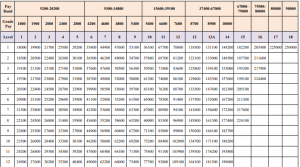
The Ministry of finance vide notification dated 25th July 2016 issued rules for 7th pay commission. The rules include a Schedule which shows categorically what payment has to be made to different positions. The said schedule is called 7th pay matrix
For the reference the table(7th pay matrix) is attached below.
Pay Band & Grade Pay
According to the table given above the first column shows the Pay band.
Pay Band is a pay scale according to the pay grades. It is a part of the salary process as it is used to rank different jobs by education, responsibility, location, and other multiple factors. The pay band structure is based on multiple factors and assigned pay grades should correlate with the salary range for the position with a minimum and maximum. Pay Band is used to define the compensation range for certain job profiles.
Here, Pay band is a part of an organized salary compensation plan, program or system. The Central and State Government has defined jobs, pay bands are used to distinguish the level of compensation given to certain ranges of jobs to have fewer levels of pay, alternative career tracks other than management, and barriers to hierarchy to motivate unconventional career moves. For example, entry-level positions might include security guard or karkoon. Those jobs and those of similar levels of responsibility might all be included in a named or numbered pay band that prescribed a range of pay.
The detailed calculation process of salary according to the pay matrix table is given under Rule 7 of the Central Civil Services (Revised Pay) Rules, 2016.
As per Rule 7A(i), the pay in the applicable Level in the Pay Matrix shall be the pay obtained by multiplying the existing basic pay by a factor of 2.57, rounded off to the nearest rupee and the figure so arrived at will be located in that Level in the Pay Matrix and if such an identical figure corresponds to any Cell in the applicable Level of the Pay Matrix, the same shall be the pay, and if no such Cell is available in the applicable Level, the pay shall be fixed at the immediate next higher Cell in that applicable Level of the Pay Matrix.
The detailed table as mentioned in the Rules showing the calculation:

For example if your pay in Pay Band is 5200 (initial pay in pay band) and Grade Pay of 1800 then 5200+1800= 7000, now the said amount of 7000 would be multiplied to 2.57 as mentioned in the Rules. 7000 x 2.57= 17,990 so as per the rules the nearest amount the figure shall be fixed as pay level. Which in this case would be 18000/-.
The basic pay would increase as your experience at that job would increase as specified in vertical cells. For example if you continue to serve in the Basic Pay of 18000/- for 4 years then your basic pay would be 19700/- as mentioned in the table.
Dearness Allowance
However, the basic pay mentioned in the table is not the only amount of remuneration an employee receives. There are catena of benefits and further additions in the salary such as dearness allowance, HRA, TADA.
According to the Notification No. 1/1/2023-E.II(B) from the Ministry of Finance and Department of Expenditure, the Dearness Allowance payable to Central Government employees was enhanced from rate of 38% to 42% of Basic pay with effect from 1st January 2023.
Here, DA would be calculated on the basic salary. For example if your basic salary is of 18,000/- then 42% DA would be of 7,560/-
House Rent Allowance
Apart from that the HRA (House Rent Allowance) is also provided to employees according to their place of duties. Currently cities are classified into three categories as ‘X’ ‘Y’ ‘Z’ on the basis of the population.
According to the Compendium released by the Ministry of Finance and Department of Expenditure in Notification No. 2/4/2022-E.II B, the classification of cities and rates of HRA as per 7th CPC was introduced.
See the table for reference
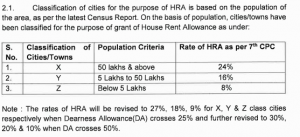
However, after enhancement of DA from 38% to 42% the HRA would be revised to 27%, 18%, and 9% respectively.
As above calculated the DA on Basic Salary, in the same manner HRA would also be calculated on the Basic Salary. Now considering that the duty of an employee’s Job is at ‘X’ category of city then HRA will be calculated at 27% of basic salary.
Here, continuing with the same example of calculation with a basic salary of 18000/-, the amount of HRA would be 4,840/-
Transport Allowance
After calculation of DA and HRA, Central government employees are also provided with Transport Allowance (TA). After the 7th CPC the revised rates of Transport Allowance were released by the Ministry of Finance and Department of Expenditure in the Notification No. 21/5/2017-EII(B) wherein, a table giving detailed rates were produced.
The same table is reproduced hereinafter.

As mentioned above in the table, all the employees are given Transport Allowance according to their pay level and place of their duties. The list of annexed cities are given in the same Notification No. 21/5/2017-EII(B).
Again, continuing with the same example of calculation with a Basic Salary of 18000/- and assuming place of duty at the city mentioned in the annexure, the rate of Transport Allowance would be 1350/-
Apart from that, DA on TA is also provided as per the ongoing rate of DA. For example, if TA is 1350/- and rate of current DA on basic Salary is 42% then 42% of TA would be added to the calculation of gross salary. Here, DA on TA would be 567/-.
Calculation of Gross Salary
After calculating all the above benefits the Gross Salary is calculated.
Here, after calculating Basic Salary+DA+HRA+TA the gross salary would be 32,317/-
However, the Gross Salary is subject to few deductions such as NPS, Professional Tax, Medical as subject to the rules and directions by the Central Government. After the deductions from the Gross Salary an employee gets the Net Salary on hand.
However, it is pertinent to note that benefits such as HRA and TA are not absolute, these allowances are only admissible if an employee is not provided with a residence by the Central Government or facility of government transport.
Conclusion
Government service is not a contract. It is a status. The employees expect fair treatment from the government. The States should play a role model for the services. The Apex Court in the case of Bhupendra Nath Hazarika and another vs. State of Assam and others (reported in 2013(2)Sec 516) has observed as follows:
“………It should always be borne in mind that legitimate aspirations of the employees are not guillotined and a situation is not created where hopes end in despair. Hope for everyone is gloriously precious and that a model employer should not convert it to be deceitful and treacherous by playing a game of chess with their seniority. A sense of calm sensibility and concerned sincerity should be reflected in every step. An atmosphere of trust has to prevail and when the employees are absolutely sure that their trust shall not be betrayed and they shall be treated with dignified fairness then only the concept of good governance can be concretized. We say no more.”
The consideration while framing Rules and Laws on payment of wages, it should be ensured that employees do not suffer economic hardship so that they can deliver and render the best possible service to the country and make the governance vibrant and effective.
Written by Husain Trivedi Advocate

Calcutta High Court Notifies Mandatory Child Access and Custody Guidelines Along With Parenting Plan: A New Era in Family Law Jurisprudence

Introduction
On September 26, 2025, the Calcutta High Court took a landmark step in family law jurisprudence by formally approving and publishing the Mandatory Child Access and Custody Guidelines on its official website[1]. This development marks a significant milestone for the State of West Bengal and the Union Territory of Andaman and Nicobar Islands, which previously lacked appropriate guidelines to address the complexities of child custody disputes. The introduction of these guidelines represents a progressive shift towards prioritizing the best interests of children caught in parental disputes while establishing a structured framework for determining custody and visitation rights.
The significance of these guidelines extends beyond mere procedural formality. They embody a judicial recognition that child custody matters require sensitivity, structure, and a child-centric approach rather than parent-centric considerations. The guidelines aim to minimize the psychological trauma that children experience during custody battles and ensure that judicial decisions are made with their welfare as the paramount concern. This article examines the regulatory framework governing child custody in India, analyzes the key provisions of the Calcutta High Court guidelines, explores relevant case law, and discusses the broader implications of this development for family law practice.
The Legal Framework Governing Child Custody in India
The Guardians and Wards Act, 1890
The primary legislation governing child custody matters in India is the Guardians and Wards Act, 1890, which provides a secular legal framework applicable across religious communities[2]. This colonial-era statute was enacted to consolidate and amend the law relating to guardians and wards, with the objective of providing a uniform law applicable to all classes of British India subjects. Despite being enacted over a century ago, the Act remains the foundational legislation for guardianship and custody matters in India.
The Guardians and Wards Act establishes the jurisdiction of courts in guardianship matters and sets forth the principles for appointing guardians. Under this Act, the District Court has the authority to appoint or declare guardians for the person or property of a minor. The Act empowers courts to direct any person having custody of a child to present the child before the court, ensuring judicial oversight in custody determinations. The legislation recognizes that guardianship involves both the custody of the minor’s person and the management of the minor’s property, treating these as distinct but related aspects of guardianship.
The Act’s provisions regarding the welfare of the minor have been consistently interpreted by Indian courts to mean that the child’s welfare supersedes all other considerations, including parental rights. Courts exercising jurisdiction under this Act are vested with parens patriae powers, enabling them to act as the ultimate guardian of minors and make decisions that serve the child’s best interests. The Act provides flexibility to courts in fashioning remedies appropriate to each case’s unique circumstances, recognizing that rigid rules cannot adequately address the diverse situations that arise in custody disputes.
The Hindu Minority and Guardianship Act, 1956
For Hindus, the Hindu Minority and Guardianship Act, 1956 provides additional provisions specific to the community[3]. This Act defines the natural guardians for Hindu minors and establishes their rights and responsibilities. According to the Act, the father is the natural guardian of a Hindu minor for both the minor’s person and property, followed by the mother. However, the Act makes a significant exception for children below the age of five years, stating that the custody of such young children ordinarily remains with the mother.
The Act recognizes that the mother’s role is particularly crucial during a child’s tender years when the need for maternal care and nurturing is greatest. This provision reflects the legislative acknowledgment of the special bond between mother and infant child and the importance of continuity in caregiving during formative years. The Act also specifies that after the mother, other relatives may serve as natural guardians in a prescribed order of priority, ensuring that children have appropriate guardianship even in circumstances where both parents are unavailable.
The Hindu Minority and Guardianship Act operates in conjunction with the Guardians and Wards Act, with courts considering provisions from both statutes when adjudicating custody disputes involving Hindu families. The personal law provisions do not override the fundamental principle that the welfare of the child is paramount; rather, they provide guidance on presumptive guardianship while allowing courts to deviate from these norms when the child’s welfare demands a different arrangement.
Personal Laws of Other Religious Communities
Different religious communities in India are governed by their respective personal laws regarding custody and guardianship. Muslim personal law provides that the custody of a male child remains with the mother until the age of seven years and a female child until puberty, after which custody typically transfers to the father. Christian personal law, governed primarily by the Divorce Act and the Indian Christian Marriage Act, does not prescribe specific age-based custody rules but leaves custody determinations to judicial discretion guided by the child’s welfare.
Despite the existence of community-specific personal laws, Indian courts have consistently held that the Guardians and Wards Act provides an overarching framework that applies across religious lines. When conflicts arise between personal law provisions and the child’s welfare, courts invariably prioritize welfare considerations, recognizing that children’s rights transcend religious boundaries. This approach ensures that all children in India receive protection under a uniform standard that places their interests above religious or customary practices.
Constitutional Imperatives and Children’s Rights
The Indian Constitution does not explicitly address child custody matters, but several constitutional provisions have significant bearing on how courts approach such cases. Article 15(3) of the Constitution empowers the State to make special provisions for women and children, recognizing their vulnerability and need for protective measures. Article 21, which guarantees the right to life and personal liberty, has been interpreted by the Supreme Court to include the right to a dignified life, which for children encompasses the right to grow up in a nurturing environment that promotes their physical, mental, and emotional development.
India is also a signatory to the United Nations Convention on the Rights of the Child, which has influenced judicial thinking on custody matters. The Convention emphasizes that in all actions concerning children, the best interests of the child shall be a primary consideration. Indian courts have increasingly incorporated this international standard into their jurisprudence, recognizing that children possess independent rights that deserve protection irrespective of parental claims.
The Calcutta High Court Child Access and Custody Guidelines: Key Features and Provisions
Background and Development
The Mandatory Child Access and Custody Guidelines published by the Calcutta High Court represent a culmination of evolving judicial thinking on custody matters and recognition of the need for standardized procedures. The State of West Bengal and the Andaman and Nicobar Islands had been operating without comprehensive guidelines, resulting in inconsistencies in how different judges approached custody disputes. The absence of uniform guidelines often led to prolonged litigation, unpredictable outcomes, and increased stress for families navigating the legal system.
The development of these guidelines involved consultation with legal experts, child psychologists, social workers, and family law practitioners. This multidisciplinary approach ensured that the guidelines address not only legal considerations but also the psychological and developmental needs of children. The guidelines draw upon best practices from other jurisdictions and incorporate insights from research on child development and the impact of parental separation on children.
Mandatory Parenting Plans
One of the most significant features of the Calcutta High Court child access and custody guidelines is the requirement for mandatory parenting plans in custody proceedings[4]. A parenting plan is a comprehensive document that outlines how parents will share responsibilities for their children’s upbringing following separation or divorce. The guidelines mandate that parents, with the assistance of counselors, must draw up an interim visitation plan within one week of receiving summons in custody proceedings.
This requirement represents a shift from adversarial litigation toward collaborative problem-solving. By requiring parents to develop parenting plans early in the proceedings, the guidelines encourage parents to focus on practical arrangements rather than engaging in acrimonious battles over custody labels. Parenting plans typically address various aspects of child-rearing, including daily routines, educational decisions, healthcare, religious upbringing, holiday schedules, and vacation arrangements. The requirement to develop these plans with counselor assistance ensures that parents receive professional guidance in creating arrangements that serve their children’s needs.
The emphasis on parenting plans reflects contemporary understanding that children benefit most when both parents remain actively involved in their lives despite the breakdown of the parental relationship. Research consistently shows that children adjust better to parental separation when they maintain meaningful relationships with both parents and when parents can cooperate in meeting their needs. Parenting plans facilitate this cooperation by establishing clear expectations and reducing opportunities for conflict.
Joint Custody Preference
The guidelines express a clear preference for joint custody arrangements wherever feasible[5]. Joint custody recognizes that children generally benefit from maintaining close relationships with both parents and that parental separation should not result in the loss of either parent from the child’s life. This preference represents a departure from traditional custody models that typically designated one parent as the primary custodian while relegating the other parent to periodic visitation.
Joint custody can take various forms, including joint legal custody where both parents share decision-making authority regarding major aspects of the child’s life, and joint physical custody where the child spends substantial time living with each parent. The guidelines recognize that joint custody arrangements require a degree of cooperation between parents and may not be appropriate in cases involving domestic violence, substance abuse, or other circumstances that compromise child safety.
The preference for joint custody aligns with the principle that children have a right to maintain relationships with both parents and that both parents have continuing responsibilities toward their children regardless of their marital status. However, the guidelines make clear that joint custody is not a rigid rule but rather a starting presumption that can be overcome when circumstances indicate that such an arrangement would not serve the child’s best interests.
Structured Visitation Frameworks
Recognizing that visitation arrangements often become sources of conflict between separated parents, the guidelines provide structured frameworks for visitation schedules. These frameworks offer templates for different visitation arrangements depending on factors such as the child’s age, the distance between parental residences, each parent’s work schedule, and the child’s school and activity commitments. By providing these templates, the guidelines reduce the need for litigation over visitation details and help ensure that children have predictable schedules that provide stability during a period of family transition.
The structured visitation frameworks address both regular visitation during the school year and special arrangements for holidays, school vacations, and significant occasions such as birthdays and religious festivals. The guidelines recognize that flexibility is necessary to accommodate changing circumstances while maintaining consistency that helps children feel secure. They encourage parents to communicate about schedule adjustments and to prioritize their children’s needs over personal convenience or the desire to limit the other parent’s time with the child.
Role of Counselors and Mediation
The Calcutta High Court guidelines place significant emphasis on counseling and mediation as alternatives to adversarial litigation[6]. The requirement that parents work with counselors in developing parenting plans reflects recognition that custody disputes often involve deep emotional issues that benefit from professional intervention. Counselors can help parents process their feelings about separation, improve communication skills, and focus on their children’s needs rather than their grievances against each other.
Mediation provides a structured process through which parents can negotiate custody and visitation arrangements with the assistance of a neutral third party. Unlike litigation, which produces winners and losers, mediation encourages collaborative problem-solving and helps parents develop solutions tailored to their family’s unique circumstances. The guidelines encourage courts to refer custody matters to mediation early in the proceedings, reserving judicial decision-making for cases where parents cannot reach agreement despite mediation efforts.
The emphasis on counseling and mediation reflects understanding that the outcome of custody proceedings is less important than the process through which that outcome is reached. Children benefit when their parents can communicate effectively and cooperate in meeting their needs, skills that counseling and mediation help develop. Moreover, parents who participate in developing custody arrangements are more likely to comply with those arrangements than parents who have decisions imposed upon them by courts.
Judicial Precedents Shaping Child Custody Law
Nil Ratan Kundu v. Abhijit Kundu (2008)
The Supreme Court’s decision in Nil Ratan Kundu v. Abhijit Kundu represents one of the most comprehensive statements of principles governing child custody in Indian jurisprudence[7]. In this case, the Court addressed a custody dispute involving grandparents seeking custody of their grandson against the child’s father. The Court held that in custody matters, the welfare of the child is paramount and supersedes the rights of parents or other individuals seeking custody.
The Court emphasized that welfare of the child is not limited to physical well-being but encompasses the child’s moral, ethical, and emotional development. The judgment recognized that courts must consider multiple factors in assessing welfare, including the child’s age, sex, religion, character and capacity of proposed guardians, the child’s wishes if the child is old enough to form intelligent preferences, and the continuity and stability of the existing custody arrangement. The Court stressed that courts should not mechanically apply presumptions about maternal or paternal custody but must examine each case’s specific circumstances.
Nil Ratan Kundu established several important principles that continue to guide custody determinations. First, the judgment affirmed that the child’s welfare is not synonymous with parental rights, and courts must distinguish between the right of guardianship and the right of custody. Second, the Court held that better financial resources alone do not determine custody, as love, affection, and ability to provide emotional support are equally or more important. Third, the judgment recognized that stability is a crucial element of child welfare, and courts should be reluctant to disturb existing custody arrangements that are working well for the child.
Gaurav Nagpal v. Sumedha Nagpal (2009)
In Gaurav Nagpal v. Sumedha Nagpal, the Supreme Court reiterated the paramountcy of child welfare while emphasizing that courts must examine all relevant factors before making custody determinations[8]. The case involved a custody dispute between parents where the mother had taken the child to India from the United States. The Court held that while international conventions and comity considerations are relevant in international child custody disputes, the welfare of the child remains the foremost consideration.
The Court observed that in determining welfare, courts should consider factors such as the child’s age and sex, the character and capacity of parents, the child’s ordinary wishes if the child is of sufficient age and maturity to form intelligent opinions, and which parent has shown greater affection and care for the child. The judgment emphasized that courts should avoid disturbing arrangements that are working satisfactorily for the child unless compelling reasons exist to do so.
Thrity Hoshie Dolikuka v. Hoshiam Shavaksha Dolikuka (1982)
This early Supreme Court decision established the foundational principle that the welfare of the child is the paramount consideration in custody disputes, superseding even parental rights[9]. The Court held that when determining custody, courts must focus on what serves the child’s best interests rather than on vindicating parental claims. This principle has been consistently followed in subsequent decisions and forms the bedrock of Indian child custody jurisprudence.
The Thrity Hoshie Dolikuka judgment recognized that while parents have natural claims to custody of their children, these claims are subordinate to considerations of child welfare. The Court observed that factors such as which parent was responsible for marital breakdown are irrelevant to custody determinations, as the focus must remain on the child’s needs rather than apportioning blame between parents. This approach reflects maturity in judicial thinking, recognizing that children should not be used as rewards or punishments in divorce proceedings.
Implications and Implementation Challenges of Child Access and Custody Guidelines
Impact on Legal Practice
The Calcutta High Court child access and custody guidelines will significantly impact how family law practitioners approach custody cases in West Bengal and the Andaman and Nicobar Islands. Lawyers will need to shift from purely adversarial strategies toward more collaborative approaches that emphasize negotiation and problem-solving. The mandatory requirement for parenting plans means that practitioners must be prepared to assist clients in developing comprehensive proposals that address all aspects of child-rearing rather than simply arguing for maximum custody time.
The child access and custody guidelines also place new responsibilities on family court judges, who must ensure compliance with procedural requirements while maintaining focus on substantive justice. Judges will need to carefully review proposed parenting plans to ensure they adequately address children’s needs and do not merely reflect one parent’s preferences imposed on the other. The emphasis on counseling and mediation means that courts will need to work closely with mental health professionals and develop referral networks that can provide timely services to families in custody disputes.
Training and Capacity Building
Effective implementation of the child access and custody guidelines requires extensive training for all stakeholders in the family justice system. Judges and court personnel need training on child development, domestic violence dynamics, substance abuse issues, and other topics relevant to custody determinations. Counselors and mediators must understand the legal framework within which they operate and develop skills specific to working with high-conflict families. Lawyers need education on collaborative law techniques and the psychology of separation and divorce.
The Calcutta High Court will likely need to establish training programs and continuing education requirements to ensure that all professionals working on custody cases have necessary competencies. Professional organizations, including bar associations and mental health professional bodies, can play important roles in developing and delivering training. Academic institutions offering law and counseling programs should incorporate family law and child development content into their curricula to prepare future professionals for practice in this area.
Resource Allocation
The successful implementation of the guidelines depends on adequate resource allocation to family courts. Courts will need additional staff to manage the increased administrative requirements associated with parenting plan review and monitoring. Funding must be available for counseling and mediation services, with provisions to ensure that indigent parties can access these services. Courts may need to establish child custody evaluation units staffed by psychologists and social workers who can conduct assessments in complex cases.
The guidelines may initially increase case processing times as courts and practitioners adjust to new procedures. However, proponents argue that investing resources in front-end processes like counseling and mediation will ultimately reduce litigation by helping more families reach agreements. The guidelines may also reduce the need for post-judgment modification proceedings by establishing more workable initial arrangements that better meet children’s needs.
Monitoring and Enforcement
The guidelines must include mechanisms for monitoring compliance with custody and visitation orders and enforcing those orders when parents fail to comply. Non-compliance with visitation schedules is a common problem in custody cases, often leading to return trips to court and continuing conflict. Courts need procedures for quickly addressing compliance issues and remedies that encourage cooperation while protecting children from exposure to parental conflict.
The guidelines may contemplate various enforcement mechanisms, including contempt proceedings for willful violations, modification of custody arrangements when one parent systematically interferes with the other’s visitation, and referral to parenting coordination services in high-conflict cases. Some jurisdictions have found success with specialized compliance programs that combine monitoring, incentives for compliance, and graduated sanctions for violations. The Calcutta High Court may adopt similar approaches as it gains experience implementing the guidelines.
Comparative Perspectives: Guidelines in Other Jurisdictions
Several other High Courts in India have adopted similar guidelines for child custody matters, providing models that may have influenced the Calcutta High Court’s approach. The Bombay High Court was among the first to formalize custody and access guidelines, recognizing the need for structured approaches to these sensitive matters. The guidelines developed by various High Courts share common themes, including emphasis on child welfare, preference for joint custody, structured visitation schedules, and use of alternative dispute resolution mechanisms.
Beyond India, many jurisdictions have developed statutory frameworks or judicial guidelines for custody determinations. The American Law Institute’s Principles of the Law of Family Dissolution proposes an approximation rule under which custody arrangements should approximate the time each parent spent performing caretaking functions before separation. This approach aims to provide continuity for children while avoiding gender-based presumptions about custody. Other jurisdictions emphasize the importance of maintaining sibling relationships and extended family connections in custody arrangements.
International instruments such as the United Nations Convention on the Rights of the Child and the Hague Convention on the Civil Aspects of International Child Abduction provide frameworks that influence domestic custody law. The emphasis in these instruments on considering children’s views, maintaining family relationships, and protecting children from abduction reflects evolving international consensus on children’s rights. Indian courts increasingly reference international standards in custody cases, demonstrating India’s integration into global human rights jurisprudence.
Future Directions and Reforms for Child Custody Laws in India
Legislative Reform Proposals
While judicial guidelines like those issued by the Calcutta High Court represent important progress, comprehensive legislative reform would provide more uniform standards across India. The Law Commission of India has examined guardianship and custody laws and recommended reforms to address gaps and inconsistencies. Proposed reforms include updating the archaic language of the Guardians and Wards Act, providing specific criteria for courts to consider in custody determinations, and establishing uniform procedures across jurisdictions.
Reform proposals also address the need for specialized family courts with jurisdiction over all family law matters. Currently, custody cases may be filed in civil courts, family courts, or as ancillary proceedings in matrimonial courts, depending on the jurisdiction and nature of the case. This fragmentation creates inefficiencies and inconsistencies. A unified family court system with trained judges, integrated services, and specialized procedures could better serve families experiencing separation and divorce.
Emerging Issues in Child Custody
Child custody law must continually evolve to address emerging family structures and social changes. The increasing prevalence of non-marital cohabitation raises questions about custody rights of unmarried parents. Same-sex couples raising children present issues that traditional legal frameworks did not contemplate. Advances in reproductive technology, including surrogacy and assisted reproduction, create complex questions about legal parentage and custody rights.
The impact of technology on children’s lives presents new custody considerations. Questions about screen time, social media use, online privacy, and exposure to inappropriate content require parents to make decisions that may generate conflict. Custody arrangements need to address these issues, potentially requiring provisions about technology use and parental monitoring. The rise of remote work and geographic mobility creates opportunities for creative custody arrangements but also challenges in maintaining stability for children.
Child Participation in Custody Proceedings
International human rights standards increasingly emphasize children’s right to be heard in proceedings affecting them. While Indian law requires courts to consider children’s preferences when children are old enough to form intelligent opinions, procedures for ascertaining and giving effect to children’s views remain underdeveloped. Future reforms should establish age-appropriate mechanisms for children to express their preferences and concerns without placing them in the middle of parental conflicts.
Child participation mechanisms might include private judicial interviews, appointment of children’s representatives or guardians ad litem, and use of child specialists who can communicate with children and convey their perspectives to courts. Care must be taken to ensure that children’s participation is voluntary, that children receive adequate information about proceedings in age-appropriate language, and that children’s expressed preferences are understood in context rather than treated as determinative. Balancing children’s participatory rights with protection from harmful exposure to parental conflict remains an ongoing challenge.
Conclusion
The notification of Mandatory Child Access and Custody Guidelines by the Calcutta High Court represents a significant advancement in family law practice in West Bengal and the Andaman and Nicobar Islands. These guidelines provide much-needed structure and consistency to custody proceedings while reinforcing the fundamental principle that child welfare must guide all custody determinations. By mandating parenting plans, expressing preference for joint custody, emphasizing counseling and mediation, and establishing clear procedural requirements, the guidelines aim to reduce the trauma that children experience during custody disputes and promote outcomes that serve their long-term interests.
The legal framework governing child custody in India, encompassing the Guardians and Wards Act, personal laws, constitutional provisions, and evolving case law, reflects continuing judicial commitment to protecting children’s welfare. Supreme Court decisions like Nil Ratan Kundu have established that children’s rights supersede parental claims and that courts must consider multiple factors in assessing welfare. The Calcutta High Court guidelines build upon this jurisprudential foundation while providing practical tools for implementing these principles.
Successful implementation of the guidelines will require sustained effort from all stakeholders in the family justice system. Training and capacity building for judges, lawyers, counselors, and mediators is essential. Adequate resources must be allocated to courts and support services. Monitoring mechanisms must ensure compliance with custody orders while addressing violations promptly. As experience accumulates, the guidelines may require refinement to address unforeseen issues and incorporate lessons learned.
The broader significance of the Calcutta High Court guidelines extends beyond their immediate jurisdictional scope. They represent judicial recognition that child custody law must evolve to meet contemporary families’ needs and incorporate insights from child development research and clinical practice. Other jurisdictions may look to these guidelines as models for their own reforms. Legislative bodies may draw upon the guidelines in developing comprehensive custody law reforms. Ultimately, the success of these guidelines will be measured not by their legal sophistication but by their impact on children’s lives, ensuring that children of separated parents receive the love, support, and stability they need to thrive.
References
[1] Calcutta High Court Notifies Mandatory Child Access & Custody Guidelines Along With Parenting Plan. (2025, September 29). LiveLaw. https://www.livelaw.in/high-court/calcutta-high-court/calcutta-high-court-notifies-mandatory-child-access-custody-guidelines-alongwith-parenting-plan-305441
[2] The Guardians and Wards Act, 1890. India Code. https://www.indiacode.nic.in/bitstream/123456789/2318/1/189008.pdf
[3] The Hindu Minority and Guardianship Act, 1956. India Code. https://www.indiacode.nic.in/bitstream/123456789/1649/1/195632.pdf
[4] Child Custody & Parenting: Calcutta High Court Issues Guidelines. (2025, September). LawBeat. https://lawbeat.in/news-updates/child-custody-parenting-calcutta-high-court-issues-comprehensive-guidelines-1532117
[5] Calcutta High Court. (2025). Notice on Child Access & Custody Guidelines. Official Website. https://www.calcuttahighcourt.gov.in/Notice-Files/general-notice/15363
[6] Supreme Court Half Yearly Digest 2025: Family Law. (2025, September 30). LiveLaw. https://www.livelaw.in/supreme-court/supreme-court-half-yearly-digest-family-law-2025-305409
[7] Nil Ratan Kundu & Anr vs Abhijit Kundu, (2008) 9 SCC 413. Indian Kanoon. https://indiankanoon.org/doc/687286/
[8] Stability of child is of paramount consideration in custody battle: Supreme Court sets aside Orissa HC judgment granting custody to father. (2024, March 14). SCC Times. https://www.scconline.com/blog/post/2024/03/06/stability-child-paramount-consideration-custody-battle-supreme-court-sets-aside-orissa-hc-judgment-granting-custody-father/
[9] The Guardians and Wards Act, 1890. Indian Kanoon. https://indiankanoon.org/doc/1874830/
TRAI Releases Recommendations on Digital Radio Broadcast Policy for Private Broadcasters: A Comprehensive Legal Analysis

Introduction
On October 2, 2025, the Telecom Regulatory Authority of India released groundbreaking recommendations that will fundamentally reshape the landscape of digital radio broadcast policy in the country. This policy framework introduces digital radio broadcasting services for private broadcasters, marking a significant departure from the exclusively analog FM radio system that has operated for decades. The recommendations cover critical aspects including technology standards, spectrum allocation mechanisms, licensing terms, and revenue-sharing models, all aimed at modernizing India’s radio broadcasting infrastructure while maintaining regulatory oversight and consumer protection.
The regulatory authority’s recommendations emerge at a crucial juncture when global broadcasting is transitioning toward digital platforms. These guidelines represent the culmination of extensive stakeholder consultations that began with a consultation paper released in September 2024, followed by an open house discussion conducted on January 8, 2025. The recommendations address fundamental questions about how India will implement digital radio technology, assign spectrum frequencies, and regulate this emerging segment while ensuring fair competition and quality service delivery to listeners across the nation [1].
Constitutional and Legislative Framework Governing Broadcasting
Constitutional Provisions and Spectrum Ownership
The constitutional foundation for regulating airwaves and broadcasting in India derives from the exclusive authority vested in the Union Government under Entry 31 of List I (Union List) of the Seventh Schedule to the Constitution of India, which covers “posts and telegraphs; telephones, wireless, broadcasting and other like forms of communication.” This constitutional mandate establishes the central government’s supreme authority over all forms of wireless communication, including radio broadcasting. The principle of state ownership of spectrum has been consistently affirmed by Indian courts, recognizing that radio frequencies constitute a scarce public resource that must be managed in the public interest.
The Telecommunications Act, 2023, which received presidential assent on December 24, 2023, fundamentally redefines this regulatory landscape. Section 4(1) of this Act explicitly declares that “The Central Government, being the owner of the spectrum on behalf of the people, shall assign the spectrum in accordance with this Act, and may notify a National Frequency Allocation Plan from time to time” [2]. This provision crystallizes the state’s custodianship over electromagnetic spectrum and establishes the legal foundation for spectrum assignment, whether through auction or administrative processes.
The TRAI Act and Regulatory Authority
The Telecom Regulatory Authority of India Act, 1997, as amended, empowers TRAI to make recommendations on various aspects of telecommunication and broadcasting services. Section 11(1) of the TRAI Act specifically mandates that the authority shall, from time to time, make recommendations either on its own initiative or on a request from the licensor on matters including terms and conditions of licenses, revocation of licenses, and measures to facilitate competition and promote efficiency in telecommunication services. The Ministry of Information and Broadcasting invoked this provision under Section 11 of the TRAI Act, 1997, when it sought recommendations from TRAI for formulating a digital radio broadcast policy [3].
The regulatory framework operates through a collaborative mechanism where the ministry requests recommendations, TRAI conducts extensive consultations and research, and ultimately provides detailed recommendations that the government considers for implementation. This process ensures that policy formulation benefits from technical expertise, stakeholder input, and regulatory experience while maintaining governmental accountability for final decisions.
Key Recommendations of TRAI’s Digital Radio Broadcasting Policy
Simulcast Mode Implementation
The cornerstone of TRAI’s recommendations is the adoption of simulcast mode for digital radio broadcasting. Under this framework, broadcasters will transmit both analog and digital signals simultaneously on the same frequency, allowing for a gradual transition period during which listeners can access services using existing analog receivers while the market develops digital radio infrastructure. Each assigned frequency will accommodate one analog channel, three digital channels, and one data channel, significantly expanding the content delivery capacity compared to traditional analog broadcasting that permits only a single channel per frequency [4].
New broadcasters entering the market will be mandated to commence operations in simulcast mode from the outset. Existing FM radio broadcasters, however, will have the flexibility to migrate to simulcast mode on a voluntary basis, recognizing the substantial infrastructure investments and operational adjustments required for such transition. This graduated approach balances the policy objective of technological advancement with pragmatic considerations of industry capacity and consumer readiness. Broadcasters must commence simulcast operations within two years of either the conclusion of the auction process or their acceptance of the migration option, establishing clear timelines for implementation while providing sufficient lead time for technical preparations.
Geographic Scope and City Classification
The recommendations propose a phased rollout strategy beginning with major metropolitan areas. The initial implementation will cover four cities classified as “A+” category, specifically Delhi, Mumbai, Kolkata, and Chennai, representing India’s largest metropolitan markets with the most developed broadcasting infrastructure and listener bases. The second tier includes nine “A” category cities: Hyderabad, Bengaluru, Ahmedabad, Surat, Pune, Jaipur, Lucknow, Kanpur, and Nagpur [5].
This strategic geographic prioritization reflects economic viability considerations, existing infrastructure availability, and population density factors. These thirteen cities collectively represent substantial listener markets and possess the technical infrastructure necessary for supporting digital broadcasting services. The phased approach allows for learning from initial implementations, addressing technical challenges, and refining regulatory mechanisms before expanding to smaller markets.
Technology Standards and Interoperability
TRAI has recommended that India adopt a single digital radio technology standard in the VHF Band II frequency range to ensure nationwide interoperability and avoid market fragmentation. However, the recommendations notably refrain from specifying a particular technology standard, instead urging the government to undertake comprehensive consultations with broadcasters, equipment manufacturers, and other stakeholders before making this critical determination. This approach recognizes that technology selection involves complex trade-offs regarding equipment costs, audio quality, spectrum efficiency, and international compatibility.
The emphasis on a unified standard stems from practical considerations of receiver manufacturing economies of scale, consumer convenience, and network efficiency. A fragmented technology landscape would complicate device manufacturing, increase consumer costs, and potentially create regional incompatibilities that undermine the policy’s objectives of expanding service availability and enhancing listener experience.
Spectrum Assignment Methodology
The recommendations advocate for auction-based spectrum assignment, aligning with the market-driven allocation methodology prescribed under the Telecommunications Act, 2023. Section 4(4) of the Act establishes that “The Central Government shall assign spectrum for telecommunication through auction except for entries listed in the First Schedule for which assignment shall be done by administrative process.” While the First Schedule includes public broadcasting services among categories eligible for administrative allocation, private commercial radio broadcasting falls outside these exceptions, necessitating competitive bidding processes [2].
The auction mechanism serves multiple policy objectives including ensuring transparent allocation procedures, discovering market-determined pricing for scarce spectrum resources, and promoting efficient utilization by assigning frequencies to entities that value them most highly. The recommendations specify that reserve prices for spectrum in different city categories should be established based on comprehensive valuation methodologies that account for market potential, existing analog frequency prices, and technological advantages of digital broadcasting.
Licensing Terms and Regulatory Conditions for Digital Radio Broadcast
Authorization Period and Renewal
The recommendations propose authorization periods of fifteen years for digital radio broadcasting licenses, providing operators with substantial certainty for long-term business planning and infrastructure investments. This duration aligns with international practices in broadcasting licensing and reflects the capital-intensive nature of establishing broadcasting networks. The extended license term enables broadcasters to amortize equipment costs, develop audience relationships, and establish sustainable business models without the uncertainty of frequent renewal processes.
Authorization under the new framework will be granted pursuant to Section 3(1) of the Telecommunications Act, 2023, which requires that “Any person intending to provide telecommunication services or establish, operate, maintain or expand telecommunication network shall obtain an authorisation from the Central Government, subject to such terms and conditions, including fees or charges, as may be prescribed” [2]. This provision establishes the legal foundation for licensing digital radio services and empowers the government to prescribe comprehensive terms covering technical standards, content regulations, and financial obligations.
Revenue Sharing and Fee Structure
The recommendations propose that license fees should be calculated based on adjusted gross revenue principles, maintaining consistency with the fee structure applicable to existing analog FM radio operations. Significantly, the recommendations specify that revenue generated from streaming digital radio content through internet platforms should be included in gross revenue calculations for fee purposes. This provision addresses the convergence of traditional broadcasting and digital distribution channels, ensuring that regulatory obligations extend to all revenue streams derived from licensed broadcasting activities.
The inclusion of streaming revenue in the fee base reflects evolving consumption patterns where listeners increasingly access radio content through mobile applications and internet platforms rather than traditional receivers. This approach prevents regulatory arbitrage where broadcasters might structure operations to minimize reportable revenues while still monetizing their content through digital channels.
Analog Sunset Provisions
Rather than establishing a definitive date for terminating analog broadcasting, the recommendations adopt a flexible approach that defers the analog sunset decision until sufficient data exists regarding digital radio adoption, receiver penetration, and service quality. The recommendations specify that the sunset date should be determined after evaluating the progress of digital radio broadcasting at a later stage, allowing policymakers to assess market development before committing to an irreversible transition timeline.
This pragmatic approach recognizes the substantial installed base of analog receivers in Indian households and vehicles, the potentially slow pace of consumer equipment upgrades, and the need to avoid service disruptions for listeners who continue relying on analog technology. The gradual transition model protects consumer interests while encouraging market-driven adoption of digital technology as receiver prices decline and content advantages become apparent.
Legal and Regulatory Challenges for Digital Radio Broadcast
Content Regulation and Program Code Compliance
Digital radio broadcasters will remain subject to content regulations established under the Cable Television Networks Rules, 1994, and the Programme Code prescribed under the All India Radio Code. These regulations govern aspects including decency standards, restrictions on content that offends religious sentiments, prohibition of obscene or defamatory material, and requirements for balanced presentation of news and current affairs. The convergence of radio broadcasting with data services raises novel questions about the applicability of these regulations to non-audio content transmitted through the data channel component of digital broadcasting.
The regulatory framework must address how traditional content standards apply to interactive services, data broadcasting, and multimedia content that digital technology enables. These questions involve balancing free speech protections, cultural sensitivities, and regulatory oversight in an evolving technological environment that blurs traditional distinctions between broadcasting, telecommunications, and internet services.
Competition Law Considerations
The auction-based allocation mechanism and market entry conditions raise important competition law questions regarding market concentration, cross-media ownership, and barrier to entry. Section 11(2) of the TRAI Act empowers the authority to ensure technical compatibility and effective competition, while recent amendments to the Act enable TRAI to direct entities to abstain from predatory pricing harmful to competition and long-term sector development.
The digital radio policy must navigate tensions between allowing sufficient market concentration to achieve economies of scale while preventing dominant operators from leveraging market power to exclude competitors or harm consumer interests. Cross-ownership restrictions, spectrum caps, and merger review processes constitute important regulatory tools for maintaining competitive market structures.
Spectrum Interference and Technical Coordination
The simultaneous transmission of analog and digital signals on the same frequency in simulcast mode creates potential for interference issues that require careful technical management. The recommendations contemplate detailed technical specifications regarding transmission power levels, modulation schemes, and guard bands to minimize interference both between analog and digital signals and among adjacent frequency assignments. The Wireless Planning and Coordination Wing of the Department of Telecommunications bears responsibility for frequency planning and interference resolution, exercising powers under the Telecommunications Act, 2023.
Section 8(1) of the Act authorizes the Central Government to “establish by notification, such monitoring and enforcement mechanism as it may deem fit to ensure adherence to terms and conditions of spectrum utilisation and enable interference-free use of the assigned spectrum” [2]. This provision provides the legal foundation for establishing technical standards and enforcement mechanisms necessary for managing the complex radio frequency environment that digital broadcasting creates.
Case Law Precedents and Judicial Interpretations
Spectrum as Public Property
The foundational principle that electromagnetic spectrum constitutes public property managed by the state on behalf of citizens received authoritative endorsement from the Supreme Court in the case of Centre for Public Interest Litigation v. Union of India, where the Court observed that natural resources including airwaves belong to the public and must be distributed in a manner that serves the common good. While this judgment primarily addressed allocation of 2G spectrum for mobile telephony, its principles apply equally to broadcasting spectrum.
The Court’s reasoning emphasized that when the state acts as custodian of scarce natural resources, it must do so in a manner that maximizes public benefit rather than private gain, necessitating transparent allocation procedures and fair pricing mechanisms. These principles undergird the auction-based allocation methodology that TRAI’s recommendations propose for digital radio spectrum.
Regulatory Authority and Ministerial Powers
The Supreme Court in Cellular Operators Association of India v. Telecom Regulatory Authority of India clarified the respective roles of TRAI and the government in licensing and regulatory matters. The Court held that while TRAI possesses recommendatory powers on licensing terms and conditions, the government retains ultimate decision-making authority regarding license grants, rejections, and modifications. However, the government must seriously consider TRAI’s recommendations and cannot arbitrarily deviate without cogent reasons.
This division of authority reflects the institutional design where TRAI brings technical expertise and regulatory independence to policy formulation while maintaining governmental accountability through ministerial control over final decisions. In the context of digital radio policy, this means that while TRAI’s recommendations carry substantial weight, the Ministry of Information and Broadcasting retains discretion in implementation details.
International Comparisons and Best Practices
European Digital Radio Transition
European countries have pursued varied approaches to digital radio implementation, with Norway becoming the first nation to completely switch off FM broadcasting in 2017. The Norwegian transition provided valuable lessons about the importance of receiver subsidies, extended transition periods, and maintaining analog services in areas with limited digital coverage. The United Kingdom has adopted a more gradual approach, requiring 50 percent digital listening share and nationwide coverage before contemplating analog shutdown.
These international experiences inform India’s simulcast approach and flexible sunset provisions, recognizing that successful digital transition requires consumer readiness, affordable receiver availability, and demonstrated service quality advantages. The gradual approach allows the market to develop organically while avoiding the service disruptions and public resistance that premature analog termination might generate.
Technology Standard Selection
Different regions have adopted various digital radio standards, with DAB+ dominating in Europe and Australia, HD Radio prevalent in the United States, and DRM gaining traction in some developing markets. Each standard presents distinct trade-offs regarding spectrum efficiency, audio quality, receiver costs, and backward compatibility. TRAI’s recommendation that India select a single standard after stakeholder consultation reflects awareness that technology selection involves balancing technical performance, economic viability, and market acceptance factors.
The choice of technology standard will profoundly influence receiver manufacturing costs, content delivery capabilities, and the competitive dynamics of the digital radio market. International interoperability considerations also matter, as receiver manufacturers achieve economies of scale by producing devices for multiple markets using common standards.
Implementation Challenges and Future Outlook for Digital Radio Broadcasting
Infrastructure Investment Requirements
The transition to digital radio broadcasting necessitates substantial capital investment in transmission equipment, studio infrastructure, and technical systems. Existing FM broadcasters contemplating migration must evaluate whether the potential audience reach and revenue advantages justify the required expenditures, particularly during the extended simulcast period when they must maintain both analog and digital transmission chains simultaneously.
The voluntary migration approach for existing broadcasters acknowledges these economic realities, allowing operators to make business-driven decisions about transition timing based on their individual circumstances, market positions, and strategic priorities. However, this flexibility creates uncertainty about adoption rates and the pace at which digital radio will achieve sufficient scale to deliver transformative benefits.
Consumer Equipment Transition
The success of digital radio ultimately depends on consumer adoption of compatible receivers. The current installed base consists almost entirely of analog-only devices in homes, vehicles, and portable electronics. Digital receiver penetration will depend on pricing, availability, marketing, and perceived value propositions that digital services offer. The automotive sector represents a particularly important channel, as factory-installed receivers in new vehicles can drive adoption, but this requires coordination with automobile manufacturers and potentially regulatory mandates for digital radio capability in new vehicles.
The data channel capability that digital broadcasting enables could support traffic information, weather alerts, and other value-added services that differentiate digital from analog reception. However, realizing these possibilities requires investment in content development, application ecosystems, and user interfaces that make digital advantages tangible and compelling for consumers.
Regulatory Evolution and Adaptation
The convergence of broadcasting with telecommunications and internet services challenges traditional regulatory categories and jurisdictional boundaries. Digital radio services that incorporate data broadcasting, internet streaming, and interactive features blur distinctions between telecommunications, broadcasting, and information services that have historically been regulated under separate frameworks with different legal principles.
The Telecommunications Act, 2023, represents an attempt to create a unified regulatory framework that accommodates technological convergence while maintaining appropriate oversight. However, implementing regulations must address numerous details regarding how traditional broadcasting principles apply to hybrid services that combine linear programming, on-demand content, and interactive applications.
Conclusion
TRAI’s recommendations for digital radio broadcasting policy represent a carefully calibrated approach to modernizing India’s radio broadcasting sector. The simulcast mode framework balances technological advancement with practical transition challenges, while the auction-based spectrum allocation aligns with market-driven resource distribution principles established under the Telecommunications Act, 2023. The recommendations reflect extensive stakeholder consultation and consideration of international experiences, offering a pragmatic pathway for introducing digital broadcasting while protecting consumer interests and maintaining regulatory oversight.
The success of this policy framework will depend on numerous factors including technology standard selection, investment by broadcasters in infrastructure upgrades, consumer adoption of digital receivers, and the development of compelling content and services that leverage digital capabilities. The flexible sunset provisions for analog broadcasting acknowledge the extended transition period likely necessary for achieving widespread digital penetration while maintaining service continuity for existing listeners.
As implementation proceeds, regulatory authorities must remain attentive to emerging challenges including spectrum interference management, content regulation in converged environments, competition concerns, and consumer protection issues. The policy framework establishes foundations for digital radio development, but ongoing regulatory adaptation will be necessary as technology evolves and market dynamics unfold. The coming years will reveal whether India’s approach to digital radio transition successfully balances innovation, competition, and public interest objectives in reshaping the nation’s broadcasting landscape.
References
[1] Morung Express. (2025, October 3). TRAI releases recommendations on digital radio broadcast policy for private broadcasters. Retrieved from https://morungexpress.com/trai-releases-recommendations-on-digital-radio-broadcast-policy-for-private-broadcasters
[2] Government of India. (2023). The Telecommunications Act, 2023 (No. 44 of 2023). The Gazette of India. Retrieved from https://egazette.gov.in/WriteReadData/2023/250880.pdf
[3] Press Information Bureau. (2024). TRAI releases Consultation Paper on “Formulating a Digital Radio Broadcast Policy for private Radio broadcasters”. Retrieved from https://www.pib.gov.in/PressReleasePage.aspx?PRID=2060201
[4] Communications Today. (2025, October 3). TRAI releases recommendations for digital radio broadcast policy. Retrieved from https://www.communicationstoday.co.in/trai-releases-recommendations-for-digital-radio-broadcast-policy/
[5] The Tribune. (2025, October 3). TRAI recommends auction for allocating frequency bands for digital radio by private broadcasters. Retrieved from https://www.tribuneindia.com/news/broadcast-policy/trai-recommends-auction-for-allocating-frequency-bands-for-digital-radio-by-private-broadcasters

U.S. Imposes Additional 25% Tariff on India Over Russian Oil Purchases: An Analysis of Legal Framework, International Trade Regulations, and Economic Implications

Introduction
In a significant escalation of trade tensions between two major democratic nations, President Donald Trump announced on August 6, 2025, the imposition of an additional 25% tariff on imports from India, effectively doubling the total tariff burden to 50%. This unprecedented trade measure stems from India’s continued procurement and resale of Russian oil despite ongoing geopolitical tensions surrounding the Russia-Ukraine conflict. The decision marks one of the most substantial trade penalties imposed by the United States on a strategic partner and represents a critical juncture in US-India relations, which have historically been characterized by growing economic cooperation and shared democratic values.
The tariff implementation, which became effective on August 27, 2025, has sent shockwaves through international trade circles and raised fundamental questions about the intersection of national security concerns, economic diplomacy, and the legal frameworks governing international commerce. With bilateral trade between the United States and India valued at approximately USD 212.3 billion in 2024, including USD 87.3 billion in US imports from India [1], the ramifications of this decision extend far beyond mere economic calculations, touching upon issues of sovereignty, strategic autonomy, and the evolving architecture of global trade governance.
Legal Foundation of the Tariff Imposition
The International Emergency Economic Powers Act
The legal basis for President Trump’s tariff imposition rests primarily on the International Emergency Economic Powers Act (IEEPA), codified at 50 U.S.C. §§ 1701-1707. This statute, enacted in 1977, grants the President expansive authority to regulate international commerce and financial transactions when facing what the legislation terms an “unusual and extraordinary threat” to national security, foreign policy, or the American economy [2]. The IEEPA represents a carefully calibrated Congressional delegation of power, allowing the executive branch to respond swiftly to emerging international crises while maintaining certain procedural safeguards and reporting requirements.
Under Section 1701(a) of the IEEPA, the President may exercise this authority only after declaring a national emergency pursuant to the National Emergencies Act. The statute specifically empowers the executive to “investigate, regulate, or prohibit” any transactions in foreign exchange, transfers of credit or payments between financial institutions, and the importation or exportation of currency or securities. Most relevant to the current situation, subsection 1702(a)(1)(B) explicitly authorizes the President to “regulate or prohibit” imports when such action is deemed necessary to address the declared emergency.
Executive Order 14257 and the Reciprocal Tariff Framework
The immediate legal instrument implementing the tariff on India derives from Executive Order 14257, titled “Regulating Imports With a Reciprocal Tariff To Rectify Trade Practices That Contribute to Large and Persistent Annual United States Goods Trade Deficits,” issued on April 2, 2025 [3]. This executive order established a comprehensive framework for what the administration termed “reciprocal tariffs,” designed to address what it characterized as unfair trade practices and persistent trade imbalances that, in the President’s determination, constituted a national emergency.
Executive Order 14257 declared that conditions reflected in large and persistent annual United States goods trade deficits constitute an unusual and extraordinary threat to the national security and economy of the United States. The order established a baseline 10% tariff on imports from most trading partners, with provisions for higher country-specific rates based on various economic and security considerations. Critically, the order included Annex II, which specified certain exempt categories of goods deemed essential to American pharmaceutical production, electronics manufacturing, and critical mineral supply chains.
The August 2025 Presidential Determination on India
On August 6, 2025, President Trump issued a separate executive determination specifically addressing India’s role in the Russian oil trade. Titled “Addressing Threats to the United States by the Government of the Russian Federation,” the order invoked both the IEEPA and the framework established under Executive Order 14257 to justify the additional 25% tariff on Indian imports. The White House fact sheet accompanying the decision stated that the measure was necessary because India’s “direct or indirect importation of Russian Federation oil” enables funding of Russia’s military operations in Ukraine, thereby undermining U.S. efforts to counter these activities and presenting a threat to American national security interests.
The determination emphasized that India’s practice of purchasing Russian crude oil at discounted rates and subsequently refining and reselling petroleum products to international markets, including potentially to American consumers, created what the administration characterized as a sanctions evasion mechanism. This characterization proved controversial, as India’s oil trade with Russia remained technically legal under existing international law, even as it complicated Western efforts to economically isolate Moscow.
Regulatory Framework Governing International Tariffs
Harmonized Tariff Schedule and Classification
The implementation of tariffs on Indian goods operates within the broader framework of the Harmonized Tariff Schedule of the United States (HTSUS), which provides the nomenclature and classification system for all goods entering American commerce. As part of this policy, the U.S. imposes an additional 25% tariff on India, applied as an ad valorem duty calculated as a percentage of the declared customs value of imported merchandise. This duty supplements, rather than replaces, any existing tariffs already applicable to specific product categories under normal trade relations.
The United States Customs and Border Protection (CBP), operating under the authority of Title 19 of the United States Code, bears responsibility for collecting these duties and enforcing compliance. Section 1500 of Title 19 establishes the procedures for appraising imported merchandise and determining the appropriate tariff classification. The CBP’s implementing regulations, found in Title 19 of the Code of Federal Regulations, provide detailed guidance on valuation methods, country of origin determinations, and the application of special tariff programs.
Exemptions and Excluded Categories
Recognizing that certain imports serve critical national interests despite broader trade tensions, the tariff order incorporates specific exemptions for goods listed in Annex II of Executive Order 14257. These exemptions reflect a pragmatic acknowledgment that American manufacturing and pharmaceutical sectors depend on certain mineral and energy resources that would be difficult or prohibitively expensive to source from alternative suppliers in the short term.
The exempt categories include various rare earth elements, critical minerals used in semiconductor manufacturing, certain pharmaceutical active ingredients, and specific energy resources. The Department of Commerce, in consultation with other agencies, maintains the authority to modify this exemption list through periodic reviews. This mechanism allows the administration to balance punitive trade measures against the practical realities of global supply chain dependencies.
The World Trade Organization Framework and International Trade Law
General Agreement on Tariffs and Trade Obligations
The imposition of country-specific tariffs by the United States raises complex questions under the World Trade Organization (WTO) legal framework, particularly regarding the General Agreement on Tariffs and Trade (GATT). Article I of the GATT enshrines the principle of Most Favored Nation (MFN) treatment, requiring WTO members to accord products from any member nation treatment no less favorable than that given to products from any other country. This fundamental principle aims to prevent discriminatory trade practices and ensure a level playing field in international commerce [5].
However, the GATT includes several exceptions that potentially provide legal cover for the American tariff measures. Article XXI, known as the security exception, permits members to take actions they consider “necessary for the protection of its essential security interests” relating to fissionable materials, traffic in arms, or actions “taken in time of war or other emergency in international relations.” The interpretation and application of Article XXI has generated considerable controversy within the WTO, with members disagreeing about whether such determinations are self-judging or subject to review by dispute settlement panels.
Previous WTO Disputes Involving Security Exceptions
The WTO dispute settlement mechanism has only recently begun to grapple seriously with security exception claims. In the landmark case of Russia – Measures Concerning Traffic in Transit (DS512), a panel established in 2019 determined that Article XXI’s security exception is not entirely self-judging, though panels should exercise restraint in reviewing a member’s characterization of its essential security interests [6]. The panel held that certain objective requirements must be met, particularly that the disputed measures must relate to one of the enumerated circumstances in Article XXI(b) and that the nexus between the measure and the stated security concern must be plausible.
This precedent suggests that while the United States enjoys considerable discretion in defining its security interests, India could potentially challenge the tariffs at the WTO by arguing that the connection between oil trade and American security interests fails to meet even this deferential standard. However, the practical utility of such a challenge remains uncertain given the WTO’s ongoing crisis surrounding its Appellate Body, which has been non-functional since December 2019 due to American blocking of new appointments.
India’s Legal Position and Response Options
Sovereignty and Non-Alignment Principles
India’s response to the U.S. Imposes Additional 25% Tariff on India must be understood within the country’s longstanding commitment to strategic autonomy and non-alignment in international affairs. Unlike the Cold War-era doctrine of non-alignment between competing power blocs, contemporary Indian foreign policy emphasizes multi-alignment: maintaining productive relationships with diverse international partners while preserving freedom of action on matters of national interest. This approach reflects India’s emergence as a major global economy that seeks to maximize its options rather than subordinate its interests to any single power’s preferences.
From India’s perspective, its oil trade with Russia represents a legitimate exercise of sovereign economic decision-making. Indian officials have consistently argued that Western nations, including the United States and European Union members, continue to import significant quantities of Russian natural gas and other commodities despite sanctions regimes. The Indian government has characterized the selective targeting of its oil purchases as reflecting a double standard that fails to acknowledge the practical energy security needs of developing economies.
Potential Retaliatory Measures
Under Indian law, the government possesses authority to impose retaliatory tariffs through provisions of the Customs Tariff Act, 1975, particularly Section 8A, which empowers the central government to levy safeguard duties when imports threaten domestic industry, and Section 9A, which addresses anti-dumping measures [7]. Additionally, India could invoke provisions allowing countervailing duties or take recourse to its commitments under various international trade agreements.
The Indian Ministry of Commerce and Industry, through the Directorate General of Trade Remedies (DGTR), conducts investigations into trade remedy cases and makes recommendations to the Department of Revenue regarding appropriate tariff responses. However, India faces a delicate balancing act: while retaliatory tariffs might satisfy domestic political pressures and signal resolve, they would also harm Indian consumers and industries dependent on American imports, potentially triggering a destructive spiral of escalating trade restrictions.
Economic Analysis and Trade Impact
Sectoral Effects on Indian Exports
The 50% total tariff rate represents a severe impediment to Indian exporters across multiple sectors. India’s export basket to the United States encompasses diverse categories including textiles and apparel, pharmaceuticals and medical devices, information technology services, automotive components, jewelry, and agricultural products. The pharmaceutical sector appears particularly vulnerable given that India supplies approximately 40% of generic drugs consumed in the American market, making affordable medication access a potential domestic political issue within the United States itself.
The textile and apparel industry, which employs millions of workers across India and contributes significantly to export revenues, faces immediate competitive disadvantage against producers from countries not subject to similar tariffs. Bangladesh, Vietnam, and other Asian manufacturing hubs stand to benefit from trade diversion effects as American importers seek alternative suppliers. This shift could prove difficult to reverse even if tariffs are eventually reduced, as supply chain relationships, once disrupted, require substantial time and investment to reconstruct.
Implications for American Consumers and Industries
The U.S. Imposes additional 25% tariff on India aims to punish India for its Russian oil trade, but the immediate economic burden falls largely on American consumers and businesses that rely on Indian imports. Basic principles of tax incidence suggest that when demand for imported goods remains relatively inelastic, tariff costs are passed forward to consumers through higher prices. Generic pharmaceutical prices, for example, may rise significantly if Indian manufacturers reduce exports to the American market or demand higher prices to offset the tariff burden.
American manufacturers depending on Indian intermediate goods and components face a deterioration in their competitive position globally. The information technology sector, characterized by significant integration between American and Indian companies through outsourcing relationships and supply chain partnerships, confronts increased costs and potential disruption to established business models. These effects illustrate the fundamental reality that contemporary international trade relationships create mutual dependencies that cannot be easily severed without imposing costs on both parties.
International Precedents and Comparative Analysis
Historical Use of Trade Measures for Political Objectives
The instrumentalization of trade policy to achieve foreign policy objectives has deep historical roots in American practice. Section 301 of the Trade Act of 1974 grants the United States Trade Representative authority to investigate and respond to foreign trade practices deemed unfair or burdensome to American commerce. This provision has been employed in numerous disputes, though typically focused on issues like intellectual property protection, market access barriers, or subsidies rather than geopolitical alignment on security matters [8].
The Trump administration’s first term saw extensive use of Section 232 of the Trade Expansion Act of 1962, which permits tariffs on imports threatening national security. Steel and aluminum tariffs imposed in 2018 on multiple countries, including traditional allies, generated significant controversy and legal challenges. The European Union, Canada, and Mexico all filed WTO disputes challenging these measures, arguing that commercial steel and aluminum trade did not genuinely implicate national security concerns.
Sanctions and Secondary Boycotts
The current tariff action against India bears certain similarities to secondary sanctions, which target third-party countries or entities for conducting business with sanctioned states. The United States has employed secondary sanctions extensively in contexts such as Iranian oil trade, where American legislation penalized foreign companies purchasing Iranian petroleum. The Iran Sanctions Act and subsequent measures created global compliance challenges, as companies faced the choice between accessing the American market or continuing business with Iran.
However, the India tariffs differ in crucial respects from traditional secondary sanctions. Rather than prohibiting specific transactions or freezing assets, the measure imposes additional costs through the tariff mechanism. This approach potentially proves less legally vulnerable to challenges based on extraterritorial overreach, as tariffs represent a sovereign state’s control over access to its own market rather than an attempt to regulate conduct occurring entirely outside its jurisdiction.
Future Outlook and Potential Resolutions
Diplomatic Negotiations and Trade Agreements
Despite the severity of the current trade dispute, diplomatic channels remain open for potential resolution. The United States and India maintain high-level dialogues through various bilateral mechanisms, including the US-India Trade Policy Forum and strategic dialogues addressing defense and security cooperation. These forums could provide venues for negotiating a face-saving resolution that addresses American concerns about Russian oil trade while acknowledging Indian energy security needs.
One potential pathway involves India agreeing to gradually reduce its Russian oil imports while the United States phases down the tariff over a corresponding timeline. Alternative arrangements might include India providing greater market access for American energy exports, thereby reducing its overall dependence on Russian supplies while creating commercial opportunities for American producers. Such an agreement would require careful diplomatic calibration to avoid either side appearing to capitulate to external pressure.
Long-term Implications for Global Trade Architecture
The India tariff episode underscores broader challenges facing the international trade system. The increasing willingness of major powers to subordinate trade relationships to security and geopolitical considerations threatens the rules-based order that has governed international commerce since World War II. If trade measures become routine instruments of foreign policy coercion, the predictability and stability that facilitated global economic integration over recent decades may erode significantly [9].
Developing countries, in particular, may reconsider their commitments to trade liberalization and WTO disciplines if they perceive the system as permitting powerful nations to impose arbitrary restrictions while invoking capacious security exceptions. This could accelerate existing trends toward regionalization of trade relationships and the fragmentation of global commerce into competing economic blocs aligned with major powers.
Conclusion
The U.S. imposes an additional 25% tariff on India, marking a major escalation in trade policy as a tool of geopolitical statecraft. While the legal foundation under the International Emergency Economic Powers Act grants the U.S. President broad discretion to address national security threats, the move raises questions about the limits of economic regulation and foreign policy coercion. Its effectiveness in influencing India’s Russian oil purchases remains uncertain, as New Delhi’s energy security priorities and commitment to strategic autonomy may outweigh the economic impact of reduced access to the American market.
From a legal perspective, the measure occupies an ambiguous space within international trade law. While the GATT’s security exception potentially provides cover for such actions, the connection between India’s oil trade and genuine threats to American security appears attenuated at best. The precedent established by this tariff could encourage other nations to invoke similarly broad interpretations of security exceptions, ultimately undermining the rule-based international trading system that has promoted global prosperity and economic development for decades.
The ultimate resolution of this dispute will likely depend less on strict legal analysis than on pragmatic diplomatic negotiation and mutual accommodation of interests. Both the United States and India benefit substantially from their economic relationship, and both face domestic political pressures regarding their response to the Russia-Ukraine conflict. Finding a path forward that allows both nations to claim success while preserving the broader bilateral partnership represents the paramount challenge for policymakers in both capitals.
References
[1] Office of the United States Trade Representative. “India.” https://ustr.gov/countries-regions/south-central-asia/india
[2] International Emergency Economic Powers Act, 50 U.S.C. §§ 1701-1707 (1977). Available at: https://uscode.house.gov/view.xhtml?path=/prelim@title50/chapter35&edition=prelim
[3] The White House. “Executive Order 14257: Regulating Imports With a Reciprocal Tariff To Rectify Trade Practices That Contribute to Large and Persistent Annual United States Goods Trade Deficits.” April 2, 2025.
[4] The White House. “Fact Sheet: President Donald J. Trump Addresses Threats to the United States by the Government of the Russian Federation.” August 6, 2025. https://www.whitehouse.gov/fact-sheets/2025/08/fact-sheet-president-donald-j-trump-addresses-threats-to-the-united-states-by-the-government-of-the-russian-federation/
[5] General Agreement on Tariffs and Trade, Oct. 30, 1947, 61 Stat. A-11, 55 U.N.T.S. 194. Available at: https://www.wto.org/english/docs_e/legal_e/gatt47_01_e.htm
[6] World Trade Organization. “Russia – Measures Concerning Traffic in Transit,” WT/DS512/R (April 5, 2019). https://www.wto.org/english/tratop_e/dispu_e/cases_e/ds512_e.htm
[7] Customs Tariff Act, 1975 (India), No. 51 of 1975.
[8] Trade Act of 1974, Pub. L. No. 93-618, 88 Stat. 1978 (codified as amended at 19 U.S.C. § 2411). Available at: https://ustr.gov/issue-areas/enforcement/section-301-investigations
[9] Congressional Research Service. “Court Decisions Regarding Tariffs Imposed Under the International Emergency Economic Powers Act (IEEPA).” Updated September 2025. https://www.congress.gov/crs-product/LSB11332

RBI’s New Directions for Novation of OTC Derivative Contracts

Introduction to Novation in OTC Derivatives Contracts
The Reserve Bank of India has introduced a significant regulatory framework through the Draft Reserve Bank of India (Novation of OTC Derivative Contracts) Directions, 2025, which was released on July 9, 2025, under Section 45W of the Reserve Bank of India Act, 1934.[1] This development marks a crucial evolution in India’s financial derivatives market, addressing the operational complexities that arise when parties seek to transfer their positions in over-the-counter derivative contracts. The new directions represent a modernization effort that aims to align India’s regulatory framework with international best practices while ensuring transparency, legal clarity, and operational efficiency in the derivatives market.
Novation, in the context of over-the-counter derivatives, refers to a sophisticated legal mechanism whereby one party to a derivative contract (the transferor) is replaced by a new party (the transferee), with the consent of the continuing party (the remaining party). This process effectively extinguishes the original contractual relationship and creates a new contract with identical economic terms but different counterparties. The RBI’s Draft Directions on Novation of OTC Derivative Contracts provide a clear regulatory framework for this process, highlighting its importance in providing liquidity and flexibility to market participants who may need to exit positions before maturity for commercial, strategic, or risk management reasons.
The regulatory intervention by the RBI comes at a time when India’s derivatives market has witnessed substantial growth and sophistication. The previous regulatory framework, established through a circular dated December 9, 2013, had served the market for over a decade.[1] However, changes in market practices, technological advancements, the evolution of the broader regulatory ecosystem governing OTC derivatives, and feedback from market participants necessitated a fresh look at the novation framework. The new directions aim to rationalize regulatory requirements, reduce operational friction, and provide greater clarity to market participants engaging in novation transactions.
Legal and Regulatory Framework Governing OTC Derivatives Contracts in India
The regulatory architecture for over-the-counter derivatives in India operates within a multi-layered legal framework. At the apex sits the Reserve Bank of India Act, 1934, which provides the RBI with comprehensive powers to regulate derivatives markets through specific provisions. Section 45U of the RBI Act, 1934 contains definitions relevant to derivatives, while Section 45V addresses transactions in derivatives generally. Most importantly, Section 45W of the RBI Act, 1934 confers upon the Reserve Bank the power to regulate transactions in derivatives, money market instruments, and related financial products.[2]
Section 45W empowers the Reserve Bank to issue directions to any person or class of persons dealing in derivatives, money market instruments, or securities. This section specifically enables the RBI to prescribe the manner in which such transactions shall be entered into or carried out, the parties who may enter into such transactions, the terms and conditions that shall govern such transactions, and the reporting requirements for such transactions. The Draft Novation Directions, 2025 have been issued in exercise of these statutory powers under Section 45W read with Section 45U of the RBI Act, 1934.
Beyond the RBI Act, the foreign exchange derivatives segment operates under the Foreign Exchange Management Act, 1999 (FEMA). The Foreign Exchange Management (Foreign Exchange Derivative Contracts) Regulations, 2000, notified as FEMA.25/RB-2000 dated May 3, 2000, governs foreign exchange derivative contracts.[1] These regulations work in conjunction with the Master Direction on Risk Management and Inter-Bank Dealings issued by the Financial Markets Regulation Department. Together, these instruments create a regulatory framework that balances market development with prudential oversight.
For interest rate derivatives, the regulatory landscape is shaped by the Rupee Interest Rate Derivatives (Reserve Bank) Directions, 2019, which was notified on June 26, 2019.[1] This framework was further supplemented by the Reserve Bank of India (Forward Contracts in Government Securities) Directions, 2025, issued on February 21, 2025. These directions govern interest rate derivative products that reference rupee interest rates or government securities. The credit derivatives segment, though relatively smaller, operates under the Master Direction on Credit Derivatives issued on February 10, 2022.[1]
The Securities Contracts (Regulation) Act, 1956 also plays an important role in the overall derivatives ecosystem by defining exchanges and regulating exchange-traded derivatives. While the new novation directions specifically exclude exchange-traded derivatives from their scope, the interplay between exchange-traded and over-the-counter markets means that regulatory coordination remains important. The Companies Act, 2013 is also relevant, particularly because the novation directions explicitly exclude novations undertaken pursuant to court-approved schemes of merger, demerger, or amalgamation under this Act.[1]
Understanding the Draft RBI Novation Directions, 2025
The Draft Reserve Bank of India (Novation of OTC Derivative Contracts) Directions, 2025 represents a codified and rationalized approach to regulating novation transactions in the Indian derivatives market. These directions apply specifically to over-the-counter derivatives transactions undertaken in terms of the provisions of what the directions term “Governing Directions” – essentially the various master directions and regulations that permit and govern specific types of OTC derivatives.[1]
The scope of application is carefully delineated. The directions apply to all OTC derivatives, which are defined as derivatives other than those traded on recognized stock exchanges, and this definition explicitly includes derivatives traded on Electronic Trading Platforms. This is a significant clarification because Electronic Trading Platforms have emerged as an important venue for derivatives trading, combining some characteristics of exchanges with the flexibility of OTC markets. The inclusion ensures that derivatives traded on these platforms remain subject to appropriate regulatory oversight regarding novation.
However, the directions carve out two important exceptions where novation does not require compliance with these directions. First, novations undertaken by central counterparties for the purpose of effecting settlement of novation of OTC derivative contracts are excluded. Central counterparties play a unique role in the financial system by interposing themselves between buyers and sellers, thereby reducing counterparty risk. Their novation activities are typically governed by separate regulatory frameworks given their systemic importance. Second, novations pursuant to court-approved schemes of merger, demerger, or amalgamation under the Companies Act, 2013 or any other law are also excluded. This exception recognizes that corporate restructurings involve comprehensive legal processes with their own safeguards and should not be hindered by additional novation requirements.
The directions come into force with immediate effect upon their finalization, though the draft was released for public consultation with comments invited until August 1, 2025. This consultation process reflects the RBI’s commitment to inclusive regulatory development that takes into account the views and concerns of market participants, industry associations, and other stakeholders.
Key Definitions and Conceptual Framework
The novation directions establish a precise definitional framework that is essential for legal certainty and operational clarity. The term “novation” itself is defined as the replacement of a market maker with another market maker in an OTC derivative contract between two counterparties to an OTC derivative transaction with a new contract between the remaining party and a third party.[1] This definition emphasizes that novation is specifically about market makers transferring their positions, which makes sense given that market makers are the primary liquidity providers in OTC derivatives markets and are most likely to need flexibility in managing their derivative portfolios.
The definition of “market-maker” adopts the meaning assigned in the Master Direction on Market-makers in OTC Derivatives issued on September 16, 2021. Market-makers are typically banks and financial institutions that have been specifically authorized by the RBI to quote two-way prices (both buy and sell prices) in derivatives and provide liquidity to users. They play a central role in the functioning of OTC derivatives markets by standing ready to take the opposite side of user transactions, thereby ensuring that end users can execute their hedging or trading strategies.
The directions introduce and define three key parties to a novation transaction. The “transferor” is the party to a transaction that proposes to transfer, or has transferred, by novation to a transferee all its rights, liabilities, duties and obligations with respect to a remaining party.[1] The “transferee” is the party that proposes to accept, or has accepted, the transferor’s transfer by novation of all these rights, liabilities, duties and obligations. The “remaining party” is the user that continues to be a counterparty in the new contract post novation – essentially, this is the party that did not initiate the novation and whose counterparty is being changed.
The definition of “user” is also adopted from the Master Direction on Market-makers in OTC Derivatives. Users are typically entities that enter into derivative contracts for hedging or risk management purposes, as opposed to market-making purposes. They represent the demand side of the derivatives market and include corporations, institutional investors, and other entities with genuine economic exposures that they wish to hedge through derivatives.
An important definitional element is the concept of “Governing Directions,” which refers to the various master directions, regulations, and notifications that govern specific types of OTC derivatives. For foreign exchange derivatives, this includes FEMA regulations and the Master Direction on Risk Management and Inter-Bank Dealings. For interest rate derivatives, this includes the Rupee Interest Rate Derivatives Directions and the Forward Contracts in Government Securities Directions. For credit derivatives, this includes the Master Direction on Credit Derivatives. This framework ensures that novated contracts remain subject to all the eligibility criteria, documentation requirements, and other regulatory standards that applied to the original contract.
Guidelines and Procedural Mechanisms for Novation of OTC Derivative Contracts
The novation of OTC Derivative Contracts establish a clear procedural framework that market participants must follow when undertaking novation. The foundational requirement is that the novation of an OTC derivative contract must be done with the prior consent of the remaining party.[1] This requirement protects the non-transferring party by ensuring they have a say in who their counterparty will be. Since derivatives involve counterparty credit risk – the risk that the other party will default on their obligations – the remaining party has a legitimate interest in approving any change in their counterparty. This consent requirement cannot be waived or bypassed, and any attempted novation without proper consent would be invalid.
The second critical requirement relates to pricing. The transaction must be undertaken at prevailing market rates, with the amount corresponding to the mark-to-market value of the OTC derivative contract at the prevailing market rate on the novation date being exchanged between the transferor and the transferee.[1] This requirement serves multiple purposes. It ensures that the transfer occurs at fair market value, preventing any value transfer between the transferor and transferee that might otherwise occur if the contract were transferred at off-market rates. It also provides clarity on the economic settlement between the transferring parties, which is separate from the continuation of the derivative contract itself.
The mark-to-market value represents the current economic value of the derivative contract based on current market conditions. If a derivative contract has positive value to one party, that party would need to be compensated for transferring that value to someone else. Conversely, if the contract has negative value (is “out of the money”), the party accepting that obligation would need to be compensated. By requiring the exchange of mark-to-market value at prevailing market rates, the directions ensure economic rationality and transparency in novation transactions.
The third key requirement is that parties to the novation must adhere to the provisions of the Governing Directions, and the new contract post novation must be in compliance with those provisions.[1] This ensures regulatory continuity – a novated contract cannot be used to circumvent regulatory requirements that applied to the original contract. For instance, if the original contract was subject to specific hedging requirements, underlying exposure documentation, or concentration limits, those same requirements continue to apply post-novation.
The Tripartite Agreement Mechanism
At the heart of the novation process lies the tripartite agreement between the transferor, transferee, and remaining party. This agreement is the legal instrument that effects the novation by simultaneously extinguishing the old contractual relationship and creating a new one. The directions specify that through this tripartite agreement, the transferee steps into the contract to face the remaining party while the transferor steps out.[1]
The legal effect of the tripartite agreement is carefully articulated in the directions. The original contract stands extinguished and is replaced by a new contract with terms and parameters identical to the original contract, except for the change in counterparty for the remaining party.[1] This ensures economic continuity – the remaining party’s economic position and contractual rights are preserved, even though their counterparty has changed. The hedging effectiveness of the derivative from the remaining party’s perspective is maintained, which is crucial for entities using derivatives for risk management purposes.
The tripartite agreement must satisfy two critical criteria. First, the counterparty credit risk and market risk arising from the OTC derivative contract must be transferred from the transferor to the transferee.[1] This means the transferee assumes all the risk that the transferor previously bore regarding this contract. The transferee becomes responsible for making payments if the derivative moves in favor of the remaining party, and conversely, becomes entitled to receive payments if the derivative moves in their favor.
Second, the transferor and the remaining party must each be released from their obligations under the original transaction to each other, and their respective rights against each other must be cancelled.[1] This clean break is essential to the concept of novation – the transferor cannot retain any lingering obligations or rights under the original contract. Simultaneously, rights and obligations identical in their terms to the original transaction are reinstated in the new transaction between the remaining party and the transferee. This creates the legal structure where the remaining party has effectively the same contract, just with a different counterparty.
The directions also clarify that the transferor and transferee may agree on charges or fees between them for the transfer of the trade, but these fees and their settlement terms need not form part of the novation agreement.[1] This sensibly separates the commercial arrangements between the transferring parties from the legal mechanics of the novation itself. The fee paid by a transferee to a transferor (or vice versa, depending on the contract’s value) represents compensation for the transfer and may reflect factors like the administrative costs of novation, the credit quality of the parties, and the market value of the position being transferred.
Documentation Standards and Industry Practice
Recognizing that standardized documentation reduces legal uncertainty and operational risk, the novation directions task two key industry associations with developing standard agreements for novation. The Fixed Income Money Market and Derivatives Association of India (FIMMDA) and the Foreign Exchange Dealers’ Association of India (FEDAI) are directed to devise standard agreements for novation in consultation with market participants and based on international best practices.[1]
FIMMDA is the industry association representing participants in India’s fixed income, money market, and derivatives markets. FEDAI performs a similar role for the foreign exchange market. These associations have historically played an important role in developing market conventions, standard documentation, and best practices that complement formal regulation. By tasking these associations with developing novation documentation, the RBI is leveraging industry expertise and ensuring that the resulting standards reflect practical market needs.
The reference to international best practices is significant because derivatives markets are global in nature, and many Indian market participants are also active in international derivatives markets. Aligning Indian novation documentation with international standards facilitates cross-border transactions and allows Indian institutions to benefit from the extensive legal and operational experience accumulated in more developed derivatives markets. Organizations like the International Swaps and Derivatives Association (ISDA) have developed widely-used standard documentation for derivatives transactions globally, and these can serve as useful reference points for Indian standards.
The directions also provide flexibility by noting that market participants may alternatively use a standard master agreement for novation.[1] This recognizes that different institutions may have different documentation needs and that a one-size-fits-all approach may not be appropriate for all situations. Larger institutions with significant derivatives activity may prefer customized master agreements that are tailored to their specific operational and legal requirements, while smaller participants may benefit from using industry-standard forms.
As part of the novation agreement, any relevant document related to the original OTC derivative contract and the underlying exposure must be transferred from the transferor to the transferee.[1] This documentation transfer is essential because many OTC derivatives, particularly those used for hedging, are subject to requirements regarding underlying exposures. For instance, a foreign exchange derivative hedging an import obligation must be backed by documentation evidencing that import transaction. When the derivative is novated, the transferee needs to receive this underlying documentation to demonstrate compliance with regulatory requirements.
Reporting Requirements and Trade Repository Obligations
Transparency and regulatory oversight in the derivatives market depend critically on accurate and timely reporting of transactions. The novation directions establish clear reporting obligations requiring market-makers involved in the novation of an OTC derivative contract to ensure that details pertaining to the novation are reported to the Trade Repository of Clearing Corporation of India Limited (CCIL).[1]
CCIL operates the designated trade repository for OTC derivatives in India and plays a central role in collecting, maintaining, and disseminating information about OTC derivative transactions. Trade repositories were mandated globally following the 2008 financial crisis as a mechanism to improve transparency in previously opaque OTC derivatives markets. By aggregating data on derivatives transactions, trade repositories enable regulators to monitor market activity, identify emerging risks, and assess systemic exposures.
The reporting must be done in terms of the provisions specified in the Governing Directions, which means that novation reporting must comply with the same standards, timelines, and formats that apply to reporting of other derivative transactions. This ensures consistency in the trade repository’s data and facilitates meaningful analysis of market activity. The specific reporting requirements vary depending on the type of derivative – foreign exchange derivatives, interest rate derivatives, and credit derivatives each have their own reporting standards as specified in their respective governing directions.
By placing reporting obligations on market-makers rather than on all parties to the novation, the directions recognize the reality that market-makers typically have more sophisticated operational infrastructure and reporting capabilities than users. Market-makers already have systems in place for reporting their derivative transactions, so extending this to novation reporting is operationally straightforward. However, this does not absolve other parties of responsibility – they must cooperate with the market-maker to ensure accurate reporting, including providing any necessary information.
Supersession of Previous Regulatory Framework
The new novation of OTC derivative contracts explicitly supersede previous regulatory provisions, creating a clean slate for the regulatory treatment of novation. The directions list in an annex the notifications and clarifications that are superseded, specifically including Notification No. DBOD.No.BP.BC.76/21.04.157/2013-14 dated December 9, 2013, and a mailbox clarification regarding the applicability of novation guidelines when transfers between entities happen by operation of law, dated December 12, 2014.[1]
The 2013 circular had provided the framework for novation for over a decade, during which time the derivatives market evolved significantly. The market saw the introduction of new products, changes in trading venues with the emergence of Electronic Trading Platforms, enhancements to the trade repository infrastructure, and revisions to various master directions governing different types of derivatives. These developments created some ambiguities and areas where the 2013 framework did not align perfectly with newer regulatory provisions.
The 2014 mailbox clarification addressed a specific question about whether novation guidelines apply when transfers occur by operation of law, such as in statutory mergers. The new directions address this more comprehensively by explicitly excluding court-approved schemes of merger, demerger, or amalgamation from the scope of the novation directions. This approach provides greater clarity and recognizes that such transfers have their own legal framework and safeguards.
The supersession of these older provisions means that once the new directions come into force, market participants must comply with the new framework. Any internal policies, procedures, or documentation based on the old framework should be updated. Industry associations like FIMMDA and FEDAI would need to review and potentially revise their standard documentation to ensure alignment with the new requirements.
Regulatory Objectives and Policy Considerations for RBI Novation of OTC Derivative Contracts
The RBI’s issuance of updated novation of OTC derivative contracts reflects several underlying policy objectives. First, the central bank seeks to enhance transparency in the OTC derivatives market. By establishing clear rules for how novation must be conducted and requiring reporting to the trade repository, the RBI ensures that regulators maintain visibility into changing counterparty relationships in the derivatives market. This is important for assessing systemic risk, monitoring market practices, and identifying potential issues before they become problems.
Second, the directions aim to protect market participants, particularly users who are having their counterparty changed through novation. The requirement for prior consent of the remaining party ensures that no party is forced to accept a counterparty they do not approve. The requirement that transactions occur at prevailing market rates protects parties from value extraction through off-market pricing. The requirement that all regulatory standards continue to apply post-novation prevents regulatory arbitrage.
Third, the RBI seeks to facilitate market liquidity and efficiency. By providing a clear framework for novation, the directions make it easier for market-makers to manage their derivative portfolios. A market-maker who has accumulated a large position with a particular counterparty may face concentration risk or balance sheet constraints. The ability to novate some of those positions to other market-makers provides operational flexibility and helps maintain market functioning. Similarly, a market-maker may wish to exit the derivatives business or a particular market segment, and novation provides a mechanism to do so in an orderly manner.
Fourth, the directions seek to align Indian practices with international standards. By directing industry associations to base their standard documentation on international best practices, the RBI is ensuring that Indian market participants can operate effectively in global derivatives markets. This is particularly important for Indian banks and financial institutions that have significant international operations and for foreign institutions operating in India.
Fifth, the RBI aims to rationalize regulatory requirements by consolidating various provisions into a single, coherent framework. The previous approach of having a main circular supplemented by various mailbox clarifications created some confusion about exactly what rules applied. The new directions provide a single authoritative source for novation requirements, reducing regulatory uncertainty.
Implications for Market Participants
The RBI Novation of OTC Derivative Contracts directions will affect different categories of market participants in different ways. For market-makers, who are the primary users of novation, the new framework provides greater clarity and a more streamlined process. They will need to ensure their novation procedures comply with requirements such as the tripartite agreement structure, mark-to-market exchange, and reporting obligations. Banks and financial institutions serving as market-makers should review their internal policies, procedures, and documentation to align with the updated framework.
For users of derivatives, particularly corporations and institutional investors using derivatives for hedging, the most important aspect is the protection afforded by the consent requirement. Users should establish clear internal processes for evaluating novation requests, which should include credit assessment of the proposed transferee, review of any changes to documentation or operational processes, and confirmation that the novated contract will continue to meet their hedging needs. Users should not feel pressured to consent to novation and should exercise their right to refuse consent if they have concerns about the proposed transferee’s credit quality or other factors.
For legal and compliance teams at financial institutions, the new directions require attention to several areas. Documentation templates must be reviewed and updated to reflect the tripartite agreement structure and other requirements. Training should be provided to front-office and middle-office staff on the novation process and requirements. Reporting systems must be configured to capture and report novation transactions to CCIL’s trade repository in the required format and timeframe.
For industry associations like FIMMDA and FEDAI, the directions create a clear mandate to develop standard novation documentation. This work should be undertaken through broad consultation with market participants to ensure the resulting standards are practical and meet market needs. The associations should also consider developing guidance notes or frequently asked questions documents to help market participants understand and implement the novation framework.
For auditors and risk managers, the novation framework has implications for how derivative portfolios are assessed and monitored. Auditors should verify that institutions have proper processes for novation, including appropriate approvals, documentation, pricing verification, and reporting. Risk managers should incorporate novation into their operational risk frameworks and should monitor novation activity for any patterns that might indicate issues.
Conclusion
The Draft Reserve Bank of India (Novation of OTC Derivative Contracts) Directions, 2025 represents a significant modernization of the regulatory framework governing an important aspect of India’s derivatives market. By providing clear rules for how parties can transfer derivative positions, the directions balance the need for market flexibility and liquidity with important protections for market participants and regulatory oversight. The requirement for consent of the remaining party ensures that counterparty changes do not occur against anyone’s wishes. The requirement for mark-to-market pricing ensures economic transparency. The tripartite agreement structure provides legal clarity about the extinguishment of old obligations and creation of new ones. The reporting requirements ensure regulatory visibility into changing market relationships.
As India’s derivatives market continues to grow and evolve, having a robust and clear framework for novation will become increasingly important. The novation mechanism provides essential flexibility for market-makers to manage their portfolios, enables orderly exits from positions or market segments, and facilitates risk management. At the same time, the regulatory framework ensures that this flexibility does not come at the cost of transparency, participant protection, or regulatory oversight. The supersession of the decade-old 2013 circular and its replacement with the new directions reflects the RBI’s commitment to keeping the regulatory framework current and aligned with market developments and international practices.
Market participants should use the implementation period to familiarize themselves with the new requirements, update their internal processes and documentation, and ensure their operational systems can support the novation framework. Industry associations should expeditiously develop standard documentation to facilitate smooth market functioning under the new regime. As the derivatives market continues to mature, frameworks like the novation directions will play an important role in ensuring that Indian markets operate efficiently, transparently, and in line with global standards.
References
[1] TaxGuru. (2025). RBI Draft Rules on Novation of OTC Derivatives 2025. Available at: https://taxguru.in/rbi/rbi-draft-rules-novation-otc-derivatives-2025.html
[2] Ministry of Law and Justice. (1934). The Reserve Bank of India Act, 1934 – Section 45W. Available at: https://www.indiacode.nic.in/bitstream/123456789/2398/1/a1934-2.pdf