




Introduction
Whenever a Job notification is out the first thing we do is go to the salary section and check what is the remuneration for that particular job. In order to apply for that particular job and later put all the effort and hard-work to get selected, is a long and tiring process. If our efforts are not compensated satisfactorily, we might not really like to get into the long time consuming process.
When we go through the salary section we often see words like Pay Scale, Grade Pay, or even level one or two salary and it is common to get confused between these jargons and to know the perfect amount of salary that we are going to receive.
To understand what pay scale, grade pay, various numbers of levels and other technical terms, we first need to know what pay commission is and how it functions.
Pay Commission
The Constitution of India under Article 309 empowers the Parliament and State Government to regulate the recruitment and conditions of service of persons appointed to public services and posts in connection with the affairs of the Union or any State.
The Pay Commission was established by the Indian government to make recommendations regarding the compensation of central government employees. Since India gained its independence, seven pay commissions have been established to examine and suggest changes to the pay structures of all civil and military employees of the Indian government.
The main objective of these various Pay Commissions was to improve the pay structure of its employees so that they can attract better talent to public service. In this 21st century, the global economy has undergone a vast change and it has seriously impacted the living conditions of the salaried class. The economic value of the salaries paid to them earlier has diminished. The economy has become more and more consumerized. Therefore, to keep the salary structure of the employees viable, it has become necessary to improve the pay structure of their employees so that better, more competent and talented people could be attracted to governance.
In this background, the Seventh Central Pay Commission was constituted and the government framed certain Terms of Reference for this Commission. The salient features of the terms are to examine and review the existing pay structure and to recommend changes in the pay, allowances and other facilities as are desirable and feasible for civil employees as well as for the Defence Forces, having due regard to the historical and traditional parities.
The Ministry of finance vide notification dated 25th July 2016 issued rules for 7th pay commission. The rules include a Schedule which shows categorically what payment has to be made to different positions. The said schedule is called 7th pay matrix
For the reference the table(7th pay matrix) is attached below.

Pay Band & Grade Pay
According to the table given above the first column shows the Pay band.
Pay Band is a pay scale according to the pay grades. It is a part of the salary process as it is used to rank different jobs by education, responsibility, location, and other multiple factors. The pay band structure is based on multiple factors and assigned pay grades should correlate with the salary range for the position with a minimum and maximum. Pay Band is used to define the compensation range for certain job profiles.
Here, Pay band is a part of an organized salary compensation plan, program or system. The Central and State Government has defined jobs, pay bands are used to distinguish the level of compensation given to certain ranges of jobs to have fewer levels of pay, alternative career tracks other than management, and barriers to hierarchy to motivate unconventional career moves. For example, entry-level positions might include security guard or karkoon. Those jobs and those of similar levels of responsibility might all be included in a named or numbered pay band that prescribed a range of pay.
The detailed calculation process of salary according to the pay matrix table is given under Rule 7 of the Central Civil Services (Revised Pay) Rules, 2016.
As per Rule 7A(i), the pay in the applicable Level in the Pay Matrix shall be the pay obtained by multiplying the existing basic pay by a factor of 2.57, rounded off to the nearest rupee and the figure so arrived at will be located in that Level in the Pay Matrix and if such an identical figure corresponds to any Cell in the applicable Level of the Pay Matrix, the same shall be the pay, and if no such Cell is available in the applicable Level, the pay shall be fixed at the immediate next higher Cell in that applicable Level of the Pay Matrix.
The detailed table as mentioned in the Rules showing the calculation:
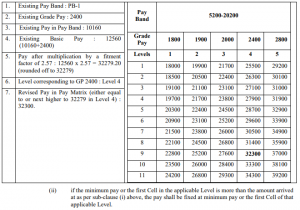
For example if your pay in Pay Band is 5200 (initial pay in pay band) and Grade Pay of 1800 then 5200+1800= 7000, now the said amount of 7000 would be multiplied to 2.57 as mentioned in the Rules. 7000 x 2.57= 17,990 so as per the rules the nearest amount the figure shall be fixed as pay level. Which in this case would be 18000/-.
The basic pay would increase as your experience at that job would increase as specified in vertical cells. For example if you continue to serve in the Basic Pay of 18000/- for 4 years then your basic pay would be 19700/- as mentioned in the table.
Dearness Allowance
However, the basic pay mentioned in the table is not the only amount of remuneration an employee receives. There are catena of benefits and further additions in the salary such as dearness allowance, HRA, TADA.
According to the Notification No. 1/1/2023-E.II(B) from the Ministry of Finance and Department of Expenditure, the Dearness Allowance payable to Central Government employees was enhanced from rate of 38% to 42% of Basic pay with effect from 1st January 2023.
Here, DA would be calculated on the basic salary. For example if your basic salary is of 18,000/- then 42% DA would be of 7,560/-
House Rent Allowance
Apart from that the HRA (House Rent Allowance) is also provided to employees according to their place of duties. Currently cities are classified into three categories as ‘X’ ‘Y’ ‘Z’ on the basis of the population.
According to the Compendium released by the Ministry of Finance and Department of Expenditure in Notification No. 2/4/2022-E.II B, the classification of cities and rates of HRA as per 7th CPC was introduced.
See the table for reference
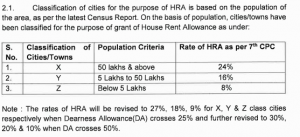
However, after enhancement of DA from 38% to 42% the HRA would be revised to 27%, 18%, and 9% respectively.
As above calculated the DA on Basic Salary, in the same manner HRA would also be calculated on the Basic Salary. Now considering that the duty of an employee’s Job is at ‘X’ category of city then HRA will be calculated at 27% of basic salary.
Here, continuing with the same example of calculation with a basic salary of 18000/-, the amount of HRA would be 4,840/-
Transport Allowance
After calculation of DA and HRA, Central government employees are also provided with Transport Allowance (TA). After the 7th CPC the revised rates of Transport Allowance were released by the Ministry of Finance and Department of Expenditure in the Notification No. 21/5/2017-EII(B) wherein, a table giving detailed rates were produced.
The same table is reproduced hereinafter.

As mentioned above in the table, all the employees are given Transport Allowance according to their pay level and place of their duties. The list of annexed cities are given in the same Notification No. 21/5/2017-EII(B).
Again, continuing with the same example of calculation with a Basic Salary of 18000/- and assuming place of duty at the city mentioned in the annexure, the rate of Transport Allowance would be 1350/-
Apart from that, DA on TA is also provided as per the ongoing rate of DA. For example, if TA is 1350/- and rate of current DA on basic Salary is 42% then 42% of TA would be added to the calculation of gross salary. Here, DA on TA would be 567/-.
Calculation of Gross Salary
After calculating all the above benefits the Gross Salary is calculated.
Here, after calculating Basic Salary+DA+HRA+TA the gross salary would be 32,317/-
However, the Gross Salary is subject to few deductions such as NPS, Professional Tax, Medical as subject to the rules and directions by the Central Government. After the deductions from the Gross Salary an employee gets the Net Salary on hand.
However, it is pertinent to note that benefits such as HRA and TA are not absolute, these allowances are only admissible if an employee is not provided with a residence by the Central Government or facility of government transport.
Conclusion
Government service is not a contract. It is a status. The employees expect fair treatment from the government. The States should play a role model for the services. The Apex Court in the case of Bhupendra Nath Hazarika and another vs. State of Assam and others (reported in 2013(2)Sec 516) has observed as follows:
“………It should always be borne in mind that legitimate aspirations of the employees are not guillotined and a situation is not created where hopes end in despair. Hope for everyone is gloriously precious and that a model employer should not convert it to be deceitful and treacherous by playing a game of chess with their seniority. A sense of calm sensibility and concerned sincerity should be reflected in every step. An atmosphere of trust has to prevail and when the employees are absolutely sure that their trust shall not be betrayed and they shall be treated with dignified fairness then only the concept of good governance can be concretized. We say no more.”
The consideration while framing Rules and Laws on payment of wages, it should be ensured that employees do not suffer economic hardship so that they can deliver and render the best possible service to the country and make the governance vibrant and effective.
Written by Husain Trivedi Advocate

IBBI’s Proposed CIRP Amendments: Strengthening Transparency and Integrity in India’s Insolvency Resolution Framework

Introduction
The Insolvency and Bankruptcy Board of India has recently invited public comments on significant amendments to the corporate insolvency resolution process (CIRP), marking another evolutionary step in India’s insolvency regime. These proposed changes, announced in August 2025, reflect the regulatory body’s commitment to refining the framework that has transformed India’s approach to corporate distress since the enactment of the Insolvency and Bankruptcy Code in 2016. The CIRP amendments 2025 focus on three critical areas: recording deliberations of the Committee of Creditors regarding resolution applicant eligibility, enhancing disclosure requirements for resolution plans, and mandating electronic platforms for invitation and submission of resolution plans. These changes emerge from a confluence of judicial pronouncements, stakeholder feedback, and practical experiences accumulated over years of implementation, and they represent a parliamentary committee recommendation following the success of similar requirements in the liquidation process.
The significance of these CIRP amendments extends beyond procedural modifications. They address fundamental concerns about transparency, accountability, and fairness that have emerged through the resolution of hundreds of corporate insolvencies since the Code’s implementation. By requiring formal documentation of Committee of Creditors’ deliberations and expanding disclosure obligations, the regulatory framework seeks to minimize litigation, prevent potential abuse, and ensure that the insolvency resolution process achieves its twin objectives of maximizing asset value while maintaining the integrity of the corporate resolution mechanism. The timing of these amendments is particularly relevant as India continues to refine its insolvency ecosystem, balancing the need for swift resolution with safeguards against misuse of the process.
Understanding the Corporate Insolvency Resolution Process Framework
The corporate insolvency resolution process operates as the cornerstone of India’s insolvency regime, established through the Insolvency and Bankruptcy Code, 2016. This time-bound process, typically limited to 330 days including judicial processes [1], provides a structured mechanism for resolving corporate distress while preserving the corporate debtor as a going concern. The process commences upon admission of an application filed by financial creditors, operational creditors, or the corporate debtor itself, triggering an automatic moratorium that protects the debtor from legal proceedings and enforcement actions during the resolution period.
Once the process begins, an interim resolution professional takes control of the corporate debtor’s management, replacing the existing board of directors. The resolution professional’s responsibilities encompass managing the debtor’s operations, preserving and protecting its assets, constituting the Committee of Creditors, and facilitating the submission and approval of resolution plans. The Committee of Creditors, comprising financial creditors with voting rights proportional to their debt, becomes the primary decision-making body during the resolution process. This committee evaluates resolution plans submitted by prospective applicants and approves a plan that offers the best prospects for maximizing asset value while satisfying creditors’ claims.
The legislative framework governing this process extends beyond the primary Code to encompass detailed regulations issued by the Insolvency and Bankruptcy Board of India. The IBBI (Insolvency Resolution Process for Corporate Persons) Regulations, 2016, supplemented by multiple amendments in subsequent years, provide operational guidelines covering every aspect of the resolution process. These regulations specify procedures for conducting the process, requirements for resolution professionals, formats for various submissions, and standards for resolution plans. The regulatory framework has evolved continuously since 2016, with the Board issuing amendments in 2025 alone that address various aspects including part-wise resolution of corporate debtors, homebuyer participation as resolution applicants, and enhanced disclosure requirements for resolution plans.
The Committee of Creditors and Decision-Making Authority
The Committee of Creditors represents one of the most distinctive features of India’s insolvency regime, concentrating decision-making authority in the hands of financial creditors who hold the largest economic stake in the corporate debtor’s revival. The composition and functioning of this committee have been subjects of extensive judicial interpretation, particularly regarding the extent of its powers and the limits on judicial interference with its commercial decisions. The Supreme Court of India, in the landmark judgment of Committee of Creditors of Essar Steel India Limited v. Satish Kumar Gupta [2], articulated the foundational principle that the Committee of Creditors possesses wide discretion in commercial matters related to the resolution process, including the evaluation and approval of resolution plans.
The Essar Steel judgment clarified that the Committee of Creditors operates with substantial autonomy in assessing resolution plans based on commercial considerations, and courts should exercise restraint in interfering with these decisions unless they violate statutory provisions or suffer from patent illegality. This judicial deference recognizes that financial creditors, having the maximum stake in the outcome, are best positioned to evaluate competing resolution proposals and determine which plan maximizes value for all stakeholders. The judgment emphasized that the Code’s architecture deliberately places commercial wisdom with financial creditors rather than operational creditors or the adjudicating authority, reflecting a policy choice to prioritize the interests of those who advanced credit to the corporate debtor.
However, the Committee’s authority, while extensive, operates within defined boundaries. The Committee cannot take decisions that violate mandatory provisions of the Code or regulations, discriminate among creditors within the same class, or approve plans that fail to meet statutory requirements. The resolution plan must satisfy multiple conditions specified in the Code, including payment of insolvency resolution process costs, provision for operational creditors, and compliance with other applicable laws. Furthermore, the Committee must ensure that resolution applicants satisfy eligibility criteria specified in the Code, particularly those outlined in Section 29A, which disqualifies certain categories of persons from submitting resolution plans.
The proposed amendments to CIRP 2025 seek to strengthen the Committee’s decision-making process by requiring formal documentation of deliberations regarding resolution applicant eligibility. This requirement addresses concerns that have emerged through practical experience, where disputes about applicant eligibility have led to protracted litigation and delayed resolution. By mandating that the Committee record its deliberations in meeting minutes, the CIRP amendments aim to create a transparent record demonstrating that the Committee properly considered each applicant’s eligibility before approving their resolution plan. This documentation requirement serves multiple purposes: it encourages thorough discussion of eligibility issues, provides a basis for reviewing the Committee’s decision if challenged, and demonstrates compliance with statutory requirements regarding applicant eligibility.
Section 29A: Eligibility Criteria for Resolution Applicants
Section 29A of the Insolvency and Bankruptcy Code establishes comprehensive disqualifications that prevent certain categories of persons from submitting resolution plans, representing one of the Code’s most critical safeguards against misuse of the insolvency process. Introduced through the Insolvency and Bankruptcy Code (Amendment) Act, 2018, this provision emerged in response to concerns that the original framework allowed promoters and related parties who contributed to the corporate debtor’s distress to regain control through the resolution process. The section’s disqualifications extend to various categories including undischarged insolvents, wilful defaulters, persons with non-performing accounts, persons convicted of specified offenses, persons prohibited from trading in securities, and persons disqualified from acting as directors.
The scope of Section 29A extends beyond the resolution applicant to encompass persons acting jointly or in concert with the applicant, preventing circumvention through related party structures. The provision disqualifies not only individuals falling within specified categories but also entities where such individuals hold significant ownership or control. For instance, if a person is a wilful defaulter, not only is that person disqualified, but any entity where that person holds beneficial interest exceeding specified thresholds also becomes ineligible to submit resolution plans. This comprehensive approach prevents sophisticated structures designed to bypass eligibility requirements while nominally complying with the provision’s letter.
The interpretation and application of Section 29A have generated substantial jurisprudence, with courts addressing questions about the provision’s scope, timing of eligibility determination, and relationship with other Code provisions. The provision’s language requires resolution applicants to submit affidavits confirming their eligibility under Section 29A along with their resolution plans, as specified in Section 30(2) of the Code. This requirement places an initial burden on resolution applicants to conduct due diligence regarding their eligibility and certify compliance with all disqualification criteria. However, the Committee of Creditors retains responsibility for independently verifying applicant eligibility before approving any resolution plan, as approval of a plan submitted by an ineligible person would violate mandatory statutory provisions and render the approval void.
The IBBI proposed CIRP amendments recognize that despite existing requirements for eligibility affidavits, disputes regarding applicant eligibility continue to arise, often leading to litigation that delays or derails resolution processes. The current framework lacks specific provisions requiring the Committee of Creditors to formally document its consideration of eligibility issues, creating situations where committees approve plans without thoroughly examining applicant eligibility or maintaining clear records of their deliberations on these matters. This gap has resulted in cases where approved resolution plans were subsequently challenged based on applicant ineligibility, leading courts to remit matters back to the Committee for reconsideration or, in some instances, to reject approved plans altogether.
To address these concerns, the proposed amendments to CIRP introduce requirements for enhanced disclosure by resolution applicants, specifically mandating submission of statements regarding beneficial ownership and affidavits confirming eligibility. The beneficial ownership statement must identify all natural persons who ultimately own or control the prospective resolution applicant, including details of the shareholding structure and jurisdiction of each entity in the ownership chain. This requirement aims to prevent situations where ineligible persons hide behind complex corporate structures to circumvent Section 29A disqualifications. By requiring full transparency regarding beneficial ownership, the amendments enable the Committee of Creditors to conduct thorough due diligence and identify potential eligibility issues before approving resolution plans.
Judicial Pronouncements Shaping CIRP Practice
The evolution of India’s insolvency framework has been substantially influenced by judicial interpretations that have clarified ambiguities, resolved conflicts, and established principles governing various aspects of the resolution process. The Supreme Court’s role has been particularly significant, with landmark judgments addressing fundamental questions about the Code’s architecture, the Committee of Creditors’ powers, eligibility of resolution applicants, and the scope of judicial review over commercial decisions made during the resolution process.
Beyond the Essar Steel judgment, which established the Committee of Creditors’ primacy in commercial decision-making, courts have addressed numerous other critical issues. In Swiss Ribbons Pvt. Ltd. v. Union of India [3], the Supreme Court upheld the constitutional validity of various Code provisions, including Section 29A’s disqualifications, rejecting challenges that these provisions violated constitutional rights or operated retrospectively. The judgment emphasized that Section 29A serves a legitimate purpose of preventing persons responsible for or connected with corporate debtor’s default from regaining control through the resolution process, and that the provision’s disqualifications represent reasonable restrictions necessary to achieve the Code’s objectives.
Courts have also addressed procedural aspects of the resolution process, including timelines, withdrawal of applications, and the relationship between settlement negotiations and insolvency proceedings. Recent Supreme Court pronouncements have clarified that applications for withdrawal under Section 12A of the Code can be filed even before constitution of the Committee of Creditors, provided settlements satisfy statutory requirements and receive necessary approvals [4]. These judgments reflect judicial recognition that while the Code establishes a time-bound process, flexibility remains necessary to accommodate genuine settlements that serve creditors’ interests better than continued insolvency proceedings.
The jurisprudence surrounding Section 29A has been particularly rich, with courts examining various disqualification criteria and their application to different factual scenarios. Courts have held that Section 29A disqualifications must be determined as of the date of resolution plan submission, and that subsequent events removing disqualifications do not render previously ineligible persons eligible. Similarly, courts have addressed questions about whether guarantors of corporate debtors’ debts are disqualified under Section 29A(h), which bars persons whose account has been classified as non-performing asset, concluding that guarantors generally fall within this disqualification when their accounts are classified as non-performing.
Judicial pronouncements have also emphasized the importance of maintaining process integrity and preventing abuse of the insolvency framework. Courts have intervened to prevent fraudulent conduct, unauthorized asset disposals, and violations of moratorium provisions, demonstrating that while the Committee of Creditors enjoys wide discretion in commercial matters, this discretion does not extend to tolerating illegal conduct or approving plans that violate mandatory statutory provisions. These judgments have shaped the practical implementation of the resolution process, establishing guardrails that balance efficiency with procedural fairness and legal compliance.
The proposed CIRP amendments draw extensively from lessons learned through judicial proceedings, incorporating requirements designed to address issues that have generated litigation and created uncertainty. The requirement to record Committee deliberations on eligibility reflects judicial emphasis on transparent decision-making and proper consideration of statutory requirements. Similarly, enhanced disclosure requirements for resolution applicants respond to judicial observations about the need for complete information regarding applicant structures and beneficial ownership to enable proper evaluation of Section 29A compliance.
Recording Committee Deliberations: Transparency and Accountability
The requirement to record Committee of Creditors’ deliberations regarding resolution applicant eligibility represents perhaps the most significant procedural innovation in the proposed CIRP amendments. Currently, the IBBI regulations require the resolution professional to prepare minutes of Committee meetings, documenting decisions taken and voting patterns. However, these regulations do not specifically mandate detailed recording of discussions, arguments, evidence considered, or reasoning underlying decisions regarding resolution applicant eligibility. The proposed amendments to CIRP seek to address this gap by requiring that the Committee’s deliberations on eligibility be formally documented in meeting minutes, creating a comprehensive record of how the Committee assessed compliance with Section 29A disqualifications.
This documentation requirement serves multiple interrelated purposes that strengthen the resolution process’s integrity and efficiency. First, it encourages thorough and rigorous consideration of eligibility issues by making the Committee’s analysis transparent and subject to review. When Committee members know their deliberations will be recorded and potentially scrutinized, they are more likely to carefully examine eligibility questions, seek necessary clarifications from resolution applicants, and ensure that decisions rest on proper evaluation of all relevant factors. This discipline in deliberation reduces the risk of cursory or superficial examination of eligibility issues that might lead to approval of plans submitted by ineligible persons.
Second, formal recording of deliberations creates evidentiary basis for defending Committee decisions if subsequently challenged. When resolution plans are approved, dissatisfied stakeholders sometimes file appeals challenging the plan’s validity, often raising questions about resolution applicant eligibility. In such proceedings, having detailed minutes documenting the Committee’s consideration of eligibility issues provides crucial evidence demonstrating that the Committee properly discharged its statutory responsibilities. Courts reviewing challenged decisions can examine the recorded deliberations to determine whether the Committee reasonably concluded that the resolution applicant satisfied Section 29A requirements, or whether the decision suffered from non-application of mind or failure to consider relevant factors.
Third, documentation requirements promote consistency and procedural fairness by ensuring that all resolution applicants receive equal consideration regarding eligibility issues. When the Committee must record its deliberations for each applicant, it becomes more difficult to apply different standards to different applicants or to dismiss eligibility concerns for favored applicants while rigorously examining others. The requirement to document deliberations thus serves as a procedural safeguard ensuring that eligibility determinations rest on objective assessment of statutory criteria rather than subjective preferences or improper considerations.
The practical implementation of this requirement will necessitate changes in how Committees conduct meetings and resolution professionals prepare minutes. Rather than simply recording votes and decisions, meeting minutes must now capture substantive discussions about eligibility issues, including concerns raised by Committee members, information provided by resolution applicants, expert opinions or legal advice considered, and the reasoning underlying the Committee’s ultimate conclusion regarding each applicant’s eligibility. Resolution professionals will need to ensure that adequate time is allocated in Committee meetings for thorough discussion of eligibility issues, and that minutes accurately reflect these deliberations while maintaining appropriate confidentiality regarding sensitive commercial information.
The documentation requirement also has implications for resolution applicants, who must anticipate that eligibility issues will receive careful scrutiny and be prepared to provide comprehensive information supporting their compliance with Section 29A requirements. Applicants may need to provide detailed submissions addressing each disqualification criterion, demonstrating through documentary evidence that neither they nor persons acting jointly or in concert fall within any disqualified category. This increased emphasis on eligibility verification may lengthen the evaluation process but should ultimately reduce post-approval challenges and enhance confidence in the integrity of approved resolution plans.
Enhanced Disclosure Requirements and Beneficial Ownership
The proposed amendments to CIRP introduce requirements for resolution applicants to file statements of beneficial ownership along with their resolution plans, addressing concerns about transparency regarding applicant structures and ultimate ownership. The concept of beneficial ownership has gained increasing prominence in corporate governance and regulatory frameworks worldwide, recognizing that legal ownership structures often obscure the natural persons who ultimately control or benefit from corporate entities. In the insolvency context, understanding beneficial ownership becomes critical for assessing Section 29A eligibility, as disqualifications extend to persons acting jointly or in concert with resolution applicants and entities where disqualified persons hold significant beneficial interest.
The beneficial ownership disclosure requirement mandates that resolution applicants provide information identifying all natural persons who ultimately own or control the applicant entity. This includes details of the complete shareholding structure, identifying each layer of ownership from the applicant entity through intermediate holding companies to ultimate individual shareholders. For each entity in the ownership chain, applicants must disclose the jurisdiction of incorporation, shareholding percentages, and any special rights or control mechanisms that affect actual control despite nominal shareholding. This comprehensive disclosure enables the Committee of Creditors to trace ownership through multiple layers and identify whether any disqualified persons hold beneficial interest in the resolution applicant.
The requirement responds to practical challenges that have emerged where resolution applicants have been structured to conceal the involvement of persons potentially disqualified under Section 29A. Complex corporate structures involving multiple jurisdictions, nominee arrangements, trust structures, and special purpose vehicles can obscure beneficial ownership, making it difficult for Committees to verify eligibility based solely on information provided in standard resolution plan formats. By mandating explicit beneficial ownership disclosure, the amendments shift responsibility to resolution applicants to transparently reveal their ownership structures, facilitating proper due diligence by the Committee.
The beneficial ownership statement must identify specific natural persons who qualify as beneficial owners under applicable definitions, which typically include persons holding significant ownership interest or exercising significant control over the entity. Significant ownership interest is generally defined as holding specified percentages of shares or voting rights, while significant control encompasses ability to appoint majority of directors, control management decisions, or exercise influence through agreements or arrangements. Resolution applicants must identify all individuals meeting these criteria at each level of their corporate structure, ensuring that the Committee can assess whether any such individuals fall within Section 29A disqualifications.
In addition to beneficial ownership statements, the amendments require resolution applicants to file affidavits confirming their eligibility under Section 29A. While Section 30(2) of the Code already requires such affidavits, the proposed CIRP amendments appear to strengthen this requirement, possibly by mandating more detailed affidavits addressing each disqualification criterion specifically. The affidavit serves as a formal certification by the resolution applicant that neither the applicant nor any person acting jointly or in concert falls within any disqualified category, and that all information provided regarding ownership, control, and related party relationships is accurate and complete.
These disclosure requirements create legal consequences for resolution applicants who provide false or misleading information. Submission of false affidavits can expose applicants to criminal liability for perjury, while material misrepresentation regarding beneficial ownership or eligibility can form grounds for rejecting resolution plans or canceling approved plans. The enhanced disclosure framework thus creates strong incentives for resolution applicants to conduct thorough internal due diligence regarding their eligibility and to provide complete and accurate information to the Committee. This shift toward greater applicant responsibility for eligibility verification should reduce situations where ineligible persons submit plans based on incomplete or misleading disclosures.
Electronic Platforms and Process Digitization
The proposed CIRP amendments include provisions requiring invitation and submission of resolution plans through electronic platforms, representing a significant step toward digitization of the insolvency resolution process. This requirement follows successful implementation of similar systems in the liquidation process, where electronic platforms have improved transparency, reduced processing time, and created comprehensive digital records of proceedings. The extension of electronic platforms to the resolution plan submission stage reflects broader governmental initiatives toward digital governance and paperless processes across regulatory domains.
Electronic platforms for resolution plan submission offer multiple advantages over traditional paper-based processes. They enable standardized data collection, ensuring that all resolution applicants provide information in consistent formats that facilitate comparison and analysis. Digital submission eliminates logistical challenges associated with physical document handling, particularly when multiple applicants submit lengthy plans with numerous annexures and supporting documents. Electronic platforms also create audit trails documenting when plans were submitted, what modifications were made, and how different versions compare, enhancing transparency and accountability throughout the evaluation process.
The requirement for electronic submission through designated platforms will necessitate development of appropriate technological infrastructure by the Insolvency and Bankruptcy Board of India. The Board will need to establish secure platforms capable of handling large document volumes, maintaining confidentiality of sensitive commercial information, providing appropriate access controls for resolution professionals and Committee members, and generating reports and analytics to support decision-making. The platform should accommodate various document formats, allow for secure communication between resolution applicants and resolution professionals, and maintain comprehensive records meeting evidentiary standards for potential litigation.
For resolution professionals and Committees of Creditors, electronic platforms promise to streamline the plan evaluation process significantly. Rather than reviewing paper documents spread across multiple volumes, Committee members can access digital plans through user-friendly interfaces that allow searching, comparison across different plans, and tracking of revisions. Electronic platforms can incorporate analytical tools that automatically extract key financial parameters, compare payment terms, and flag potential issues requiring closer examination. These capabilities should enable more efficient and thorough evaluation of resolution plans, particularly in cases involving multiple competing proposals.
Resolution applicants will need to adapt their plan preparation processes to accommodate electronic submission requirements. This includes preparing documents in specified electronic formats, organizing information according to platform requirements, and potentially using digital signatures or other authentication mechanisms to verify submitted materials. While electronic submission may initially present learning curves for some applicants, the standardization and efficiency gains should ultimately simplify the submission process compared to preparing multiple physical copies of voluminous plan documents.
The electronic platform requirement also facilitates compliance monitoring and regulatory oversight by the Insolvency and Bankruptcy Board of India. The Board can access standardized data from all corporate insolvency resolution processes, enabling analysis of trends, identification of systemic issues, and evidence-based policymaking. Electronic records allow the Board to monitor compliance with timelines, track outcomes across different categories of corporate debtors, and evaluate the effectiveness of regulatory requirements. This data-driven approach to regulation should support continuous refinement of the insolvency framework based on empirical evidence rather than anecdotal observations.
Implications for Stakeholders and Future Outlook
The IBBI’s Proposed CIRP Amendments carry significant implications for all participants in the corporate insolvency resolution process (CIRP), requiring adjustments to established practices and creating new compliance obligations. For resolution professionals, the amendments expand responsibilities regarding documentation, verification, and platform management. Resolution professionals must ensure that Committee meetings allocate sufficient time for thorough discussion of eligibility issues and that minutes accurately capture these deliberations while maintaining appropriate confidentiality. They must also manage the electronic platform for plan submission, verify that applicants have provided required beneficial ownership statements and affidavits, and facilitate Committee access to all submitted materials.
Financial creditors serving on Committees of Creditors will face expectations for more active engagement with eligibility issues. Rather than deferring to resolution professional recommendations or accepting applicant representations at face value, Committee members should conduct their own due diligence regarding eligibility, raise questions about concerning aspects of applicant structures or histories, and ensure that deliberations adequately address all relevant factors. The requirement to record deliberations creates accountability for Committee members’ contributions to eligibility discussions, potentially increasing their diligence in reviewing applicant credentials.
Resolution applicants confront heightened disclosure obligations and increased scrutiny of their eligibility credentials. Preparing beneficial ownership statements and detailed eligibility affidavits will require substantial effort, particularly for applicants with complex corporate structures spanning multiple jurisdictions. Applicants must conduct thorough internal due diligence to identify all persons who might be considered to be acting jointly or in concert and to verify that none of these persons falls within Section 29A disqualifications. The enhanced transparency requirements may deter some potential applicants whose eligibility status is uncertain or whose ownership structures would raise concerns if fully disclosed.
For the broader insolvency ecosystem, these amendments signal continued evolution toward greater transparency, formalization, and digital integration. The amendments reflect lessons learned from several years of implementation experience, incorporating practical solutions to recurring problems. They demonstrate the Insolvency and Bankruptcy Board of India’s commitment to evidence-based regulation that responds to stakeholder feedback and judicial pronouncements while advancing the Code’s fundamental objectives of maximizing value and preserving viable businesses.
Looking forward, successful implementation of these amendments will depend on several factors. The Board must develop robust electronic platforms that function reliably under high transaction volumes while maintaining security and confidentiality. Resolution professionals require training on new documentation requirements and platform operation. Committee members need guidance on conducting and recording eligibility deliberations. Resolution applicants should receive clear instructions regarding beneficial ownership disclosure requirements and affidavit contents. Stakeholder education and capacity building will be essential to ensure smooth transition to the amended framework.
The CIRP amendments also open possibilities for further evolution of India’s insolvency regime. Experience with electronic platforms in plan submission may inform broader digitization of insolvency processes, including claims verification, asset valuation, and distribution calculations. Enhanced beneficial ownership disclosure requirements established in the insolvency context might influence beneficial ownership reporting in other regulatory domains. Documentation of Committee deliberations could extend to other aspects of decision-making beyond eligibility determination, creating comprehensive records supporting all key decisions during the resolution process.
Conclusion
The proposed amendments to the corporate insolvency resolution (CIRP) process regulations represent thoughtful refinements addressing practical challenges identified through implementation experience. By requiring documentation of Committee deliberations on resolution applicant eligibility, mandating enhanced disclosure of beneficial ownership, and establishing electronic platforms for plan submission, the CIRP amendments strengthen transparency, reduce litigation risk, and modernize process infrastructure. These changes align with broader global trends toward greater transparency in insolvency proceedings and beneficial ownership reporting while respecting the distinctive architecture of India’s insolvency framework.
The CIRP amendments reflect careful balancing of competing considerations. They impose additional procedural requirements that may extend resolution timelines and increase compliance burdens, but these costs appear justified by benefits of reduced litigation, enhanced confidence in approved plans, and improved decision-making quality. The amendments preserve the Committee of Creditors’ primacy in commercial decision-making while creating accountability mechanisms ensuring that this discretion is exercised responsibly and transparently. They leverage technology to improve process efficiency without sacrificing the flexibility necessary to accommodate diverse circumstances across different corporate insolvencies.
As these CIRP amendments move from proposal to implementation, their success will ultimately be measured by whether they achieve intended objectives without creating unintended obstacles. Stakeholder comments during the public consultation period will provide valuable input for refining proposed provisions before finalization. The insolvency ecosystem’s response—how effectively participants adapt practices to comply with new requirements—will determine whether the amendments deliver promised improvements. With appropriate implementation support and continued monitoring of outcomes, these amendments should advance India’s insolvency framework toward greater maturity, transparency, and effectiveness in achieving the twin goals of maximizing value and preserving viable businesses facing financial distress.
References
[1] Supreme Court of India. (2025). Committee of Creditors of Essar vs. Satish. 2025 INSC 124.
[2] Supreme Court of India. (2019). Committee of Creditors of Essar Steel India Limited v. Satish Kumar Gupta & Ors. Civil Appeal No. 8766-67 of 2018. Available at: https://ibclaw.in/summary-of-landmark-judgment-of-supreme-court-in-committee-of-creditors-of-essar-steel-india-limited-vs-satish-kumar-gupta-ors-under-ibc/
[3] Supreme Court of India. (2019). Swiss Ribbons Pvt. Ltd. v. Union of India. Civil Appeal No. 99 of 2018.
[4] Supreme Court of India. (2023). Withdrawal applications under Section 12A IBC. Available at: https://www.livelaw.in/top-stories/ibc-application-under-section-12a-for-withdrawal-of-cirp-is-maintainable-prior-to-constitution-of-coc-supreme-court-225026
[5] Insolvency and Bankruptcy Board of India. (2016). IBBI (Insolvency Resolution Process for Corporate Persons) Regulations, 2016. Available at: https://ibbi.gov.in
[6] Government of India. (2016). The Insolvency and Bankruptcy Code, 2016 (Act No. 31 of 2016). Available at: https://www.indiacode.nic.in/bitstream/123456789/15479/1/the_insolvency_and_bankruptcy_code,_2016.pdf
[7] Insolvency and Bankruptcy Board of India. (2025). IBBI (Insolvency Resolution Process for Corporate Persons) (Fifth Amendment) Regulations, 2025. Available at: https://indiacorplaw.in/2025/07/24/amendments-to-the-ibbi-regulations-on-corporate-insolvency-the-future-of-transparency/
[8] IBC Laws. (2024). Section 29A of IBC – Persons not eligible to be resolution applicant. Available at: https://ibclaw.in/section-29a-persons-not-eligible-to-be-resolution-applicant/
[9] ELP Law. (2024). Recent landmark judgments of the Supreme Court under IBC. Available at: https://elplaw.in/leadership/recent-landmark-judgments-of-the-supreme-court-under-ibc/

India-EAEU Free Trade Agreement: A Comprehensive Analysis of Legal Framework and Economic Implications

Introduction
The signing of the Terms of Reference between India and the Eurasian Economic Union in September 2025 represents a watershed moment in India’s trade diplomacy. India-EAEU agreement to commence negotiations for a free trade agreement marks India’s strategic pivot towards diversifying its trade partnerships beyond traditional Western markets. The Eurasian Economic Union, comprising Armenia, Belarus, Kazakhstan, the Kyrgyz Republic, and the Russian Federation, presents a combined market with a GDP of USD 6.5 trillion and offers Indian exporters unprecedented access to a largely untapped regional bloc.[1]
The ceremonial signing took place in Moscow, where Ajay Bhadoo, Additional Secretary of India’s Department of Commerce, and Mikhail Cherekaev, Deputy Director of the Trade Policy Department at the Eurasian Economic Commission, formalized the procedural framework that will govern the negotiation process. This development comes at a time when bilateral trade between India and the EAEU reached USD 69 billion in 2024, reflecting a seven percent increase from the previous year.[2] The momentum behind this initiative underscores both parties’ commitment to establishing a robust institutional mechanism for long-term economic cooperation.
Understanding Free Trade Agreements in India’s Trade Architecture
Free trade agreements have become instrumental tools in India’s economic strategy to integrate with the global economy while protecting domestic interests. The fundamental distinction between various types of trade agreements helps contextualize the significance of the India-EAEU negotiations. A Free Trade Agreement eliminates tariffs on items covering substantial bilateral trade between partner countries, while each nation maintains its individual tariff structure for non-members. This differs from Preferential Trade Agreements, which provide preferential access by reducing tariffs on select products, and Comprehensive Economic Cooperation Agreements or Comprehensive Economic Partnership Agreements, which encompass goods, services, investment, and trade facilitation measures.[3]
India’s approach to free trade agreements has evolved significantly over the past three decades. The country has moved from protective trade policies to a more liberalized regime that seeks to balance domestic industry protection with the benefits of global integration. The legal architecture supporting this transformation provides the foundation for negotiating and implementing international trade agreements like the proposed India-EAEU FTA.
Legal Framework Governing Trade Agreements in India
The Foreign Trade (Development and Regulation) Act, 1992
The cornerstone of India’s trade regulation framework is the Foreign Trade (Development and Regulation) Act, 1992, which came into force on August 7, 1992. This legislation replaced the outdated Imports and Exports (Control) Act, 1947, reflecting India’s transition toward economic liberalization. The Act establishes the legal basis for the development and regulation of foreign trade by facilitating imports into India and augmenting exports from the country.[4]
The Act empowers the Central Government to formulate and announce the Foreign Trade Policy, which is typically released every five years and contains provisions for promoting exports, regulating imports, and implementing trade agreements. Under Section 5 of the Act, the Central Government is authorized to make provisions for facilitating and regulating foreign trade through various measures including the prohibition or restriction of imports or exports, quality control and inspection requirements, and the registration of exporters and importers.
The procedural aspects of trade agreement negotiations fall within the purview of this Act, as it provides the Director General of Foreign Trade with powers to issue licenses, permissions, and other authorizations necessary for implementing trade facilitation measures. The Act’s flexibility allows the government to incorporate obligations arising from international trade agreements into domestic trade policy without requiring separate legislative approval for each agreement.
Constitutional Framework and Treaty-Making Powers
India’s Constitution does not explicitly delineate the treaty-making process, but Article 73 vests executive power in the Union Government to conduct international relations and enter into treaties. The legislative competence to implement international agreements derives from Entry 14 of List I (Union List) of the Seventh Schedule, which grants Parliament exclusive authority over matters relating to “entering into treaties and agreements with foreign countries and implementing of treaties, agreements and conventions with foreign countries.”
This constitutional architecture means that while the executive branch possesses the power to negotiate and sign international trade agreements, the implementation of such agreements often requires parliamentary approval, particularly when the agreement necessitates changes to existing domestic legislation. However, for trade agreements that fall within the ambit of executive action and do not contradict existing laws, the government can proceed with implementation through executive orders and policy notifications.
Customs Act, 1962 and Tariff Regulations
The Customs Act, 1962, works in conjunction with the Foreign Trade (Development and Regulation) Act to operationalize trade agreements. Section 25 of the Customs Act empowers the Central Government to grant exemptions from customs duties through notifications, which becomes the mechanism for implementing tariff concessions agreed upon in free trade agreements. The Customs Tariff Act, 1975, provides the framework for imposing duties on imports and exports and allows for preferential tariff treatment under trade agreements.[5]
When India enters into a free trade agreement, the tariff concessions are typically implemented through notifications under Section 25 of the Customs Act. These notifications specify the rules of origin, which determine whether imported goods qualify for preferential treatment under the agreement. The rules of origin are crucial in preventing trade deflection, where goods from non-member countries might be routed through member countries to benefit from reduced tariffs.
The Eurasian Economic Union: Structure and Significance
The Eurasian Economic Union represents a unique regional integration project that emerged from the post-Soviet space. Established through the Treaty on the Eurasian Economic Union signed on May 29, 2014, the EAEU came into force on January 1, 2015. The union’s foundational treaty created a single market among its member states, characterized by the free movement of goods, services, capital, and labor. The EAEU’s institutional framework includes the Supreme Eurasian Economic Council, the Eurasian Economic Commission, and the Court of the Eurasian Economic Union.
For India, engaging with the EAEU offers several strategic advantages beyond immediate trade benefits. The geographical expanse of the EAEU provides India with land-based connectivity to European markets through the International North-South Transport Corridor, potentially reducing logistics costs and transit times. Additionally, the EAEU’s close relationship with China through parallel Belt and Road initiatives means that India’s engagement can serve broader geopolitical objectives of maintaining balanced relationships in the Eurasian space.
The combined GDP of USD 6.5 trillion and a population exceeding 180 million people make the EAEU an attractive market for Indian goods and services. Russia, as the largest economy within the union, accounts for approximately 85 percent of the EAEU’s GDP, making bilateral India-Russia trade a significant component of overall India-EAEU economic relations. The existing bilateral trade of USD 69 billion in 2024 provides a substantial foundation upon which a free trade agreement can build momentum.[2]
Terms of Reference: Establishing the Negotiating Framework
The Terms of Reference signed in September 2025 establish both the procedural and organizational basis for conducting negotiations between India and the EAEU. This document outlines the scope of negotiations, the structure of negotiating groups, timelines for negotiation rounds, and the decision-making processes that will govern the talks. While the specific contents of the Terms of Reference have not been publicly disclosed in their entirety, standard practice suggests that such documents include provisions for dispute resolution mechanisms during negotiations, confidentiality clauses, and the framework for technical consultations on specific sectors.
Following the signing ceremony, Ajay Bhadoo engaged in discussions with Andrei Slepnev, the Minister in charge of trade at the Eurasian Economic Commission, along with heads of various negotiation groups. These consultations focused on reviewing the implementation roadmap and identifying the next steps required to launch formal negotiations. The establishment of sector-specific negotiating groups suggests that the agreement will follow a modular approach, addressing different aspects of trade relations through specialized working groups that can progress simultaneously.
The involvement of multiple negotiating groups indicates the agreement’s intended scope will extend beyond simple tariff reductions. Modern free trade agreements typically encompass provisions related to services trade, investment protection, intellectual property rights, government procurement, competition policy, and regulatory cooperation. The complexity of these negotiations requires specialized expertise across various domains, justifying the creation of dedicated working groups for each major area.
Sectoral Implications and Market Access Opportunities
Pharmaceuticals and Healthcare Products
India’s pharmaceutical industry stands to gain substantially from enhanced market access to EAEU countries. Indian generic drug manufacturers have already established a presence in several EAEU markets, particularly Russia and Kazakhstan. A free trade agreement could reduce tariff barriers on pharmaceutical products while potentially addressing non-tariff barriers related to registration procedures, clinical trial requirements, and intellectual property protections that currently impede smoother market access.
The EAEU’s pharmaceutical market represents significant potential for Indian exporters, given the region’s healthcare needs and India’s capabilities as a leading producer of affordable generic medications. However, regulatory harmonization will be crucial to fully realize this potential. The negotiating process will need to address sanitary and phytosanitary measures, good manufacturing practices recognition, and the mutual acceptance of pharmaceutical standards to facilitate trade while ensuring patient safety.
Agricultural Products and Food Processing
Agriculture represents a sensitive sector in free trade negotiations, both for India and EAEU member states. India’s agricultural exports, including rice, tea, coffee, spices, and processed foods, could find expanded markets within the EAEU if tariff and non-tariff barriers are appropriately addressed. Conversely, India will need to carefully consider the impact of agricultural imports from EAEU countries on domestic farmers, particularly in sectors where domestic production requires continued protection for food security and livelihood preservation.
The negotiation of rules of origin for agricultural products will be particularly important to prevent circumvention and ensure that the benefits of the agreement accrue to producers in the participating countries. Additionally, addressing sanitary and phytosanitary measures through mutual recognition agreements or harmonization of standards can significantly reduce trade friction in agricultural products.
Information Technology and Services
India’s information technology and IT-enabled services sector represents one of the country’s strongest export capabilities. The EAEU market offers opportunities for Indian IT companies to expand their presence through enhanced services trade provisions in the FTA. Negotiations will likely address market access for services, movement of natural persons for service delivery, recognition of professional qualifications, and data localization requirements that affect IT service providers.
The services component of the free trade agreement could follow the General Agreement on Trade in Services framework, which allows countries to make specific commitments regarding market access and national treatment across different service sectors and modes of supply. For India, securing commitments on Mode 4 (movement of natural persons) will be particularly important given the industry’s reliance on the ability to send professionals to client locations for project delivery.
Textiles and Apparel
India’s textile and apparel industry, one of the largest employers in the manufacturing sector, views the EAEU as a potential growth market. The elimination of tariff barriers on textile products could enhance the competitiveness of Indian textiles in EAEU markets. However, the sector faces challenges related to meeting specific technical standards and regulations that vary across EAEU member states.
Negotiations on textiles will need to address rules of origin that account for the global nature of textile supply chains while ensuring sufficient local content to justify preferential treatment. The agreement might also include provisions for technical cooperation to help Indian exporters meet EAEU technical requirements and facilitate certification processes.
Micro, Small and Medium Enterprises: Expanding Commercial Opportunities
The Terms of Reference specifically acknowledge the anticipated benefits for micro, small and medium enterprises, recognizing that MSMEs form the backbone of India’s export sector and require special attention in trade agreements. MSMEs often face disproportionate challenges in accessing foreign markets due to limited resources for understanding foreign regulations, establishing distribution networks, and meeting compliance requirements.
The free trade agreement can address MSME concerns through several mechanisms. First, simplified rules of origin procedures can reduce the documentary burden on small exporters. Second, provisions for mutual recognition of conformity assessment can eliminate duplicate testing and certification requirements. Third, enhanced transparency in regulations and trade procedures helps MSMEs navigate foreign markets more effectively. Fourth, the establishment of trade facilitation mechanisms, including help desks and information portals, can provide targeted support to small businesses seeking to export.
The negotiation process should consider incorporating a dedicated chapter on MSME cooperation, as seen in recent Indian trade agreements. Such chapters typically include provisions for enhancing MSME participation in global value chains, facilitating access to trade finance, promoting digital trade platforms that benefit small businesses, and encouraging cooperation between MSME support institutions in partner countries.
Trade Facilitation and Customs Cooperation
Modern free trade agreements extend beyond tariff reductions to address trade facilitation measures that reduce the time and cost of moving goods across borders. The India-EAEU Free Trade Agreement negotiations will likely incorporate provisions aligned with the World Trade Organization’s Trade Facilitation Agreement, which India ratified in 2016. These provisions could include commitments on transparency and predictability in customs procedures, simplification of import and export documentation, implementation of risk management systems, and establishment of authorized economic operator programs.
Customs cooperation provisions can enhance the effective implementation of the agreement by addressing issues such as verification of rules of origin, exchange of customs data, mutual administrative assistance in preventing customs fraud, and harmonization of customs valuation methodologies. The development of electronic systems for submitting and processing trade documents can significantly reduce clearance times and facilitate commerce, particularly for time-sensitive products.
Investment Protection and Promotion
While the primary focus of free trade agreements is on trade in goods and services, investment provisions have become increasingly common in modern trade agreements. India and the EAEU both seek to attract foreign investment for economic development, making investment protection and promotion a natural component of their negotiations. The agreement could include provisions on investment liberalization, national treatment for established investments, fair and equitable treatment standards, and investor-state dispute settlement mechanisms.
India’s approach to investment protection has evolved following its experience with bilateral investment treaties that led to numerous arbitration cases. The Model Indian Bilateral Investment Treaty, finalized in 2016, reflects this evolution by incorporating safeguards such as narrower definitions of investment, exhaustion of local remedies before international arbitration, and carve-outs for sensitive sectors. The EAEU negotiations will likely reflect this more cautious approach while still providing sufficient protection to encourage investment flows.
Regulatory Cooperation and Standards Harmonization
Technical barriers to trade often pose greater obstacles than tariffs in contemporary international commerce. Differences in product standards, testing requirements, certification procedures, and labeling regulations can effectively prevent market access even when tariff barriers are eliminated. The India-EAEU FTA negotiations must address these technical barriers through provisions on regulatory cooperation and standards harmonization.
The agreement might establish mechanisms for mutual recognition of conformity assessment, whereby products tested and certified in one country are accepted in partner countries without additional testing. This reduces costs and delays for exporters while maintaining appropriate standards for consumer protection and safety. Additionally, regulatory cooperation chapters can promote alignment of standards with international norms, enhance transparency in standard-setting processes, and provide for dialogue between regulatory authorities.
Intellectual Property Rights Considerations
Intellectual property protection represents a sensitive area in trade negotiations, balancing innovation incentives with access to knowledge and technology. India has consistently advocated for a balanced approach to intellectual property rights that promotes innovation while ensuring access to essential goods like medicines. The EAEU countries have varying levels of intellectual property protection, and the negotiations will need to find common ground that satisfies both parties’ interests.
The intellectual property chapter of the agreement might address patents, trademarks, copyrights, geographical indications, and protection of traditional knowledge. Given India’s pharmaceutical industry interests, provisions related to patent linkages, data exclusivity, and compulsory licensing will require careful negotiation to preserve India’s ability to produce generic medicines while respecting the EAEU’s intellectual property framework.
Competition Policy and State-Owned Enterprises
Competition policy provisions in free trade agreements aim to ensure that the benefits of trade liberalization are not undermined by anticompetitive practices. As both India and EAEU countries have significant state-owned enterprise sectors, the agreement will need to address the competitive neutrality of state-owned entities and prevent anticompetitive conduct that could distort trade.
India’s Competition Act, 2002, provides the domestic legal framework for addressing anticompetitive practices, including cartels, abuse of dominant position, and anticompetitive mergers. The FTA negotiations might include provisions for cooperation between competition authorities, exchange of information on competition matters, and commitments to apply competition laws in a non-discriminatory manner. However, both parties will likely seek carve-outs for strategic sectors where state involvement is considered necessary for national security or economic development.
Dispute Resolution Mechanisms
Effective dispute resolution mechanisms are essential for ensuring that parties comply with their obligations under the agreement and for providing predictability to exporters and investors. The India-EAEU Free Trade Agreement will likely establish a multi-tiered dispute resolution system, beginning with consultations between the parties, potentially followed by mediation or good offices, and ultimately providing for arbitration through an ad hoc panel or standing tribunal.
The design of dispute resolution mechanisms requires balancing effectiveness with sovereignty concerns. India has traditionally preferred diplomatic approaches to trade disputes and has been cautious about binding arbitration mechanisms that significantly constrain policy flexibility. The negotiations will need to find an appropriate balance that provides sufficient enforcement while allowing parties reasonable flexibility to respond to legitimate public policy concerns.
Environmental and Labor Standards
Contemporary trade agreements increasingly incorporate provisions related to environmental protection and labor standards, reflecting growing recognition that trade liberalization should not come at the expense of environmental sustainability or workers’ rights. The India-EAEU negotiations might include chapters addressing environmental cooperation, sustainable development, and labor rights, though the specific commitments will depend on the negotiating priorities of both parties.
India has traditionally viewed environmental and labor provisions in trade agreements with some caution, concerned that such provisions might be used as protectionist tools or might impose standards that do not account for different levels of development. However, India has increasingly accepted that appropriate environmental and labor provisions can be part of a balanced trade agreement, provided they focus on cooperation and capacity building rather than punitive enforcement mechanisms.
Implementation Timeline and Institutional Arrangements
Following the signing of the Terms of Reference in September 2025, the negotiating parties have expressed their commitment to concluding the agreement as expeditiously as possible. Based on India’s experience with other recent trade negotiations, the negotiation process typically extends over eighteen to thirty-six months, depending on the complexity of issues and the political will of both parties. Statements from Indian diplomatic officials suggest an ambitious timeline of approximately eighteen months for completing the negotiations.[6]
The institutional arrangements for implementing the agreement will likely include the establishment of a joint committee or council comprising senior officials from both sides, responsible for overseeing implementation, addressing implementation issues, and considering amendments or updates to the agreement. Sector-specific committees might be created to address technical issues in particular areas such as customs procedures, sanitary measures, or technical barriers to trade.
Challenges and Critical Considerations
Despite the promising potential of the India-EAEU Free Trade Agreement, several challenges must be navigated during negotiations and implementation. One significant concern involves balancing trade liberalization with protection of sensitive domestic sectors. Indian agriculture, for instance, employs a substantial portion of the population, and hasty liberalization could adversely affect farmer livelihoods. Similarly, certain manufacturing sectors that are still developing require continued protection from import surges until they achieve sufficient competitiveness.
The diversity within the EAEU itself presents coordination challenges. While Russia dominates the union economically, the other member states have distinct economic profiles and priorities. Ensuring that the agreement addresses the specific interests of all EAEU members while maintaining coherence requires careful negotiation and potentially differentiated timelines for implementing various provisions.
Geopolitical considerations cannot be ignored in India’s engagement with the EAEU. The union’s close relationship with Russia and China, combined with India’s own strategic relationships with Western powers, creates a complex diplomatic landscape. The trade agreement must be structured to yield economic benefits without creating political complications or constraining India’s flexibility in its broader foreign policy.
Non-tariff barriers often prove more challenging than tariff reductions in trade agreements. Differences in regulatory frameworks, standards, and certification requirements between India and EAEU countries can impede trade even after tariff elimination. The agreement’s success will depend significantly on its effectiveness in addressing these non-tariff barriers through regulatory cooperation and harmonization initiatives.
Comparative Analysis with India’s Other Trade Agreements
India’s trade agreement landscape provides useful reference points for understanding the likely contours of the India-EAEU Free Trade Agreement. The India-Korea Comprehensive Economic Partnership Agreement, which entered into force in 2010, demonstrates India’s willingness to enter into ambitious agreements covering not just goods but also services, investment, and economic cooperation. However, concerns about the agreement’s impact on India’s trade balance led to subsequent reviews and adjustments, highlighting the importance of balanced market access commitments.
More recently, the India-European Free Trade Association Trade and Economic Partnership Agreement, signed in March 2024, showcases India’s evolving approach to trade agreements. This agreement includes innovative provisions on investment promotion, with EFTA states committing to facilitate significant investment flows into India. The India-EAEU negotiations might similarly incorporate investment promotion commitments given both parties’ interest in attracting foreign investment for economic development.[7]
The India-United Kingdom Free Trade Agreement, concluded in July 2025, represents another relevant comparison. This agreement reportedly includes provisions on digital trade, intellectual property rights, and services liberalization that reflect contemporary priorities in trade policy. The India-EAEU Free Trade Agreement will need to address similar issues, adapted to the specific contexts and priorities of India and the EAEU member states.[8]
Economic Impact Projections
While comprehensive economic modeling of the proposed India-EAEU Free Trade Agreement has not been publicly released, certain projections can be made based on the existing trade relationship and the potential for trade creation. The current bilateral trade of USD 69 billion provides a baseline, with significant potential for expansion across multiple sectors. Trade agreements typically generate trade creation effects through tariff elimination, trade diversion effects as preferential access shifts trade patterns, and dynamic effects from increased competition and economies of scale.
For Indian exporters, particularly in pharmaceuticals, IT services, textiles, and certain agricultural products, the agreement could open substantial new market opportunities. The EAEU’s combined market of over 180 million consumers represents significant demand potential. On the import side, India could benefit from access to EAEU energy resources, minerals, and certain manufactured goods at competitive prices, potentially reducing input costs for Indian industries.
The agreement’s impact on micro, small and medium enterprises deserves particular attention in economic assessments. If the agreement successfully incorporates MSME-friendly provisions on trade facilitation, technical assistance, and simplified procedures, the trade creation effects for small businesses could be substantial. However, MSMEs are also potentially vulnerable to import competition, necessitating appropriate adjustment assistance and capacity building programs.
The Road Ahead
As India and the EAEU embark on formal negotiations for a free trade agreement, both parties enter with clear economic interests and strategic objectives. For India, diversifying trade partnerships and securing access to new markets aligns with its goal of becoming a USD five trillion economy. The EAEU represents an underexplored market where Indian exporters can potentially gain first-mover advantages in sectors where they possess competitive strengths.
For the EAEU, deepening economic engagement with India offers a hedge against excessive dependence on any single economic partner and provides access to India’s growing consumer market and manufacturing capabilities. The agreement can also strengthen the EAEU’s institutional capacity and international profile as it seeks to expand its network of free trade agreements.
The success of the India-EAEU Free Trade Agreement will ultimately depend on the negotiators’ ability to craft an agreement that is comprehensive enough to yield significant economic benefits while being sensitive to the legitimate concerns of stakeholders in both parties. This requires not just technical expertise in trade policy but also political wisdom in balancing competing interests and managing implementation challenges. The Terms of Reference signed in September 2025 have established the framework for this endeavor, and the coming months of negotiations will determine whether this framework can be translated into a mutually beneficial trade agreement that stands the test of time.
Conclusion
The initiation of free trade agreement negotiations between India and the Eurasian Economic Union represents a significant development in international trade relations. Built upon a solid foundation of existing bilateral trade worth USD 69 billion and supported by a clear legal framework under India’s Foreign Trade (Development and Regulation) Act, 1992, this agreement has the potential to reshape trade flows between South Asia and Eurasia. The Terms of Reference signed in Moscow in September 2025 establish the procedural and organizational basis for negotiations that will likely span the next eighteen to twenty-four months.
The agreement’s success will require addressing complex issues ranging from tariff liberalization to regulatory cooperation, from services trade to investment protection, and from intellectual property rights to dispute resolution. Both parties have expressed their commitment to concluding the agreement expeditiously, recognizing the mutual benefits that enhanced trade and economic cooperation can bring. For India, this agreement represents another step in its journey toward greater integration with the global economy while maintaining policy space for addressing domestic concerns. For the EAEU, the agreement offers an opportunity to deepen engagement with one of the world’s fastest-growing major economies.
As negotiations progress, stakeholders including exporters, importers, industry associations, and civil society organizations will play important roles in shaping the agreement’s provisions through consultations and inputs. The ultimate measure of the agreement’s success will be its ability to generate tangible economic benefits for businesses and consumers while maintaining appropriate protections for sensitive sectors and ensuring that trade liberalization contributes to broader objectives of sustainable and inclusive development.
References
[1] Press Information Bureau, Government of India. (2025). “India and Eurasian Economic Union sign Terms of Reference to launch FTA negotiations.” Retrieved from https://www.pib.gov.in/PressReleasePage.aspx?PRID=2158480
[2] Law.asia. (2025, September 15). “India, EAEU sign agreement to start free-trade talks.” Retrieved from https://law.asia/india-eaeu-free-trade-agreement/
[3] Indian Trade Portal. (n.d.). “Free Trade Agreements.” Retrieved from https://indiantradeportal.in/vs.jsp?lang=0&id=0,55,288
[4] India Code. (1992). “Foreign Trade (Development and Regulation) Act, 1992.” Retrieved from https://www.indiacode.nic.in/handle/123456789/1947
[5] Chambers and Partners. (2025). “International Trade 2025 – India.” Global Practice Guides. Retrieved from https://practiceguides.chambers.com/practice-guides/international-trade-2025/india
[6] Drishti IAS. (2025). “India – Eurasian Economic Union FTA Negotiations.” Retrieved from https://www.drishtiias.com/daily-updates/daily-news-analysis/india-eurasian-economic-union-fta-negotiations
[7] European Free Trade Association. (2024). “India.” Retrieved from https://www.efta.int/trade-relations/free-trade-network/india
[8] India Briefing. (2025, September 1). “India’s Free Trade Agreements: Updates in 2025.” Retrieved from https://www.india-briefing.com/news/indias-free-trade-agreements-updates-2025-36271.html/
[9] Indian Kanoon. (n.d.). “The Foreign Trade (Development and Regulation) Act, 1992.” Retrieved from https://indiankanoon.org/doc/137887/

SEBI Co-Investment Schemes Framework: Transforming Alternative Investment Landscape in India

Introduction
The Securities and Exchange Board of India (SEBI) has introduced a transformative regulatory framework through the SEBI (Alternative Investment Funds) (Second Amendment) Regulations 2025, which marks a significant evolution in India’s alternative investment ecosystem. This amendment introduces SEBI co-investment schemes within the Alternative Investment Funds (AIFs) framework, creating new opportunities for investors while maintaining robust regulatory oversight. The development represents a carefully calibrated approach to enhance market efficiency while protecting investor interests, a balance that has defined SEBI’s regulatory philosophy since its inception.
Understanding the Alternative Investment Funds Regulatory Framework
The journey of alternative investments in India began with the SEBI (Alternative Investment Funds) Regulations 2012, which came into force on May 21, 2012 [1]. These regulations replaced the earlier SEBI (Venture Capital Funds) Regulations 1996, creating a unified regulatory framework for all non-traditional investment vehicles. The 2012 regulations established AIFs as privately pooled investment vehicles that collect funds from investors, whether Indian or foreign, for investing according to a defined investment policy for the benefit of their investors.
The regulatory framework divides AIFs into three distinct categories, each serving different investment objectives and risk profiles. Category I AIFs include venture capital funds, infrastructure funds, social venture funds, and SME funds, which invest in start-ups, early-stage ventures, social enterprises, and infrastructure sectors. These funds receive certain incentives from the government due to their positive impact on the economy and employment generation. Category II AIFs encompass private equity funds, debt funds, and fund of funds that do not fall under Category I or Category III, operating without leverage except for meeting day-to-day operational requirements. Category III AIFs employ diverse or complex trading strategies and may use leverage, including hedge funds and trading-oriented funds.
The regulatory architecture established in 2012 set minimum investment requirements, disclosure obligations, and operational guidelines that have shaped the growth trajectory of India’s alternative investment sector. Over the years, SEBI has demonstrated a dynamic approach to regulation, periodically amending these rules to address emerging market needs while maintaining investor protection standards.
The Genesis of Co-Investment Schemes
Prior to the 2025 amendment, co-investment arrangements existed in a limited form through the Centralized Portfolio Management System (CPMS) route, which allowed portfolio managers to facilitate co-investments [2]. However, this mechanism had inherent limitations that restricted its utility for both fund managers and investors. The existing framework lacked clarity on governance structures, operational procedures, and regulatory compliance requirements specific to co-investment arrangements.
Co-investment, in its fundamental essence, represents an arrangement where investors in an AIF participate directly in specific investment opportunities alongside the main fund. This structure offers several advantages including enhanced capital deployment flexibility, reduced fee burden for investors on co-invested amounts, and improved alignment of interests between fund managers and investors. However, the absence of explicit regulatory recognition created uncertainty around permissibility, documentation requirements, and compliance obligations.
The introduction of dedicated co-investment schemes through the 2025 amendment addresses these gaps systematically. Under the amended regulations, co-investment is formally defined as investments made by managers, sponsors, or investors of Category I or Category II AIFs in unlisted securities of investee companies where the fund also makes investments [3]. This definition brings clarity to what constitutes permissible co-investment activity and establishes boundaries for regulatory oversight.
Key Features of the New Co-Investment Framework
The amended regulations introduce several critical features that define the operational contours of co-investment schemes under SEBI. The framework restricts participation to accredited investors of Category I and Category II AIFs, ensuring that only sophisticated investors who understand the risks and complexities of such arrangements can participate. This restriction aligns with SEBI’s broader philosophy of graduated investor protection based on investor sophistication and financial capacity.
Each co-investment scheme is permitted to invest in only one investee company, a restriction designed to maintain transparency and avoid commingling of investments across multiple opportunities. This single-company limitation ensures that investors have complete clarity about where their co-investment capital is deployed and can make informed decisions based on the specific merits of each investment opportunity. The scheme cannot invest in units of other AIFs, maintaining a clear separation between primary fund investments and co-investment arrangements.
The shelf placement memorandum emerges as the cornerstone document for co-investment schemes [4]. This memorandum must contain principal terms relating to co-investments, including the governance structure, regulatory framework, investment strategy, and risk factors. The document serves as the primary disclosure mechanism through which fund managers communicate the essential features of the co-investment opportunity to potential participants. The memorandum approach provides flexibility while ensuring adequate disclosure, allowing managers to structure co-investment opportunities efficiently without repetitive documentation requirements for each specific opportunity.
Governance and Operational Requirements
The governance architecture established by the regulations ensures proper segregation and management of co-investment schemes. Each scheme must maintain separate bank accounts and demat accounts, creating a clear financial and securities holding separation from the parent AIF and other schemes [5]. This segregation serves multiple purposes including facilitating accurate accounting, preventing commingling of assets, and enabling clear audit trails for regulatory compliance and investor reporting.
The concept of ring-fencing assumes particular importance in the co-investment context. All assets held under a co-investment scheme remain insulated from the assets of other schemes and the parent fund. This legal and operational separation protects co-investors from risks associated with other schemes or the parent fund’s portfolio, ensuring that each co-investment stands on its own merits and risks. The ring-fencing also simplifies exit and liquidation processes, as each scheme’s assets can be dealt with independently.
Investment limits form another crucial aspect of the governance framework. The regulations stipulate that co-investment in an investee company cannot exceed three times the contribution of an investor in that company, unless the co-investment is made through specific financial institutions [6]. This provision prevents excessive concentration and ensures that co-investment remains supplementary to the main fund’s investment rather than becoming the primary deployment mechanism. The three-times limit balances the objectives of providing flexibility for larger co-investment tickets while preventing potential abuse or excessive concentration risks.
Compliance and Regulatory Safeguards
The regulatory framework incorporates several compliance requirements designed to prevent circumvention of securities laws and maintain market integrity. Fund managers bear the responsibility of ensuring that investors do not hold stakes indirectly through co-investment that they would be prohibited from holding directly. This provision addresses potential regulatory arbitrage where investors might use the co-investment structure to bypass direct investment restrictions or limitations applicable to them under other regulations.
The regulations also mandate that managers ensure no investment is made through co-investment schemes that would trigger additional disclosure requirements if made directly by the investor. This requirement maintains the integrity of disclosure regimes under various securities laws and prevents the co-investment structure from becoming a mechanism to avoid transparency obligations. For instance, if an investor’s direct investment would trigger public shareholding disclosure requirements under takeover regulations, the co-investment route cannot be used to circumvent such requirements.
An important safeguard addresses the prevention of fund flow from prohibited sources. The regulations require managers to ensure that no investee company receives funds from an investor who is otherwise restricted or prohibited from making such investments [7]. This provision is particularly relevant in the context of foreign investment regulations, where certain sectors have restrictions on the nature and source of investments. The co-investment structure cannot become a conduit for circumventing such sectoral restrictions or source-based limitations.
Cost Sharing and Economic Arrangements
The treatment of expenses associated with co-investment arrangements reflects principles of fairness and proportionality. The regulations mandate that expenses incurred in making co-investments must be shared proportionately between the AIF and the co-investment scheme based on the ratio of their respective investments [8]. This provision ensures that neither the main fund investors nor the co-investors bear a disproportionate expense burden relative to their investment quantum.
The expense-sharing mechanism addresses a practical challenge that has characterized co-investment arrangements globally. Deal sourcing, due diligence, legal documentation, and transaction execution involve significant costs. The proportionate sharing principle ensures that these costs are allocated fairly, preventing situations where either party subsidizes the other’s investment. This clarity on cost allocation enhances transparency and reduces potential disputes between fund managers, main fund investors, and co-investors.
The regulations leave certain aspects of economic arrangements to contractual negotiations between parties, subject to disclosure in the shelf placement memorandum. These include carry arrangements, management fee structures for co-investment schemes, and preferred return mechanisms. This flexibility allows fund managers to structure economically viable co-investment opportunities while ensuring full disclosure to participants.
Penalties and Enforcement Mechanisms
The regulatory framework incorporates penalty provisions to ensure compliance and deter potential violations. A significant provision addresses investor defaults in contribution commitments. Where an investor has defaulted on their contribution obligation, that investor is barred from participating in co-investment in the relevant investee company [9]. This penalty serves as a strong deterrent against commitment defaults while protecting the interests of other investors and the investee company who rely on committed capital being deployed as agreed.
The default penalty reflects broader principles of commercial discipline and contract sanctity. Co-investment arrangements involve commitments to deploy capital at specified times or upon occurrence of specified conditions. Default by one investor can impact the entire investment structure, potentially causing losses to the fund, other investors, and the investee company. The exclusion penalty ensures that defaulting investors cannot enjoy the benefits of co-investment opportunities while failing to honor their obligations.
Beyond the specific default penalty, co-investment schemes remain subject to SEBI’s broader enforcement framework under the AIF Regulations. This includes adjudication and penalty provisions for various violations, consent mechanisms for settling proceedings, and appellate procedures. Fund managers operating co-investment schemes must ensure compliance not only with the specific co-investment provisions but also with general AIF obligations regarding registration, reporting, disclosure, and conduct standards.
Regulatory Evolution and Market Development
The introduction of co-investment schemes represents part of SEBI’s broader strategy to develop alternative investment markets in India while maintaining appropriate regulatory safeguards. The alternative investment sector has grown substantially since 2012, with assets under management increasing from modest levels to becoming a significant component of India’s financial landscape. This growth has been accompanied by increasing sophistication among investors, fund managers, and investee companies, creating conditions conducive to more flexible investment structures like co-investments.
SEBI’s approach to introducing co-investment schemes demonstrates regulatory pragmatism. Rather than imposing rigid structures, the regulations establish broad principles and essential safeguards while allowing flexibility in operational details. The shelf placement memorandum approach, in particular, exemplifies this balance between regulatory oversight and operational flexibility. Fund managers can structure schemes to meet specific opportunity requirements while ensuring adequate disclosure and investor protection.
The timing of the co-investment framework introduction aligns with several market developments. Increasing deal sizes in private equity and venture capital transactions often strain individual fund capacities, making co-investment attractive for deploying larger tickets. Growing investor sophistication has created demand for more flexible participation options beyond traditional fund structures. The success of co-investment arrangements in mature markets like the United States and Europe has demonstrated the viability and benefits of such structures, providing a template that Indian regulations have adapted to local conditions.
International Comparisons and Best Practices
While India’s co-investment framework is tailored to local market conditions and regulatory philosophy, examining international approaches provides useful context. In the United States, co-investment arrangements have become standard practice in private equity and venture capital, governed primarily by contractual arrangements between fund managers and investors, with regulatory oversight focused on ensuring adequate disclosure and preventing conflicts of interest. The Securities and Exchange Commission has provided guidance on when co-investment opportunities must be offered to all investors versus when they can be selectively offered based on investor capacity and interest.
European markets have seen co-investment structures flourish under the Alternative Investment Fund Managers Directive (AIFMD) framework, which establishes broad principles for investor protection while leaving operational details to member state implementation and contractual arrangements. The European approach emphasizes disclosure, conflict management, and ensuring fair treatment of all investors, principles that resonate with SEBI’s framework.
Singapore’s co-investment landscape operates under the regulatory oversight of the Monetary Authority of Singapore, which has adopted a principles-based approach similar to India’s current framework. The emphasis on accredited investor participation, adequate disclosure, and alignment of interests characterizes Singapore’s approach, reflecting recognition that sophisticated investors can evaluate and assume the risks associated with co-investment structures.
Implications for Fund Managers
For fund managers, the new co-investment framework presents both opportunities and operational challenges. The ability to offer co-investment opportunities enhances fundraising prospects, as many institutional investors actively seek such opportunities to deploy larger capital amounts in attractive opportunities while managing overall fund concentration. Co-investment capabilities have become a competitive differentiator among fund managers, and the regulatory clarity provided by the 2025 amendment enables Indian managers to compete more effectively with international peers.
However, implementing co-investment schemes under SEBI requires significant operational infrastructure. Fund managers must establish processes for identifying appropriate co-investment opportunities, marketing these to qualified investors, managing the shelf placement memorandum disclosure process, maintaining separate accounting and reporting systems for each scheme, and ensuring compliance with all regulatory requirements including the restrictions on indirect holdings and disclosure triggering. The requirement to ensure proportionate expense allocation adds complexity to financial management systems.
The governance responsibilities imposed on managers under the co-investment framework are substantial. Managers must actively monitor to ensure that co-investment structures are not used to circumvent applicable regulations, that investors honor their commitments, and that all disclosure obligations are met. These responsibilities create potential liability exposure that managers must carefully manage through robust compliance systems, appropriate insurance coverage, and clear contractual terms with investors.
Impact on Investors
For investors, particularly institutional investors like pension funds, insurance companies, and endowments, the formalization of co-investment schemes offers significant advantages. Co-investment opportunities enable larger deployment in attractive opportunities without the concentration risks associated with investing more in the main fund. The ability to selectively participate in specific opportunities allows investors to apply their own investment judgment and sector expertise to individual deals.
The fee advantages of co-investment are particularly attractive. Typically, co-investments are made without paying management fees or carried interest on the co-invested amount, or with reduced fees compared to main fund investments. Over the lifetime of investments, these fee savings can substantially enhance net returns to investors. For large institutional investors managing billions in assets, even modest fee reductions translate into significant absolute savings.
However, co-investment also requires investors to develop capabilities for evaluating individual opportunities, often within compressed timeframes. Unlike main fund investments where the fund manager conducts diligence and makes investment decisions, co-investment requires investors to independently assess opportunities and make timely commitment decisions. This necessity has led many institutional investors to build dedicated co-investment evaluation teams with sector expertise and deal execution capabilities.
Future Directions and Potential Refinements
As the co-investment framework becomes operational and market participants gain experience with its provisions, several areas may warrant future regulatory attention. The restriction limiting each scheme to one investee company, while providing clarity and transparency, may prove operationally cumbersome if investors wish to make multiple co-investments alongside the same fund. Future refinements might consider allowing schemes to invest in multiple companies while maintaining appropriate segregation and disclosure mechanisms.
The three-times investment limit, though designed to prevent excessive concentration, may be restrictive in certain circumstances where investee companies require larger capital infusions and investors have both the capacity and willingness to deploy more significant amounts. Regulatory consideration of higher limits under specified conditions or for certain categories of investors might enhance the framework’s flexibility without compromising its protective objectives.
The expense allocation methodology, while establishing the principle of proportionate sharing, leaves several practical implementation questions that may benefit from further guidance. Questions around allocation of expenses that benefit both main fund and co-investment differently, treatment of aborted transaction costs, and timing of expense recognition could be addressed through illustrative examples or clarificatory circulars as practical experience accumulates.
Conclusion
The introduction of co-investment schemes under the SEBI (Alternative Investment Funds) (Second Amendment) Regulations 2025 represents a significant advancement in India’s alternative investment regulatory framework. By providing explicit recognition and a structured framework for co-investment arrangements, SEBI has addressed a market need while maintaining robust investor protection standards. The framework balances flexibility in structuring arrangements with essential safeguards around governance, disclosure, and compliance.
The success of this initiative will depend on effective implementation by fund managers and constructive participation by investors. As market participants gain experience with the framework, best practices will emerge that enhance the efficiency and attractiveness of co-investment opportunities. Regulatory monitoring and periodic refinements based on practical experience will ensure that the framework continues serving its objectives of promoting market development while protecting investor interests.
For India’s alternative investment ecosystem, the co-investment framework opens new possibilities for capital deployment, investor engagement, and deal structuring. As the market matures and participants leverage these opportunities, co-investment has the potential to become a standard feature of alternative investment transactions, contributing to the depth and sophistication of India’s capital markets. The regulatory clarity provided by the 2025 amendment establishes the foundation for this evolution, positioning India’s alternative investment sector for continued growth and development.
References
[1] Securities and Exchange Board of India (Alternative Investment Funds) Regulations, 2012. Available at: https://www.sebi.gov.in/legal/regulations/aug-2024/securities-and-exchange-board-of-india-alternative-investment-funds-regulations-2012-last-amended-on-august-06-2024-_85618.html
[2] Vinod Kothari Consultants. (2025). CIV-ilizing Co-investments: SEBI’s new framework for Co-investments under AIF Regulations. Available at: https://vinodkothari.com/2025/09/civ-ilizing-co-investments/
[3] TaxGuru. (2025). SEBI (Alternative Investment Funds) (Second Amendment) Regulations, 2025. Available at: https://taxguru.in/sebi/sebi-alternative-investment-funds-second-amendment-regulations-2025.html
[4] Cyril Amarchand Mangaldas. (2025). Beyond CPMS Route: SEBI Unlocks Co-Investment Schemes for AIFs. India Corporate Law. Available at: https://corporate.cyrilamarchandblogs.com/2025/09/beyond-cpms-route-sebi-unlocks-co-investment-schemes-for-aifs/
[5] StudyCafe. (2025). SEBI Notifies Second Amendment to AIF Regulations, 2025: Introduction of Co-Investment Schemes. Available at: https://studycafe.in/sebi-notifies-second-amendment-to-aif-regulations-2025-introduction-of-co-investment-schemes-392931.html
[6] TaxScan. (2025). SEBI Notifies Amendments to Alternative Investment Funds Regulations, 2012. Available at: https://www.taxscan.in/top-stories/sebi-notifies-amendments-to-alternative-investment-funds-regulations-1432258

GST Rate Reduction and Consumer Protection: Delhi High Court’s Stand Against Hidden Quantity Increases
Introduction
The Delhi High Court recently delivered a crucial judgment establishing that manufacturers and suppliers cannot circumvent their obligation to reduce prices following a GST Rate Reduction by secretly increasing product quantities while maintaining the same Maximum Retail Price. This landmark decision reinforces the fundamental principle underlying India’s anti-profiteering framework: any benefit arising from a GST Rate Reduction must flow directly to consumers through price reductions, not through alternative mechanisms decided unilaterally by businesses.
The judgment, delivered by a division bench comprising Justices Prathiba M. Singh and Shail Jain, addresses a growing concern where businesses attempt to retain the financial benefits of a GST Rate Reduction by offering marginally more quantity at unchanged prices instead of making products genuinely more affordable for consumers. This practice, the Court observed, defeats the entire purpose of GST rate rationalization exercises undertaken by the GST Council.
Understanding the Anti-Profiteering Framework Under GST
The anti-profiteering mechanism constitutes one of the most significant consumer protection measures embedded within India’s Goods and Services Tax regime. This framework emerged from the recognition that tax rate reductions or increased availability of input tax credits could potentially be retained by businesses as additional profit margins unless specific provisions mandated their transfer to consumers.
The Central Goods and Services Tax Act, 2017 contains explicit provisions designed to prevent such profiteering behavior. The statutory mandate requires that whenever the government reduces tax rates on goods or services, or when businesses benefit from enhanced input tax credit availability, these advantages must translate into commensurate price reductions for end consumers. This legal obligation exists irrespective of whether businesses face cost pressures from other sources or whether they believe alternative methods of benefit transfer would be more appropriate.
The anti-profiteering provisions operate on the foundational premise that tax policy changes intended to provide relief to consumers should not become windfalls for businesses. When the GST Council deliberates and decides to reduce tax rates on specific goods or services, this decision reflects a policy choice to make those items more affordable for the general public. Allowing businesses to determine how consumers receive this benefit would fundamentally undermine the Council’s authority and the government’s fiscal policy objectives.
Statutory Provisions Governing Anti-Profiteering
The Central Goods and Services Tax Act, 2017 addresses anti-profiteering through specific statutory language that creates enforceable obligations on registered persons. The Act mandates that any reduction in the rate of tax on any supply of goods or services or the benefit of input tax credit shall be passed on to the recipient by way of commensurate reduction in prices. [1]
This statutory language establishes several key principles. First, the obligation applies universally to all registered persons supplying goods or services subject to GST. Second, the trigger for this obligation arises from either tax rate reductions or input tax credit benefits. Third, the method of benefit transfer is specifically prescribed as commensurate price reduction. The use of the word “shall” in the statutory text indicates that this obligation is mandatory rather than discretionary.
The legislation further empowers the Central Government to constitute an authority or empower an existing authority to examine whether input tax credits availed by registered persons or reductions in tax rates have actually resulted in corresponding price reductions for consumers. This examination authority possesses broad investigative powers to scrutinize pricing data, cost structures, and business records to verify compliance with anti-profiteering obligations.
The statutory framework also provides for penalties and consequences when businesses fail to pass on benefits to consumers. These consequences include requiring businesses to reduce prices prospectively, ordering refunds to consumers who paid excess amounts, and imposing financial penalties calculated based on the profiteered amount. The severity of these consequences reflects the legislature’s intent to create strong deterrents against profiteering behavior.
Constitutional Validity and Judicial Affirmation
The constitutional validity of anti-profiteering provisions faced judicial scrutiny in the case of Reckitt Benckiser India Private Limited v. Union of India. [2] This case assumed particular significance because the petitioner, represented by senior counsel including former Finance Minister P. Chidambaram, challenged the constitutional foundations of the anti-profiteering mechanism on multiple grounds.
The Delhi High Court’s judgment in this matter, delivered on January 29, 2024, comprehensively addressed various constitutional challenges and ultimately upheld the validity of the anti-profiteering provisions. The Court examined whether these provisions violated fundamental rights guaranteed under the Constitution, whether they exceeded the legislative competence of Parliament, and whether they created an arbitrary or unreasonable regulatory framework.
The High Court concluded that anti-profiteering provisions serve legitimate governmental objectives and operate within constitutional bounds. The judgment recognized that consumer protection constitutes a valid legislative purpose and that ensuring the pass-through of tax benefits to consumers represents a reasonable means of achieving this purpose. The Court noted that the provisions do not arbitrarily restrict business freedom but rather impose targeted obligations tied to specific triggering events, namely tax rate reductions or input tax credit enhancements.
Significantly, the Court also addressed concerns about the composition and functioning of the National Anti-Profiteering Authority. The petitioners had argued that the absence of judicial members in the Authority raised questions about procedural fairness and adequate safeguards against arbitrary decision-making. The High Court rejected this contention, holding that the Authority’s composition reflected a policy choice within the government’s discretion and that adequate appellate remedies existed to address any procedural irregularities or substantive errors.
The Reckitt Benckiser judgment established crucial precedential value for understanding the scope and application of anti-profiteering provisions. Courts and authorities examining subsequent anti-profiteering matters now have authoritative guidance on the constitutional permissibility of these provisions and the balance they strike between consumer protection and business autonomy. This clarity helps reduce uncertainty and provides businesses with clearer parameters for compliance.
The Recent Delhi High Court Judgment on Quantity Increases
The recent Delhi High Court judgment that forms the primary focus of this analysis emerged from circumstances where a business entity attempted to comply with anti-profiteering obligations through a novel mechanism. Instead of reducing the Maximum Retail Price following a GST rate reduction, the respondent business increased the quantity of product sold while maintaining the same price point. From the business perspective, this approach ostensibly provided value to consumers by offering more product for the same money.
The division bench comprising Justices Prathiba M. Singh and Shail Jain examined this practice and concluded that it could not satisfy anti-profiteering obligations. The Court’s reasoning proceeded from several fundamental observations about the nature and purpose of anti-profiteering provisions and the specific language used in the statutory framework.
The Court emphasized that the statute specifically requires commensurate reduction in prices, not alternative forms of value transfer. This precise statutory language reflects legislative intent regarding how tax benefits should reach consumers. When the legislature chose to mandate price reductions rather than using broader language about passing on benefits generally, this choice carried legal significance that courts must respect.
Furthermore, the Court observed that allowing businesses to increase quantities instead of reducing prices would effectively permit unilateral determination of how consumers receive tax reduction benefits. This outcome would be inconsistent with the statutory scheme, which vests authority over tax policy implementation with governmental authorities rather than individual businesses. The GST Council reduces tax rates to make products more affordable through lower prices, not to ensure consumers receive marginally larger quantities.
The judgment also addressed practical concerns about how quantity increases operate in consumer markets. The Court noted that increasing product quantity without consumer knowledge or consent does not provide genuine choice or benefit. Many consumers purchase products based on desired quantity and price point combinations. Forcing consumers to buy more product than they need, even at a per-unit discount, may not align with their preferences or consumption patterns.
Additionally, the Court recognized that secret or unannounced quantity increases raise transparency concerns. If manufacturers increase quantities without clearly communicating this change, consumers cannot make informed decisions about whether they are actually receiving the benefit of tax reductions. The opacity of such practices contradicts the fundamental transparency principles underlying consumer protection law.
The judgment firmly established that the anti-profiteering obligation requires actual price reduction on the labeled MRP. Businesses cannot satisfy this obligation through creative accounting, quantity adjustments, promotional schemes, or other indirect mechanisms. The directness and transparency of price reduction serves important purposes in ensuring consumers actually receive and recognize the benefits intended by tax policy changes.
Regulatory Framework for Maximum Retail Price
The regulatory framework governing Maximum Retail Price labeling in India operates under the Legal Metrology Act, 2009 and rules made thereunder. These provisions require that pre-packaged commodities bear declarations of MRP prominently on their packaging. The declared MRP represents the maximum amount that can be charged to consumers and includes all applicable taxes.
This MRP framework serves several policy objectives. It provides price transparency, allowing consumers to compare products and make informed purchasing decisions. It prevents retailers from arbitrarily marking up prices beyond manufacturer-determined levels. It creates accountability by linking the manufacturer to the declared price that consumers ultimately pay.
When GST rate changes occur, the MRP framework requires businesses to revise declared prices on packaging accordingly. If GST rates on a product category decrease, manufacturers must recalculate MRP to reflect the lower tax incidence and revise packaging to display the new, reduced MRP. This requirement ensures that tax benefits translate into visible price reductions that consumers can readily identify and verify.
The Legal Metrology framework also prohibits deceptive practices regarding quantity declarations. Any changes to net quantity must be clearly and prominently displayed on packaging. Regulations specify the size, placement, and visibility requirements for quantity declarations to ensure consumers can easily identify what they are purchasing. These requirements exist precisely to prevent the kind of secret quantity increases that the Delhi High Court found objectionable in the recent judgment.
Enforcement of MRP and quantity declaration requirements falls under the Legal Metrology enforcement machinery, which includes inspectors empowered to examine packaged commodities in the market, verify compliance with declaration requirements, and take action against violations. Penalties for non-compliance can include fines and, in serious cases, imprisonment. This enforcement mechanism operates independently of but complementarily to the anti-profiteering framework under GST.
Interaction Between Anti-Profiteering and Consumer Protection Laws
India’s legal framework contains multiple layers of consumer protection that interact with and reinforce the specific anti-profiteering provisions under GST. The Consumer Protection Act, 2019 provides comprehensive rights to consumers and establishes mechanisms for redressing grievances arising from unfair trade practices, defective goods, or deficient services.
The Consumer Protection Act defines unfair trade practices broadly to include various deceptive or misleading business conduct. This definition potentially encompasses situations where businesses claim to pass on GST Rate Reduction benefits but do so in ways that do not genuinely advantage consumers or that mislead consumers about the actual benefits being provided. Consumers who believe they have been misled about GST Rate Reduction pass-through could potentially pursue remedies under consumer protection law in addition to anti-profiteering proceedings.
The interaction between these frameworks creates a comprehensive system addressing different aspects of price fairness and business conduct. Anti-profiteering provisions specifically target the pass-through of tax benefits, while consumer protection law addresses broader concerns about unfair practices, misleading representations, and exploitation of consumers. Both frameworks share the common objective of ensuring market transactions occur fairly and transparently.
However, these frameworks also differ in important respects regarding jurisdiction, procedure, and remedies. Anti-profiteering proceedings occur before specialized authorities with expertise in tax matters and pricing analysis. Consumer protection proceedings occur before consumer dispute redressal forums organized at district, state, and national levels. The choice of forum and applicable law depends on the specific nature of the consumer’s complaint and the relief sought.
Courts have generally recognized that these multiple frameworks can operate concurrently without conflict. A business found to have violated anti-profiteering obligations might simultaneously face consumer protection proceedings if their conduct also constituted unfair trade practices. The existence of multiple potential avenues for accountability reinforces the importance of compliance and provides consumers with flexible options for seeking redress.
Practical Implications for Businesses
The Delhi High Court’s recent judgment creates important practical implications for businesses operating in the GST regime, particularly those selling consumer goods with declared MRP. Businesses must now clearly understand that compliance with anti-profiteering obligations requires actual reduction of labeled prices following GST rate reductions, and alternative approaches like quantity increases will not suffice.
This clarity necessitates careful planning and execution when GST rate changes occur. Businesses must promptly recalculate pricing to reflect reduced tax incidence, redesign and reprint packaging showing reduced MRP, and manage inventory transitions from old packaging to new packaging. The costs and logistical challenges associated with these transitions must be anticipated and budgeted rather than treated as reasons to avoid or delay compliance.
Businesses must also maintain detailed documentation demonstrating compliance with anti-profiteering obligations. This documentation should include calculations showing how GST rate reductions were quantified, how corresponding price reductions were determined, and how revised pricing was implemented across distribution channels. Such documentation becomes crucial if authorities later scrutinize compliance or if disputes arise.
Communication strategies assume particular importance in the context of anti-profiteering compliance. Businesses should proactively communicate price reductions to retailers, distributors, and consumers. Clear communication serves multiple purposes including demonstrating good faith compliance, preventing confusion about pricing, and potentially generating positive customer sentiment by visibly passing on tax benefits.
Businesses operating across multiple product categories or price points must implement systems ensuring consistent compliance across their entire portfolio. A business cannot selectively comply with anti-profiteering obligations on some products while ignoring them on others. Comprehensive compliance requires organization-wide processes, training, and oversight to ensure all product lines reflect appropriate price adjustments following GST changes.
The judgment also underscores the importance of legal advice when navigating anti-profiteering obligations. Businesses uncertain about how to implement price reductions, facing practical challenges in compliance, or considering alternative approaches to benefit pass-through should seek professional guidance before proceeding. The costs of non-compliance, including penalties, reputational damage, and legal proceedings, typically far exceed the costs of proper legal advice and compliance planning.
Consumer Rights and Enforcement Mechanisms
Consumers occupy a central position in the anti-profiteering framework as the intended beneficiaries of GST Rate Reduction benefits. Understanding consumer rights under this framework empowers individuals to identify potential violations and seek appropriate redress when businesses fail to pass on these benefits as required.
Consumers possess the right to receive price reductions commensurate with GST rate reductions on goods and services they purchase. This right exists as a matter of law rather than depending on business discretion or voluntary compliance. When businesses fail to reduce prices appropriately, consumers can initiate formal complaints with designated authorities responsible for anti-profiteering enforcement.
The complaint mechanism under anti-profiteering provisions allows any person, including individual consumers, consumer associations, or even anonymous complainants, to file applications alleging profiteering. This broad standing reflects the recognition that profiteering affects consumers collectively and that effective enforcement requires accessible complaint channels. Complaints can be filed with screening committees established at state and central levels, which conduct preliminary examinations before referring matters to the appropriate authority for detailed investigation.
Consumers filing anti-profiteering complaints need not prove violations with technical precision or detailed evidence. The complaint should identify the business entity, the product or service concerned, the approximate time period of alleged profiteering, and a basic description of why the complainant believes benefits were not passed on. Investigation authorities possess powers to obtain detailed information from businesses, analyze pricing data, and determine whether violations occurred.
Successful anti-profiteering proceedings can result in various remedies benefiting consumers. Authorities can order businesses to reduce prices prospectively, ensuring future consumers benefit from proper pricing. They can order refunds or price reductions to compensate consumers who overpaid during the profiteering period. They can impose penalties on violating businesses, with penalty amounts sometimes directed toward consumer welfare funds. These remedies serve both compensatory and deterrent purposes.
Consumer awareness about anti-profiteering rights remains crucial for effective enforcement. Many consumers may not realize that price reductions should follow GST rate changes or may assume businesses automatically comply with these obligations. Educational initiatives, media coverage of anti-profiteering proceedings, and outreach by consumer organizations help build awareness and encourage consumers to monitor pricing and report suspected violations.
Comparative Analysis with International Practices
Examining how other jurisdictions address the pass-through of tax benefits to consumers provides valuable perspective on India’s anti-profiteering framework. Different countries have adopted varying approaches based on their economic philosophies, legal traditions, and market structures.
Some jurisdictions rely primarily on market competition to ensure tax benefits reach consumers rather than creating specific anti-profiteering mechanisms. The theory underlying this approach holds that in competitive markets, businesses passing on tax reductions through lower prices will attract customers from competitors who retain tax savings as profit. This competitive pressure, rather than legal obligation, drives benefit pass-through. However, this approach assumes functioning competition and may not protect consumers effectively in markets characterized by oligopoly or limited competition.
Other jurisdictions have implemented monitoring mechanisms similar to India’s approach, particularly following major tax reforms. When countries introduce value-added tax systems or significantly restructure tax rates, concerns about benefit pass-through often lead to temporary or permanent monitoring arrangements. These mechanisms vary in their legal force, ranging from voluntary industry commitments to mandatory pricing regulations with penalties for non-compliance.
The European Union’s experience with VAT rate changes offers relevant comparisons. EU member states occasionally reduce VAT rates on specific goods or services for policy reasons. While the EU framework does not contain anti-profiteering provisions identical to India’s, member states have sometimes implemented country-specific measures to monitor pricing following VAT changes. These experiences demonstrate common concerns about ensuring tax policy changes achieve intended consumer benefits.
Australia’s implementation of the Goods and Services Tax included significant attention to pricing impacts and consumer protection. The Australian Competition and Consumer Commission played an active role in monitoring pricing around GST implementation, investigating complaints about unjustified price increases, and enforcing consumer protection laws against misleading pricing claims. This approach combined competition law enforcement with consumer protection rather than creating separate anti-profiteering provisions.
India’s anti-profiteering framework represents a relatively distinctive approach that explicitly mandates benefit pass-through through dedicated institutional mechanisms. This approach reflects particular concerns about market structure in India, where many sectors have limited competition, and regulatory intervention may be necessary to ensure consumer benefits. The framework also aligns with India’s broader tradition of consumer protection regulation and skepticism toward pure market-based approaches.
Future Directions and Policy Considerations
The anti-profiteering framework under GST continues evolving as authorities, businesses, and courts gain experience with its implementation. The recent Delhi High Court judgment contributes to this evolution by clarifying that price reduction means actual MRP reduction rather than alternative benefit transfer mechanisms. However, several aspects of the framework merit ongoing attention and potential refinement.
One significant policy consideration concerns the sunset clause for anti-profiteering provisions. The GST Council has indicated that anti-profiteering complaints would not be accepted after a specified date, reflecting a view that market maturity and stabilization reduce the need for active anti-profiteering enforcement. This transition raises questions about whether market forces alone will adequately protect consumers or whether some form of ongoing monitoring remains necessary.
The relationship between anti-profiteering enforcement and broader competition policy also warrants continued examination. While anti-profiteering provisions address specific situations involving tax changes, competition law addresses broader concerns about pricing practices, market power, and anti-competitive behavior. Ensuring coordination between these frameworks while avoiding duplication or conflict requires ongoing attention from policymakers and enforcement authorities.
Administrative capacity and efficiency in processing anti-profiteering complaints present another area for potential improvement. Large numbers of complaints can strain investigation resources and create delays in resolution. Developing more efficient processes, potentially including preliminary screening mechanisms, standardized methodologies for benefit calculation, and streamlined procedures for straightforward cases, could enhance the framework’s effectiveness.
The scope of products and services subject to anti-profiteering obligations may also warrant periodic review. Current provisions apply broadly to all goods and services under GST. Whether certain categories merit different treatment, either stricter scrutiny or exemption from routine enforcement, could be evaluated based on market characteristics, consumer vulnerability, and enforcement priorities.
Finally, the integration of technology in anti-profiteering enforcement presents opportunities for innovation. Digital platforms could facilitate complaint filing, enable more sophisticated data analysis to identify potential violations, and improve transparency about enforcement activities and outcomes. Technology-enabled monitoring might detect pricing patterns suggesting non-compliance more effectively than relying solely on individual complaints.
Conclusion
The Delhi High Court’s recent judgment affirming that GST rate reduction benefits must flow to consumers through actual price reductions rather than secret quantity increases represents a significant clarification of anti-profiteering obligations. This decision reinforces fundamental principles underlying India’s consumer protection framework and the specific objectives of GST anti-profiteering provisions.
The judgment establishes clear boundaries for business compliance, confirming that creative approaches to benefit transfer cannot substitute for straightforward price reductions following a GST Rate Reduction. This clarity benefits both businesses, which now understand compliance requirements more precisely, and consumers, who can confidently expect tax benefits to materialize as lower prices.
The broader anti-profiteering framework, upheld as constitutionally valid by the courts and supported by complementary consumer protection laws, serves vital purposes in ensuring India’s tax policy achieves its intended objectives. When the government reduces tax rates to make goods and services more affordable, businesses must honor this policy choice by reducing prices correspondingly. Regulatory oversight and enforcement mechanisms exist to ensure compliance and protect consumers from profiteering behavior.
As the GST regime matures and the business community gains experience with its requirements, the principles established by judicial decisions like this recent Delhi High Court judgment provide essential guidance. These principles help shape business practices, inform regulatory enforcement priorities, and ultimately serve the interests of consumers who constitute the intended beneficiaries of GST Rate Reduction reforms.
The commitment to anti-profiteering enforcement reflects a policy choice that tax systems should serve public welfare and that businesses operating in regulated markets bear obligations to consumers beyond simple legal compliance. This approach may differ from purely market-based philosophies but aligns with India’s regulatory traditions and the particular characteristics of Indian consumer markets. The ongoing refinement and enforcement of these provisions will continue shaping the relationship between taxation, pricing, and consumer protection in India’s evolving economic landscape.
References
[1] Central Board of Indirect Taxes and Customs. (2017). Central Goods and Services Tax Act, 2017 – Section 171. https://taxinformation.cbic.gov.in/content/html/tax_repository/gst/acts/2017_CGST_act/active/chapter21/section171_v1.00.html
[2] Taxguru. (2024). Delhi HC Upholds Validity of Anti-Profiteering Provisions Under GST – Reckitt Benckiser India Private Limited v. Union of India. https://taxguru.in/goods-and-service-tax/delhi-hc-upholds-validity-anti-profiteering-provisions-gst.html
[3] LiveLaw. (2025). After GST Rate Cut, Non-Reduction Of Price Can’t Be Justified By Secretly Increasing Product Quantity At Same MRP: Delhi High Court. https://www.livelaw.in/high-court/delhi-high-court/after-gst-rate-cut-non-reduction-of-price-cant-be-justified-by-saying-quantity-has-been-increased-without-customers-knowledge-delhi-high-court-305519
[4] ClearTax. (2025). All About Anti-Profiteering under GST | Section 171, Complaints and Sunset Clause Explained. https://cleartax.in/s/anti-profiteering-gst-law
[5] GST Council. (2024). FAQ on Anti-profiteering provisions. https://www.gstcouncil.gov.in/sites/default/files/2024-02/anti-prof-faq.pdf
[6] Taxmann. (2024). Delhi HC Upheld the Constitutional Validity of Anti-Profiteering Measures Under Section 171. https://www.taxmann.com/post/blog/delhi-hc-upheld-the-constitutional-validity-of-anti-profiteering-measures-under-section-171/
[7] SCC Online. (2024). Delhi High Court upholds Legitimacy of GST Anti-Profiteering Mechanism with a Cautionary Note on Potential Arbitrary Exercises of Power. https://www.scconline.com/blog/post/2024/01/31/del-hc-upholds-constitutional-validity-gst-anti-profiteering-mechanism-cautions-potential-arbitrary-use-legal-news/
[8] National Anti-Profiteering Authority. (n.d.). CGST Act – Anti-profiteering measure. https://www.naa.gov.in/page.php?id=cgst-act
[9] TaxO. (2025). GST rate-cuts: Increasing quantity of product while charging same MRP will defeat purpose, says Delhi High Court. https://taxo.online/latest-news/30-09-2025-gst-rate-cuts-increasing-quantity-of-product-while-charging-same-mrp-will-defeat-purpose-says-delhi-high-court/