




Introduction
Whenever a Job notification is out the first thing we do is go to the salary section and check what is the remuneration for that particular job. In order to apply for that particular job and later put all the effort and hard-work to get selected, is a long and tiring process. If our efforts are not compensated satisfactorily, we might not really like to get into the long time consuming process.
When we go through the salary section we often see words like Pay Scale, Grade Pay, or even level one or two salary and it is common to get confused between these jargons and to know the perfect amount of salary that we are going to receive.
To understand what pay scale, grade pay, various numbers of levels and other technical terms, we first need to know what pay commission is and how it functions.
Pay Commission
The Constitution of India under Article 309 empowers the Parliament and State Government to regulate the recruitment and conditions of service of persons appointed to public services and posts in connection with the affairs of the Union or any State.
The Pay Commission was established by the Indian government to make recommendations regarding the compensation of central government employees. Since India gained its independence, seven pay commissions have been established to examine and suggest changes to the pay structures of all civil and military employees of the Indian government.
The main objective of these various Pay Commissions was to improve the pay structure of its employees so that they can attract better talent to public service. In this 21st century, the global economy has undergone a vast change and it has seriously impacted the living conditions of the salaried class. The economic value of the salaries paid to them earlier has diminished. The economy has become more and more consumerized. Therefore, to keep the salary structure of the employees viable, it has become necessary to improve the pay structure of their employees so that better, more competent and talented people could be attracted to governance.
In this background, the Seventh Central Pay Commission was constituted and the government framed certain Terms of Reference for this Commission. The salient features of the terms are to examine and review the existing pay structure and to recommend changes in the pay, allowances and other facilities as are desirable and feasible for civil employees as well as for the Defence Forces, having due regard to the historical and traditional parities.
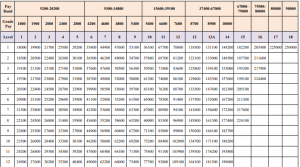
The Ministry of finance vide notification dated 25th July 2016 issued rules for 7th pay commission. The rules include a Schedule which shows categorically what payment has to be made to different positions. The said schedule is called 7th pay matrix
For the reference the table(7th pay matrix) is attached below.
Pay Band & Grade Pay
According to the table given above the first column shows the Pay band.
Pay Band is a pay scale according to the pay grades. It is a part of the salary process as it is used to rank different jobs by education, responsibility, location, and other multiple factors. The pay band structure is based on multiple factors and assigned pay grades should correlate with the salary range for the position with a minimum and maximum. Pay Band is used to define the compensation range for certain job profiles.
Here, Pay band is a part of an organized salary compensation plan, program or system. The Central and State Government has defined jobs, pay bands are used to distinguish the level of compensation given to certain ranges of jobs to have fewer levels of pay, alternative career tracks other than management, and barriers to hierarchy to motivate unconventional career moves. For example, entry-level positions might include security guard or karkoon. Those jobs and those of similar levels of responsibility might all be included in a named or numbered pay band that prescribed a range of pay.
The detailed calculation process of salary according to the pay matrix table is given under Rule 7 of the Central Civil Services (Revised Pay) Rules, 2016.
As per Rule 7A(i), the pay in the applicable Level in the Pay Matrix shall be the pay obtained by multiplying the existing basic pay by a factor of 2.57, rounded off to the nearest rupee and the figure so arrived at will be located in that Level in the Pay Matrix and if such an identical figure corresponds to any Cell in the applicable Level of the Pay Matrix, the same shall be the pay, and if no such Cell is available in the applicable Level, the pay shall be fixed at the immediate next higher Cell in that applicable Level of the Pay Matrix.
The detailed table as mentioned in the Rules showing the calculation:
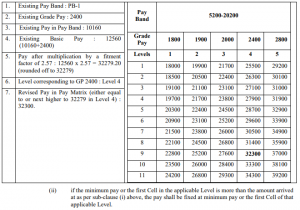
For example if your pay in Pay Band is 5200 (initial pay in pay band) and Grade Pay of 1800 then 5200+1800= 7000, now the said amount of 7000 would be multiplied to 2.57 as mentioned in the Rules. 7000 x 2.57= 17,990 so as per the rules the nearest amount the figure shall be fixed as pay level. Which in this case would be 18000/-.
The basic pay would increase as your experience at that job would increase as specified in vertical cells. For example if you continue to serve in the Basic Pay of 18000/- for 4 years then your basic pay would be 19700/- as mentioned in the table.
Dearness Allowance
However, the basic pay mentioned in the table is not the only amount of remuneration an employee receives. There are catena of benefits and further additions in the salary such as dearness allowance, HRA, TADA.
According to the Notification No. 1/1/2023-E.II(B) from the Ministry of Finance and Department of Expenditure, the Dearness Allowance payable to Central Government employees was enhanced from rate of 38% to 42% of Basic pay with effect from 1st January 2023.
Here, DA would be calculated on the basic salary. For example if your basic salary is of 18,000/- then 42% DA would be of 7,560/-
House Rent Allowance
Apart from that the HRA (House Rent Allowance) is also provided to employees according to their place of duties. Currently cities are classified into three categories as ‘X’ ‘Y’ ‘Z’ on the basis of the population.
According to the Compendium released by the Ministry of Finance and Department of Expenditure in Notification No. 2/4/2022-E.II B, the classification of cities and rates of HRA as per 7th CPC was introduced.
See the table for reference
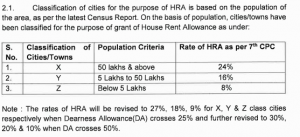
However, after enhancement of DA from 38% to 42% the HRA would be revised to 27%, 18%, and 9% respectively.
As above calculated the DA on Basic Salary, in the same manner HRA would also be calculated on the Basic Salary. Now considering that the duty of an employee’s Job is at ‘X’ category of city then HRA will be calculated at 27% of basic salary.
Here, continuing with the same example of calculation with a basic salary of 18000/-, the amount of HRA would be 4,840/-
Transport Allowance
After calculation of DA and HRA, Central government employees are also provided with Transport Allowance (TA). After the 7th CPC the revised rates of Transport Allowance were released by the Ministry of Finance and Department of Expenditure in the Notification No. 21/5/2017-EII(B) wherein, a table giving detailed rates were produced.
The same table is reproduced hereinafter.
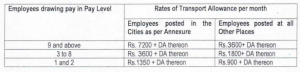
As mentioned above in the table, all the employees are given Transport Allowance according to their pay level and place of their duties. The list of annexed cities are given in the same Notification No. 21/5/2017-EII(B).
Again, continuing with the same example of calculation with a Basic Salary of 18000/- and assuming place of duty at the city mentioned in the annexure, the rate of Transport Allowance would be 1350/-
Apart from that, DA on TA is also provided as per the ongoing rate of DA. For example, if TA is 1350/- and rate of current DA on basic Salary is 42% then 42% of TA would be added to the calculation of gross salary. Here, DA on TA would be 567/-.
Calculation of Gross Salary
After calculating all the above benefits the Gross Salary is calculated.
Here, after calculating Basic Salary+DA+HRA+TA the gross salary would be 32,317/-
However, the Gross Salary is subject to few deductions such as NPS, Professional Tax, Medical as subject to the rules and directions by the Central Government. After the deductions from the Gross Salary an employee gets the Net Salary on hand.
However, it is pertinent to note that benefits such as HRA and TA are not absolute, these allowances are only admissible if an employee is not provided with a residence by the Central Government or facility of government transport.
Conclusion
Government service is not a contract. It is a status. The employees expect fair treatment from the government. The States should play a role model for the services. The Apex Court in the case of Bhupendra Nath Hazarika and another vs. State of Assam and others (reported in 2013(2)Sec 516) has observed as follows:
“………It should always be borne in mind that legitimate aspirations of the employees are not guillotined and a situation is not created where hopes end in despair. Hope for everyone is gloriously precious and that a model employer should not convert it to be deceitful and treacherous by playing a game of chess with their seniority. A sense of calm sensibility and concerned sincerity should be reflected in every step. An atmosphere of trust has to prevail and when the employees are absolutely sure that their trust shall not be betrayed and they shall be treated with dignified fairness then only the concept of good governance can be concretized. We say no more.”
The consideration while framing Rules and Laws on payment of wages, it should be ensured that employees do not suffer economic hardship so that they can deliver and render the best possible service to the country and make the governance vibrant and effective.
Written by Husain Trivedi Advocate

Gujarat Government Introduces Key Reforms in Land Acquisition for Transparency and Efficiency

Introduction
Gandhinagar, Gujarat: In a significant move to streamline the land acquisition process, the Government of Gujarat has introduced Key Reforms in Land Acquisition aimed at making the procedure more systematic, transparent, and time-bound. Through a new resolution issued by the Revenue Department on August 14, 2025, the state has revised the methodology for determining the market value of land under Section 26 of “The Right to Fair Compensation and Transparency in Land Acquisition, Rehabilitation and Resettlement Act, 2013” (RFCTLARR Act, 2013). This decision is expected to minimize disputes and accelerate developmental projects.
As part of this reform, the state government has rescinded two previous circulars from 2014 and 2022 and established a new “Land Acquisition Valuation Committee” (LAVC) to determine market prices.
Background: The RFCTLARR Act, 2013
Enacted by the Parliament of India in 2013, the RFCTLARR Act replaced the archaic Land Acquisition Act of 1894. The primary objectives of this legislation are to ensure fair compensation for landowners, introduce transparency into the acquisition process, and guarantee the rehabilitation and resettlement of affected families. Section 26 of the Act outlines the criteria for the Collector to determine the market value of the land, which includes considering the value specified for stamp duty, the average sale price of similar land in the vicinity, or the consented compensation amount, whichever is higher.
Key Provisions and Implications of the New Resolution
- Constitution of the Land Acquisition Valuation Committee (LAVC):
To address complexities and delays in market value determination, the state government has constituted a three-member expert committee. This committee will assist the Collector in assessing the market value of the land. The composition of the LAVC is as follows:
Chairman: The District Collector or another competent officer appointed by the State Government.
Member: Deputy Collector (Stamp Duty), Class-I.
Member: Town Planner, Class-I.
The primary role of this committee is to conduct a fair and accurate valuation of the land and provide recommendations to the Collector, ensuring that the compensation is both just and transparent. However, the final decision regarding the market value will remain with the Collector.
- Time-bound Determination of Market Value:
Previously, the lack of a clear timeline for determining market value often led to procedural delays, which in turn increased the financial burden on the government. The new resolution explicitly states that the market value must be determined after the publication of the preliminary notification under Section 11(1) of the Act, but before the publication of the final declaration under Section 19(1). This timeline is designed to prevent unnecessary delays and streamline the acquisition process.
-
Streamlining the Process and Mitigating Disputes:
The repeal of the 2014 and 2022 circulars signifies the government’s commitment to simplifying and improving the land acquisition framework. The establishment of a specialized committee and the introduction of a clear timeline are expected to reduce disagreements between landowners and acquiring bodies.
Furthermore, the resolution clarifies that its provisions will also apply to cases where the determination of market value under Section 26 was pending as of the date of the resolution’s publication.
Conclusion
The latest resolution by the Gujarat Government is a pivotal and positive reforms in land acquisition process. The formation of the Land Acquisition Valuation Committee will bring expert oversight to the valuation process, enhancing transparency and fairness. By enforcing a strict timeline, the government aims to ensure that developmental projects are executed without undue delay and that landowners receive fair and prompt compensation. This measure is poised to make the land acquisition process in the state smoother, more efficient, and less contentious, thereby fostering an environment conducive to industrial and infrastructural growth.
References

ગુજરાત સરકાર દ્વારા જમીન સંપાદન પ્રક્રિયામાં પારદર્શિતા અને કાર્યક્ષમતા લાવવા માટે મહત્વપૂર્ણ સુધારા

પરિચય
ગાંધીનગર, ગુજરાત: ગુજરાત સરકારે જમીન સંપાદનની પ્રક્રિયાને વધુ સુવ્યવસ્થિત, પારદર્શક અને સમયબદ્ધ બનાવવાના ઉદ્દેશ્ય સાથે એક મહત્વપૂર્ણ નિર્ણય લીધો છે. ૧૪ ઓગસ્ટ, ૨૦૨૫ના રોજ મહેસૂલ વિભાગ દ્વારા જારી કરાયેલા નવા ઠરાવ મુજબ, “જમીન સંપાદન, પુન:સ્થાપન અને પુનર્વસનમાં વાજબી વળતર અને પારદર્શિતાનો અધિકાર અધિનિયમ, ૨૦૧૩” (RFCTLARR Act, 2013) ની કલમ-૨૬ હેઠળ બજારકિંમત નિર્ધારિત કરવાની પ્રક્રિયામાં સુધારો કરવામાં આવ્યો છે. આ નિર્ણયથી જમીન સંપાદન સમયે થતા વિવાદોને ટાળવામાં અને વિકાસલક્ષી પ્રોજેક્ટ્સને વેગ આપવામાં મદદ મળશે.[1]
આ નવા ઠરાવ દ્વારા, રાજ્ય સરકારે ૨૦૧૪ અને ૨૦૨૨ના અગાઉના બે પરિપત્રોને રદ કરી દીધા છે અને બજારભાવ નક્કી કરવા માટે એક નવી “જમીન સંપાદન મૂલ્યાંકન સમિતિ” (Land Acquisition Valuation Committee – LAVC) ની રચના કરી છે.
પૃષ્ઠભૂમિ: જમીન સંપાદન અધિનિયમ, ૨૦૧૩
વર્ષ ૨૦૧૩માં ભારતીય સંસદ દ્વારા પસાર કરાયેલ “જમીન સંપાદન, પુન:સ્થાપન અને પુનર્વસનમાં વાજબી વળતર અને પારદર્શિતાનો અધિકાર અધિનિયમ” એ બ્રિટીશ શાસન સમયના ૧૮૯૪ના જૂના કાયદાનું સ્થાન લીધું હતું. આ નવા કાયદાનો મુખ્ય હેતુ જમીન માલિકોને વાજબી વળતર આપવાનો, સમગ્ર પ્રક્રિયામાં પારદર્શિતા લાવવાનો અને વિસ્થાપિત થતા પરિવારોના પુનર્વસન અને પુન:સ્થાપનની ખાતરી કરવાનો છે. કાયદાની કલમ-૨૬ કલેક્ટર દ્વારા જમીનની બજારકિંમત નક્કી કરવા માટેના માપદંડો સ્પષ્ટ કરે છે, જેમાં સ્ટેમ્પ ડ્યુટી માટે નિર્ધારિત બજારમૂલ્ય અથવા નજીકના વિસ્તારમાં સમાન પ્રકારની જમીનના સરેરાશ વેચાણ ભાવને ધ્યાનમાં લેવાની જોગવાઈ છે.
નવા ઠરાવની મુખ્ય જોગવાઈઓ અને તેની અસરો
૧. જમીન સંપાદન મૂલ્યાંકન સમિતિ (LAVC) ની રચના:
જમીન સંપાદનની પ્રક્રિયામાં બજારભાવ નિર્ધારણને લગતી ગૂંચવણો અને વિલંબને દૂર કરવા માટે, રાજ્ય સરકારે એક ત્રિ-સભ્યોની સમિતિની રચના કરી છે. આ સમિતિ કલેક્ટરને બજારકિંમત નક્કી કરવામાં મદદરૂપ થશે. સમિતિની રચના નીચે મુજબ છે:
અધ્યક્ષ: જિલ્લા કલેક્ટર અથવા રાજ્ય સરકાર દ્વારા નિયુક્ત અન્ય સક્ષમ અધિકારી.
સભ્ય: નાયબ કલેક્ટર (સ્ટેમ્પ ડ્યુટી), વર્ગ-૧.
સભ્ય: નગર નિયોજક, વર્ગ-૧.
આ સમિતિનો મુખ્ય ઉદ્દેશ્ય જમીનની બજારકિંમતનું સચોટ અને નિષ્પક્ષ મૂલ્યાંકન કરી કલેક્ટરને ભલામણ કરવાનો છે, જેથી વળતરની રકમ વાજબી અને પારદર્શક રીતે નક્કી થઈ શકે. જોકે, બજારકિંમત અંગેનો આખરી નિર્ણય કલેક્ટરનો જ ગણાશે.
૨. બજારકિંમત નિર્ધારણનો સમયગાળો:
અગાઉ બજાર કિંમત ક્યારે નક્કી કરવી તે અંગે કોઈ સ્પષ્ટતા ન હોવાને કારણે પ્રક્રિયામાં વિલંબ થતો હતો અને તેના કારણે સરકાર પર નાણાકીય ભારણ પણ વધતું હતું. નવા ઠરાવમાં સ્પષ્ટપણે જણાવવામાં આવ્યું છે કે બજારકિંમતનું નિર્ધારણ અધિનિયમની કલમ-૧૧(૧) હેઠળ પ્રાથમિક જાહેરનામું પ્રસિદ્ધ થયા બાદ, પરંતુ કલમ-૧૯(૧) હેઠળના આખરી જાહેરનામાની પ્રસિદ્ધિ પહેલાં કરવાનું રહેશે. આ સમયમર્યાદા નક્કી થવાથી બિનજરૂરી વિલંબ ટાળી શકાશે.
૩. પ્રક્રિયામાં સુધારો અને વિવાદોનું નિવારણ:
આ ઠરાવ દ્વારા ૨૦૧૪ અને ૨૦૨૨ના જૂના પરિપત્રો રદ કરવામાં આવ્યા છે, જે દર્શાવે છે કે સરકાર જમીન સંપાદન પ્રક્રિયાને વધુ સરળ અને કાર્યક્ષમ બનાવવા પ્રતિબદ્ધ છે. નવી સમિતિની રચના અને સમયમર્યાદાના નિર્ધારણથી જમીન માલિકો અને સંપાદન કરતી સંસ્થાઓ વચ્ચે થતા વિવાદોમાં ઘટાડો થવાની અપેક્ષા છે.
વધુમાં, ઠરાવમાં એ પણ સ્પષ્ટતા કરવામાં આવી છે કે જે કિસ્સાઓમાં આ ઠરાવની પ્રસિદ્ધિની તારીખે કલમ-૨૬ હેઠળ બજારકિંમત નક્કી કરવાની બાકી છે, તેવા કિસ્સાઓમાં પણ આ નવી જોગવાઈઓ લાગુ પડશે.
નિષ્કર્ષ
ગુજરાત સરકારનો આ નવો ઠરાવ જમીન સંપાદનની પ્રક્રિયામાં એક મહત્વપૂર્ણ અને સકારાત્મક સુધારો છે. જમીન સંપાદન મૂલ્યાંકન સમિતિની રચનાથી બજારભાવ નિર્ધારણમાં વધુ નિષ્ણાત અભિપ્રાય મળશે અને પ્રક્રિયામાં પારદર્શિતા વધશે. સમયમર્યાદાનું પાલન થવાથી વિકાસલક્ષી પ્રોજેક્ટ્સ સમયસર પૂર્ણ કરી શકાશે અને જમીન માલિકોને પણ ઝડપથી અને વાજબી વળતર મળી શકશે. આ પગલાથી રાજ્યમાં ઔદ્યોગિક અને માળખાકીય વિકાસ માટે જમીન સંપાદનની પ્રક્રિયા વધુ સરળ અને વિવાદ-મુક્ત બનવાની પ્રબળ સંભાવના છે.
સંદર્ભ

Rupee Internationalization: India’s Bold Strategy to Redefine Global Finance

Introduction
The world is witnessing a financial transformation from the heart of India, as the nation steps onto the global stage with its dynamic initiative towards rupee internationalization. This isn’t just a tale of economic policy—it’s a story of ambition, sovereignty, and the daring strategic maneuvers that could alter the course of global finance.
The Unfolding Saga: India’s Currency Dream
With every sunrise since August 2025, India is breaking new ground. The Reserve Bank of India (RBI), in an audacious move, allowed foreign banks to open Special Rupee Vostro Accounts (SRVAs)—a maneuver so swift that what once took six weeks now takes less than a day[1]. No longer does the nation wait for bureaucratic nods. India has sounded the bugle for financial independence.
Imagine this: foreign traders, from the UAE to Russia, now settle dues in rupees. It’s not just trade; it’s a declaration. The rupee isn’t just currency—it’s India’s identity, marching across borders and making its mark.
The Core Moves: Rewriting the Rulebook
- On August 5th, 2025: The RBI issued its game-changing circular. Foreign players can open SRVAs in Indian banks, and even overseas branches, almost at will—a radical departure from old norms. This move turbocharges India’s ability to facilitate trade directly in rupees, bypassing the dollar-dominated system[1][2].
- On August 12th, 2025: The boldness continued. Now, surplus rupees sitting in these accounts can be invested in government securities—no restrictive 30% cap, no cumbersome FPI processes. Every rupee can now fuel the engines of India’s economy[3].
The Mechanism: How India’s Rupee Play Works
- SRVAs allow foreign countries to bank in rupees[4]. For each export or import, rupees move between accounts, not dollars. Trade with neighbors like Nepal, Bhutan, Bangladesh? All rupees. Deals with Russia, the UAE, Mauritius? Increasingly, rupees.
- Once a foreign trader has surplus rupees, investing in Indian bonds is a breeze, further tying up their interests with India’s growth[5].
Each transaction is a quiet revolution, challenging a century-old economic order.
Scaling New Heights: Numbers That Inspire
- 156 SRVAs established in over 30 countries — from Russia to the UK, Singapore to Bangladesh[3][6].
- India-Russia trade? 90% in local currencies now — a testament to courage and collaboration[7].
- Dollar dependency slashed — from 85% to 72% of trade, and India isn’t stopping here[3].
- Annual savings: Up to $4 billion by ditching SWIFT fees and unnecessary currency conversions[8].
Why This Is Sensational: India’s Patriotism in Practice
When sanctions froze Russia’s dollars, it was local currencies—not the greenback—that got trade moving. The world saw India’s wisdom. Suddenly, rupee settlements weren’t just convenient—they were a lifeline.
- BRICS Aspirations: India proudly aligns with partners like Brazil, China, South Africa, targeting 70% intra-BRICS trade in local currencies by 2030[9][10]. It’s more than policy; it’s a joint resistance against dollar hegemony[[11].
- Technological Triumphs: UPI goes global—real-time payments, instant settlements, and Indian tech outpaces the world[12].
Challenges That Sharpen Resolve
India’s leap is not without its hurdles:
- Currency convertibility limits and KYC compliance headaches remain.[13]
- Global payment infrastructures still favor dollar settlements, and the rupee must fight for market depth and recognition.
- Risk of volatility: As more foreigners invest in rupee assets, India must vigilantly guard against instability.[14].
But each challenge is a dare—and India thrives on dares.
Diplomacy & Destiny: Balancing the American Equation
Trump’s America threatens tariffs. Washington voices alarm over alternatives to the US dollar. India’s trading partners risk higher duties—yet India stands firm[15]. The official word? This isn’t “de-dollarization,” but “derisking.” A call not for isolation, but for strategic freedom[11].
Road Ahead: Goals Worthy of India’s Spirit
- By 2027: SRVA networks to span 50+ countries, local currency trade to hit new highs.
- 2030 Vision: The rupee to join the ranks of top global currencies, the pride of a self-reliant Bharat resonating in every international transaction.[16]
Conclusion: The March of the Rupee
This is patriotism taking shape on ledger sheets, nationalism embedded in cross-border payments, and sovereignty expressed in every Indian bond sold to the world. India’s rupee internationalization is more than sensational headlines. It is an analytical triumph—a systematic, logical answer to global currency imbalance.
India, with the energy of its youth and the wisdom of its policymakers, is reshaping the currency of the future. The journey is bold; the tone is assertive; the narrative, unmistakably Indian. The rupee’s rise is the story of a nation daring to dream—and turning that dream into policy, progress, and pride.
Sources
[1] RBI Eases SRVA Norms to Boost Rupee Trade Settlement Globally https://www.indialaw.in/blog/banking-and-finance/rbi-eases-srva-norms-to-boost-rupee-trade-settlement-globally/
[2] RBI Eases SRVA Norms for INR Trade Settlement – Taxmann https://www.taxmann.com/post/blog/rbi-eases-srva-norms-for-inr-trade-settlement
[3] India’s RBI allows ‘vostro’ accounts to invest entire surplus … – Reuters https://www.reuters.com/sustainability/boards-policy-regulation/indias-rbi-allows-vostro-accounts-invest-entire-surplus-government-securities-2025-08-12/
[4] Special Rupee Vostro Account (SRVA) – TaxTMI https://www.taxtmi.com/article/detailed?id=14811
[5] RBI’s Push to Internationalize the Indian Rupee https://www.usthadian.com/rbis-push-to-internationalize-the-indian-rupee/
[6] (18 Aug, 2025) – Drishti IAS https://www.drishtiias.com/current-affairs-news-analysis-editorials/news-analysis/18-08-2025
[7] 90 per cent of India-Russia trade in local currency now – Industry News https://www.financialexpress.com/business/industry-90-per-cent-of-india-russia-trade-in-local-currency-now-3663287/
[8] India & UAE forge new path with Local Currency Settlement System … https://www.newsonair.gov.in/india-uae-forge-new-path-with-local-currency-settlement-system-to-reshape-economic-relations/
[9] BRICS countries move towards local currency settlements in … https://tvbrics.com/en/news/brics-countries-move-towards-local-currency-settlements-in-bilateral-trade/
[10] BRICS nations agree to boost trade, financial settlement in local … https://economictimes.com/news/economy/foreign-trade/brics-nations-agree-to-boost-trade-financial-settlement-in-local-currencies/articleshow/114513017.cms
[11] India reaffirms stance on de-dollarisation in Brics; focuses on local … https://www.caalley.com/news-updates/indian-news/not-part-of-financial-agenda-india-reaffirms-stance-on-de-dollarisation-in-brics-focuses-on-local-currency-trade
[12] India-UAE Local Currency Settlement System – Drishti IAS https://www.drishtiias.com/daily-updates/daily-news-analysis/india-uae-local-currency-settlement-system
[13] SRVAs and Internationalization of Rupee – Drishti IAS https://www.drishtiias.com/daily-updates/daily-news-analysis/srvas-and-internationalization-of-rupee
[14] Internationalization of Rupee – PMF IAS https://www.pmfias.com/internationalization-of-rupee/
[15] Brics currencies are no realistic alternative to the dollar https://www.omfif.org/2025/07/brics-currencies-are-no-realistic-alternative-to-the-dollar/
[16] BRICS+ 2025 growth and trade promoting initiatives https://www.ey.com/en_in/insights/tax/economy-watch/brics-2025-growth-and-trade-promoting-initiatives

Motor Accident Compensation in India: Supreme Court Guidelines and Evolving Legal Framework

Introduction
The legal framework governing motor accident compensation in India has reached maturity through decades of judicial evolution, with the Supreme Court establishing comprehensive guidelines that ensure both uniformity and adequate compensation for victims. The current system, primarily built upon the foundational decisions in Sarla Verma vs Delhi Transport Corporation (2009) and subsequently enhanced by National Insurance Company Ltd vs Pranay Sethi (2017), continues to guide Motor Accident Claims Tribunals (MACT) and courts across India in determining fair compensation. [1][2]
Supreme Court’s Established Multiplier Framework
Sarla Verma Foundation (2009)
The Sarla Verma vs Delhi Transport Corporation (2009) 6 SCC 121 case established the fundamental multiplier framework that remains binding today. [1] This two-judge bench decision created a standardized age-based multiplier table that eliminates arbitrary variations in compensation awards. The Supreme Court established specific multipliers ranging from 18 for victims aged 15-25 years down to 5 for those aged 66-70 years, with the multiplier selection based exclusively on the deceased’s age at the time of death, not the dependents’ ages. [3]
Pranay Sethi Enhancement (2017)
The National Insurance Company Ltd vs Pranay Sethi (2017) 16 SCC 680 Constitution Bench judgment significantly expanded this framework by introducing enhanced future prospects guidelines. [2] This landmark five-judge decision extended future prospects benefits to self-employed and fixed-salary workers, previously denied such additions. The court established differential percentages for future prospects: 50% for permanent employees under 40 years, 30% for those aged 40-50, and 15% for the 50-60 age group. For self-employed individuals, the percentages are slightly lower at 40%, 25%, and 10% respectively.
Recent Judicial Reaffirmation
Recent Supreme Court decisions have consistently reaffirmed the established multiplier framework. In Maya Singh and Others v. The Oriental Insurance Co. Ltd. (2025), the Supreme Court explicitly stated that “Courts and Tribunals have to apply the multiplier as per the judgement of this Court in Sarla Verma. Any deviation from the same warrants special reasons to be recorded.” [4][5] This case reinforced that split multiplier methods cannot be applied without specific justification.
Specific Guidelines for Vulnerable Age Groups
Victims Under 15 Years
The current binding precedent for victims under 15 years was definitively established in Divya vs National Insurance Co Ltd (2022), where the Supreme Court held that a multiplier of 15 must be applied for all victims up to age 15. [6][7] The court provided clear justification for this approach, referencing the Child and Adolescent Labour (Prohibition and Regulation) Act, 1986, which prohibits employment of children under 14 years.
For income calculation purposes, courts apply the minimum wages of a skilled workman in the relevant state as the notional income base, rejecting lower figures provided under Motor Vehicle Act provisions. [8] Recent Supreme Court decisions emphasize that future prospects must be considered based on the child’s potential upon reaching majority.
Enhanced Protection for Disabled Minors
Baby Sakshi Greola v. Manzoor Ahmad Simon (2024) demonstrated the enhanced protection for disabled minors, with the Supreme Court awarding ₹50.8 lakhs for a 7-year-old with 75% disability, applying a multiplier of 18 and including comprehensive attendant care provisions.[9] The court noted that “her mental age will be that of a child studying in the 2nd Standard/Class” while emphasizing the need for lifetime care.
Master Ayush v. Branch Manager Reliance General Insurance (2022) applied similar principles for a 5-year-old paraplegic victim, applying a multiplier of 18 with the final award of ₹49,93,000.[10] This case established comprehensive compensation calculation methodology for disabled minors.
Current Compensation Calculation Methodology
The established methodology follows a systematic approach:
Step 1: Income Assessment – Determine actual income less income tax, applying minimum wages where documentary proof is lacking.
Step 2: Future Prospects Addition – Add appropriate percentages based on Pranay Sethi guidelines: permanent employees receive 50%/30%/15% while self-employed receive 40%/25%/10% based on age brackets under-40, 40-50, and 50-60 respectively. [2]
Step 3: Personal Expenses Deduction – Subtract 1/3rd for 2-3 dependents, 1/4th for 4-6 dependents, 1/5th for more than 6 dependents, or 50% for bachelors. [1]
Step 4: Multiplier Application – Apply age-based multiplier from Sarla Verma table based on deceased’s age.
Step 5: Conventional Compensation – Add standardized amounts for loss of estate (₹15,000), funeral expenses (₹15,000), and loss of consortium (₹40,000 per eligible dependent), with 10% enhancement every three years. [11]
Motor Vehicle Act 2019 Amendments
The Motor Vehicles (Amendment) Act 2019 introduced significant changes to compensation structure. Section 164 now provides fixed no-fault compensation of ₹5 lakhs for death cases and ₹2.5 lakhs for grievous hurt, regardless of fault determination. [12] Hit-and-run compensation under Section 161 was enhanced to ₹2 lakhs for death and ₹50,000 for grievous injury, with mandatory 5% annual increases from January 1, 2019.
These provisions work alongside traditional Section 166 tort-based claims, with claimants able to choose the more beneficial option. [11]
Current MACT Practices and Implementation
Motor Accident Claims Tribunals across India now follow increasingly standardized procedures. The Delhi MACT system requires filing within 6 months of the accident date (post-2019 amendment), with insurance companies mandated to make settlement offers within 30 days of accident information receipt. [13]
Standard MACT procedures require specific documentation including:
- Copy of FIR and medical reports
- Identity documents of claimants and deceased
- Original treatment bills and medical records
- Educational qualifications and income proof
- Disability certificate (if applicable)
- Insurance policy details
- Relationship affidavit [13]
Current Best Practices and Technological Advancement
Recent Supreme Court decisions emphasize technological integration in compensation disbursement. The court advocates direct bank transfer of compensation amounts to claimants’ accounts rather than traditional tribunal deposit processes, noting that “technology has transformed financial transactions” allowing for “instantaneous transactions 24/7.” [14]
Legal practitioners should:
- Strictly adhere to established multiplier tables with detailed justification for any deviation
- Utilize standardized calculation methodologies based on Sarla Verma and Pranay Sethi principles
- Ensure comprehensive documentation of income and dependency relationships
- Consider enhanced compensation heads for vulnerable victims, particularly disabled minors
- Leverage digital tools for efficient case processing and compensation disbursement [14]
Recent Case Law Verification and Application
Recent Supreme Court decisions continue to reinforce established principles. Chandra v. Branch Manager, Oriental Insurance Company Limited (2021) applied a multiplier of 16 for a 33-year-old deceased and granted ₹20 lakhs compensation after applying 40% future prospects addition. The case emphasizes that the multiplier relevant to the deceased must be applied, not that of claimants or dependents.
Abhimanyu Partap Singh vs Namita Sekhon (2022) validated multiplier methodology for lifetime attendant charges and confirmed the multiplier of 18 for victims below age 15. This case reinforced that the multiplier method is “the most realistic and reasonable method” for compensation calculation.
Conclusion
The current legal framework represents a mature system balancing judicial discretion with standardized methodology. The Supreme Court’s consistent reaffirmation of Sarla Verma and Pranay Sethi principles through 2025 demonstrates commitment to predictable compensation while adapting to economic realities. The enhanced protection for vulnerable groups, particularly minors and disabled victims, reflects evolving jurisprudential sensitivity while maintaining mathematical precision in compensation calculations.
For optimal practice, legal professionals should maintain strict adherence to established guidelines while remaining current with periodic updates reflecting economic conditions. The framework’s evolution from foundational principles to current comprehensive implementation demonstrates the judiciary’s successful balance between consistency and justice in motor accident compensation law.
Citations:
[1] summary of sarla verman case – Supreme Today AI https://supremetoday.ai/issue/summary-of-sarla-verman-case
[2] National Insurance Co. Ltd Vs Pranay Sethi: In case of conflicting … https://www.linkedin.com/pulse/national-insurance-co-ltd-vs-pranay-sethi-case-judgments-suman-a7kbc
[3] [PDF] sarla.pdf https://www.wbja.nic.in/wbja_adm/files/sarla.pdf
[4] Motor Accident Claim and ‘Split Multiplier’; Supreme Court … https://caseguru.in/post/motor-accident-claim-and-split-multiplier-supreme-court-reinstates-compensation
[5] Normally Courts & Tribunals Have To Apply Multiplier As Per Ruling … https://www.verdictum.in/court-updates/supreme-court/maya-singh-and-others-v-the-oriental-insurance-co-ltd-and-others-2025-insc-161-multiplier-sarla-verma-case-courts-tribunals-motor-accident-1567491
[6] Motor Accident Claims- Multiplier For Victims Up To Age Of 15 To Be … https://www.verdictum.in/court-updates/supreme-court/multiplier-of-victims-up-to-age-of-15-to-be-15-enhancing-compensation-1446799
[7] [PDF] Reportable – Supreme Court of India https://api.sci.gov.in/supremecourt/2019/34916/34916_2019_6_1502_39151_Judgement_18-Oct-2022.pdf
[8] [PDF] reportable – Supreme Court of India https://api.sci.gov.in/supremecourt/2018/11292/11292_2018_2_1501_57774_Judgement_11-Dec-2024.pdf
[9] ‘Her mental age will be that of a child,’ SC raises compensation for … https://lawbeat.in/supreme-court-judgments/her-mental-age-will-be-child-supreme-court-raises-compensation-road-accident-victim
[10] MASTER AYUSH VERSUS THE BRANCH MANAGER, RELIANCE … https://www.indianemployees.com/judgments/details/master-ayush-versus-the-branch-manager-reliance-general-insurance-co-ltd-anr
[11] [PDF] JUDGMENT (ORAL) – High Court of Sikkim https://hcs.gov.in/hcs/hg_orders/201300000102024_8.pdf
[12] What is Section 164 of the Motor Vehicles Act – Supreme Today AI https://supremetoday.ai/issue/What-is-Section-164-of-the-Motor-Vehicles-Act
[13] Motor Accident Claims Tribunals https://session.delhi.gov.in/session/motor-accident-claims-tribunals
[14] Supreme Court advocates direct bank transfer of compensation to … https://www.scconline.com/blog/post/2025/03/24/supreme-court-bank-transfer-motor-accident-compensation/