




Introduction
Whenever a Job notification is out the first thing we do is go to the salary section and check what is the remuneration for that particular job. In order to apply for that particular job and later put all the effort and hard-work to get selected, is a long and tiring process. If our efforts are not compensated satisfactorily, we might not really like to get into the long time consuming process.
When we go through the salary section we often see words like Pay Scale, Grade Pay, or even level one or two salary and it is common to get confused between these jargons and to know the perfect amount of salary that we are going to receive.
To understand what pay scale, grade pay, various numbers of levels and other technical terms, we first need to know what pay commission is and how it functions.
Pay Commission
The Constitution of India under Article 309 empowers the Parliament and State Government to regulate the recruitment and conditions of service of persons appointed to public services and posts in connection with the affairs of the Union or any State.
The Pay Commission was established by the Indian government to make recommendations regarding the compensation of central government employees. Since India gained its independence, seven pay commissions have been established to examine and suggest changes to the pay structures of all civil and military employees of the Indian government.
The main objective of these various Pay Commissions was to improve the pay structure of its employees so that they can attract better talent to public service. In this 21st century, the global economy has undergone a vast change and it has seriously impacted the living conditions of the salaried class. The economic value of the salaries paid to them earlier has diminished. The economy has become more and more consumerized. Therefore, to keep the salary structure of the employees viable, it has become necessary to improve the pay structure of their employees so that better, more competent and talented people could be attracted to governance.
In this background, the Seventh Central Pay Commission was constituted and the government framed certain Terms of Reference for this Commission. The salient features of the terms are to examine and review the existing pay structure and to recommend changes in the pay, allowances and other facilities as are desirable and feasible for civil employees as well as for the Defence Forces, having due regard to the historical and traditional parities.
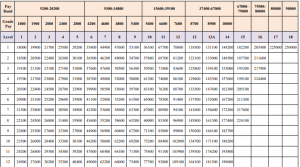
The Ministry of finance vide notification dated 25th July 2016 issued rules for 7th pay commission. The rules include a Schedule which shows categorically what payment has to be made to different positions. The said schedule is called 7th pay matrix
For the reference the table(7th pay matrix) is attached below.
Pay Band & Grade Pay
According to the table given above the first column shows the Pay band.
Pay Band is a pay scale according to the pay grades. It is a part of the salary process as it is used to rank different jobs by education, responsibility, location, and other multiple factors. The pay band structure is based on multiple factors and assigned pay grades should correlate with the salary range for the position with a minimum and maximum. Pay Band is used to define the compensation range for certain job profiles.
Here, Pay band is a part of an organized salary compensation plan, program or system. The Central and State Government has defined jobs, pay bands are used to distinguish the level of compensation given to certain ranges of jobs to have fewer levels of pay, alternative career tracks other than management, and barriers to hierarchy to motivate unconventional career moves. For example, entry-level positions might include security guard or karkoon. Those jobs and those of similar levels of responsibility might all be included in a named or numbered pay band that prescribed a range of pay.
The detailed calculation process of salary according to the pay matrix table is given under Rule 7 of the Central Civil Services (Revised Pay) Rules, 2016.
As per Rule 7A(i), the pay in the applicable Level in the Pay Matrix shall be the pay obtained by multiplying the existing basic pay by a factor of 2.57, rounded off to the nearest rupee and the figure so arrived at will be located in that Level in the Pay Matrix and if such an identical figure corresponds to any Cell in the applicable Level of the Pay Matrix, the same shall be the pay, and if no such Cell is available in the applicable Level, the pay shall be fixed at the immediate next higher Cell in that applicable Level of the Pay Matrix.
The detailed table as mentioned in the Rules showing the calculation:
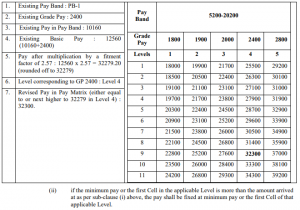
For example if your pay in Pay Band is 5200 (initial pay in pay band) and Grade Pay of 1800 then 5200+1800= 7000, now the said amount of 7000 would be multiplied to 2.57 as mentioned in the Rules. 7000 x 2.57= 17,990 so as per the rules the nearest amount the figure shall be fixed as pay level. Which in this case would be 18000/-.
The basic pay would increase as your experience at that job would increase as specified in vertical cells. For example if you continue to serve in the Basic Pay of 18000/- for 4 years then your basic pay would be 19700/- as mentioned in the table.
Dearness Allowance
However, the basic pay mentioned in the table is not the only amount of remuneration an employee receives. There are catena of benefits and further additions in the salary such as dearness allowance, HRA, TADA.
According to the Notification No. 1/1/2023-E.II(B) from the Ministry of Finance and Department of Expenditure, the Dearness Allowance payable to Central Government employees was enhanced from rate of 38% to 42% of Basic pay with effect from 1st January 2023.
Here, DA would be calculated on the basic salary. For example if your basic salary is of 18,000/- then 42% DA would be of 7,560/-
House Rent Allowance
Apart from that the HRA (House Rent Allowance) is also provided to employees according to their place of duties. Currently cities are classified into three categories as ‘X’ ‘Y’ ‘Z’ on the basis of the population.
According to the Compendium released by the Ministry of Finance and Department of Expenditure in Notification No. 2/4/2022-E.II B, the classification of cities and rates of HRA as per 7th CPC was introduced.
See the table for reference
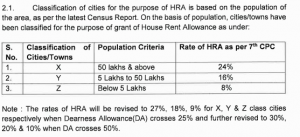
However, after enhancement of DA from 38% to 42% the HRA would be revised to 27%, 18%, and 9% respectively.
As above calculated the DA on Basic Salary, in the same manner HRA would also be calculated on the Basic Salary. Now considering that the duty of an employee’s Job is at ‘X’ category of city then HRA will be calculated at 27% of basic salary.
Here, continuing with the same example of calculation with a basic salary of 18000/-, the amount of HRA would be 4,840/-
Transport Allowance
After calculation of DA and HRA, Central government employees are also provided with Transport Allowance (TA). After the 7th CPC the revised rates of Transport Allowance were released by the Ministry of Finance and Department of Expenditure in the Notification No. 21/5/2017-EII(B) wherein, a table giving detailed rates were produced.
The same table is reproduced hereinafter.

As mentioned above in the table, all the employees are given Transport Allowance according to their pay level and place of their duties. The list of annexed cities are given in the same Notification No. 21/5/2017-EII(B).
Again, continuing with the same example of calculation with a Basic Salary of 18000/- and assuming place of duty at the city mentioned in the annexure, the rate of Transport Allowance would be 1350/-
Apart from that, DA on TA is also provided as per the ongoing rate of DA. For example, if TA is 1350/- and rate of current DA on basic Salary is 42% then 42% of TA would be added to the calculation of gross salary. Here, DA on TA would be 567/-.
Calculation of Gross Salary
After calculating all the above benefits the Gross Salary is calculated.
Here, after calculating Basic Salary+DA+HRA+TA the gross salary would be 32,317/-
However, the Gross Salary is subject to few deductions such as NPS, Professional Tax, Medical as subject to the rules and directions by the Central Government. After the deductions from the Gross Salary an employee gets the Net Salary on hand.
However, it is pertinent to note that benefits such as HRA and TA are not absolute, these allowances are only admissible if an employee is not provided with a residence by the Central Government or facility of government transport.
Conclusion
Government service is not a contract. It is a status. The employees expect fair treatment from the government. The States should play a role model for the services. The Apex Court in the case of Bhupendra Nath Hazarika and another vs. State of Assam and others (reported in 2013(2)Sec 516) has observed as follows:
“………It should always be borne in mind that legitimate aspirations of the employees are not guillotined and a situation is not created where hopes end in despair. Hope for everyone is gloriously precious and that a model employer should not convert it to be deceitful and treacherous by playing a game of chess with their seniority. A sense of calm sensibility and concerned sincerity should be reflected in every step. An atmosphere of trust has to prevail and when the employees are absolutely sure that their trust shall not be betrayed and they shall be treated with dignified fairness then only the concept of good governance can be concretized. We say no more.”
The consideration while framing Rules and Laws on payment of wages, it should be ensured that employees do not suffer economic hardship so that they can deliver and render the best possible service to the country and make the governance vibrant and effective.
Written by Husain Trivedi Advocate

Supreme Court on Enforcement of Consumer Forum Orders: Palm Groves Cooperative Housing Society Ltd. v. Magar Girme

Introduction
The Supreme Court of India’s recent judgment in Palm Groves Cooperative Housing Society Ltd. v. Magar Girme [1] has emerged as a watershed moment in consumer protection jurisprudence, fundamentally reshaping the enforcement landscape of consumer forum orders. This landmark decision addresses a critical legislative anomaly that existed for nearly two decades, during which consumer forum orders passed between 2003 and 2020 faced enforcement challenges due to restrictive interpretation of statutory provisions.
The ruling has profound implications for millions of consumers who had obtained favorable orders from consumer forums but struggled with their enforcement. By interpreting “interim order” under Section 25(1) of the Consumer Protection Act, 1986, to encompass “any order,” the Supreme Court has restored the efficacy of the consumer protection mechanism and reinforced the principle that justice should not remain a mere paper decree [2].
Background and Context of the Case
The dispute in Palm Groves Cooperative Housing Society Ltd. v. Magar Girme originated from a typical real estate transaction gone awry, where a cooperative housing society filed a complaint against builders for their failure to execute a conveyance deed despite clear orders from the District Consumer Forum. The builders’ resistance to execution proceedings created a legal quandary that eventually required the Supreme Court’s intervention to resolve fundamental questions about the enforcement of consumer forum orders [3].
The case represents a broader pattern of enforcement difficulties that plagued the consumer protection system for years. Between 2003 and 2020, thousands of consumers found themselves in similar situations where they had obtained favorable orders from consumer forums but faced insurmountable obstacles in enforcing these orders due to technical interpretations of the law.
Historical Evolution of Consumer Protection Enforcement Mechanisms
The Consumer Protection Act, 1986, was enacted with the noble objective of providing speedy and inexpensive redressal to consumer grievances. The original framework envisioned consumer forums as quasi-judicial bodies with powers equivalent to civil courts for the purpose of enforcing their orders. However, the enforcement mechanism underwent significant changes through subsequent amendments that created unintended consequences.
Initially, the Act provided clear enforcement powers to consumer forums through various provisions. The 2002 amendment to the Consumer Protection Act introduced changes to Section 25, which dealt with the enforcement of orders. However, the amendment inadvertently created a gap in the enforcement mechanism by limiting the scope of enforceable orders to “interim orders” only, thereby excluding final orders from the enforcement purview.
This legislative oversight created a paradoxical situation where interim orders could be enforced through attachment of property under Section 25(1), but final orders, which represent the culmination of adjudicatory proceedings, were left without effective enforcement mechanisms. The anomaly persisted until the Consumer Protection Act, 2019, which restored comprehensive enforcement powers, but left a significant period of legal uncertainty regarding orders passed during the intervening years.
Analysis of Section 25 of the Consumer Protection Act, 1986
Section 25 of the Consumer Protection Act, 1986, titled “Enforcement of orders of the District Forum, the State Commission or the National Commission,” forms the cornerstone of the enforcement mechanism within the consumer protection framework. The provision, as it stood after the 2002 amendment, stated: “Where an interim order made under this Act is not complied with, the District Forum or the State Commission or the National Commission, as the case may be, may order the property of the person, not complying with such order to be attached” [4].
The restrictive language limiting enforcement to “interim orders” created significant practical difficulties. Consumer forums across the country struggled with the interpretation, leading to inconsistent approaches to enforcement. Some forums adopted a liberal interpretation, while others strictly adhered to the literal meaning, creating legal uncertainty and forum shopping.
The Supreme Court’s intervention in Palm Groves became necessary to provide authoritative guidance on this contentious issue. The Court examined the legislative intent behind the provision and concluded that the restriction to “interim orders” was an unintended consequence of the 2002 amendment that defeated the very purpose of the consumer protection mechanism.
The Supreme Court’s Landmark Judgment
The two-judge bench comprising Justice J.K. Maheshwari and Justice Rajesh Bindal delivered a comprehensive judgment that addresses multiple dimensions of consumer forum order enforcement. The Court’s primary holding that “interim order” in Section 25(1) should be read as “any order” represents a judicial correction of a legislative anomaly that had persisted for nearly two decades [5].
The Court’s reasoning was grounded in several fundamental principles of legal interpretation and consumer protection jurisprudence. First, the Court emphasized that consumer forums are statutory bodies created to provide effective relief to consumers, and any interpretation that defeats this purpose would be contrary to the Act’s objectives. Second, the Court applied the principle of purposive interpretation, noting that the legislature could not have intended to create a situation where final orders remained unenforceable.
The judgment also addressed practical concerns about the enforcement mechanism. The Court observed that “an order passed by any court, or any forum is merely a kind of paper decree unless effective relief is granted to the party entitled thereto.” This observation underscores the Court’s commitment to ensuring that consumer protection remains effective rather than merely ceremonial [6].
Legal and Regulatory Implications of the Palm Groves Judgment
The Supreme Court’s decision has far-reaching implications for the regulatory framework governing consumer protection in India. By establishing that all consumer forum orders, regardless of when they were passed between 2003 and 2020, are enforceable as civil decrees, the Court has effectively bridged a significant gap in the consumer protection mechanism.
The ruling harmonizes the enforcement provisions across different periods of the Consumer Protection Act’s evolution. Orders passed before 2002 were enforceable under the original provisions, orders passed after 2020 are enforceable under the new Consumer Protection Act, 2019, and now, orders passed during the intervening period are also enforceable through the Court’s interpretive correction.
From a regulatory perspective, the decision strengthens the authority of consumer forums and enhances their credibility as effective dispute resolution mechanisms. Consumer commissions can now proceed with enforcement proceedings without being constrained by technical interpretations that previously limited their powers.
Impact on Housing and Real Estate Sector
The real estate and housing sector, which forms the backdrop of the Palm Groves case, stands to benefit significantly from this judgment. Housing disputes constitute a substantial portion of consumer complaints, often involving significant financial stakes and lengthy litigation processes. The enforceability of consumer forum orders provides developers and housing societies with greater certainty about the consequences of non-compliance with forum orders.
For cooperative housing societies, the judgment provides a powerful tool to enforce their rights against errant developers or contractors. The decision validates the approach taken by Palm Groves Cooperative Housing Society in pursuing enforcement proceedings and establishes a clear legal precedent for similar future cases.
The judgment also has implications for the broader real estate regulatory framework, including the Real Estate (Regulation and Development) Act, 2016 (RERA). While RERA provides its own dispute resolution mechanism, consumer forums continue to play an important role in addressing certain categories of real estate disputes, and the enhanced enforcement powers strengthen the overall regulatory ecosystem [7].
Comparative Analysis with Civil Court Procedures
The Supreme Court’s decision brings consumer forum enforcement procedures in line with civil court practices. By treating consumer forum orders as equivalent to civil court decrees for enforcement purposes, the judgment eliminates artificial distinctions that previously created enforcement difficulties.
This alignment is particularly significant because it allows consumer forums to utilize the entire range of enforcement mechanisms available to civil courts, including attachment of property, garnishment of debts, and other execution procedures provided under the Code of Civil Procedure, 1908. The procedural uniformity enhances the effectiveness of consumer forum orders and provides greater certainty to parties involved in consumer disputes.
The decision also clarifies that consumer forum orders enjoy the same legal status as civil court judgments, thereby strengthening the finality and binding nature of consumer forum adjudications. This enhanced legal status is expected to encourage voluntary compliance with forum orders and reduce the need for lengthy enforcement proceedings.
Procedural Guidelines for Enforcement of Consumer Forum Orders
The practical implementation of the Supreme Court’s decision requires consumer forums to adopt appropriate procedural guidelines for enforcement proceedings. The judgment provides that consumer forums can exercise powers equivalent to civil courts for the purpose of enforcing their orders, but the specific procedures must be adapted to the consumer protection framework.
Consumer forums need to develop standardized procedures for handling enforcement applications, including requirements for documentation, notice procedures, and methods for attachment and sale of property. The procedural framework should balance the need for effective enforcement with due process protections for parties against whom enforcement is sought.
The decision also has implications for the training and capacity building of consumer forum personnel. Officials responsible for enforcement proceedings need to be familiar with civil court procedures and property attachment processes to ensure effective implementation of the Court’s directions.
Constitutional and Jurisprudential Dimensions
From a constitutional perspective, the Supreme Court’s decision reinforces the principle of access to justice enshrined in Article 21 of the Constitution. By ensuring that consumer forum orders are effectively enforceable, the judgment strengthens the constitutional guarantee of fair procedure and meaningful access to justice for consumers.
The decision also reflects evolving jurisprudential trends toward functional and purposive interpretation of consumer protection statutes. Rather than adopting a strict literal interpretation that would defeat the statute’s purpose, the Court applied interpretive principles that advance the legislative objective of providing effective consumer protection.
The judgment contributes to the broader development of consumer rights jurisprudence in India by establishing that procedural technicalities should not be allowed to undermine substantive consumer rights. This approach aligns with international trends in consumer protection law that emphasize effectiveness and accessibility of dispute resolution mechanisms.
Economic and Social Impact of Palm Groves Judgment
The economic impact of the Supreme Court’s decision extends beyond individual consumer disputes to encompass broader market dynamics and business practices. Enhanced enforcement of consumer forum orders creates stronger incentives for businesses to comply with consumer protection standards and address consumer grievances proactively.
For the economy as a whole, the decision contributes to improved market confidence and consumer trust, which are essential elements of a well-functioning market system. When consumers have confidence that their rights will be effectively protected and enforced, they are more likely to engage in market transactions, thereby promoting economic growth and development.
The social impact of the decision is equally significant, particularly for vulnerable consumer groups who may lack the resources to pursue lengthy enforcement proceedings in regular courts. The streamlined enforcement mechanism provided by consumer forums makes justice more accessible and affordable for ordinary consumers.
Future Policy and Directions Post Palm Groves Judgment
The Supreme Court’s decision in Palm Groves sets important precedents for future consumer protection policy development. The judgment demonstrates the importance of ensuring that legislative amendments do not inadvertently create enforcement gaps that undermine the effectiveness of consumer protection mechanisms.
For future policy development, the decision suggests that consumer protection statutes should be drafted with careful attention to enforcement mechanisms and should include clear provisions for transitional periods when amendments are made. The experience of the 2003-2020 period highlights the risks of creating enforcement gaps through inadequate legislative drafting.
The judgment also has implications for the ongoing development of alternative dispute resolution mechanisms in consumer protection. As India moves toward greater use of mediation and conciliation in consumer disputes, the principles established in Palm Groves regarding enforcement will be relevant for ensuring that alternative dispute resolution outcomes are also effectively enforceable.
Enforcement Challenges of Consumer Forum Orders
While the Supreme Court’s decision represents a significant advancement in consumer protection enforcement, several challenges remain in its practical implementation. Consumer forums across the country will need to develop appropriate infrastructure and expertise for handling enforcement proceedings effectively.
Resource constraints at the forum level may limit the practical impact of enhanced enforcement powers. Many consumer forums operate with limited staff and resources, which may affect their ability to handle complex enforcement proceedings involving property attachment and sale.
The decision also raises questions about the relationship between consumer forum enforcement and other legal proceedings involving the same parties. Coordination between different forums and courts will be necessary to prevent conflicting enforcement actions and ensure orderly resolution of disputes.
International Perspectives and Comparative Analysis
The enforcement challenges addressed in Palm Groves are not unique to India but reflect broader international concerns about the effectiveness of consumer dispute resolution mechanisms. Comparative analysis of consumer protection systems in other jurisdictions reveals similar struggles with enforcement and the need for robust implementation mechanisms.
Countries with well-developed consumer protection systems typically provide multiple enforcement options, including administrative penalties, civil enforcement, and criminal sanctions for serious violations. The Indian experience suggests that effective enforcement requires not just appropriate legal frameworks but also adequate institutional capacity and resources.
The Supreme Court’s approach in Palm Groves aligns with international best practices that emphasize the importance of making consumer dispute resolution accessible, affordable, and effective. The decision contributes to India’s reputation as a jurisdiction that takes consumer rights seriously and provides effective legal remedies.
Conclusion
The Supreme Court’s judgment in Palm Groves Cooperative Housing Society Ltd. v. Magar Girme represents a pivotal moment in the evolution of consumer protection law in India. By correcting a legislative anomaly that had persisted for nearly two decades, the Court has restored the effectiveness of consumer forum orders and reinforced the principle that consumer protection should be practical and meaningful rather than merely theoretical.
The decision’s impact extends far beyond the specific facts of the case to encompass the entire consumer protection ecosystem in India. Enhanced enforcement mechanisms will strengthen consumer confidence, improve business compliance, and contribute to the overall development of a fair and efficient marketplace.
As India continues to develop its consumer protection framework in response to changing market conditions and consumer needs, the principles established in Palm Groves will serve as important guideposts for ensuring that consumer rights remain effectively protected and enforced. The judgment stands as a testament to the judiciary’s role in ensuring that legislative intent is realized and that justice remains accessible to all consumers.
The legal enforcement of consumer forum orders, as established by this landmark judgment, marks a new chapter in Indian consumer protection jurisprudence, one that prioritizes substance over form and effectiveness over technicality. This approach bodes well for the future development of consumer rights in India and serves as a model for other jurisdictions grappling with similar enforcement challenges.
References
[1] Palm Groves Cooperative Housing Society Ltd. v. Magar Girme and Gaikwad Associates, 2025 INSC 1023. Available at: https://www.livelaw.in/supreme-court/supreme-court-holds-consumer-fora-can-enforce-final-orders-passed-between-2003-2020-rectifies-anomaly-in-s251-of-1986-act-301709
[2] Supreme Court Judgment Analysis on Consumer Forum Orders. Available at: https://www.verdictum.in/court-updates/supreme-court/palm-groves-cooperative-housing-society-ltd-v-magar-girme-and-gaikwad-associates-2025-insc-1023-court-or-forum-order-1589061
[3] LiveLaw Report on Consumer Forum Enforcement. Available at: https://www.livelaw.in/supreme-court/supreme-court-holds-consumer-fora-can-enforce-final-orders-passed-between-2003-2020-rectifies-anomaly-in-s251-of-1986-act-301709
[4] Consumer Protection Act, 1986, Section 25. Available at: https://indiankanoon.org/doc/1098723/
[5] Legal Analysis on Consumer Protection Act Amendments. Available at: https://www.legalbites.in/topics/articles/does-interim-order-under-section-251-of-the-consumer-protection-act-now-mean-any-order-1178198
[6] Verdictum Report on Supreme Court Consumer Protection Ruling. Available at: https://www.verdictum.in/court-updates/supreme-court/palm-groves-cooperative-housing-society-ltd-v-magar-girme-and-gaikwad-associates-2025-insc-1023-consumer-protection-act-1589049
[7] Consumer Protection Enforcement Analysis. Available at: https://blog.ipleaders.in/a-comparative-analysis-on-execution-of-orders-in-consumer-protection-act-1986-and-consumer-protection-act-2019/
[8] National Consumer Disputes Redressal Commission. Available at: https://ncdrc.nic.in/bare_acts/consumer%20protection%20act-1986.html
[9] Consumer Protection Legal Framework. Available at: https://wbconsumers.gov.in/writereaddata/ACT%20&%20RULES/Act%20&%20Rules/1%20Consumer%20Protection%20%20Act,%201986.htm
Quantity Calculation Under NDPS Act: Implications of Supreme Court’s Review for Drug Law Sentencing

Introduction
The calculation of narcotic drug quantities under the Narcotic Drugs and Psychotropic Substances Act, 1985 (NDPS Act) represents one of the most contentious and legally significant issues in Indian criminal jurisprudence. The Supreme Court’s recent decision to revisit its landmark judgment in Hira Singh v. Union of India has reignited debates about whether sentencing should be based on the total weight of seized mixtures or solely on the actual drug content [1]. This development has profound implications for thousands of pending cases and future prosecutions under the NDPS Act, as the distinction between small, intermediate, and commercial quantities directly determines the severity of punishment and the availability of bail. The NDPS Act establishes a graduated punishment scheme wherein different levels of punishment are prescribed based on whether the quantity involved constitutes small quantity, intermediate quantity, or commercial quantity. The determination of these categories has become increasingly complex as enforcement agencies frequently seize narcotic substances mixed with neutral materials, diluents, or adulterants. The legal question of whether to consider the entire weight of the mixture or only the pure drug content lies at the heart of quantity calculation under NDPS Act, leading to divergent judicial interpretations and inconsistent outcomes across different jurisdictions
Legislative Framework and Statutory Provisions
Structure of the NDPS Act
The NDPS Act, 1985 establishes a comprehensive framework for controlling narcotic drugs and psychotropic substances in India. The Act categorizes offenses based on quantity thresholds, with Section 20 dealing with small quantity offenses, Section 25 addressing intermediate quantities, and Section 25A governing commercial quantities. The punishment structure creates significant disparities between categories, with small quantity offenses carrying imprisonment of up to six months or one year and fines, while commercial quantity offenses mandate minimum imprisonment of ten years extending up to twenty years along with substantial monetary penalties.
The Act empowers the Central Government to notify the quantities constituting small quantity and commercial quantity for different narcotic drugs and psychotropic substances. These notifications, issued under Section 2(xxiiia) and Section 2(viia) of the Act, form the foundation for determining applicable punishment provisions. The intermediate quantity, though not explicitly defined in the statute, encompasses quantities exceeding small quantity but falling short of commercial quantity thresholds.
Government Notifications and Quantity Determination
The Central Government has issued multiple notifications specifying quantity thresholds for various substances. The crucial notification dated October 19, 2001, as subsequently amended, provides detailed quantity specifications for different narcotic drugs and psychotropic substances. Note 4 of this notification, which became the subject of extensive judicial scrutiny, states that for the purpose of applying the provisions of the Act relating to small quantity and commercial quantity, the weight of the narcotic drug or psychotropic substance, as the case may be, shall be the aggregate weight of the mixture or solution containing such drug or substance.
This notification effectively clarified that the entire weight of seized material, including adulterants and neutral substances, should be considered for determining quantity categories. The rationale behind this approach stems from the practical difficulties in separating pure drug content from mixtures and the legislative intent to create a deterrent effect against drug trafficking at all levels.
Constitutional Validity and Legislative Intent
The constitutional validity of quantity-based punishment schemes under the NDPS Act has been consistently upheld by the Supreme Court. The Court has recognized that the classification of offenses based on quantity serves a legitimate purpose of distinguishing between different levels of culpability in drug offenses. The legislative intent behind graduated punishment reflects the understanding that larger quantities typically indicate commercial involvement and organized trafficking networks, warranting more severe punishment.
The amendment of 2001 introduced significant changes to the punishment structure, reducing penalties for small quantity offenses while maintaining stringent punishment for commercial quantities. This amendment reflected a policy shift toward treating addiction as a health issue while maintaining deterrent effect against trafficking and commercial activities.
Evolution of Judicial Interpretation
Early Judicial Approach and E. Micheal Raj Decision
The question of quantity calculation first gained prominence in E. Micheal Raj v. Intelligence Officer, Narcotic Control Bureau, where the Supreme Court took a restrictive approach to quantity determination [2]. The Court in this case held that only the actual content of narcotic drugs should be considered for determining whether the quantity constitutes small, intermediate, or commercial quantity. This interpretation was based on the Court’s understanding that punishment should be proportionate to the actual drug content rather than the total weight of mixture.
The E. Micheal Raj decision created significant practical difficulties for enforcement agencies, as determining pure drug content required complex chemical analysis and expert testimony in every case. Courts were required to engage in detailed examination of forensic reports and expert opinions to ascertain the actual drug content, leading to delays in trials and inconsistent outcomes based on varying analytical methods.
This approach, while seemingly favoring a narrower interpretation of penal provisions, created an unintended consequence where traffickers could potentially escape severe punishment by diluting drugs with large quantities of neutral substances. The decision also raised questions about the effectiveness of the NDPS Act’s deterrent mechanism, as punishment became disconnected from the total quantity of material that could be potentially harmful to society.
The Hira Singh Judgment: A Paradigm Shift
The Supreme Court’s decision in Hira Singh v. Union of India marked a fundamental shift in the judicial approach to quantity calculation under the NDPS Act [3]. The three-judge bench, overruling the E. Micheal Raj decision, held that the total weight of mixture containing narcotic drugs or psychotropic substances must be considered for determining small, intermediate, or commercial quantity categories. The Court upheld the validity of Note 4 of the 2001 notification, which mandates consideration of aggregate weight of the mixture or solution.
The Court’s reasoning in Hira Singh was multifaceted, addressing both legal and practical considerations. The judgment emphasized that even mixtures of narcotic drugs or psychotropic substances pose significant danger to society, regardless of the actual drug content. The Court noted that the harmful effects of drug consumption are not necessarily proportional to the purity of the substance, as even diluted drugs can cause addiction and social harm.
The decision also considered the practical difficulties in implementing the E. Micheal Raj approach, noting that requiring determination of exact drug content in every case would create insurmountable evidentiary burdens and provide opportunities for legal manipulation. The Court observed that traffickers could exploit the pure content approach by deliberately diluting drugs to escape severe punishment, thereby undermining the Act’s deterrent effect.
Legal Reasoning and Constitutional Considerations
The Hira Singh judgment extensively analyzed the constitutional validity of the notification-based approach to quantity determination. The Court held that the Central Government’s power to notify quantities under the NDPS Act includes the authority to specify the method of calculation. The judgment emphasized that legislative classification based on total weight serves a reasonable purpose and does not violate constitutional principles of equality or proportionality.
The Court addressed arguments about the harshness of punishment for individuals possessing heavily diluted substances, noting that the graded punishment structure already provides for differentiated treatment based on quantity categories. The judgment emphasized that the primary objective of the NDPS Act is prevention and deterrence, which requires a broad interpretation of quantity thresholds rather than narrow technical distinctions.
Recent Developments and Supreme Court’s Review
Challenge to Hira Singh Decision
The Supreme Court’s recent decision to review the Hira Singh judgment represents a significant development in NDPS jurisprudence [4]. The Court has agreed to hear a writ petition challenging the correctness of the 2020 decision, particularly questioning whether the total weight approach creates disproportionate punishment for individuals possessing substances with minimal actual drug content. The petition argues that the Hira Singh decision may violate constitutional principles of proportionality and fairness in sentencing.
The challenge to Hira Singh raises fundamental questions about the balance between deterrence and individual justice in drug law enforcement. Critics argue that the total weight approach can lead to situations where individuals possessing heavily diluted substances face the same punishment as those possessing pure drugs, creating potential constitutional issues regarding proportionality of punishment.
Arguments for Reconsideration
Proponents of reviewing the Hira Singh decision present several compelling arguments. They contend that punishment should be proportionate to culpability, which is better reflected by actual drug content rather than total weight. This approach would align with general principles of criminal law that require proportionality between offense gravity and punishment severity.
The argument for pure content calculation also emphasizes that the harm to society is directly related to the actual narcotic substance present in seized material. From this perspective, an individual possessing a large quantity of heavily diluted substance poses less societal danger than someone possessing a smaller quantity of pure drugs. The review petition argues that this distinction should be reflected in sentencing determinations.
Additionally, advocates for review point to international practices and scientific understanding of drug potency, arguing that most jurisdictions base their punishment on actual drug content rather than total mixture weight. They suggest that India’s approach may be inconsistent with global standards and scientific principles underlying drug regulation.
Counter-Arguments Supporting Hira Singh
Supporters of the Hira Singh decision present equally compelling reasons for maintaining the total weight approach. They argue that the practical implementation of pure content calculation would create significant evidentiary and procedural challenges that could undermine effective enforcement of the NDPS Act. The requirement for detailed chemical analysis in every case would increase costs, delay proceedings, and create opportunities for technical defenses based on analytical variations.
The deterrence argument remains central to supporting the total weight approach. Proponents contend that allowing quantity calculation based on pure content would incentivize traffickers to dilute drugs, potentially increasing the overall volume of dangerous substances in circulation. They argue that the current approach prevents manipulation of quantity calculations and maintains the Act’s deterrent effect.
From a policy perspective, supporters emphasize that even diluted drugs contribute to addiction and social harm. They argue that the law should focus on the total quantum of harmful material rather than engaging in technical distinctions that may not reflect actual societal impact.
Impact on Different Categories of Cases
Small Quantity Offenses and Bail Considerations
The quantity calculation under NDPS Act methodology significantly impacts the availability of bail for NDPS Act offenses. Small quantity offenses under Section 20 are generally bailable and carry relatively lenient punishment. However, when total weight calculation results in reclassification of offenses from small to intermediate or commercial quantity, the accused faces stringent bail conditions and potentially longer pre-trial detention.
The impact on small quantity cases is particularly significant for individual users who may possess substances mixed with diluents for personal consumption. The total weight approach can result in these individuals being classified as intermediate or commercial quantity offenders, fundamentally altering their legal status and available defenses. This has raised concerns about the criminalization of addiction and the proportionality of punishment for personal use cases.
Courts have struggled with cases involving substances like charas or ganja that are naturally mixed with plant material. The application of total weight calculation in such cases can result in severe punishment for individuals who may have been unaware of the exact drug content in their possession. This has led to calls for more nuanced approaches that consider the nature of the substance and the circumstances of possession.
Commercial Quantity Cases and Mandatory Sentencing
Commercial quantity cases under Section 25A carry mandatory minimum sentences of ten years imprisonment, making the quantity determination absolutely crucial for sentencing outcomes. The difference between intermediate and commercial quantity can mean the difference between discretionary sentencing and mandatory minimum punishment. The total weight approach has resulted in more cases being classified as commercial quantity, leading to increased incarceration rates and longer sentences.
The impact on commercial quantity classification is particularly pronounced in cases involving sophisticated drug trafficking operations that deliberately dilute substances to increase volume and profitability. The total weight approach ensures that such operations cannot escape severe punishment through dilution strategies, maintaining the deterrent effect intended by the legislature.
However, critics argue that the approach can also result in individuals involved in small-scale distribution being classified as commercial quantity offenders based solely on the presence of adulterants or diluents. This has led to concerns about proportionality in punishment and the need for judicial discretion in sentencing determinations.
Intermediate Quantity Cases and Judicial Discretion
Intermediate quantity cases, falling between small and commercial quantity thresholds, provide courts with greater sentencing discretion. The quantity calculation methodology under NDPS Act can significantly influence whether a case falls into this category, affecting both the punishment range and the availability of alternative sentencing options.
The flexibility available in intermediate quantity cases has made the quantity determination even more critical, as it can determine whether an offender receives a lenient sentence focused on rehabilitation or a severe punishment emphasizing deterrence. Courts have expressed varying views on how to exercise this discretion, particularly in cases where the total weight approach results in intermediate quantity classification for substances with minimal actual drug content.
Forensic and Evidentiary Implications
Chemical Analysis and Expert Testimony
The choice between total weight and pure content calculation has profound implications for forensic analysis and expert testimony in NDPS cases. The total weight approach simplifies evidentiary requirements, as courts need only consider the weight of seized material without detailed analysis of drug purity or concentration. This reduces dependence on sophisticated laboratory facilities and expert testimony, making prosecutions more efficient and cost-effective.
Conversely, the pure content approach would require comprehensive chemical analysis to determine exact drug content in seized substances. This would necessitate advanced laboratory facilities, standardized analytical procedures, and qualified expert witnesses capable of explaining complex analytical results to courts. The evidentiary burden would increase substantially, potentially creating bottlenecks in the justice system.
The reliability and consistency of analytical results also become crucial considerations under the pure content approach. Variations in analytical methods, laboratory standards, and expert interpretations could lead to inconsistent outcomes in similar cases. The legal system would need to develop robust standards for analytical procedures and expert testimony to ensure reliable quantity determinations.
Chain of Custody and Sample Integrity
Both approaches require maintaining proper chain of custody for seized substances, but the pure content calculation places additional emphasis on sample integrity and prevention of contamination. Any compromise in sample handling could affect analytical results and create grounds for challenging quantity determinations. The total weight approach, while still requiring proper custody procedures, is less vulnerable to technical challenges based on analytical variations.
The practical implications extend to storage facilities, transportation procedures, and laboratory protocols. The pure content approach would require more sophisticated handling procedures to ensure sample integrity throughout the legal process. This could increase costs and create additional points of potential procedural challenge.
Comparative Analysis with International Practices
United States Approach and Federal Guidelines
The United States federal sentencing guidelines generally follow a total weight approach similar to India’s current methodology under Hira Singh. The U.S. approach considers the entire weight of mixtures containing controlled substances for determining sentence enhancements and punishment categories. This approach has been consistently upheld by American courts based on practical enforcement considerations and deterrence objectives.
However, the U.S. system provides for certain exceptions and adjustments based on the nature of substances and individual circumstances. The federal guidelines include provisions for downward departures in cases involving unusual circumstances or disproportionate punishment. This flexibility addresses some concerns about the harshness of total weight calculations while maintaining overall enforcement effectiveness.
The American experience demonstrates both the benefits and challenges of the total weight approach. While it provides clarity and prevents manipulation, it has also generated criticism regarding disproportionate punishment in certain cases. The ongoing debate in the United States parallels the current Indian discussion about quantity calculation methodologies under NDPS Act.
European Approaches and Pure Content Systems
Several European jurisdictions employ pure content calculations for determining punishment categories in drug offenses. These systems typically require detailed analytical procedures to establish actual drug content, with punishment based on the quantity of pure narcotic substances. The European approach reflects a different philosophical foundation emphasizing precise proportionality between drug content and punishment severity.
The European experience suggests that pure content systems can function effectively with adequate laboratory infrastructure and standardized procedures. However, these jurisdictions typically have more developed forensic facilities and established protocols for drug analysis. The success of pure content systems may depend significantly on the availability of technical resources and expertise.
Lessons from International Comparisons
International comparisons reveal that both total weight and pure content approaches can achieve legitimate law enforcement objectives, but their effectiveness depends on broader systemic factors including laboratory capacity, legal procedures, and enforcement priorities. The choice between approaches often reflects different balances between practical enforcement considerations and theoretical principles of proportional punishment.
The international experience also highlights the importance of consistency and predictability in quantity calculation methodologies Under NDPS Act. Regardless of which approach is adopted, clear guidelines and consistent application are essential for maintaining legitimacy and effectiveness of drug law enforcement systems.
Implications for Legal Practice and Procedure
Defense Strategies and Case Preparation
The quantity calculation under NDPS methodology significantly influences defense strategies in NDPS cases. Under the total weight approach established by Hira Singh, defense counsel typically focus on challenging the accuracy of weighing procedures, chain of custody issues, and the reliability of seizure documentation. These challenges are generally procedural rather than technical, making them accessible to practitioners without specialized scientific knowledge.
If the Supreme Court moves toward a pure content approach, defense strategies would need to incorporate more sophisticated scientific challenges. Defense counsel would need to understand analytical procedures, challenge laboratory methodologies, and present expert testimony on drug analysis. This would require significant investment in technical expertise and could create disparities based on the resources available to different defendants.
The shift in evidentiary focus would also affect case preparation timelines and costs. Pure content determination requires detailed analytical work and expert consultation, potentially extending pre-trial preparation periods and increasing litigation expenses. These practical considerations could affect access to effective legal representation, particularly for indigent defendants.
Prosecutorial Considerations and Case Management
From the prosecution perspective, the total weight approach simplifies case preparation and presentation. Prosecutors can focus on establishing the fact of seizure and the weight of seized material without engaging in complex technical arguments about drug purity. This efficiency allows for more effective case management and resource allocation in high-volume NDPS prosecutions.
A shift to pure content calculation would require prosecutors to develop expertise in forensic analysis and maintain closer coordination with laboratory facilities. The prosecution would need to present detailed scientific evidence in each case, potentially extending trial durations and increasing resource requirements. This could affect prosecution strategies and case prioritization decisions.
The evidentiary burden associated with pure content determination might also influence charging decisions and plea negotiations. Cases with marginal analytical results or technical complications might be more likely to result in reduced charges or alternative dispositions, potentially affecting the overall deterrent effect of NDPS enforcement.
Future Directions and Legal Reform Considerations
Potential Outcomes of Supreme Court Review
The Supreme Court’s review of the Hira Singh decision could result in several possible outcomes, each with distinct implications for NDPS law and practice. The Court might reaffirm the total weight approach, providing additional clarity and stability to the current system while addressing concerns about proportionality through other mechanisms such as sentencing guidelines or judicial discretion provisions.
Alternatively, the Court might adopt a hybrid approach that considers both total weight and drug content in appropriate cases. Such an approach could involve different methodologies for different types of substances or different quantity categories, providing flexibility while maintaining practical enforceability. This approach would require detailed guidelines to ensure consistent application across jurisdictions.
The most significant change would be a return to the pure content approach, either fully or in modified form. Such a decision would require substantial adjustments to law enforcement procedures, laboratory facilities, and legal practice. The implementation would need to address practical challenges while ensuring that the change achieves its intended objectives of proportional punishment.
Legislative Reform and Policy Considerations
Regardless of the Supreme Court’s decision, the ongoing debate highlights the need for comprehensive policy review of NDPS Act implementation. Legislative reform could address some concerns about quantity calculation through statutory amendments that provide clearer guidance on calculation methodologies, exceptions for specific circumstances, and enhanced judicial discretion in sentencing.
Policy reform might also address broader issues in NDPS enforcement, including the balance between criminalization and treatment approaches, the adequacy of rehabilitation programs, and the effectiveness of current deterrence strategies. The quantity calculation Under NDPS Act debate is part of a larger discussion about the appropriate role of criminal law in addressing drug-related problems.
Future reforms might also consider technological developments that could improve the accuracy and efficiency of drug analysis. Advances in forensic science might make pure content determination more practical and cost-effective, potentially addressing some current limitations of the approach.
Conclusion
The Supreme Court’s review of quantity calculation under the NDPS Act represents a critical juncture in Indian drug law jurisprudence. The decision will have far-reaching implications for thousands of pending cases and future enforcement strategies. While the Hira Singh decision provided clarity and practical enforceability, the ongoing review reflects legitimate concerns about proportionality and fairness in punishment.
The challenge lies in balancing competing objectives of effective enforcement, proportional punishment, and practical implementation. The total weight approach offers simplicity and deterrent effect but may result in disproportionate punishment in some cases. The pure content approach promises greater proportionality but faces significant practical and resource challenges.
Whatever approach the Supreme Court ultimately adopts, it must address the fundamental tension between theoretical ideals of proportional justice and practical requirements of effective law enforcement. The decision should provide clear guidance on quantity calculation under NDPS Act for lower courts, law enforcement agencies, and legal practitioners, while maintaining the NDPS Act’s core objectives of preventing drug trafficking and protecting society from the harmful effects of narcotic substances.
The review also presents an opportunity for broader reflection on India’s approach to drug policy and the role of criminal law in addressing drug-related problems. The outcome may influence not only quantity calculation under NDPS Act methodologies but also broader conversations about rehabilitation versus punishment, the criminalization of addiction, and the effectiveness of current enforcement strategies in achieving public health and safety objectives.
References
[1] Supreme Court to revisit Hira Singh ruling on calculating narcotic quantities under NDPS Act. Bar & Bench. Available at: https://www.barandbench.com/news/supreme-court-to-revisit-hira-singh-ruling-on-calculating-narcotic-quantities-under-ndps-act
[2] E. Micheal Raj v. Intelligence Officer, Narcotic Control Bureau, (2008) 5 SCC 161. Indian Kanoon. Available at: https://indiankanoon.org/doc/128615827/
[3] Hira Singh & Anr. v Union of India & Anr. (2020) 20 SCC 272. The Amikus Qriae. Available at: https://theamikusqriae.com/hira-singh-anr-v-union-of-india-anr-2020-20-scc-272/
[4] NDPS Act | Supreme Court Agrees To Hear Plea Against Judgment That Total Weight Of Mixture Determines Contraband Quantity. LiveLaw. Available at: https://www.livelaw.in/top-stories/ndps-act-supreme-court-agrees-to-hear-plea-against-judgment-that-total-weight-of-mixture-determines-contraband-quantity-302606
[5] NDPS – Quantity Of Neutral Substances In Mixture Must Be Taken Into Account With Actual Drug Weight To Determine ‘Small Or Commercial Quantity’ : SC. LiveLaw. Available at: https://www.livelaw.in/top-stories/ndps-quantity-neutral-substances-mixture-taken-into-account-along-actual-drug-weight-small-or-commercial-quantity-155647
[6] Important NDPS Decisions by Supreme Court and High Courts in 2023. SCC Blog. Available at: https://www.scconline.com/blog/post/2024/01/03/important-ndps-decisions-supreme-court-high-courts-2023/
[7] NDPS Act Provisions On Commercial Quantity Should Be Strictly Construed, Entire Weight Of Magic Mushroom Containing Prohibited Substance To Be Considered: Madras HC. Verdictum. Available at: https://www.verdictum.in/court-updates/high-courts/magic-mushrooms-drugs-dhanaraj-v-inspector-police-15148-of-2024-1559299
[8] [NDPS Act] Actual Drug Content Or Total Mixture Amount : Why SC Decision In ‘Hira Singh’ May Need Reconsideration? LiveLaw. Available at: https://www.livelaw.in/columns/ndps-act–why-the-supreme-court-decision-in-hira-singh-may-need-to-be-reconsidered-156100
[9] Nasir Husain vs State Of H.P on 30 April, 2024. Indian Kanoon. Available at: https://indiankanoon.org/doc/197792346/

The National Sports Governance Act 2025: A New Legal Framework for Sports in India

Introduction
The National Sports Governance Act, 2025 represents a watershed moment in Indian sports legislation, fundamentally transforming how sports bodies operate within the country’s legal framework. This Act of the Parliament of India establishes a statutory framework for recognition, governance, and oversight of national sports bodies, seeking to align Indian sports governance with the Olympic Charter, Paralympic Charter, and international best practices [1]. The legislation, which received parliamentary approval through voice votes in both houses – the Lok Sabha on August 11, 2025, and the Rajya Sabha on August 12, 2025, marks the culmination of over a decade of efforts to reform India’s sports administration landscape.
The Act emerges against the backdrop of persistent challenges in Indian sports governance, including issues of transparency, accountability, and compliance with international sporting norms. The legislation addresses long-standing concerns about the autonomy versus accountability debate that has plagued Indian sports federations, particularly following various controversies and legal interventions in sports body elections and management practices.
Historical Context and Legislative Evolution
The journey toward the National Sports Governance Act, 2025 began with the National Sports Development Code of India, 2011, which attempted to establish governance standards for sports federations. The Delhi High Court played a crucial role in enforcing compliance with the Sports Code, warning the Indian Olympic Association (IOA) of derecognition if compliance was not maintained and striking down provisions in sporting bodies’ constitutions that were inconsistent with the Code [2]. The court’s intervention highlighted the tension between governmental oversight and sporting autonomy, a balance that the new Act seeks to achieve more effectively.
The government’s position has consistently been that the highest level of probity and transparency is needed in the working of sports bodies, requiring them to follow proper, democratic and healthy management practices that provide for greater accountability at all levels [3]. This principle forms the foundation of the 2025 Act, which codifies these expectations into statutory requirements while respecting international sporting charter obligations.
The legislative process involved extensive consultations with stakeholders, including sports federations, athletes, and international bodies. The draft bill underwent multiple iterations, with the Ministry of Youth Affairs and Sports incorporating feedback to balance domestic governance requirements with international sporting autonomy principles.
Key Provisions and Legal Framework
Establishment of National Sports Board
The Act establishes a National Sports Board (NSB) to oversee the functioning of national sports bodies [4]. This board represents the central regulatory mechanism through which the government exercises its oversight function without directly interfering in day-to-day sporting activities. The NSB is empowered to grant recognition to national sports bodies and maintain a comprehensive registry of affiliate units across the country.
The board’s composition includes representatives from various stakeholder groups, ensuring that decisions reflect the interests of athletes, coaches, sports administrators, and the broader sporting community. The NSB operates under specific procedural guidelines that mandate transparency in decision-making while maintaining the independence necessary for effective sports governance.
Recognition and Registration Framework
The Act provides for the establishment of one National Olympic Committee, one National Paralympic Committee, a National Sports Federation for each designated sport, and a Regional Sports Federation for each designated sport, with these bodies required to hold international recognition [5]. This structure ensures that India’s sports ecosystem aligns with global standards while maintaining clear hierarchical relationships between different levels of sports administration.
The recognition process involves rigorous evaluation criteria covering financial transparency, democratic governance structures, athlete representation, and compliance with anti-doping protocols. Sports bodies must demonstrate their capacity to promote their respective sports effectively while maintaining ethical standards in their operations.
Regulatory Compliance and Governance Standards
The Act mandates that all recognized sports bodies adhere to specific governance standards, including regular elections, financial auditing, and transparent selection procedures for national teams. These requirements address historical concerns about nepotism, financial irregularities, and lack of accountability that have plagued some sports federations.
Sports bodies must establish clear conflict-of-interest policies, ensure gender representation in their governing structures, and maintain robust grievance redressal mechanisms for athletes and other stakeholders. The Act also requires regular reporting to the NSB on various aspects of their operations, creating a systematic monitoring framework.
Government Powers and Exemptions
The central government retains the power to exempt a national body or its affiliates from any or all provisions of the Act if necessary in public interest for the promotion of that sport [6]. This provision acknowledges that certain circumstances may require flexibility in application, particularly when dealing with sports that have unique international requirements or face extraordinary circumstances.
However, such exemptions are subject to strict procedural safeguards and periodic review to prevent misuse. The government must provide clear justification for any exemption granted and establish timelines for bringing the exempted body into full compliance with the Act’s provisions.
Integration with International Sports Law
Olympic Charter Compliance
The Act’s alignment with the Olympic Charter addresses one of the most complex challenges in sports governance – balancing national regulatory requirements with international sporting autonomy. Previous attempts at sports governance reform faced resistance from bodies like the IOA due to concerns about government interference potentially leading to IOC suspension, as occurred when the IOA faced suspension and de-recognition for failing to maintain charter compliance [7].
The new Act incorporates specific provisions that respect the Olympic Charter’s requirements for sporting autonomy while establishing necessary governance standards. This includes provisions for independent election processes, athlete representation in decision-making bodies, and protection from political interference in sporting matters.
Paralympic Charter Integration
Similar provisions ensure compliance with Paralympic Charter requirements, recognizing the specific needs of para-sports governance. The Act mandates that sports bodies develop inclusive policies that promote para-sport participation and ensure equal representation in governance structures.
The legislation also requires sports federations to allocate appropriate resources for para-sport development and maintain specialized expertise in para-sport coaching and administration. This represents a significant advancement in India’s approach to inclusive sports governance.
Enforcement Mechanisms and Penalties
Monitoring and Oversight
The Act establishes multiple layers of monitoring to ensure compliance with its provisions. The NSB conducts regular audits of recognized sports bodies, examining their financial records, election procedures, and adherence to governance standards. These audits follow standardized protocols that ensure consistent evaluation across different sports and regions.
Sports bodies must submit annual reports detailing their activities, finances, and governance practices. These reports undergo scrutiny by independent evaluators who assess compliance with statutory requirements and identify areas for improvement.
Penalty Framework
The Act provides for various penalties including suspension for grounds such as suspension by relevant international or Asian federations, suspension by the IOA, failure to submit audited accounts, misuse of government assistance, failure to provide accurate information to the government, and improper conduct of elections [8]. This framework ensures that sports bodies face meaningful consequences for non-compliance while providing due process protections.
The penalty system operates on a graduated scale, beginning with warnings and corrective measures for minor violations and escalating to suspension or de-recognition for serious or persistent non-compliance. Sports bodies have the right to appeal penalties through an independent tribunal system established under the Act.
Dispute Resolution Mechanisms
The Act aims to enhance transparency, resolve disputes, and bring all sports bodies, including the BCCI, under a common regulatory framework [9]. This includes establishing specialized sports tribunals that can adjudicate disputes between athletes, coaches, administrators, and sports bodies.
The dispute resolution system incorporates alternative dispute resolution mechanisms, including mediation and arbitration, to provide cost-effective and timely resolution of conflicts. These mechanisms are designed to minimize disruption to sporting activities while ensuring fair treatment of all parties.
Case Law and Judicial Precedents
Delhi High Court Interventions
The legal foundation for the 2025 Act draws heavily from judicial precedents established by the Delhi High Court in various sports governance cases. In Rahul Mehra vs Union Of India And Ors, the court emphasized that the government could not remain a mute spectator to blatant violations of principles of ethics and good governance by sports bodies, while respecting the IOC Charter and protecting sporting autonomy [3].
This case established the principle that governmental oversight of sports bodies is not inherently inconsistent with sporting autonomy, provided such oversight focuses on governance standards rather than sporting decisions. The court’s approach balances the need for accountability with the requirements of international sporting charters.
Constitutional Validation
Despite challenges to the Sports Code’s legality, the Delhi High Court ruled that sports governance regulations would apply in their entirety to National Sports Federations and the IOA [2]. This judicial validation provides the constitutional foundation for the more detailed statutory framework established by the 2025 Act.
The court’s decisions have consistently emphasized that sports bodies, despite their specialized nature, remain subject to general principles of good governance and transparency. This jurisprudential foundation supports the Act’s detailed regulatory framework while respecting the unique characteristics of sports administration.
Implementation Challenges and Solutions
Balancing Autonomy and Accountability
The Act addresses the persistent challenge of balancing sporting autonomy with governmental accountability requirements. Previous implementation challenges included difficulties in incorporating age and tenure restrictions into sports body constitutions and conflicts between National Sports Code requirements and International Olympic Committee regulations [8].
The new legislation provides clearer guidance on resolving such conflicts, establishing procedures for seeking exemptions when international charter requirements genuinely conflict with domestic governance standards. This approach reduces uncertainty and provides sports bodies with clear pathways for compliance.
Administrative Capacity Building
Successful implementation requires significant investment in administrative capacity at both the NSB and individual sports federation levels. The Act includes provisions for training programs, technical assistance, and gradual phase-in periods to ensure sports bodies can adapt to new requirements without disrupting their core functions.
The legislation also establishes mentoring programs where well-governed sports bodies assist those struggling with compliance, creating a peer-support network that facilitates knowledge transfer and best practice sharing.
Impact on Different Categories of Sports Bodies
National Olympic Committee and Paralympic Committee
The Act provides special recognition for the singular roles of the National Olympic Committee and Paralympic Committee while subjecting them to the same governance standards as other sports bodies. This approach acknowledges their unique international relationships while ensuring domestic accountability.
Both committees must maintain specialized expertise in Olympic and Paralympic sports while developing broad-based programs that promote sporting excellence across all recognized sports. The Act requires these bodies to coordinate effectively with individual sports federations to ensure coherent national sports policies.
Individual Sports Federations
Each recognized sport must have a single national federation that serves as the primary interface with international federations and the domestic sports ecosystem. These federations bear primary responsibility for developing their sports, conducting national competitions, and selecting national teams.
The Act requires federations to maintain democratic governance structures with regular elections, athlete representation, and transparent financial management. Federations must also develop long-term strategic plans that align with national sports development objectives while respecting their sports’ unique characteristics.
Regional and State-Level Bodies
The Act provides for Regional Sports Federations for each designated sport [5], creating a structured hierarchy that connects grassroots sports development with national-level competition. These regional bodies serve as crucial links between local sports clubs and national federations.
Regional federations must align their constitutions and procedures with national federation requirements while adapting to local conditions and needs. The Act provides flexibility for regional variations in implementation while maintaining core governance standards across all levels.
Anti-Doping Integration and Compliance
National Anti-Doping Agency Coordination
The Act coordinates with anti-doping legislation that gives effect to the UNESCO convention against doping in sports, prohibiting doping and providing frameworks for testing, enforcement, and adjudication of violations through the National Anti-Doping Agency (NADA) [7]. This integration ensures that sports governance and anti-doping efforts work in harmony rather than creating conflicting requirements.
Sports federations must incorporate anti-doping education and testing protocols into their regular operations, with the NSB monitoring compliance and effectiveness. The Act requires federations to allocate appropriate resources for anti-doping programs and maintain expertise in relevant procedures.
Education and Prevention Programs
The legislation mandates that all recognized sports bodies implement education programs that inform athletes, coaches, and support personnel about anti-doping regulations and procedures. These programs must be regularly updated to reflect changes in international anti-doping standards and emerging threats.
Sports bodies must also establish clear procedures for handling anti-doping rule violations, ensuring due process protections for athletes while maintaining the integrity of their sports. The Act provides guidance on balancing punishment with rehabilitation for first-time offenders in appropriate circumstances.
Financial Regulation and Transparency
Government Funding and Oversight
The Act establishes clear criteria for government financial support to sports bodies, linking funding to governance performance and sporting outcomes. Sports bodies must demonstrate effective use of public resources through regular auditing and performance reporting.
Funding decisions follow transparent procedures that consider both sporting potential and governance quality. The Act prevents arbitrary withdrawal of support while ensuring that public resources support bodies that maintain appropriate governance standards.
Commercial Activities and Revenue Generation
Sports federations may engage in commercial activities to generate revenue for their operations and development programs. However, the Act requires that such activities align with their sporting objectives and maintain appropriate ethical standards.
Commercial partnerships must be disclosed transparently, with potential conflicts of interest identified and managed appropriately. The Act provides guidance on acceptable commercial practices while preserving the integrity of sporting competition and decision-making.
Future Implications and Development
Technology Integration
The Act anticipates future technological developments in sports governance, providing frameworks for digital record-keeping, online elections, and virtual meeting procedures. This forward-looking approach ensures that sports bodies can adapt to changing technological environments while maintaining governance standards.
Digital platforms facilitate greater transparency in sports body operations, allowing stakeholders to access information about elections, financial reports, and policy decisions. The Act requires sports bodies to maintain user-friendly digital interfaces that promote stakeholder engagement.
International Cooperation
The legislation positions India to participate more effectively in international sports governance initiatives, providing a stable domestic framework that aligns with global standards. This enhances India’s influence in international sporting forums and facilitates cooperation on issues like anti-doping, athlete welfare, and sporting development.
The Act also creates opportunities for India to share its governance expertise with other developing nations facing similar challenges in balancing domestic accountability requirements with international sporting autonomy principles.
Conclusion
The National Sports Governance Act, 2025 represents a sophisticated attempt to address the complex challenges of modern sports governance in India. By learning from previous implementation difficulties and incorporating extensive stakeholder feedback, the legislation provides a framework that balances competing demands while promoting sporting excellence and ethical conduct.
The Act’s success will depend on careful implementation that respects the unique characteristics of different sports while maintaining consistent governance standards. The legislation provides the legal foundation for India’s continued development as a major sporting nation, creating an environment where sporting talent can flourish within a framework of accountability and transparency.
As India prepares to host major international sporting events and compete at the highest levels of global competition, the National Sports Governance Act, 2025 provides the regulatory foundation necessary to support these ambitions while maintaining the integrity and autonomy that international sporting organizations require.
References
[1] National Sports Governance Act, 2025 – Wikipedia. Available at: https://en.wikipedia.org/wiki/National_Sports_Governance_Act,_2025
[2] Compliance with Sports Code non-negotiable; Delhi High Court warns IOA. SCC Times. Available at: https://www.scconline.com/blog/post/2022/08/18/compliance-with-sports-code-non-negotiable-delhi-high-court-warns-ioa-of-derecognition-if-compliance-with-sports-code-is-not-made-temporary-coa-constituted/
[3] Rahul Mehra vs Union Of India And Ors on 16 August, 2022. Indian Kanoon. Available at: https://indiankanoon.org/doc/29790977/
[4] National Sports Governance Act, 2025. NammaKPSC. Available at: https://www.nammakpsc.com/affairs/national-sports-governance-act-2025/
[5] The National Sports Governance Bill, 2025. Fox Mandal. Available at: https://foxmandal.in/News/indias-sports-governance-gets-legal-teeth-the-national-sports-governance-bill-2025/
[6] The National Sports Governance Bill, 2025. PRS India. Available at: https://prsindia.org/billtrack/the-national-sports-governance-bill-2025
[7] Indian Olympic Association vs Union Of India on 9 May, 2014. Indian Kanoon. Available at: https://indiankanoon.org/doc/167695616/
[8] Complying With The National Sports Development Code Of India, 2011. Mondaq. Available at: https://www.mondaq.com/india/sport/959720/complying-with-the-national-sports-development-code-of-india-2011
[9] National Sports Governance Bill 2025 – Reshaping India’s Sports Administration. Vajira & Reddy Institute. Available at: https://vajiramandravi.com/current-affairs/national-sports-governance-bill-2025/

GST Compliance Reforms: Analyzing the 56th GST Council Meeting Outcomes
Introduction
The 56th meeting of the GST Council, convened on September 3, 2025, under the chairpersonship of Union Finance Minister Nirmala Sitharaman, marked a transformative milestone in India’s indirect taxation journey [1]. This landmark session introduced comprehensive reforms that fundamentally restructured India’s GST framework, moving from the existing four-tier structure to a simplified three-slab system. The reforms, effective from September 22, 2025, represent the most significant overhaul of the Goods and Services Tax regime since its implementation in July 2017.
The Council’s decisions encompass sweeping rate rationalizations, procedural simplifications, and the operationalization of crucial institutional mechanisms that had remained dormant for years. These reforms directly impact millions of taxpayers, from individual consumers to large corporations, reshaping compliance requirements and administrative procedures across multiple sectors of the Indian economy.
Structural Framework Transformation of the 56th GST Council Reforms
Revolutionary Rate Structure Simplification
The 56th GST Council meeting introduced a groundbreaking transformation of India’s tax architecture through the implementation of a simplified three-slab structure [2]. The new framework consolidates the previous four-tier system into a more rational arrangement comprising a Merit Rate of 5% for essential goods and services, a Standard Rate of 18% for general items, and a special De-merit Rate of 40% reserved for luxury items and sin goods. This restructuring eliminates the complexities that previously existed with multiple rate categories and provides greater predictability for businesses in their tax planning and compliance activities.
The transition represents a fundamental shift in India’s approach to indirect taxation, moving away from the complex multi-tiered system that often created classification disputes and compliance challenges. The new structure aligns with international best practices while maintaining adequate revenue generation capabilities for both central and state governments. The Council’s decision to retain only three primary rates significantly reduces the administrative burden on taxpayers and tax authorities alike.
Under the revised framework, the nil rate category continues to apply to essential commodities and services deemed critical for public welfare. Essential food items such as Ultra-High Temperature (UHT) milk, pre-packaged paneer, and various Indian bread varieties have been moved to the nil rate category, providing direct relief to consumers and supporting the government’s commitment to affordable nutrition for all citizens.
Sectoral Impact Analysis
The rate rationalization exercise undertaken by the 56th GST Council demonstrates a comprehensive understanding of sectoral requirements and their economic implications. The food sector emerged as a primary beneficiary, with numerous items experiencing substantial rate reductions. Items such as condensed milk, butter, cheese, and various processed foods moved from the 12% category to the 5% bracket, reflecting the Council’s focus on making nutritious food more affordable for the common citizen.
The textile and garment industry received significant relief through the correction of inverted duty structures that had plagued the sector since GST implementation. Manmade fibres saw their GST rates reduced from 18% to 5%, while manmade yarn rates decreased from 12% to 5%. This correction addresses long-standing industry grievances and is expected to boost the competitiveness of Indian textile manufacturers in global markets.
Healthcare and pharmaceutical sectors experienced substantial benefits with the reduction of GST rates on various medicines and medical devices. Thirty-three life-saving drugs moved to the nil rate category, while all other drugs and medicines saw their rates reduced from 12% to 5%. Medical equipment and devices also benefited from rate reductions, making healthcare more accessible and affordable for ordinary citizens.
Institutional Reforms and GST Appellate Tribunal Operationalization
GST Appellate Tribunal Framework
One of the most significant institutional reforms emerging from the 56th GST Council meeting involves the operationalization of the Goods and Services Tax Appellate Tribunal (GSTAT) [3]. The Council decided that GSTAT would become operational for accepting appeals by the end of September 2025, with hearings scheduled to commence before December 2025. This development addresses a critical gap in the GST dispute resolution mechanism that has existed since the tax regime’s inception.
The GSTAT operationalization represents a watershed moment for GST jurisprudence in India. The tribunal’s establishment will provide a specialized forum for resolving GST disputes, reducing the burden on High Courts and ensuring more consistent interpretation of GST provisions. The Principal Bench of GSTAT will also serve as the National Appellate Authority for Advance Rulings, creating a unified approach to advance ruling mechanisms across the country.
The Council’s decision to allow the filing of backlog appeals until June 30, 2026, provides taxpayers with adequate opportunity to seek redressal for pending disputes. This transition period acknowledges the substantial backlog of cases that have accumulated in various High Courts due to the absence of a functional appellate mechanism. The tribunal’s establishment will significantly strengthen the institutional framework of GST by providing robust dispute resolution mechanisms and ensuring greater certainty for taxpayers.
Procedural Simplifications and Compliance Reforms
The 56th GST Council meeting introduced comprehensive procedural simplifications designed to enhance ease of doing business and reduce compliance costs for taxpayers. A simplified registration scheme, effective from November 1, 2025, allows automated approval within three working days for applicants with monthly output tax liability up to ₹2.5 lakh [4]. This streamlined process covers approximately 96% of new registrants, significantly reducing the administrative burden on small and medium enterprises.
The Council approved the implementation of a revised system for provisional refunds arising from inverted duty structures, with 90% provisional refunds to be granted based on data analysis and risk evaluation starting November 1, 2025. This system-driven approach reduces discretionary decision-making and provides faster refund processing for eligible taxpayers, improving cash flow management for businesses operating in sectors with inverted duty structures.
Enhanced digital integration forms a cornerstone of the procedural reforms, with the Council emphasizing the use of technology to streamline compliance processes. The new framework incorporates advanced data analytics and risk assessment tools to identify genuine cases requiring intervention while allowing routine compliance activities to proceed without unnecessary bureaucratic delays.
Revenue and Fiscal Implications of the 56th GST Council Reforms
Implementation Strategy and Revenue Considerations
The phased implementation strategy adopted by the 56th GST Council demonstrates careful consideration of fiscal implications and revenue requirements [5]. While most rate changes became effective from September 22, 2025, certain tobacco products including pan masala, gutkha, cigarettes, and bidis continue at existing rates until compensation cess account obligations are completely discharged. This strategic approach ensures that essential revenue streams remain intact while implementing taxpayer-friendly reforms in other categories.
The Council’s decision to maintain higher rates on luxury items and sin goods reflects the government’s commitment to maintaining a progressive tax structure. Motor vehicles, luxury goods, and tobacco products continue to attract higher rates, ensuring that the tax system promotes social objectives while generating adequate revenue. The 40% rate category for luxury and sin goods represents a clear demarcation between essential and non-essential consumption patterns.
The reform package includes specific provisions for revenue protection through enhanced compliance mechanisms and technological interventions. Digital monitoring systems and data analytics capabilities are being strengthened to ensure that rate reductions do not translate into revenue losses through non-compliance or tax evasion. This balanced approach addresses taxpayer concerns while maintaining fiscal sustainability.
Economic Impact Assessment
The comprehensive rate rationalization implemented through the 56th GST Council meeting is expected to generate significant positive economic impacts across multiple sectors. The reduction in input costs for manufacturing industries, particularly in textiles, food processing, and pharmaceuticals, will enhance their competitiveness in both domestic and international markets. These cost savings are likely to translate into either improved profit margins for businesses or lower prices for consumers, depending on market dynamics.
The correction of inverted duty structures in key sectors eliminates distortions that previously hindered efficient resource allocation. Manufacturing industries will no longer face the anomalous situation where finished goods attracted lower tax rates than raw materials, improving cash flow management and reducing working capital requirements. This correction is particularly beneficial for export-oriented industries that faced significant liquidity challenges under the previous structure.
Small and medium enterprises constitute the primary beneficiaries of the procedural simplifications and automated systems introduced by the Council. Reduced compliance costs, faster refund processing, and simplified registration procedures will enable SMEs to focus more resources on productive activities rather than administrative compliance. This shift is expected to boost entrepreneurship and support the government’s Make in India initiatives.
Compliance Architecture and Technology Integration
Digital-First Approach to Tax Administration
The 56th GST Council meeting emphasized the adoption of a digital-first approach to tax administration, leveraging advanced technologies to improve compliance efficiency and reduce human intervention in routine processes [6]. The new framework incorporates artificial intelligence and machine learning algorithms to assess risk profiles and identify cases requiring manual intervention, allowing the majority of compliant taxpayers to experience seamless digital services.
The implementation of system-driven provisional refunds represents a significant advancement in using technology for tax administration. The new system analyzes transaction data, cross-references multiple databases, and applies risk assessment parameters to determine refund eligibility automatically. This approach reduces processing time from months to days while maintaining adequate safeguards against fraudulent claims.
Enhanced data integration across various government databases enables real-time verification of taxpayer information and transaction details. This integration reduces the documentation burden on taxpayers while providing tax authorities with comprehensive visibility into business activities. The system’s ability to cross-verify information across multiple sources significantly improves the accuracy of tax assessments and reduces disputes.
Compliance Monitoring and Risk Assessment
The reformed GST framework introduces sophisticated compliance monitoring mechanisms that continuously assess taxpayer behavior and identify potential risk areas [7]. Advanced analytics tools analyze transaction patterns, compare industry benchmarks, and flag unusual activities for detailed examination. This risk-based approach allows tax authorities to focus their resources on high-risk cases while providing facilitative services to compliant taxpayers.
The new system incorporates predictive analytics capabilities that can identify potential compliance issues before they materialize into tax disputes. By analyzing historical data patterns and comparing them with current transactions, the system can alert both taxpayers and tax authorities about potential discrepancies or classification issues. This proactive approach prevents many disputes from arising and improves overall compliance quality.
Real-time reporting capabilities provide taxpayers with immediate feedback on their compliance status and highlight areas requiring attention. Dashboard interfaces display key compliance metrics, pending obligations, and upcoming due dates, enabling businesses to maintain better control over their tax affairs. This transparency reduces uncertainty and helps taxpayers make informed decisions about their business operations.
Sectoral Analysis and Industry-Specific
Healthcare and Pharmaceutical Sector Transformation
The healthcare and pharmaceutical sectors experienced the most comprehensive reforms through the 56th GST Council decisions, with substantial rate reductions across multiple product categories [8]. The decision to move 33 life-saving drugs to the nil rate category directly supports the government’s universal healthcare objectives and makes critical medications more accessible to economically disadvantaged populations. Additional drugs used for treating cancer, rare diseases, and chronic conditions also received nil rate treatment, acknowledging their essential nature.
Medical equipment and devices saw comprehensive rate reductions, with various apparatus moving from 18% to 5% and medical supplies such as glucometers, diagnostic kits, and surgical instruments receiving similar treatment. These reductions will significantly impact healthcare delivery costs and potentially improve access to quality medical care across the country. Healthcare providers will benefit from reduced input costs, which can translate into more affordable treatment options for patients.
The pharmaceutical industry’s relief through rate reductions on active pharmaceutical ingredients and raw materials addresses long-standing concerns about cost competitiveness. These changes will particularly benefit generic drug manufacturers who form the backbone of India’s pharmaceutical sector and contribute significantly to making medications affordable both domestically and in global markets.
Automotive Industry Realignment
The automotive sector received targeted relief through strategic rate adjustments designed to support different segments based on their economic and environmental impact [9]. Small cars with engine capacity not exceeding specific thresholds saw their GST rates reduced from 28% to 18%, making personal transportation more affordable for middle-class families. Similarly, motorcycles with engine capacity up to 350cc received rate reductions, supporting two-wheeler adoption in rural and semi-urban areas.
Commercial vehicles including buses, trucks, and ambulances experienced rate reductions from 28% to 18%, which will positively impact logistics costs and public transportation systems. The decision to reduce rates on ambulances specifically acknowledges their critical role in healthcare delivery and emergency services. Auto parts now attract a uniform 18% rate regardless of their HSN classification, eliminating classification disputes and simplifying compliance for manufacturers.
The automotive industry’s transition toward cleaner technologies received support through favorable treatment of electric vehicles and fuel cell vehicles. These vehicles continue to enjoy lower tax rates, supporting the government’s environmental objectives and encouraging adoption of sustainable transportation alternatives.
Future Outlook and Implementation Challenges of GST Reforms
Implementation Roadmap and Monitoring Mechanisms
The successful implementation of reforms introduced by the 56th GST Council requires careful coordination between central and state tax authorities, technology platforms, and taxpayer education initiatives. The phased approach adopted by the Council allows for systematic implementation while monitoring impact and addressing implementation challenges as they arise. Regular review mechanisms will assess the effectiveness of reforms and identify areas requiring further refinement.
Technology infrastructure upgrades form a critical component of the implementation strategy, with significant investments required in server capacity, data processing capabilities, and user interface improvements. The GST Network (GSTN) is implementing comprehensive system enhancements to support the new rate structure, automated processes, and enhanced reporting capabilities. These technological improvements must be completed without disrupting existing operations or creating compliance difficulties for taxpayers.
Taxpayer education and awareness programs will play a crucial role in ensuring smooth transitions to new procedures and rate structures. The Council has emphasized the importance of comprehensive communication strategies that reach all categories of taxpayers, from large corporations to small traders. Training programs for tax practitioners, chartered accountants, and company secretaries will ensure that professional advice remains accurate and updated.
Long-term Strategic Vision
The reforms implemented through the 56th GST Council meeting align with the government’s broader vision of creating a simplified, technology-enabled tax system that supports economic growth while ensuring adequate revenue generation [10]. The emphasis on rate rationalization, procedural simplification, and institutional strengthening creates a foundation for further reforms that may include additional rate consolidations and enhanced digital integration.
The establishment of GSTAT and its eventual maturity into a robust dispute resolution mechanism will significantly improve the predictability and consistency of GST jurisprudence. This institutional development will reduce litigation costs for taxpayers and provide clearer guidance on complex issues that have emerged since GST implementation. The tribunal’s decisions will create valuable precedents that guide both taxpayers and tax authorities in their interpretation of GST provisions.
Future reforms may focus on further rate simplification, potentially moving toward a dual-rate structure with limited exemptions. The success of current reforms in terms of revenue neutrality, compliance improvement, and economic impact will influence the pace and direction of future changes. The Council’s commitment to evidence-based policy making ensures that future decisions will be grounded in comprehensive analysis of actual outcomes rather than theoretical projections.
Conclusion: Significance of the 56th GST Council Reforms
The 56th GST Council meeting represents a defining moment in India’s indirect taxation history, implementing comprehensive reforms that address long-standing issues while laying the groundwork for a more efficient and taxpayer-friendly system. The transformation from a four-tier to a three-tier rate structure, coupled with extensive sectoral rate reductions and procedural simplifications, demonstrates the Council’s commitment to creating a modern tax system that supports economic growth and development.
The operationalization of GSTAT addresses a critical institutional gap that has existed since GST implementation, providing taxpayers with a specialized forum for dispute resolution and ensuring more consistent interpretation of tax provisions. Combined with technological enhancements and simplified procedures, these reforms create a comprehensive framework for improved tax administration and compliance.
The phased implementation approach balances reform objectives with fiscal considerations, ensuring that essential revenue streams remain protected while implementing taxpayer-friendly changes. This strategic approach reduces implementation risks and provides opportunities for course corrections based on actual experience.
The success of these reforms will be measured not only by their immediate impact on compliance costs and revenue generation but also by their contribution to India’s broader economic objectives. By creating a more efficient and transparent tax system, the 56th GST Council meeting’s outcomes support the government’s vision of positioning India as a global manufacturing and services hub while ensuring that the benefits of economic growth reach all sections of society.
References
[1] Ministry of Finance, Government of India. (2025). “Recommendations of the 56th Meeting of the GST Council held at New Delhi.” Press Information Bureau. https://www.pib.gov.in/PressReleasePage.aspx?PRID=2163555
[2] TaxTMI. (2025). “56th GST Council Meeting: Key Policy Highlights & HSN Wise Rate Changes.” https://www.taxtmi.com/article/detailed?id=15061
[3] TaxTMI. (2025). “The Best ever GST council meeting is the 56th GST Council Meeting.” https://www.taxtmi.com/article/detailed?id=15056
[4] SCC Online. (2025). “GST Council’s 56th Meet introduces Key Slab Reforms and Tribunal Rollout — New GST Rates & FAQs Inside.” https://www.scconline.com/blog/post/2025/09/04/gst-council-56th-meeting-slab-reforms-tribunal-rollouts-2025/
[5] TaxGuru. (2025). “56th GST Council Meeting Summary & Key Decisions.” https://taxguru.in/goods-and-service-tax/56th-gst-council-meeting-summary-key-decisions.html
[6] TaxGuru. (2025). “56th GST Council: Rate Changes and Reforms.” https://taxguru.in/goods-and-service-tax/56th-gst-council-rate-changes-reforms.html
[7] TaxGuru. (2025). “GST Appellate Tribunal (Procedure) Rules, 2025.” https://taxguru.in/goods-and-service-tax/gst-appellate-tribunal-procedure-rules-2025.html
[8] TaxTMI. (2025). “Top ten beneficial proposals of the 56th GST Council meeting.” https://www.taxtmi.com/article/detailed?id=15060
[9] Doordarshan News. (2025). “GST 2.0: India’s bold tax reforms and the push for self-reliance.” https://ddnews.gov.in/en/gst-2-0-indias-bold-tax-reforms-and-the-push-for-self-reliance/
[10] Vision IAS. (2025). “GST Reform 2025: India’s Two-Slab Tax Revolution.” https://www.visionias.in/blog/current-affairs/gst-reform-2025-indias-two-slab-tax-revolution