




Introduction
Whenever a Job notification is out the first thing we do is go to the salary section and check what is the remuneration for that particular job. In order to apply for that particular job and later put all the effort and hard-work to get selected, is a long and tiring process. If our efforts are not compensated satisfactorily, we might not really like to get into the long time consuming process.

When we go through the salary section we often see words like Pay Scale, Grade Pay, or even level one or two salary and it is common to get confused between these jargons and to know the perfect amount of salary that we are going to receive.
To understand what pay scale, grade pay, various numbers of levels and other technical terms, we first need to know what pay commission is and how it functions.
Pay Commission
The Constitution of India under Article 309 empowers the Parliament and State Government to regulate the recruitment and conditions of service of persons appointed to public services and posts in connection with the affairs of the Union or any State.
The Pay Commission was established by the Indian government to make recommendations regarding the compensation of central government employees. Since India gained its independence, seven pay commissions have been established to examine and suggest changes to the pay structures of all civil and military employees of the Indian government.
The main objective of these various Pay Commissions was to improve the pay structure of its employees so that they can attract better talent to public service. In this 21st century, the global economy has undergone a vast change and it has seriously impacted the living conditions of the salaried class. The economic value of the salaries paid to them earlier has diminished. The economy has become more and more consumerized. Therefore, to keep the salary structure of the employees viable, it has become necessary to improve the pay structure of their employees so that better, more competent and talented people could be attracted to governance.
In this background, the Seventh Central Pay Commission was constituted and the government framed certain Terms of Reference for this Commission. The salient features of the terms are to examine and review the existing pay structure and to recommend changes in the pay, allowances and other facilities as are desirable and feasible for civil employees as well as for the Defence Forces, having due regard to the historical and traditional parities.
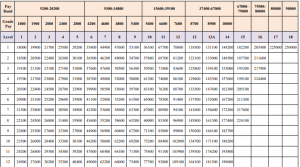
The Ministry of finance vide notification dated 25th July 2016 issued rules for 7th pay commission. The rules include a Schedule which shows categorically what payment has to be made to different positions. The said schedule is called 7th pay matrix
For the reference the table(7th pay matrix) is attached below.
Pay Band & Grade Pay
According to the table given above the first column shows the Pay band.
Pay Band is a pay scale according to the pay grades. It is a part of the salary process as it is used to rank different jobs by education, responsibility, location, and other multiple factors. The pay band structure is based on multiple factors and assigned pay grades should correlate with the salary range for the position with a minimum and maximum. Pay Band is used to define the compensation range for certain job profiles.
Here, Pay band is a part of an organized salary compensation plan, program or system. The Central and State Government has defined jobs, pay bands are used to distinguish the level of compensation given to certain ranges of jobs to have fewer levels of pay, alternative career tracks other than management, and barriers to hierarchy to motivate unconventional career moves. For example, entry-level positions might include security guard or karkoon. Those jobs and those of similar levels of responsibility might all be included in a named or numbered pay band that prescribed a range of pay.
The detailed calculation process of salary according to the pay matrix table is given under Rule 7 of the Central Civil Services (Revised Pay) Rules, 2016.
As per Rule 7A(i), the pay in the applicable Level in the Pay Matrix shall be the pay obtained by multiplying the existing basic pay by a factor of 2.57, rounded off to the nearest rupee and the figure so arrived at will be located in that Level in the Pay Matrix and if such an identical figure corresponds to any Cell in the applicable Level of the Pay Matrix, the same shall be the pay, and if no such Cell is available in the applicable Level, the pay shall be fixed at the immediate next higher Cell in that applicable Level of the Pay Matrix.
The detailed table as mentioned in the Rules showing the calculation:
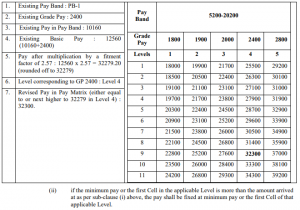
For example if your pay in Pay Band is 5200 (initial pay in pay band) and Grade Pay of 1800 then 5200+1800= 7000, now the said amount of 7000 would be multiplied to 2.57 as mentioned in the Rules. 7000 x 2.57= 17,990 so as per the rules the nearest amount the figure shall be fixed as pay level. Which in this case would be 18000/-.
The basic pay would increase as your experience at that job would increase as specified in vertical cells. For example if you continue to serve in the Basic Pay of 18000/- for 4 years then your basic pay would be 19700/- as mentioned in the table.
Dearness Allowance
However, the basic pay mentioned in the table is not the only amount of remuneration an employee receives. There are catena of benefits and further additions in the salary such as dearness allowance, HRA, TADA.
According to the Notification No. 1/1/2023-E.II(B) from the Ministry of Finance and Department of Expenditure, the Dearness Allowance payable to Central Government employees was enhanced from rate of 38% to 42% of Basic pay with effect from 1st January 2023.
Here, DA would be calculated on the basic salary. For example if your basic salary is of 18,000/- then 42% DA would be of 7,560/-
House Rent Allowance
Apart from that the HRA (House Rent Allowance) is also provided to employees according to their place of duties. Currently cities are classified into three categories as ‘X’ ‘Y’ ‘Z’ on the basis of the population.
According to the Compendium released by the Ministry of Finance and Department of Expenditure in Notification No. 2/4/2022-E.II B, the classification of cities and rates of HRA as per 7th CPC was introduced.
See the table for reference
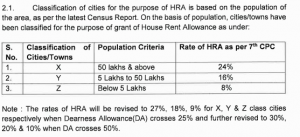
However, after enhancement of DA from 38% to 42% the HRA would be revised to 27%, 18%, and 9% respectively.
As above calculated the DA on Basic Salary, in the same manner HRA would also be calculated on the Basic Salary. Now considering that the duty of an employee’s Job is at ‘X’ category of city then HRA will be calculated at 27% of basic salary.
Here, continuing with the same example of calculation with a basic salary of 18000/-, the amount of HRA would be 4,840/-
Transport Allowance
After calculation of DA and HRA, Central government employees are also provided with Transport Allowance (TA). After the 7th CPC the revised rates of Transport Allowance were released by the Ministry of Finance and Department of Expenditure in the Notification No. 21/5/2017-EII(B) wherein, a table giving detailed rates were produced.
The same table is reproduced hereinafter.

As mentioned above in the table, all the employees are given Transport Allowance according to their pay level and place of their duties. The list of annexed cities are given in the same Notification No. 21/5/2017-EII(B).
Again, continuing with the same example of calculation with a Basic Salary of 18000/- and assuming place of duty at the city mentioned in the annexure, the rate of Transport Allowance would be 1350/-
Apart from that, DA on TA is also provided as per the ongoing rate of DA. For example, if TA is 1350/- and rate of current DA on basic Salary is 42% then 42% of TA would be added to the calculation of gross salary. Here, DA on TA would be 567/-.
Calculation of Gross Salary
After calculating all the above benefits the Gross Salary is calculated.
Here, after calculating Basic Salary+DA+HRA+TA the gross salary would be 32,317/-
However, the Gross Salary is subject to few deductions such as NPS, Professional Tax, Medical as subject to the rules and directions by the Central Government. After the deductions from the Gross Salary an employee gets the Net Salary on hand.
However, it is pertinent to note that benefits such as HRA and TA are not absolute, these allowances are only admissible if an employee is not provided with a residence by the Central Government or facility of government transport.
Conclusion
Government service is not a contract. It is a status. The employees expect fair treatment from the government. The States should play a role model for the services. The Apex Court in the case of Bhupendra Nath Hazarika and another vs. State of Assam and others (reported in 2013(2)Sec 516) has observed as follows:
“………It should always be borne in mind that legitimate aspirations of the employees are not guillotined and a situation is not created where hopes end in despair. Hope for everyone is gloriously precious and that a model employer should not convert it to be deceitful and treacherous by playing a game of chess with their seniority. A sense of calm sensibility and concerned sincerity should be reflected in every step. An atmosphere of trust has to prevail and when the employees are absolutely sure that their trust shall not be betrayed and they shall be treated with dignified fairness then only the concept of good governance can be concretized. We say no more.”
The consideration while framing Rules and Laws on payment of wages, it should be ensured that employees do not suffer economic hardship so that they can deliver and render the best possible service to the country and make the governance vibrant and effective.
Written by Husain Trivedi Advocate

Renewable Energy Land Policy: Solar Parks, Wind Farms, and Grid Infrastructure

Introduction
India’s renewable energy sector has emerged as a cornerstone of the nation’s climate commitments and energy security strategy, necessitating a comprehensive renewable energy land policy to guide land acquisition, utilization, and transmission infrastructure development. With the sector growing from 89.635 GW in 2022 towards the ambitious target of 500 GW by 2030, there is an increasing need to balance development objectives with agricultural sustainability, environmental protection, and community rights [1]. This transformation requires a deep understanding of the legal framework governing solar parks, wind farms, and grid infrastructure, including constitutional federalism, statutory provisions, and emerging jurisprudence that shape land rights in India.
The Ministry of New and Renewable Energy (MNRE) estimates that achieving India’s renewable energy targets may require between 50,000-75,000 square kilometers of land for solar installations and 1,500-2,000 square kilometers for wind infrastructure, representing approximately 2% of India’s total surface area [2]. This massive land requirement has catalyzed the development of specialized legal frameworks, from the National Solar Mission’s guidelines to state-specific policies addressing land lease arrangements, compensation mechanisms, and transmission corridor development.
Constitutional Framework and Federal-State Dynamics
Constitutional Division of Powers
The renewable energy sector operates within India’s federal constitutional structure, where electricity is a concurrent subject under the Seventh Schedule, necessitating coordination between Union and state authorities. Article 246 places “electricity” in the Concurrent List (Entry 38), while land remains a state subject under Entry 18 of the State List [3]. This jurisdictional framework creates a complex regulatory environment where renewable energy policy formulation occurs at the Union level while land acquisition and local approvals remain state prerogatives.
The Electricity Act, 2003, provides the foundational legal framework for renewable energy development, establishing regulatory institutions and market mechanisms. Section 86(1)(e) specifically mandates State Electricity Regulatory Commissions to “promote cogeneration and generation of electricity from renewable sources of energy” [4]. This provision creates binding obligations on state regulators to facilitate renewable energy development while respecting state sovereignty over land resources.
Recent Constitutional Developments
The Supreme Court’s decision in Mineral Area Development Authority v. Steel Authority of India (2024) has significant implications for renewable energy projects, particularly regarding state taxation powers over mineral-bearing lands that may be utilized for renewable energy installations. The Court’s holding that states retain taxation authority over mineral rights, subject to express Parliamentary limitations, affects the fiscal framework for renewable energy projects on mineral-rich lands [5].
Furthermore, the Court’s recent modification of its Great Indian Bustard order demonstrates judicial recognition of the renewable energy imperative. The Court constituted an expert committee to determine the feasibility of overhead versus underground transmission lines in Rajasthan and Gujarat, acknowledging the “intricate interface between conservation of an endangered species and the imperative of protecting against climate change” [6].
Solar Park Development Framework
National Solar Mission and Institutional Architecture
The Jawaharlal Nehru National Solar Mission (JNNSM), launched in January 2010 with an enhanced target of 100 GW by 2022, established the policy foundation for large-scale solar development. The Mission’s guidelines for solar park development prioritize government wasteland and non-agricultural land to expedite acquisition processes while minimizing displacement of agricultural communities [7].
MNRE’s December 2014 notification on the “Scheme for Development of Solar Parks and Ultra Mega Solar Power Projects” provides the comprehensive regulatory framework for solar park establishment. The scheme mandates that solar parks must have “at least 5 acres per MW towards installation of solar projects” and requires state governments to identify suitable land with appropriate insolation levels near transmission infrastructure [8].
Land Acquisition and Compensation Mechanisms
Solar park development involves multiple land acquisition pathways, each with distinct legal implications. The Gujarat model, revised in 2020, establishes a 40-year lease structure with the first five years for park development and 35 years for generation activities. The policy mandates Rs. 15,000 per hectare annual rent plus applicable taxes, with security deposits of Rs. 200,000 per MW [9].
The compensation framework addresses both land acquisition and rehabilitation requirements. For projects requiring private land acquisition, the provisions of the Right to Fair Compensation and Transparency in Land Acquisition, Rehabilitation and Resettlement Act, 2013 (LARR Act) apply, ensuring enhanced compensation and rehabilitation measures. However, solar park guidelines encourage minimizing private land acquisition through strategic site selection [10].
Specialized Solar Park Policies
State governments have developed nuanced policies reflecting local conditions and priorities. The Rajasthan Solar Energy Policy provides specific provisions for land allotment, including preferential rates for government land and streamlined procedures for land conversion from agricultural to industrial status. The policy establishes clear timelines for project development, with milestones for capacity installation and penalties for non-compliance [11].
Karnataka’s experience with the Pavagada Solar Park, involving lease agreements with approximately 1,800 farmers across five villages for 5,260 hectares, demonstrates both the potential and challenges of large-scale solar development. The project’s lease model provides annual payments to farmers while maintaining agricultural activities in non-solar areas, creating a framework for rural economic development alongside renewable energy generation [12].
Wind Energy Land Rights and Development
Wind Resource Assessment and Site Selection
Wind energy development requires extensive resource assessment and site identification, governed by the National Institute of Wind Energy’s technical guidelines. The legal framework recognizes wind energy’s unique land use characteristics, where installations occupy only 2% of wind farm area, facilitating continued agricultural activities [13]. This land use efficiency creates opportunities for multiple land use arrangements while ensuring minimal disruption to existing agricultural practices.
The National Wind Energy Policy emphasizes competitive bidding for wind project allocation, requiring coordination between central auction mechanisms and state land availability. The Central Electricity Regulatory Commission’s 2019 amendments to interstate transmission regulations specifically include renewable energy developers and wind park operators, facilitating grid integration [14].
Land Lease Arrangements and Community Participation
Wind farm development typically involves long-term lease agreements with landowners, spanning 25-30 years to align with project lifecycles. These arrangements provide annual rental income to farmers while preserving agricultural land use rights. Maharashtra’s wind energy policy exemplifies this approach, establishing standardized lease terms and annual payment structures based on wind turbine capacity and land area [15].
The wind sector’s land requirements differ significantly from solar installations, with transmission infrastructure representing the primary land acquisition challenge. Right-of-way acquisition for evacuation lines often involves multiple landowners and requires coordination between wind developers and transmission utilities. The Supreme Court’s Great Indian Bustard order initially mandated underground transmission lines in critical habitats, subsequently modified to allow expert committee recommendations on feasible approaches [16].
Wind-Solar Hybrid Projects and Land Optimization
The National Wind-Solar Hybrid Policy, 2018, promotes optimal land utilization through combined installations. The policy defines hybrid projects where either renewable source constitutes at least 25% of the other’s rated capacity, enabling improved capacity utilization factors and transmission infrastructure optimization [17]. This approach addresses land availability constraints while enhancing project economics through complementary generation profiles.
MNRE’s 2018 scheme for 2,500 MW of interstate transmission-connected wind-solar hybrid projects initially focused on battery storage integration, subsequently expanded to include pumped hydro, compressed air, and other storage technologies. This comprehensive approach recognizes storage infrastructure’s land requirements and regulatory frameworks [18].
Grid Infrastructure and Transmission Development
Transmission Planning and Land Acquisition
Grid infrastructure development for renewable energy integration requires systematic transmission planning and coordinated land acquisition strategies. The Central Electricity Authority’s National Electricity Plan emphasizes renewable energy evacuation infrastructure, necessitating proactive transmission capacity development ahead of generation additions.
The Power Grid Corporation of India Limited (PGCIL) manages interstate transmission development through competitive bidding and public-private partnership structures. PGCIL’s Infrastructure Investment Trust monetizes transmission assets to fund new construction, creating innovative financing mechanisms for grid expansion [19]. The company’s approach to land acquisition follows the Indian Telegraph Act, 1885, for transmission line right-of-way, providing specific compensation mechanisms distinct from general land acquisition frameworks.
Green Energy Corridors and Specialized Infrastructure
The Green Energy Corridor initiative, launched to facilitate renewable power evacuation, addresses transmission bottlenecks constraining renewable energy integration. Phase-I focuses on states with high renewable energy potential, establishing dedicated transmission infrastructure for wind and solar power evacuation. The project’s land acquisition strategy prioritizes government land while ensuring community consultation and environmental compliance [20].
Intrastate transmission development remains state responsibility, creating coordination challenges for renewable energy projects spanning multiple states. The Central Electricity Regulatory Commission’s connectivity and open access regulations provide frameworks for renewable energy developers to access transmission networks, but land acquisition procedures vary significantly across states [21].
Smart Grid Integration and Digital Infrastructure
The National Smart Grid Mission’s land requirements extend beyond traditional transmission infrastructure to include communication networks, advanced metering infrastructure, and grid management centers. Smart grid development involves coordination between power and telecommunications sectors, creating novel land use requirements and regulatory interfaces [22].
Energy storage infrastructure, particularly pumped hydro storage, requires substantial land areas and specialized environmental clearances. The National Electricity Storage Strategy emphasizes reducing grid connection costs and supporting storage facility construction, necessitating integrated land use planning for renewable energy and storage infrastructure [23].
Legal Challenges and Dispute Resolution
Land Acquisition Disputes and Compensation Issues
Renewable energy projects face increasing litigation regarding land acquisition procedures, compensation adequacy, and environmental compliance. Solar project developers encounter disputes over traditional grazing rights, easement claims, and family land ownership conflicts. The litigation pattern demonstrates the need for enhanced community consultation and transparent compensation mechanisms [24].
The Supreme Court’s intervention in transmission infrastructure development, particularly the Great Indian Bustard case, illustrates the complex balance between environmental protection and renewable energy development. The Court’s expert committee approach provides a template for resolving conflicts between conservation imperatives and climate mitigation objectives [25].
Environmental Clearance and Regulatory Compliance
Environmental clearance requirements for renewable energy projects involve multiple agencies and assessment procedures. Large solar parks require Environmental Impact Assessment under the EIA Notification, 2006, while wind projects require bird impact assessments and wildlife clearances. The clearance process coordination between environment and energy ministries affects project timelines and land holding costs [26].
Forest land diversion for transmission infrastructure follows the Forest (Conservation) Act, 1980, requiring prior Central Government approval. The compensatory afforestation requirements and forest clearance timelines significantly impact grid infrastructure development schedules and project economics [27].
Innovation in Legal Frameworks: Agrivoltaics and Multiple Land Use
Emerging legal frameworks address innovative land use models like agrivoltaics, enabling simultaneous agricultural and solar energy production. These systems require regulatory adaptation to address land classification, taxation, and subsidy eligibility issues. Research indicates agrivoltaic systems can maintain agricultural productivity while generating renewable energy, necessitating policy frameworks supporting multiple land use [28].
The legal framework for agrivoltaics involves coordination between agriculture and energy policies, affecting land revenue classification, agricultural subsidy eligibility, and electricity regulations. State governments are developing specific guidelines for agrivoltaic installations to address farmer concerns about soil fertility and groundwater impacts [29].
Contemporary Policy Developments and Future Directions
Ultra Mega Renewable Energy Parks
MNRE’s February 2022 notification establishing 50 GW ultra-mega renewable energy parks in Gujarat (Khavada) and Rajasthan (Jaisalmer) represents the sector’s largest land allocation initiative. Each 25 GW park requires unprecedented coordination between land acquisition, transmission development, and environmental clearance processes [30].
The ultra-mega parks utilize wasteland areas to minimize agricultural displacement while requiring substantial transmission infrastructure investment. The projects’ success depends on streamlined land acquisition procedures, environmental compliance frameworks, and community participation mechanisms ensuring local benefit sharing [31].
Technology Integration and Land Use Optimization
Digitalization initiatives, including blockchain-based land record management and satellite-based resource assessment, enhance land acquisition transparency and project planning accuracy. The Digital India Land Records Modernization program’s integration with renewable energy planning databases reduces documentation delays and ownership verification challenges [32].
Floating solar technology development on water bodies represents a land use alternative reducing terrestrial land requirements. The National Solar Mission’s amendments addressing floating solar installations require coordination between water resource management and renewable energy policies, affecting reservoir usage rights and fishing community livelihoods [33].
Interstate Coordination and Uniform Policy Development
The proposed national land acquisition policy for renewable energy projects aims to standardize procedures across states while respecting federal principles. The policy development involves consultation between MNRE, state governments, and renewable energy industry associations to address regulatory fragmentation and procedural delays [34].
Competitive Renewable Energy Zones (CREZ) concept development, inspired by international models, requires proactive transmission infrastructure development and coordinated land acquisition. CREZ implementation necessitates interstate agreements on resource sharing, transmission cost allocation, and revenue distribution mechanisms [35].
Economic Analysis and Investment Implications
Land Cost Impact on Project Economics
Land acquisition costs represent 8-12% of total project costs for utility-scale solar installations and 5-8% for wind projects, significantly affecting renewable energy competitiveness. The variation in land costs across states influences investment patterns and project site selection, with developers gravitating toward states with transparent land policies and reasonable lease rates [36].
The emergence of land leasing models provides alternatives to outright purchase, reducing upfront capital requirements while ensuring long-term land access. Lease arrangements with escalation clauses and revenue-sharing provisions create mechanisms for landowner participation in project economics, addressing community acceptance challenges [37].
Insurance and Risk Management
Renewable energy projects require specialized insurance coverage for land-related risks, including title disputes, environmental liabilities, and transmission corridor access. The insurance framework addresses force majeure events, regulatory changes affecting land use rights, and community opposition impacts on project operations [38].
Land title insurance products, emerging in renewable energy financing, provide protection against ownership disputes and encumbrance discovery. These products facilitate international investment by addressing due diligence concerns and providing recourse mechanisms for title-related losses [39].
Conclusion
India’s renewable energy land policy framework represents a dynamic intersection of constitutional federalism, environmental imperatives, and development priorities, requiring continuous adaptation to technological innovation and climate commitments. The sector’s growth trajectory from current capacity levels toward 500 GW by 2030 necessitates systematic policy evolution addressing land availability constraints, community participation mechanisms, and environmental protection requirements.
The legal architecture encompassing solar parks, wind farms, and grid infrastructure demonstrates sophisticated policy development responsive to diverse stakeholder needs while maintaining focus on renewable energy objectives. The National Solar Mission’s emphasis on wasteland utilization, wind energy’s multiple land use capabilities, and transmission infrastructure’s coordinated planning approach provide templates for sustainable renewable energy development.
Future renewable energy land policy directions must address emerging challenges, including technology integration, interstate coordination, and innovative land-use models such as agrivoltaics. The Supreme Court’s evolving jurisprudence on environmental protection and renewable energy development recognizes climate change mitigation as a constitutional imperative, requiring a balanced approach to conservation and development objectives.
The success of the renewable energy sector depends on continued innovation in land policy, focusing on streamlined land acquisition, improved compensation mechanisms, and enhanced community participation. The integration of digital technologies, standardized procedures, and transparent governance will be critical for India to achieve its renewable energy goals while ensuring equitable and sustainable land-use transformation.
As India advances toward its net-zero commitments, the renewable energy land policy framework must evolve to address scale requirements, technological developments, and social acceptance challenges. The foundation established through current legal frameworks provides a robust platform for this transformation, requiring adaptive management and stakeholder engagement to ensure successful implementation of India’s renewable energy vision.
References
[1] Ministry of New and Renewable Energy, Government of India. India’s Progress Towards Renewable Energy Targets 2024. Available at: https://mnre.gov.in/
[4] The Electricity Act, 2003, Section 86(1)(e).
[5] Mineral Area Development Authority v. Steel Authority of India Ltd., 2024 SCC OnLine SC 1796
[6] Supreme Court of India. Great Indian Bustard v. Union of India, Modified Order 2024
[7] Jawaharlal Nehru National Solar Mission Guidelines, 2010. Ministry of New and Renewable Energy
[9] Gujarat Solar Park Policy Amendment, 2020. Gujarat Energy Development Agency
Industrial Land Allocation: SEZ Act, Industrial Parks, and Land Banking

Abstract
Industrial land allocation in India operates through a sophisticated regulatory framework encompassing Special Economic Zones, industrial parks, and strategic land banking mechanisms. This article examines the legal architecture governing industrial land development, analyzing the Special Economic Zones Act, 2005, industrial park policies, and emerging land banking initiatives. The analysis reveals the evolution from traditional industrial estates to integrated townships, highlighting challenges in land acquisition, regulatory compliance, and sustainable development while exploring contemporary innovations in industrial land management and allocation systems.
Introduction
India’s industrial transformation requires systematic allocation and development of land resources to support manufacturing growth, export promotion, and employment generation. The regulatory framework governing industrial land allocation has evolved significantly since economic liberalization, incorporating specialized legislation for export-oriented development, integrated industrial townships, and strategic land reserves.
The contemporary landscape encompasses multiple institutional mechanisms, from Special Economic Zones designed for export promotion to comprehensive industrial corridors supporting integrated manufacturing ecosystems. Understanding this complex framework requires analysis of statutory provisions, institutional arrangements, and implementation challenges that shape Industrial Land Allocation across different scales and sectors.
The intersection of land acquisition law, environmental regulations, and industrial policy creates a multi-layered governance system that must balance development imperatives with social and environmental concerns. Recent innovations in land banking and digital platforms demonstrate evolving approaches to Industrial Land Allocation, while ongoing policy reforms seek to address systemic challenges in land availability, acquisition procedures, and regulatory compliance.
Special Economic Zones: Legal Framework and Implementation
The Special Economic Zones Act, 2005
The Special Economic Zones Act, 2005, represents a paradigmatic shift in India’s approach to export promotion and industrial development. Enacted to “provide for the establishment, development and management of the Special Economic Zones for the promotion of exports,” the Act creates a comprehensive legal framework for integrated industrial townships with specialized regulatory regimes. [1]
Section 3 of the SEZ Act establishes the fundamental requirement for Central Government notification before SEZ establishment, ensuring central oversight of zone development. The notification process requires consideration of factors including “economic potential of the area,” “availability of infrastructure,” and “development plans of the State Government,” creating a comprehensive assessment framework for zone viability.
The Act’s definitional framework distinguishes between “Developers” who establish zones and “Units” that operate within them. Section 2(g) defines a Developer as “a person who or a State Government which has been granted by the Central Government a letter of approval,” while Units encompass all manufacturing and service enterprises operating within SEZ boundaries.
Section 4 specifies minimum area requirements of 1,000 hectares for multi-product SEZs and 100 hectares for sector-specific zones, though subsequent amendments have reduced requirements for specialized sectors. Recent amendments for semiconductor manufacturing have reduced minimum land requirements from 50 hectares to 10 hectares, demonstrating policy responsiveness to sector-specific needs. [2]
The Act establishes a dual regulatory structure through the Board of Approval under Section 8 and zone-specific SEZ Authorities under Section 34. The Board of Approval, chaired by the Secretary of the Department of Commerce, approves zone establishment and major policy decisions, while SEZ Authorities manage operational oversight and regulatory compliance within individual zones.
Land Acquisition and Development Framework
SEZ development requires substantial land acquisition, typically involving both voluntary purchase and state-facilitated acquisition. Section 28 empowers state governments to declare SEZ development as “public purpose” under land acquisition legislation, facilitating compulsory acquisition where necessary.
The integration of SEZ development with the Right to Fair Compensation and Transparency in Land Acquisition, Rehabilitation and Resettlement Act, 2013 (LARR Act), creates complex procedural requirements. While SEZ development qualifies as “public purpose,” the LARR Act requires consent of 70% of affected families for public projects and 80% for public-private partnerships, significantly impacting acquisition timelines and costs.
Recent case law demonstrates judicial scrutiny of SEZ land acquisition, particularly regarding the relationship between export promotion objectives and displacement impacts. Courts have emphasized the requirement for genuine export orientation rather than speculative land development, establishing precedents for scrutinizing acquisition justifications.
The SEZ Act provides fiscal incentives to facilitate land acquisition and development, including customs duty exemptions, income tax benefits, and simplified regulatory procedures. These incentives aim to offset land acquisition costs and administrative complexities, though their effectiveness varies significantly across different states and sectors.
Regulatory Framework and Compliance
SEZ operations require compliance with multiple regulatory frameworks, integrated through the “single window clearance” mechanism under Section 14 of the Act. This system aims to provide unified approval processes for manufacturing licenses, environmental clearances, and other regulatory requirements.
Environmental clearance for SEZ projects follows specialized procedures under the Environmental Impact Assessment Notification, 2006. Large SEZs require Category A clearance from the central government, while smaller zones may qualify for state-level Category B clearance, though specific requirements depend on sectoral composition and environmental sensitivity.
The integration of labor law compliance within SEZ regulatory frameworks creates unique challenges, as units must follow Indian labor legislation while maintaining competitive operational flexibility. Recent amendments have attempted to balance labor protection with operational efficiency, though implementation remains contentious.
Tax compliance within SEZs involves dual tracking systems for export and domestic sales, with different tax treatment for each category. The introduction of Goods and Services Tax has simplified some aspects of SEZ taxation while creating new compliance requirements for units engaged in both export and domestic markets.
Industrial Parks and Estates Development
Policy Framework and Institutional Mechanisms
Industrial parks represent a broader category of industrial development encompassing various scales and sectoral focuses. Unlike SEZs, industrial parks do not require central government approval but operate under state industrial policies and development authority oversight.
State Industrial Development Corporations (SIDCs) typically spearhead industrial park development, acquiring land, developing infrastructure, and allocating plots to industrial units. Organizations like the Uttar Pradesh State Industrial Development Authority (UPSIDA) have developed comprehensive land banks spanning 25,000 acres across 75 districts, demonstrating systematic approaches to industrial land management. [3]
The National Manufacturing Policy, 2011, envisioned establishment of National Investment and Manufacturing Zones (NIMZs) as large-scale integrated industrial townships. Though the NIMZ concept has evolved into broader industrial corridor initiatives, it established important precedents for comprehensive planning and infrastructure integration.
Recent policy developments emphasize cluster-based development and sector-specific parks, such as pharmaceutical parks, textile clusters, and automotive hubs. These specialized parks leverage sectoral synergies while addressing specific infrastructure and regulatory requirements for targeted industries.
Land Allocation Mechanisms and Procedures
Industrial park land allocation typically follows standardized procedures involving application submission, technical evaluation, and allotment approval. State industrial development authorities have increasingly adopted transparent allocation mechanisms including e-auctions and online application systems.
The Uttar Pradesh experience demonstrates systematic land allocation evolution, with e-auction implementation resulting in a three-fold increase in plot allotments from 191 plots in 2017-18 to 693 plots in subsequent years. This transparency enhancement has improved allocation efficiency while reducing corruption risks.
Plot allocation criteria typically consider investment commitments, employment generation potential, environmental compliance, and sectoral priorities. Some states provide preferential allocation for MSME units, export-oriented industries, or specific sectors aligned with state industrial policies.
Recent innovations include “plug and play” infrastructure provision, where industrial development authorities provide ready-to-use plots with utilities and approvals in place. This approach reduces setup time for industrial units while ensuring systematic infrastructure development.
Integration with Industrial Corridor Development
The National Industrial Corridor Development Programme represents India’s most ambitious industrial land development initiative, encompassing 11 corridors across multiple states. The Delhi-Mumbai Industrial Corridor (DMIC), as the flagship project, demonstrates integrated approaches to industrial land development spanning 1,504 kilometers with investment commitments exceeding $90 billion. [4]
DMIC project implementation involves establishment of Integrated Industrial Townships (IITs) and Special Investment Regions (SIRs) providing comprehensive industrial infrastructure. Land allotment in these projects follows competitive bidding processes with emphasis on anchor industries and integrated value chain development.
The National Industrial Corridor Development Corporation (NICDC) coordinates corridor development through Special Purpose Vehicles (SPVs) established for individual projects. This institutional framework ensures professional project management while facilitating state-central coordination.
Recent progress includes completion of trunk infrastructure at Dholera Special Investment Region (Gujarat), Shendra-Bidkin Industrial Area (Maharashtra), and Integrated Industrial Townships in Greater Noida and Vikram Udyogpuri. Land allotment processes have commenced with significant investor interest from domestic and international companies.
Land Banking Mechanisms and Digital Platforms
India Industrial Land Bank (IILB) Initiative
The India Industrial Land Bank represents a transformative approach to industrial land information management, providing a GIS-enabled database of industrial areas across the country. Developed by the Department for Promotion of Industry and Internal Trade (DPIIT) in collaboration with Invest India and the Ministry of Electronics and Information Technology, IILB provides comprehensive information on over 4,500 industrial parks spanning 5.06 lakh hectares. [5]
The platform integrates with industry-based GIS systems of 34 states and union territories, ensuring real-time information updates on land availability, plot characteristics, and infrastructure facilities. This integration represents a significant advancement in transparency and accessibility of industrial land information.
IILB provides investors with detailed information including raw material availability, sectoral parks, land allocation status, and connectivity infrastructure. The platform supports advanced search capabilities enabling investors to identify suitable locations based on multiple parameters including sector preferences, land area requirements, and connectivity priorities.
The mobile application and web-based interface ensure accessibility across different user categories, from small entrepreneurs to multinational corporations. This democratization of land information reduces information asymmetries while facilitating informed investment decisions.
State-Level Land Banking Initiatives
Several states have developed sophisticated land banking mechanisms to ensure systematic industrial land availability. Uttar Pradesh’s comprehensive land bank spanning 25,000 acres represents one of the largest state-level initiatives, with strategic distribution across 75 districts to support the state’s trillion-dollar economy target by 2027.
Gujarat’s innovative approach includes establishment of land recovery mechanisms through the Gujarat Industrial Development Corporation (GIDC), offering up to 75% market value reimbursement for voluntary land surrender by industries. This approach addresses land hoarding while ensuring efficient utilization of industrial land resources.
West Bengal’s conversion of leasehold to freehold land during 2022-23 demonstrates policy innovation in land tenure arrangements, facilitating greater investment security while generating revenue for the state. The Vidyasagar Industrial Park near Kharagpur exemplifies successful utilization of underutilized industrial land for new ventures.
Telangana’s identification and notification of approximately 1,800 acres of unutilized government land allocated between 2004-2014 demonstrates systematic approaches to land auditing and recovery. The state’s substantial land allocation to Foxconn (200 acres) while recovering underutilized land illustrates balanced land management strategies.
Technological Innovation in Land Management
Digital platforms are revolutionizing industrial land management through real-time monitoring, transparent allocation processes, and integrated information systems. The integration of GIS technology enables precise land mapping, infrastructure assessment, and connectivity analysis supporting informed decision-making.
Satellite-based monitoring systems facilitate land use compliance tracking and infrastructure development progress assessment. These systems enable authorities to monitor approved project implementation while identifying underutilized or improperly used industrial land.
Blockchain technology applications in land record management promise enhanced transparency and reduced disputes in land transactions. Pilot projects in several states demonstrate potential for immutable land records and automated compliance monitoring.
Artificial intelligence applications in land suitability analysis consider multiple parameters including topography, connectivity, environmental constraints, and market proximity to recommend optimal land allocation strategies. These tools support systematic planning while optimizing resource utilization.
Regulatory Challenges and Compliance Framework
Land Acquisition and Consent Requirements
The intersection of industrial development with land acquisition law creates significant procedural complexities in industrial land allocation. The LARR Act, 2013, requires consent of 70% of affected families for public purpose projects and 80% for public-private partnerships, substantially impacting industrial project timelines and viability.
Recent amendments to the LARR Act have attempted to streamline acquisition for certain categories of industrial projects, including industrial corridors and infrastructure projects. However, implementation challenges persist, particularly regarding consent obtaining procedures and social impact assessment requirements.
Environmental compliance requirements add additional layers of complexity, with industrial projects requiring clearances under multiple statutes including the Environment Protection Act, Water Act, Air Act, and Forest Conservation Act. Coordination among different regulatory authorities remains a persistent challenge affecting project timelines.
The integration of tribal rights considerations under the Forest Rights Act, 2006, requires careful attention in areas with significant tribal populations. Industrial projects affecting forest land must demonstrate compliance with forest rights recognition processes and community consent requirements.
Infrastructure Development and Utilities
Industrial land development requires substantial infrastructure investment including roads, power supply, water systems, waste treatment facilities, and telecommunications connectivity. Coordination among different agencies responsible for various infrastructure components often creates implementation bottlenecks.
The development of “plug and play” infrastructure represents an attempt to address these coordination challenges by providing ready-to-use industrial plots with utilities and approvals in place. However, maintaining infrastructure quality and ensuring adequate capacity for growing industrial requirements remains challenging.
Water resource availability increasingly constrains industrial development, particularly in water-stressed regions. Industrial projects must demonstrate sustainable water management plans while ensuring adequate supply for operational requirements.
Power supply reliability remains critical for industrial competitiveness, with many industrial parks developing captive power generation capabilities. The integration of renewable energy systems in industrial parks represents an emerging trend supporting sustainability objectives while ensuring energy security.
Financial Mechanisms and Incentives
Industrial land development requires substantial capital investment, often supported by various financial mechanisms including government grants, concessional loans, and private investment. The National Industrial Corridor Development and Implementation Trust (NICDIT) provides structured financing for corridor projects through blended finance mechanisms.
State governments provide various incentives for industrial land acquisition and development, including stamp duty reductions, infrastructure subsidies, and expedited approval processes. However, the effectiveness of these incentives varies significantly across states and sectors.
Land lease versus sale policies affect long-term industrial development patterns, with leasing arrangements providing government revenue streams while potentially constraining private investment in land improvements. Different states follow varying policies regarding land tenure arrangements for industrial purposes.
Performance-based incentives increasingly link benefits to actual industrial performance including investment commitments, employment generation, and export achievements. These mechanisms aim to ensure efficient land utilization while supporting policy objectives.
Case Studies and Implementation Experiences
Special Economic Zone Development Outcomes
As of March 2024, 280 operational SEZs demonstrate varied success levels across different sectors and locations. Tamil Nadu leads with 54 operational SEZs, contributing significantly to state exports while providing employment for thousands of workers.
The Dholera Special Investment Region in Gujarat represents one of the most ambitious SEZ projects, spanning 22.5 square kilometers with comprehensive infrastructure development. Despite initial challenges including land acquisition delays and infrastructure coordination issues, the project has attracted significant investments across automotive, pharmaceutical, and engineering sectors.
Shendra-Bidkin Industrial Area near Aurangabad demonstrates successful SEZ development with completed trunk infrastructure and initiated land allotment. The project’s integration with Aurangabad’s existing industrial base provides synergistic advantages while supporting regional economic development.
IT/ITES SEZs have achieved significant success in cities like Hyderabad, Chennai, and Pune, leveraging existing IT infrastructure and skilled workforce availability. These zones demonstrate the effectiveness of sector-specific development approaches while contributing substantially to software exports.
Industrial Corridor Implementation Progress
The Delhi-Mumbai Industrial Corridor has made substantial progress with completed trunk infrastructure at four locations and initiated land allotment processes. Investment commitments exceeding INR 16,760 crore across 173 allotted plots demonstrate investor confidence while generating approximately 21,000 employment opportunities.
International investment participation includes companies from South Korea, Russia, China, UK, and Japan, demonstrating the corridor’s global appeal. MSME participation alongside large anchor industries provides inclusive development while supporting diverse industrial ecosystem development.
Infrastructure completion at Integrated Industrial Township Greater Noida and Vikram Udyogpuri has enabled commencement of manufacturing operations by several units. These early successes provide demonstration effects encouraging additional investments.
The integration of logistics and connectivity infrastructure through dedicated freight corridors substantially reduces transportation costs while improving competitiveness. Container travel time reduction from 50 hours to 17 hours demonstrates infrastructure efficiency gains.
State-Level Innovation Examples
Gujarat’s land recovery initiative through GIDC has successfully retrieved underutilized industrial land while providing fair compensation to original allottees. This approach addresses land hoarding concerns while ensuring efficient utilization of scarce land resources.
Uttar Pradesh’s systematic land banking approach across 75 districts provides comprehensive coverage supporting diverse industrial development requirements. The state’s focus on women-centric facilities under the Atal Industrial Infrastructure Mission demonstrates inclusive development approaches.
Karnataka’s Campus Industrial Park Scheme 2024 represents innovative utilization of higher education institution land for industrial purposes, addressing land scarcity while leveraging institutional infrastructure and human resources.
West Bengal’s conversion of leasehold to freehold land has facilitated greater investment security while generating revenue for the state. The success of Vidyasagar Industrial Park demonstrates effective utilization of previously underutilized industrial space.
Environmental and Social Considerations
Environmental Compliance and Sustainability
Industrial land development must comply with comprehensive environmental regulations including Environmental Impact Assessment requirements, pollution control measures, and waste management standards. Large industrial parks require Category A environmental clearance involving detailed assessment of cumulative environmental impacts.
Common Effluent Treatment Plants (CETPs) and Treatment, Storage, and Disposal Facilities (TSDFs) represent important infrastructure components for sustainable industrial development. Industrial park developers must ensure adequate pollution control infrastructure while maintaining cost-effectiveness for industrial units.
Water resource sustainability increasingly influences industrial location decisions, with many parks developing rainwater harvesting, wastewater recycling, and water-efficient technologies. Industrial corridors incorporate comprehensive water management plans considering regional water availability and sustainability requirements.
Carbon footprint reduction initiatives in industrial parks include renewable energy integration, energy-efficient infrastructure, and green building standards. Several industrial corridors have committed to carbon neutrality targets supporting national climate change mitigation objectives.
Social Impact and Community Engagement
Land acquisition for industrial development often affects agricultural communities, requiring careful attention to rehabilitation and resettlement requirements. The LARR Act mandates comprehensive social impact assessment and community consultation processes for major industrial projects.
Employment generation represents a primary social benefit of industrial development, though skill requirements may not align with local workforce capabilities. Industrial parks increasingly include skill development centers and training programs to bridge this gap.
Infrastructure development for industrial areas often provides spillover benefits to surrounding communities through improved roads, power supply, and connectivity. However, careful planning is required to ensure equitable access to these benefits.
Displacement impacts require systematic mitigation through fair compensation, alternative livelihood provision, and community development programs. Successful industrial projects demonstrate proactive community engagement and benefit-sharing arrangements.
Future Directions and Policy Innovations
Technological Integration and Industry 4.0
Industrial land development is increasingly incorporating Industry 4.0 concepts including smart factory infrastructure, IoT connectivity, and automated systems integration. New industrial parks provide digital infrastructure supporting advanced manufacturing technologies.
The integration of artificial intelligence in industrial park management enables predictive maintenance, energy optimization, and operational efficiency improvements. Smart city concepts are being applied to industrial township development enhancing livability and operational effectiveness.
Blockchain applications in land records management promise enhanced transparency and reduced disputes in industrial land transactions. Several states are piloting blockchain-based land record systems supporting industrial development.
Digital twin technology enables virtual modeling of industrial parks supporting optimal layout planning, infrastructure optimization, and operational simulation. These tools facilitate better planning while reducing development risks.
Policy Reforms and Regulatory Streamlining
Ongoing policy reforms aim to simplify land acquisition procedures while maintaining social and environmental safeguards. The proposed amendments to various acts seek to reduce approval timelines and enhance transparency in allocation processes.
Single window clearance systems are being strengthened through digital integration and inter-agency coordination improvements. These reforms aim to reduce regulatory burden while ensuring compliance with all applicable requirements.
Land pooling and development models offer alternatives to traditional acquisition approaches, enabling landowner participation in development benefits while facilitating systematic industrial development.
Performance-based regulation emphasizes outcomes rather than prescriptive procedures, providing flexibility to developers while ensuring achievement of policy objectives including employment generation, export promotion, and environmental protection.
Sustainable Development Integration
Climate resilience considerations are increasingly incorporated into industrial land development planning, addressing risks from extreme weather events, water scarcity, and environmental degradation. Industrial corridors include comprehensive climate adaptation strategies.
Circular economy principles are being integrated into industrial park design, emphasizing waste-to-resource conversion, material recycling, and industrial symbiosis. These approaches reduce environmental impacts while improving economic efficiency.
Green building standards and sustainable infrastructure development are becoming standard requirements for new industrial projects. LEED certification and similar standards are increasingly adopted for industrial park development.
Biodiversity conservation and ecological restoration components are incorporated into large industrial projects, ensuring minimal environmental impact while supporting ecosystem services preservation.
Conclusion
Industrial land allocation in India has evolved from simple estate development to sophisticated integrated township planning encompassing comprehensive infrastructure, regulatory frameworks, and sustainable development principles. The Special Economic Zones Act, 2005, represents a landmark in creating specialized regulatory regimes for export-oriented development, while broader industrial park policies support diverse manufacturing requirements.
The emergence of land banking mechanisms and digital platforms demonstrates significant innovation in industrial land management, improving transparency and accessibility while supporting informed investment decisions. The India Industrial Land Bank exemplifies how technology can transform traditional governance approaches while facilitating economic development.
Contemporary challenges include balancing development imperatives with social and environmental concerns, streamlining regulatory procedures while maintaining necessary safeguards, and ensuring sustainable resource utilization in industrial development. The integration of land acquisition law with industrial policy creates complex procedural requirements that require careful navigation.
Future directions emphasize technological integration, sustainability considerations, and inclusive development approaches that address community concerns while supporting economic growth. The National Industrial Corridor Development Programme represents the scale of ambition required for transformational industrial development while demonstrating the complexity of implementation challenges.
Successful industrial land allocation requires continued policy innovation, institutional capacity building, and stakeholder engagement to address evolving requirements of modern manufacturing while ensuring sustainable and inclusive development outcomes. The framework’s evolution demonstrates India’s commitment to creating world-class industrial infrastructure while addressing the lessons learned from earlier development experiences.
The regulatory architecture governing industrial land allocation will continue evolving to address technological change, sustainability imperatives, and social inclusion requirements. Success depends on maintaining balance among competing objectives while ensuring that industrial development contributes to broad-based economic growth and improved living standards for affected communities.
References
[1] Special Economic Zones Act, 2005, Long Title. Available at: https://www.indiacode.nic.in/handle/123456789/2042?sam_handle=123456789/1362
[2] Special Economic Zones Amendments for Semiconductor Manufacturing. Vajir & Associates. Available at: https://vajiramandravi.com/current-affairs/special-economic-zones-sezs/
[3] Uttar Pradesh Government Scales Up Industrial Land Bank to 25,000 Acres. Business Standard. Available at: https://www.business-standard.com/amp/economy/news/uttar-pradesh-govt-scales-up-industrial-land-bank-to-25-000-acres-124042200677_1.html
[4] Delhi Mumbai Industrial Corridor Development. NICDC. Available at: https://nicdc.in/projects/national-industrial-corridor-development-programme/delhi-mumbai-industrial-corridor-dmic
[5] India Industrial Land Bank Initiative. Invest India. Available at: https://www.investindia.gov.in/team-india-blogs/india-industrial-land-bank-iilb
[6] Special Economic Zones and Land Acquisition Economic Analysis. ResearchGate. Available at: https://www.researchgate.net/publication/324312762_SPECIAL_ECONOMIC_ZONES_SEZS_AND_LAND_ACQUISITION_AN_ECONOMIC_ANALYSIS
[7] National Industrial Corridor Development Programme. Vision IAS. Available at: https://visionias.in/current-affairs/monthly-magazine/2024-10-17/economics-(indian-economy)/national-industrial-corridor-development-programme
[8] The Land Acquisition Act, 2013 and SEZ Development. iPleaders. Available at: https://blog.ipleaders.in/the-land-acquisition-act-2013/

Educational Land Governance: UGC Act, Campus Expansion, and Public-Private Partnerships

Introduction
Educational land governance in India operates within a complex regulatory framework that balances institutional autonomy with public oversight while facilitating infrastructure development for expanding higher education access. The University Grants Commission Act, 1956 establishes the foundational regulatory architecture governing university land acquisition, campus development, and institutional expansion. This framework has evolved to accommodate diverse educational models including public universities, private institutions, and innovative public-private partnership arrangements that leverage both public resources and private sector efficiency.
The contemporary educational landscape faces unprecedented challenges requiring strategic land utilization and infrastructure development. Current statistics indicate that India hosts over 1,000 universities and 42,000 colleges serving approximately 38 million students, necessitating continued expansion and modernization of educational infrastructure. The National Education Policy 2020 envisages achieving 50% gross enrollment ratio in higher education by 2035, requiring substantial infrastructure investment and innovative financing mechanisms to support this ambitious target.
Educational land governance encompasses multiple dimensions including regulatory compliance, campus planning, infrastructure development, financing mechanisms, and stakeholder coordination across various levels of government and private sector entities. The regulatory framework must balance educational access objectives with property rights protection, environmental sustainability, and fiscal responsibility while ensuring quality standards and institutional accountability.
Legal Framework: University Grants Commission Act 1956
Statutory Foundation and Regulatory Authority
The University Grants Commission Act, 1956 establishes the UGC as a statutory body charged with coordination, determination, and maintenance of standards in university education throughout India. Section 12 of the Act empowers the UGC to allocate and disburse grants to universities and colleges, while Section 12A requires institutions to obtain UGC recognition before receiving government grants or offering degrees with statutory recognition [1]. This regulatory framework creates the legal foundation for educational institution establishment and campus development activities.
Section 2(f) of the UGC Act defines “university” to include institutions declared as universities under any law, deemed universities, and institutions of national importance. This broad definition encompasses various institutional models requiring different approaches to land acquisition and campus development. The definitional framework enables regulatory oversight across diverse educational entities while accommodating institutional diversity and specialized educational objectives.
Section 3 of the UGC Act grants the Central Government authority to declare institutions as deemed universities upon UGC recommendation, creating pathways for institutional recognition that influence land acquisition and development strategies. Deemed university status provides academic autonomy while requiring compliance with UGC standards regarding infrastructure, faculty, and academic programs, directly impacting campus development requirements and land utilization patterns.
UGC Powers and Regulatory Functions
Section 12 of the UGC Act grants comprehensive powers including determination of standards for university education, maintenance of coordination among universities, and allocation of grants for educational development. These powers extend to infrastructure standards and campus development requirements that directly influence land acquisition strategies and institutional expansion plans. The UGC exercises these powers through various regulations addressing specific aspects of educational institution governance.
The UGC (Establishment and Maintenance of Standards in Private Universities) Regulations, 2003 establish detailed requirements for private university establishment including land area specifications, infrastructure standards, and campus development criteria. These regulations require private universities to possess adequate land holdings with specified minimum areas for different institutional categories, directly impacting land acquisition strategies and campus planning processes [2].
Section 14 of the UGC Act authorizes the Commission to withhold grants from institutions failing to maintain prescribed standards, creating enforcement mechanisms that ensure compliance with infrastructure and campus development requirements. This regulatory authority enables the UGC to influence institutional behavior regarding land utilization, campus planning, and infrastructure investment through financial incentives and sanctions.
Campus Expansion Regulations and Land Requirements
Institutional Land Requirements and Standards
UGC regulations establish specific land area requirements for different categories of educational institutions, reflecting the relationship between land holdings and educational quality standards. Single-domain private universities require minimum 10 acres of developed land, while multi-domain institutions require 25 acres, demonstrating regulatory recognition of the connection between land availability and institutional capacity [3]. These requirements ensure adequate space for educational infrastructure, student amenities, and future expansion while preventing overcrowding and maintaining educational quality.
The educational land governance framework addresses both quantitative and qualitative aspects of campus development, including built-up area specifications, open space requirements, and infrastructure standards for laboratories, libraries, and student facilities. Recent regulatory modifications have reduced land requirements for open universities from 40–60 acres to 5 acres of developed land, reflecting technological advances in distance education and recognition of urban land constraints [4].
Environmental and safety considerations increasingly influence campus development standards through requirements for green building compliance, disaster management planning, and sustainable infrastructure development. These evolving standards reflect growing awareness of environmental sustainability and climate change adaptation requirements in educational infrastructure development.
Off-Campus Center Development
The UGC has recently clarified regulations governing off-campus center establishment, addressing long-standing uncertainties regarding institutional expansion beyond main campuses. February 2024 guidelines enable state private universities to establish off-campus centers within their states, subject to State University Act provisions and UGC approval processes [5]. This regulatory development facilitates geographical expansion while maintaining quality oversight and preventing unauthorized franchising arrangements.
Off-campus center regulations require parent institutions to demonstrate adequate infrastructure, financial stability, and academic capacity before establishing satellite campuses. The approval process includes site inspections, infrastructure assessments, and ongoing monitoring to ensure compliance with UGC standards. These requirements balance expansion opportunities with quality assurance while addressing concerns regarding educational commercialization and substandard offerings.
The Supreme Court decision in Prof. Yash Pal & Others vs. State of Chhattisgarh & Others establishes judicial precedent regarding unauthorized off-campus centers and franchising arrangements, emphasizing the importance of regulatory compliance in institutional expansion activities. This judicial guidance reinforces UGC authority over educational institution governance while protecting student interests and maintaining educational standards.
Deemed University Expansion Framework
The UGC (Institutions Deemed to be Universities) Regulations, 2023 establish updated frameworks for deemed university governance including provisions for off-campus and offshore center establishment. These regulations enable qualified deemed universities to expand their geographical presence while maintaining rigorous oversight and quality standards [6]. The regulatory framework addresses concerns regarding uncontrolled expansion while facilitating legitimate educational access initiatives.
Deemed universities seeking expansion must demonstrate sustained compliance with UGC standards, financial viability, and academic excellence over specified periods before receiving approval for additional campuses. The approval process includes comprehensive evaluation of proposed sites, infrastructure plans, and resource allocation strategies to ensure expansion enhances rather than compromises educational quality.
International campus establishment receives particular regulatory attention through provisions governing offshore center development by Indian institutions. These regulations balance international expansion opportunities with quality assurance and regulatory oversight requirements, reflecting India’s growing prominence in global higher education markets.
Public-Private Partnership Models in Education
PPP Framework and Policy Context
Public-private partnerships in education operate within broader PPP policy frameworks established by the Department of Economic Affairs while addressing sector-specific requirements related to educational access, quality, and sustainability. The Viability Gap Funding Scheme and other PPP support mechanisms provide financial incentives for private sector participation in educational infrastructure development, particularly for projects serving public interest objectives [7].
Educational PPPs encompass various models ranging from infrastructure development partnerships to comprehensive educational service delivery arrangements. Infrastructure-focused PPPs typically address campus development, student housing, and technology infrastructure requirements while maintaining public ownership of educational assets and academic control over educational programs.
The regulatory framework governing educational PPPs requires balance between private sector efficiency and public interest protection, particularly regarding educational access, affordability, and quality standards. PPP agreements must address risk allocation, performance monitoring, and contract termination procedures while ensuring continued educational service delivery and stakeholder protection.
Infrastructure Development Partnerships
Campus infrastructure development represents a significant application of PPP models in higher education, addressing capital constraints while leveraging private sector expertise in construction, project management, and facility operations. These partnerships typically involve private entities financing, constructing, and maintaining educational infrastructure while universities retain academic control and long-term asset ownership.
Student housing development through PPP arrangements addresses growing accommodation demands while reducing public investment requirements. Private partners provide capital, construction expertise, and operational management while universities ensure integration with academic programs and student support services. These arrangements require careful attention to affordability, service quality, and long-term sustainability considerations.
Technology infrastructure partnerships enable educational institutions to access advanced technological capabilities without substantial upfront investment while ensuring ongoing maintenance and upgrades. These arrangements address rapidly evolving technology requirements while providing predictable cost structures and professional management of complex technical systems.
Service Delivery Partnerships
Educational service delivery partnerships extend beyond infrastructure to encompass various support functions including food services, transportation, security, and maintenance operations. These arrangements enable institutions to focus resources on core educational activities while ensuring professional management of support services through experienced private sector partners.
Research and development partnerships between educational institutions and private sector entities create opportunities for knowledge transfer, innovation development, and industry-relevant education programs. These arrangements require careful intellectual property management and conflict of interest resolution while ensuring academic freedom and research integrity.
International partnership arrangements enable Indian institutions to access global educational resources, international accreditation, and student exchange opportunities while providing private partners with access to growing Indian education markets. These partnerships require compliance with multiple regulatory frameworks while addressing quality assurance and academic standard maintenance requirements.
Land Acquisition Procedures and Legal Framework
Constitutional and Statutory Framework
Educational land acquisition operates within constitutional parameters established by Article 300A regarding property rights protection and various statutory frameworks governing land acquisition procedures. The Right to Fair Compensation and Transparency in Land Acquisition, Rehabilitation and Resettlement Act, 2013 applies to educational institution land acquisition involving compulsory acquisition procedures, requiring compliance with detailed procedural requirements and compensation mechanisms [8].
State-level land acquisition legislation provides additional frameworks governing educational institution land acquisition, particularly for state universities and state-supported private institutions. These frameworks typically address public purpose determination, compensation calculation, and dispute resolution mechanisms while accommodating educational sector requirements and stakeholder interests.
The Land Acquisition Act procedures require clear demonstration of public purpose for educational institution land acquisition, particularly for private university development. Recent Supreme Court guidance emphasizes the importance of genuine public purpose determination and adequate compensation provision while distinguishing between authentic educational initiatives and commercial ventures disguised as educational projects.
Negotiated Acquisition and Market Mechanisms
Educational institutions increasingly rely on negotiated land acquisition rather than compulsory acquisition procedures, reflecting market-based approaches and stakeholder preference for consensual arrangements. Negotiated acquisition enables more flexible terms and conditions while avoiding lengthy administrative procedures and potential litigation associated with compulsory acquisition processes.
Private universities typically acquire land through direct purchase arrangements or long-term lease agreements that provide security of tenure while reducing initial capital requirements. These arrangements require careful legal documentation addressing development restrictions, expansion rights, and transfer procedures while ensuring compliance with educational regulatory requirements.
Public-private partnership land arrangements may involve government land provision combined with private development and operation responsibilities, creating complex ownership and management structures requiring detailed legal frameworks. These arrangements must address public asset protection, private investment security, and long-term sustainability while ensuring educational objectives achievement.
Tribal Land and Special Considerations
Educational institution development in tribal areas requires compliance with special constitutional protections and statutory frameworks governing tribal land rights. The Supreme Court decision in Anil Agarwal Foundation Etc v State of Orissa & Ors emphasizes the importance of genuine public purpose determination and tribal community consent for educational projects in tribal areas, establishing important precedents for future educational development initiatives [9].
The Panchayat (Extension to the Scheduled Areas) Act 1996 grants gram panchayats authority over land acquisition and development in tribal areas, requiring educational institutions to obtain local government approval and community consent before proceeding with campus development projects. These requirements ensure tribal community participation in decision-making while protecting traditional land rights and cultural interests.
Environmental clearance requirements apply to educational institution development in ecologically sensitive areas, requiring comprehensive impact assessments and mitigation planning. These requirements address concerns regarding biodiversity protection, water resource management, and sustainable development while accommodating educational infrastructure requirements.
Regulatory Compliance and Quality Assurance
UGC Inspection and Monitoring Framework
The UGC maintains comprehensive inspection and monitoring systems ensuring educational institutions comply with prescribed standards regarding infrastructure, academic programs, and administrative governance. Regular inspection processes evaluate campus facilities, library resources, laboratory equipment, and other infrastructure components while assessing institutional compliance with regulatory requirements.
The National Assessment and Accreditation Council (NAAC) provides quality assessment services evaluating institutional performance across multiple dimensions including infrastructure adequacy, academic quality, and governance effectiveness. NAAC accreditation influences institutional reputation, government funding eligibility, and student preference while providing feedback for continuous improvement initiatives.
Institutional ranking systems including the National Institutional Ranking Framework (NIRF) consider infrastructure quality and campus development as significant evaluation criteria, creating incentives for institutional investment in physical infrastructure and campus improvement projects. These ranking systems influence stakeholder perceptions and institutional competitiveness while promoting quality enhancement activities.
Financial Monitoring and Grant Administration
Section 12B of the UGC Act requires institutions to obtain UGC inclusion in a specified list before receiving central government grants, creating gatekeeping mechanisms that ensure minimum quality standards and regulatory compliance. This requirement influences institutional behavior regarding infrastructure development, academic program quality, and administrative governance while providing leverage for regulatory enforcement.
The UGC monitoring framework includes financial auditing requirements ensuring grant utilization for approved purposes including infrastructure development, academic program enhancement, and student support services. Financial monitoring mechanisms prevent misuse of public funds while ensuring accountability and transparency in grant administration processes.
Performance-based funding mechanisms increasingly link grant allocation to institutional performance indicators including infrastructure adequacy, academic quality, and graduate employment outcomes. These mechanisms create incentives for institutional excellence while ensuring efficient utilization of public resources and achievement of educational policy objectives.
State Government Oversight
State governments exercise concurrent jurisdiction over educational institution governance through university establishment procedures, land use planning authority, and various regulatory approvals required for campus development. State-level oversight mechanisms complement central government regulation while addressing local planning considerations and stakeholder interests.
Building approval processes managed by local authorities ensure educational institution infrastructure complies with safety standards, zoning regulations, and environmental requirements. These approval processes require coordination between educational institutions and local government agencies while ensuring compliance with multiple regulatory frameworks.
Environmental clearance procedures administered by state pollution control boards evaluate campus development impacts on air quality, water resources, and waste management systems. These procedures ensure sustainable development practices while addressing community concerns regarding environmental impacts of educational institution expansion.
Recent Judicial Developments and Case Law
Supreme Court Guidance on Educational Land Rights
Recent Supreme Court decisions have clarified important principles governing educational institution land acquisition and development, particularly regarding public purpose determination and stakeholder rights protection. The Court’s emphasis on genuine public purpose evaluation prevents misuse of land acquisition powers while ensuring legitimate educational development initiatives receive appropriate support, strengthening the framework of educational land governance in India.
The constitutional framework governing property rights protection under Article 300A requires educational institutions to follow due process procedures when acquiring land through compulsory acquisition mechanisms. Supreme Court interpretation emphasizes the importance of adequate compensation, procedural compliance, and genuine public purpose determination while recognizing educational institution development as serving public interests.
Judicial scrutiny of private university land acquisition emphasizes the distinction between authentic educational initiatives and commercial ventures seeking to exploit educational sector benefits. Courts examine institutional governance structures, educational program quality, and community benefit provision when evaluating the legitimacy of educational institution land acquisition claims.
High Court Decisions on Campus Development
Various High Courts have addressed conflicts between educational institution expansion and local planning regulations, environmental protection requirements, and community interests. These decisions generally support educational development while requiring compliance with applicable regulatory frameworks and stakeholder consultation processes. Proper management of educational land governance plays a central role in ensuring these expansions align with legal and community standards.
Property rights disputes involving educational institution campus development have resulted in judicial emphasis on contractual clarity, compensation adequacy, and procedural compliance. Courts protect legitimate property owner interests while recognizing the importance of educational infrastructure development for social and economic development objectives.
Environmental protection cases involving educational institution development have established precedents regarding impact assessment requirements, mitigation planning, and ongoing monitoring obligations. These decisions balance educational development needs with environmental protection responsibilities while ensuring sustainable institutional growth.
Regulatory Enforcement and Institutional Accountability
Courts have consistently supported UGC regulatory authority over educational institution governance while requiring procedural fairness and reasoned decision-making in regulatory enforcement actions. Judicial review of UGC decisions emphasizes the importance of evidence-based evaluation and stakeholder consultation in regulatory decision-making processes.
The judicial framework governing deemed university status and recognition procedures ensures institutional compliance with prescribed standards while protecting institutional autonomy and academic freedom. Courts balance regulatory oversight requirements with institutional self-governance principles while ensuring educational quality and public interest protection.
Recent decisions regarding off-campus center operations emphasize the importance of regulatory compliance and quality assurance in institutional expansion activities. Courts support legitimate educational expansion while preventing unauthorized operations that compromise educational standards and student interests.
Economic and Policy Implications
Infrastructure Investment and Financing
Educational infrastructure development requires substantial capital investment that challenges traditional public financing mechanisms while creating opportunities for innovative financing arrangements including public-private partnerships and alternative funding models. The National Education Policy 2020 envisages substantial infrastructure expansion requiring coordinated public and private sector investment strategies, a goal closely tied to effective educational land governance in India.
International experience demonstrates successful educational PPP models that leverage private sector efficiency while maintaining public oversight and educational quality standards. These models require careful risk allocation, performance monitoring, and contract management while ensuring long-term sustainability and stakeholder benefit realization.
The economic impact of educational infrastructure development extends beyond immediate construction activities to include long-term employment generation, technology transfer, and regional development benefits. Strategic campus location decisions influence regional economic development while addressing educational access and equity considerations.
Regional Development and Educational Access
Educational institution location decisions significantly influence regional development patterns through employment generation, business development, and infrastructure investment multiplier effects. Strategic placement of educational institutions can address regional disparities while ensuring educational access for underserved populations and geographic areas.
Transportation infrastructure development accompanying educational institution establishment creates broader regional benefits while improving educational access for students from diverse geographic backgrounds. These infrastructure investments require coordination between educational institutions and transportation authorities while addressing funding and maintenance responsibilities.
Rural campus development faces unique challenges regarding infrastructure availability, faculty recruitment, and student attraction while offering opportunities for agricultural education, rural development research, and community engagement. These initiatives require innovative approaches to infrastructure development and service delivery while maintaining educational quality standards.
Technology Integration and Digital Infrastructure
Digital infrastructure requirements for modern educational institutions necessitate substantial investment in technology systems, connectivity infrastructure, and ongoing maintenance capabilities. Public-private partnerships can provide access to advanced technology while ensuring professional management and regular upgrades addressing rapidly evolving technological requirements.
The National Education Policy 2020 emphasizes technology integration in educational delivery requiring campus infrastructure that supports digital learning, research computing, and administrative automation. These requirements influence campus design and development strategies while creating opportunities for technology sector partnerships and innovation development.
Distance education and online learning capabilities require specialized infrastructure including broadcast facilities, content production capabilities, and robust connectivity systems. These requirements create opportunities for PPP arrangements that leverage private sector technology expertise while ensuring educational quality and accessibility standards.
Future Outlook and Emerging Challenges
Sustainability and Environmental Considerations
Educational institution development increasingly incorporates sustainability principles including green building standards, renewable energy systems, and sustainable transportation options. These requirements reflect growing environmental consciousness and climate change adaptation needs while creating opportunities for innovative infrastructure solutions and partnership arrangements.
Carbon neutrality objectives established by various educational institutions require comprehensive energy management strategies including renewable energy development, energy efficiency improvements, and carbon offset mechanisms. These objectives influence campus development decisions while creating opportunities for environmental technology partnerships and research initiatives.
Water resource management and waste reduction requirements affect campus design and operation strategies while creating opportunities for environmental engineering partnerships and sustainability research programs. These initiatives demonstrate institutional environmental leadership while providing practical learning opportunities for students and faculty.
Demographic Changes and Educational Demand
Changing demographic patterns including urbanization trends, economic development, and social mobility aspirations influence educational demand patterns requiring flexible institutional development strategies and infrastructure planning approaches. Educational institutions must anticipate changing demand while maintaining financial sustainability and educational quality standards.
Industry collaboration requirements in response to changing employment patterns necessitate specialized infrastructure including research facilities, technology centers, and industry partnership spaces. These infrastructure developments require coordination with industry partners while ensuring academic freedom and research integrity maintenance. At the same time, effective educational land governance plays a vital role in ensuring such collaborations are sustainable and aligned with broader institutional growth.
Industry collaboration requirements in response to changing employment patterns necessitate specialized infrastructure including research facilities, technology centers, and industry partnership spaces. These infrastructure developments require coordination with industry partners while ensuring academic freedom and research integrity maintenance.
Regulatory Evolution and Policy Adaptation
The proposed Higher Education Commission of India (HECI) to replace the UGC may influence educational institution governance frameworks including land acquisition procedures, campus development standards, and quality assurance mechanisms. Regulatory modernization initiatives aim to enhance efficiency while maintaining educational quality and institutional accountability.
International education cooperation agreements may influence campus development standards and quality assurance mechanisms while creating opportunities for international partnership development and student exchange programs. These developments require adaptation of existing regulatory frameworks while ensuring compatibility with international standards and practices.
Technology-enabled education delivery models may influence campus design requirements and infrastructure development strategies while creating opportunities for innovative educational service delivery and cost reduction. These developments require regulatory framework adaptation while ensuring educational quality and student experience maintenance.
Conclusion
Educational land governance in India represents a sophisticated balance between institutional autonomy and regulatory oversight, combining traditional public administration approaches with innovative partnership models that leverage private sector capabilities. The UGC Act, 1956 provides foundational regulatory authority while contemporary developments including PPP initiatives and campus expansion regulations address evolving educational infrastructure requirements and financing challenges.
The regulatory framework’s emphasis on quality assurance and institutional accountability ensures educational institutions maintain prescribed standards while providing flexibility for innovative approaches to campus development and infrastructure financing. Recent judicial decisions reinforce the importance of procedural compliance and genuine public purpose determination while supporting legitimate educational development initiatives.
Current challenges in educational land governance in India reflect broader tensions between infrastructure development requirements and resource constraints, requiring innovative financing mechanisms and partnership arrangements that balance public interest protection with private sector efficiency. The framework’s evolution toward performance-based funding and quality-focused regulation demonstrates commitment to educational excellence while accommodating diverse institutional models and stakeholder interests.
Future success in educational land governance in India depends on continued regulatory modernization that addresses technological advancement, demographic changes, and sustainability requirements while maintaining core principles of educational quality, institutional accountability, and public interest protection. The framework must balance innovation encouragement with risk management while ensuring educational infrastructure development supports national development objectives and student success outcomes.
The emerging paradigm emphasizes collaborative approaches that combine public oversight with private sector capabilities, creating educational infrastructure that meets contemporary quality standards while remaining financially sustainable and environmentally responsible. This evolution provides foundations for addressing future challenges while preserving educational institutions’ essential role in social and economic development within India’s rapidly evolving higher education landscape.
References
[1] University Grants Commission. (n.d.). University Grants Commission Act, 1956.
[3] Enterslice. (2019). Private Universities Establishments Registration Process Online. Retrieved from https://enterslice.com/learning/private-universities-establishments/
[4] iGauge. (n.d.). University Grants Commission (UGC), Fostering Reforms in Higher Education. Retrieved from https://www.igauge.in/blogs/higher-ed-round-up-university-grants-commission-ugc-fostering-reforms-in-higher-education
[5] Organiser. (2024). UGC gives detailed guidelines on setting off-campus centres for private universities. Retrieved from https://organiser.org/2024/03/11/226774/bharat/ugc-gives-detailed-guidelines-on-setting-off-campus-centres-for-private-universities-check-details-here/
[6] University Grants Commission. (2023). UGC (Institutions Deemed to be Universities) Regulations, 2023
[7] ResearchGate. (2024). Public Private Partnership in Strengthening the Base of Higher Education in India. Retrieved from https://www.researchgate.net/publication/383815429_PUBLIC_PRIVATE_PARTNERSHIP_IN_STRENGTHENING_THE_BASE_OF_HIGHER_EDUCATION_IN_INDIA
[8] PRS India. (2015). The Right to Fair Compensation and Transparency in Land Acquisition, Rehabilitation and Resettlement (Second Amendment) Bill, 2015. Retrieved from https://prsindia.org/billtrack/the-right-to-fair-compensation-and-transparency-in-land-acquisition-rehabilitation-and-resettlement-second-amendment-bill-2015
[9] Oxford Human Rights Hub. (n.d.). Public Purpose or Private Interest? The Supreme Court of India’s Scrutiny of Land Acquisition for a University Project in Tribal Areas. Retrieved from https://ohrh.law.ox.ac.uk/public-purpose-or-private-interest-the-supreme-court-of-indias-scrutiny-of-land-acquisition-for-a-university-project-in-tribal-areas/
Published and Authorized by Rutvik Desai

Compensation Calculation Under Land Acquisition Act 2013: Methods and Multipliers

Introduction
The Right to Fair Compensation and Transparency in Land Acquisition, Rehabilitation and Resettlement Act, 2013 (RFCTLARR Act) revolutionized land acquisition procedures in India by replacing the colonial-era Land Acquisition Act of 1894. This landmark legislation introduced a paradigm shift toward fair compensation mechanisms, transparent procedures, and comprehensive rehabilitation frameworks. The Act establishes a structured methodology for compensation calculation under land acquisition Act 2013 that balances public purpose requirements with landowner rights, ensuring equitable treatment for all affected parties.
The compensation framework under the RFCTLARR Act represents a fundamental departure from arbitrary valuation methods, implementing scientifically determined market-based assessments coupled with multiplication factors and additional benefits. This comprehensive approach acknowledges not merely the land value but encompasses all attached assets, providing solatium for involuntary displacement while incorporating rehabilitation and resettlement entitlements. The Act’s compensation structure reflects the constitutional mandate to provide just compensation as enshrined in Article 300A of the Constitution, which declares that no person shall be deprived of property except by authority of law.
Legal Framework Governing Compensation Calculation Under Land Acquisition Act 2013
Statutory Provisions and Constitutional Foundation
The compensation determination mechanism under the Land Acquisition Act 2013 operates within a robust legal framework anchored in constitutional principles and statutory mandates. Section 26 of the Act establishes the foundational criteria for market value determination, requiring collectors to adopt specific methodologies that ensure objectivity and fairness in valuation processes [1]. The constitutional underpinning derives from Article 300A, which, despite its relocation from Part III to Part XII following the 44th Amendment, continues providing substantive protection against arbitrary deprivation of property.
The Supreme Court in Kolkata Municipal Corporation v. Bimal Kumar Shah (2024) articulated seven constitutional tests for land acquisition, emphasizing that proper procedural safeguards must accompany compensation provisions to ensure constitutional validity [2]. These procedural sub-rights include the right to notice, right to be heard, right to receive reasons, right to fair and adequate compensation, right to review and appeal, right to speedy disposal, and right to conclusion of acquisition proceedings.
The legislative intent behind the RFCTLARR Act, as evident from its Statement of Objects and Reasons, aimed to create a humane, participative, and transparent process ensuring that affected persons become development partners rather than victims of state action. This philosophy permeates the Compensation Calculation Under Land Acquisition Act 2013, mandating enhanced payments that reflect true economic loss while providing additional benefits for rehabilitation and resettlement.
Regulatory Framework and Implementation Guidelines
The RFCTLARR Act empowers both Central and State governments to formulate rules and regulations governing Compensation Calculation Under Land Acquisition Act 2013 specifics. Section 109 grants rule-making powers to appropriate governments, enabling them to prescribe detailed procedures for market value determination, multiplication factor application, and payment mechanisms. The Central Government issued the Right to Fair Compensation and Transparency in Land Acquisition, Rehabilitation and Resettlement (Removal of Difficulties) Order, 2015, clarifying that compensation provisions under the First Schedule apply to all acquisitions under enactments specified in the Fourth Schedule.
State governments have exercised their rule-making powers to adapt the Act’s provisions to local conditions while maintaining compliance with central mandates. Maharashtra enacted the Maharashtra Land Acquisition Rules, 2014 (amended in 2023), while Karnataka implemented the Karnataka Land Acquisition Rules, 2015. These state-specific regulations address regional variations in land markets while ensuring uniform application of compensation principles.
Market Value Determination Under Section 26
Criteria for Market Value Assessment
Section 26 establishes the cornerstone of compensation calculation Under land acquisition act 2013 by mandating specific criteria for market value determination. The Collector must adopt the highest value derived from three distinct sources: first, the market value specified in the Indian Stamp Act, 1899 for registration of sale deeds or agreements to sell in the relevant area; second, the average sale price for similar land in the nearest village or vicinity; and third, the consented compensation amount agreed upon for private company or public-private partnership acquisitions.
The average sale price determination requires examination of registered sale deeds or agreements for similar land types during the three years immediately preceding the proposed acquisition. Critically, Explanation 2 to Section 26 mandates consideration of one-half of the total number of sale deeds reflecting the highest sale prices, ensuring that valuation reflects genuine market conditions rather than distressed sales or speculative transactions.
The Act incorporates important safeguards against manipulation through Explanations 3 and 4, which exclude compensation amounts paid under previous RFCTLARR Act acquisitions and authorize collectors to discount prices not indicative of actual prevailing market values. These provisions prevent artificial inflation of land values while ensuring realistic market-based assessments.
Reference Date and Valuation Methodology
The proviso to Section 26(1) establishes the reference date for market value determination as the date of preliminary notification under Section 11. This fixed reference point prevents speculation and ensures that compensation reflects land values at the acquisition announcement rather than fluctuating market conditions during prolonged proceedings. However, recent Supreme Court jurisprudence recognizes exceptional circumstances where delayed compensation disbursement may warrant valuation date adjustment.
In Bernanard Francis Joseph Vaz v. State of Goa (2025), the Supreme Court held that landowners are entitled to current market value when compensation payment is inordinately delayed [3]. The Court emphasized that prolonged delays in compensation disbursement violate Article 300A rights, potentially justifying valuation date modification in exceptional circumstances where government delays are unconscionable.
The valuation methodology requires comprehensive assessment of comparable transactions, considering factors such as land classification, location, accessibility, development potential, and existing infrastructure. Collectors must engage qualified valuers and technical experts to ensure accurate assessments, particularly for specialized properties or unique land parcels lacking direct comparables.
Multiplication Factors Under the First Schedule
Urban and Rural Multiplication Framework
Section 26(2) mandates multiplication of calculated market value by factors specified in the First Schedule, creating a graduated compensation system that recognizes differential land markets and development patterns. The First Schedule establishes distinct multiplication factors for urban and rural areas, reflecting varying infrastructure availability, market dynamics, and displacement impacts.
For urban areas, the multiplication factor typically remains 1.0, meaning landowners receive the calculated market value without additional enhancement. However, the Act recognizes that urban land markets generally reflect true development potential through regular transactions and established valuation mechanisms.
Rural areas receive enhanced protection through multiplication factors ranging from 1.0 to 2.0, depending on distance from urban centers and infrastructure availability. The precise multiplication factors are determined by state governments considering regional characteristics, agricultural productivity, and rural-urban connectivity. This graduated approach acknowledges that rural landowners often lack alternative livelihood opportunities and require enhanced compensation to rebuild their economic foundations.
State Government Discretion and Factor Determination
The First Schedule empowers state governments to notify specific multiplication factors within the prescribed range, considering local conditions and development patterns. States must balance several factors including agricultural productivity, rural employment opportunities, infrastructure development, and market maturity when determining appropriate multiplication factors.
The legislative design recognizes that uniform multiplication factors cannot address India’s diverse geographical and economic conditions. States with well-developed rural infrastructure may apply lower multiplication factors, while regions with limited alternative economic opportunities warrant higher enhancement factors. This flexibility ensures that compensation calculations reflect actual displacement impacts rather than arbitrary uniform standards.
Recent judicial pronouncements emphasize that multiplication factor determination must follow objective criteria rather than administrative convenience. Courts have scrutinized state government decisions to ensure that factor selection reflects genuine assessment of rural-urban differentials and displacement impacts rather than fiscal considerations.
Assets Attached to Land Under Section 27
Comprehensive Asset Valuation Framework
Section 27 mandates inclusion of all assets attached to land in compensation calculations, ensuring that landowners receive payment for the complete property package rather than bare land value alone. This provision reflects the Act’s comprehensive approach to compensation, recognizing that land value encompasses not merely soil but all improvements, structures, and attached assets that contribute to property utility and economic value.
The asset valuation framework requires detailed assessment of buildings, structures, wells, tube wells, trees, standing crops, and any other improvements that enhance land productivity or utility. Section 29 specifically mandates engagement of competent engineers and specialists for building valuation, experienced agricultural experts for tree and crop assessment, and other relevant professionals to ensure accurate asset quantification.
Asset valuation must reflect replacement cost rather than depreciated values, ensuring that landowners can rebuild equivalent facilities at current market prices. This approach acknowledges that forced acquisition should not result in economic diminishment beyond the land loss itself, requiring compensation sufficient for complete property reconstitution.
Specialized Valuation Requirements
The Act recognizes that different asset categories require specialized expertise for accurate valuation. Buildings and structures demand engineering assessment considering construction quality, age, condition, and replacement costs at current material and labor prices. Agricultural assets including fruit trees, timber trees, and specialized crops require horticultural or agricultural expertise to determine productive capacity and replacement costs.
Water sources including wells, tube wells, and bore wells receive special attention given their critical importance for agricultural and domestic use. Valuation must consider drilling costs, equipment value, water yield, and strategic importance for continued agricultural operations. The Act ensures that compensation reflects not merely installation costs but also the strategic value of assured water access.
Infrastructure improvements including approach roads, compound walls, gates, and utility connections require separate assessment to ensure comprehensive compensation. These improvements often represent substantial investments that enhance overall property value and utility, warranting specific recognition in compensation calculations.
Solatium Calculation Under Section 30
Legal Framework and Judicial Interpretation
Section 30 establishes the solatium framework, mandating additional payment equivalent to 100% of determined compensation amount to acknowledge the involuntary nature of land acquisition. This provision recognizes that forced acquisition creates unique hardships beyond mere economic loss, requiring additional compensation to address psychological, social, and transitional impacts.
The Supreme Court in RB Dealers Private Limited v. Metro Railway, Kolkata (2019) definitively clarified solatium calculation methodology, holding that solatium must be calculated only on market value plus asset values determined under Sections 26, 27, and 28, excluding the 12% annual interest component payable under Section 30(3) [4]. This landmark judgment resolved conflicting interpretations regarding solatium base calculation, establishing that interest payments represent separate compensation components rather than solatium calculation bases.
The Court emphasized that solatium serves distinct compensatory purposes from interest payments, addressing involuntary displacement impacts rather than delayed payment consequences. This interpretation ensures that landowners receive appropriate solatium amounts based on actual property values while maintaining separation between different compensation components serving distinct purposes.
Calculation Methodology and Practical Application
Solatium calculation requires systematic approach beginning with market value determination under Section 26, followed by asset value addition under Section 27, and culminating in 100% enhancement under Section 30(1). This methodology ensures transparent calculation while preventing double counting or mathematical errors that could disadvantage either landowners or acquiring authorities.
The calculation sequence follows established patterns: first, determine basic market value using Section 26 criteria; second, apply appropriate multiplication factors from the First Schedule; third, add asset values from Section 27 assessment; fourth, calculate solatium as 100% of the combined amount; and finally, add interest payments under Section 30(3) as separate compensation components.
Practical implementation requires careful documentation of each calculation step to ensure transparency and enable verification by affected parties or reviewing authorities. Collectors must maintain detailed records showing market value sources, multiplication factor application, asset valuation methods, and final solatium calculations to support their determinations.
Interest Payments and Additional Compensation
Interest Calculation Framework
Section 30(3) mandates interest payments at 12% per annum on market value from Social Impact Assessment publication date until award date or possession taking, whichever occurs first. This provision acknowledges that acquisition proceedings create financial hardship through delayed compensation, requiring additional payments to compensate for lost investment opportunities and inflation impacts.
Interest calculation requires precise determination of relevant time periods, excluding periods when proceedings were stayed by court orders or injunctions. The exclusion provision prevents penalizing acquiring authorities for delays beyond their control while ensuring that landowners receive appropriate compensation for government-caused delays.
The 12% annual interest rate reflects legislative assessment of appropriate compensation for delayed payments, considering prevailing interest rates and inflation impacts. This rate provides meaningful compensation for lost opportunities while remaining within reasonable fiscal parameters for acquiring authorities.
Enhanced Interest for Delayed Payments
Section 80 establishes enhanced interest rates for payments not made within prescribed timeframes, mandating 9% annual interest until payment or deposit, escalating to 15% for payments delayed beyond one year from possession taking. This graduated interest structure incentivizes prompt payment while providing meaningful compensation for extended delays.
The enhanced interest framework recognizes that prolonged payment delays create severe hardship for displaced landowners who cannot rebuild their lives without compensation access. The 15% rate for extended delays provides substantial incentive for acquiring authorities to prioritize prompt payment while ensuring adequate compensation for affected parties.
Recent Supreme Court decisions emphasize that delayed compensation violates constitutional rights, potentially warranting additional remedies beyond statutory interest payments. Courts increasingly scrutinize payment delays and may order enhanced compensation or other remedies for unconscionable delays in compensation disbursement.
Recent Judicial Developments and Case Law
Supreme Court Pronouncements on Compensation Methodology
Recent Supreme Court jurisprudence has refined compensation calculation principles while addressing emerging issues in land acquisition practice. In Central Warehousing Corporation v. Thakur Dwara Kalan (2023), the Court reduced annual increase rates from 15% to 8%, emphasizing that cumulative increase grants are not absolute entitlements but discretionary enhancements based on specific circumstances [5].
The Court in Manik Panjabrao Kalmegh v. Executive Engineer (2024) reiterated that cumulative increase in market value is not an absolute rule, requiring case-specific assessment of circumstances justifying such enhancements [6]. This approach prevents automatic application of enhancement formulas while ensuring that legitimate cases receive appropriate compensation adjustments.
Ultra-Tech Cement Ltd. v. Mast Ram (2024) addressed compensation delays, holding that prolonged delays in compensation payment violate Article 300A rights and may warrant additional remedies beyond statutory provisions [7]. This decision strengthens landowner protection against administrative delays while emphasizing government obligations for prompt compensation disbursement.
High Court Decisions and Regional Variations
Various High Courts have addressed specific compensation calculation issues, providing guidance on complex valuation problems and procedural requirements. The Punjab and Haryana High Court in State of Haryana v. Subhash Chander (2023) held that annual increase rates could vary from 8% to 15% based on specific circumstances, providing flexibility in compensation determination [8].
Regional variations in compensation calculation reflect different market conditions, agricultural patterns, and development levels across Indian states. Courts increasingly recognize that uniform compensation formulas may not address diverse regional conditions, requiring flexible approaches that consider local circumstances while maintaining constitutional protection standards.
The trend toward context-specific compensation determination reflects judicial recognition that land acquisition impacts vary significantly across regions, requiring tailored approaches that address actual displacement consequences rather than formulaic applications of statutory provisions.
Practical Implementation Challenges and Solutions
Administrative Capacity and Technical Expertise
Effective compensation calculation requires substantial administrative capacity and technical expertise often lacking in district-level revenue departments. Collectors must coordinate with multiple specialists including valuers, engineers, agricultural experts, and legal advisors to ensure accurate compensation determination within statutory timeframes.
Training programs for revenue officials, standardized valuation procedures, and technical support systems can address capacity constraints while ensuring consistent application of compensation principles. State governments increasingly invest in capacity building initiatives to improve compensation calculation accuracy and reduce disputes.
Technology solutions including digital valuation tools, automated calculation systems, and online databases of comparable sales can enhance accuracy while reducing processing time. These innovations enable more sophisticated analysis while maintaining transparency and accountability in compensation determination.
Dispute Resolution and Appeals
The Act establishes comprehensive dispute resolution mechanisms through Land Acquisition, Rehabilitation and Resettlement Authorities with appeal rights to High Courts. This multi-tier system provides affected parties with meaningful review opportunities while ensuring expert consideration of technical compensation issues.
Effective dispute resolution requires authorities with appropriate technical expertise and adequate resources to handle complex valuation disputes. The six-month disposal timeline for Authority proceedings demands efficient case management and streamlined procedures to prevent unnecessary delays.
Alternative dispute resolution mechanisms including mediation and arbitration could supplement formal proceedings, particularly for technical valuation disputes where expert determination might resolve issues more efficiently than adversarial proceedings.
Conclusion
The compensation calculation framework under the RFCTLARR Act represents a significant advancement in protecting landowner rights while facilitating necessary development projects. The Act’s comprehensive methodology addressing market value determination, multiplication factors, asset valuation, solatium calculation, and interest payments ensures fair compensation that acknowledges both economic loss and displacement impacts.
Recent judicial developments continue refining compensation principles while addressing emerging implementation challenges. The Supreme Court’s emphasis on constitutional protection, procedural fairness, and prompt payment strengthens landowner protection while providing clearer guidance for acquiring authorities.
Successful implementation requires continued attention to administrative capacity building, technology adoption, and dispute resolution enhancement. The Act’s compensation framework provides solid foundation for fair land acquisition, but effective implementation demands sustained commitment to its principles and continued refinement based on practical experience.
The evolution toward more sophisticated compensation calculation reflects broader recognition that land acquisition must balance development needs with individual rights, requiring careful attention to both procedural fairness and substantive justice. The RFCTLARR Act’s compensation framework provides the necessary tools for achieving this balance, but success depends on faithful implementation and continued judicial oversight.
References
[1] The Right to Fair Compensation and Transparency in Land Acquisition, Rehabilitation and Resettlement Act, 2013, Section 26. Available at: https://www.indiacode.nic.in/handle/123456789/2121
[2] Kolkata Municipal Corporation & Anr. v. Bimal Kumar Shah & Ors., Civil Appeal No. 6466 of 2024, Supreme Court of India. Available at: https://cjp.org.in/supreme-court-lays-down-7-constitutional-tests-for-land-acquisition/
[3] Bernanard Francis Joseph Vaz and Others v. State of Goa, Supreme Court of India, January 3, 2025. Available at: https://www.barandbench.com/news/landowners-entitled-market-value-acquired-land-when-compensation-delayed-supreme-court
[4] RB Dealers Private Limited v. The Metro Railway, Kolkata, Special Leave Petition (Civil) No. 14078 of 2019, Supreme Court of India, July 17, 2019. Available at: https://indiankanoon.org/doc/176611920/
[5] Central Warehousing Corporation v. Thakur Dwara Kalan ul-Maruf Baraglan Wala, 2023 SCC OnLine SC 1361, Supreme Court of India, October 19, 2023. Available at: https://www.scconline.com/blog/post/2023/10/28/land-acquisition-compensation-rate-supreme-court-reduces-15-percent-annual-increase-to-8-percent/
[6] Manik Panjabrao Kalmegh v. Executive Engineer Bembla Project Division Yavatmal, 2024 INSC 844, Supreme Court of India. Available at: https://www.verdictum.in/court-updates/supreme-court/supreme-court-manik-panjabrao-kalmegh-vs-executive-engineer-bembla-project-division-yavatmal-2024-insc-844-1557627
[7] Ultra-Tech Cement Ltd. v. Mast Ram and Others, Supreme Court of India, 2024. Available at: https://www.livelaw.in/supreme-court/land-acquisition-compensation-in-exceptional-cases-courts-can-direct-market-value-be-determined-based-on-a-date-after-prelim-notification-supreme-court-279857
[8] State of Haryana v. Subhash Chander, (2023) 5 SCC 435, Supreme Court of India. Available at: https://www.scconline.com/blog/post/2023/10/28/land-acquisition-compensation-rate-supreme-court-reduces-15-percent-annual-increase-to-8-percent/
[9] Right to Fair Compensation and Transparency in Land Acquisition, Rehabilitation and Resettlement (Removal of Difficulties) Order, 2015, Ministry of Rural Development, Government of India. Available at: https://taxguru.in/income-tax/decoding-income-tax-compensation-compulsory-acquisition.html