




Introduction
Whenever a Job notification is out the first thing we do is go to the salary section and check what is the remuneration for that particular job. In order to apply for that particular job and later put all the effort and hard-work to get selected, is a long and tiring process. If our efforts are not compensated satisfactorily, we might not really like to get into the long time consuming process.
When we go through the salary section we often see words like Pay Scale, Grade Pay, or even level one or two salary and it is common to get confused between these jargons and to know the perfect amount of salary that we are going to receive.
To understand what pay scale, grade pay, various numbers of levels and other technical terms, we first need to know what pay commission is and how it functions.
Pay Commission
The Constitution of India under Article 309 empowers the Parliament and State Government to regulate the recruitment and conditions of service of persons appointed to public services and posts in connection with the affairs of the Union or any State.
The Pay Commission was established by the Indian government to make recommendations regarding the compensation of central government employees. Since India gained its independence, seven pay commissions have been established to examine and suggest changes to the pay structures of all civil and military employees of the Indian government.
The main objective of these various Pay Commissions was to improve the pay structure of its employees so that they can attract better talent to public service. In this 21st century, the global economy has undergone a vast change and it has seriously impacted the living conditions of the salaried class. The economic value of the salaries paid to them earlier has diminished. The economy has become more and more consumerized. Therefore, to keep the salary structure of the employees viable, it has become necessary to improve the pay structure of their employees so that better, more competent and talented people could be attracted to governance.
In this background, the Seventh Central Pay Commission was constituted and the government framed certain Terms of Reference for this Commission. The salient features of the terms are to examine and review the existing pay structure and to recommend changes in the pay, allowances and other facilities as are desirable and feasible for civil employees as well as for the Defence Forces, having due regard to the historical and traditional parities.
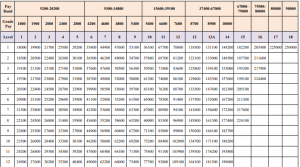
The Ministry of finance vide notification dated 25th July 2016 issued rules for 7th pay commission. The rules include a Schedule which shows categorically what payment has to be made to different positions. The said schedule is called 7th pay matrix
For the reference the table(7th pay matrix) is attached below.
Pay Band & Grade Pay
According to the table given above the first column shows the Pay band.
Pay Band is a pay scale according to the pay grades. It is a part of the salary process as it is used to rank different jobs by education, responsibility, location, and other multiple factors. The pay band structure is based on multiple factors and assigned pay grades should correlate with the salary range for the position with a minimum and maximum. Pay Band is used to define the compensation range for certain job profiles.
Here, Pay band is a part of an organized salary compensation plan, program or system. The Central and State Government has defined jobs, pay bands are used to distinguish the level of compensation given to certain ranges of jobs to have fewer levels of pay, alternative career tracks other than management, and barriers to hierarchy to motivate unconventional career moves. For example, entry-level positions might include security guard or karkoon. Those jobs and those of similar levels of responsibility might all be included in a named or numbered pay band that prescribed a range of pay.
The detailed calculation process of salary according to the pay matrix table is given under Rule 7 of the Central Civil Services (Revised Pay) Rules, 2016.
As per Rule 7A(i), the pay in the applicable Level in the Pay Matrix shall be the pay obtained by multiplying the existing basic pay by a factor of 2.57, rounded off to the nearest rupee and the figure so arrived at will be located in that Level in the Pay Matrix and if such an identical figure corresponds to any Cell in the applicable Level of the Pay Matrix, the same shall be the pay, and if no such Cell is available in the applicable Level, the pay shall be fixed at the immediate next higher Cell in that applicable Level of the Pay Matrix.
The detailed table as mentioned in the Rules showing the calculation:
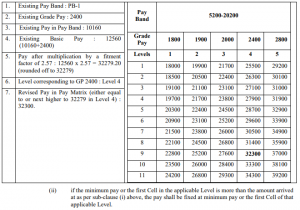
For example if your pay in Pay Band is 5200 (initial pay in pay band) and Grade Pay of 1800 then 5200+1800= 7000, now the said amount of 7000 would be multiplied to 2.57 as mentioned in the Rules. 7000 x 2.57= 17,990 so as per the rules the nearest amount the figure shall be fixed as pay level. Which in this case would be 18000/-.
The basic pay would increase as your experience at that job would increase as specified in vertical cells. For example if you continue to serve in the Basic Pay of 18000/- for 4 years then your basic pay would be 19700/- as mentioned in the table.
Dearness Allowance
However, the basic pay mentioned in the table is not the only amount of remuneration an employee receives. There are catena of benefits and further additions in the salary such as dearness allowance, HRA, TADA.
According to the Notification No. 1/1/2023-E.II(B) from the Ministry of Finance and Department of Expenditure, the Dearness Allowance payable to Central Government employees was enhanced from rate of 38% to 42% of Basic pay with effect from 1st January 2023.
Here, DA would be calculated on the basic salary. For example if your basic salary is of 18,000/- then 42% DA would be of 7,560/-
House Rent Allowance
Apart from that the HRA (House Rent Allowance) is also provided to employees according to their place of duties. Currently cities are classified into three categories as ‘X’ ‘Y’ ‘Z’ on the basis of the population.
According to the Compendium released by the Ministry of Finance and Department of Expenditure in Notification No. 2/4/2022-E.II B, the classification of cities and rates of HRA as per 7th CPC was introduced.
See the table for reference
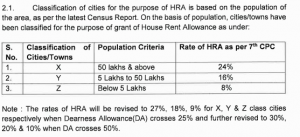
However, after enhancement of DA from 38% to 42% the HRA would be revised to 27%, 18%, and 9% respectively.
As above calculated the DA on Basic Salary, in the same manner HRA would also be calculated on the Basic Salary. Now considering that the duty of an employee’s Job is at ‘X’ category of city then HRA will be calculated at 27% of basic salary.
Here, continuing with the same example of calculation with a basic salary of 18000/-, the amount of HRA would be 4,840/-
Transport Allowance
After calculation of DA and HRA, Central government employees are also provided with Transport Allowance (TA). After the 7th CPC the revised rates of Transport Allowance were released by the Ministry of Finance and Department of Expenditure in the Notification No. 21/5/2017-EII(B) wherein, a table giving detailed rates were produced.
The same table is reproduced hereinafter.

As mentioned above in the table, all the employees are given Transport Allowance according to their pay level and place of their duties. The list of annexed cities are given in the same Notification No. 21/5/2017-EII(B).
Again, continuing with the same example of calculation with a Basic Salary of 18000/- and assuming place of duty at the city mentioned in the annexure, the rate of Transport Allowance would be 1350/-
Apart from that, DA on TA is also provided as per the ongoing rate of DA. For example, if TA is 1350/- and rate of current DA on basic Salary is 42% then 42% of TA would be added to the calculation of gross salary. Here, DA on TA would be 567/-.
Calculation of Gross Salary
After calculating all the above benefits the Gross Salary is calculated.
Here, after calculating Basic Salary+DA+HRA+TA the gross salary would be 32,317/-
However, the Gross Salary is subject to few deductions such as NPS, Professional Tax, Medical as subject to the rules and directions by the Central Government. After the deductions from the Gross Salary an employee gets the Net Salary on hand.
However, it is pertinent to note that benefits such as HRA and TA are not absolute, these allowances are only admissible if an employee is not provided with a residence by the Central Government or facility of government transport.
Conclusion
Government service is not a contract. It is a status. The employees expect fair treatment from the government. The States should play a role model for the services. The Apex Court in the case of Bhupendra Nath Hazarika and another vs. State of Assam and others (reported in 2013(2)Sec 516) has observed as follows:
“………It should always be borne in mind that legitimate aspirations of the employees are not guillotined and a situation is not created where hopes end in despair. Hope for everyone is gloriously precious and that a model employer should not convert it to be deceitful and treacherous by playing a game of chess with their seniority. A sense of calm sensibility and concerned sincerity should be reflected in every step. An atmosphere of trust has to prevail and when the employees are absolutely sure that their trust shall not be betrayed and they shall be treated with dignified fairness then only the concept of good governance can be concretized. We say no more.”
The consideration while framing Rules and Laws on payment of wages, it should be ensured that employees do not suffer economic hardship so that they can deliver and render the best possible service to the country and make the governance vibrant and effective.
Written by Husain Trivedi Advocate

Online Gaming Act 2025: Legal and Regulatory Impact on India’s Digital Entertainment Economy

Introduction
India’s digital entertainment landscape underwent a seismic shift in August 2025 when President Droupadi Murmu gave her assent to the Promotion and Regulation of Online Gaming Act, 2025 [1]. This landmark legislation, passed by Parliament on August 21, 2025, represents one of the most significant regulatory overhauls in the country’s gaming industry, fundamentally reshaping how online gaming operates within Indian borders. The Act establishes a comprehensive legal framework that simultaneously promotes certain forms of digital gaming while imposing strict prohibitions on others, particularly real money gaming platforms.
The legislation emerged from growing concerns about the unregulated expansion of online gaming platforms and their potential impact on Indian consumers, particularly the youth. With the digital gaming market in India valued at over $2.8 billion and projected to grow exponentially, the need for regulatory clarity became paramount. The Act addresses critical issues ranging from consumer protection and addiction prevention to taxation and industry standards, marking a definitive shift from the previously fragmented state-wise regulatory approach to a unified national framework.
Legislative Framework and Scope
Comprehensive Regulatory Architecture
The Promotion and Regulation of Online Gaming Act, 2025 establishes a bifurcated regulatory approach that distinctly categorizes online gaming activities [2]. The legislation provides detailed definitions and classifications that determine which gaming activities are permissible and which face prohibition. Under Section 2 of the Act, “online gaming” is defined as any electronic game played through the internet or computer networks, while “online money games” specifically refer to games where participants can win or lose money or money’s worth based on the outcome.
The Act’s scope encompasses all forms of digital gaming platforms operating within India or serving Indian consumers. This extraterritorial application ensures that foreign gaming companies cannot circumvent Indian regulations by operating from offshore locations while targeting Indian users. The legislation applies to mobile applications, web-based platforms, and any digital medium that facilitates online gaming activities.
The regulatory framework establishes the Online Gaming Authority as the central regulatory body responsible for policy formulation, strategic development, and oversight of the gaming sector [3]. This authority operates under the Ministry of Electronics and Information Technology and possesses wide-ranging powers to investigate violations, impose penalties, and coordinate with other government agencies to ensure compliance.
Classification of Gaming Activities
The Act introduces a clear distinction between permissible and prohibited gaming activities. E-sports and online social games receive promotional support under the legislation, provided they meet specific criteria outlined in the Act. E-sports is defined as online games that are part of multi-sports events, recognized under the National Sports Governance Act, 2025, and have outcomes determined solely by factors such as physical dexterity, mental agility, and strategic thinking [4].
Online social games, which involve no monetary stakes and focus purely on entertainment and social interaction, are actively encouraged under the regulatory framework. These games can operate with minimal regulatory interference, subject to basic compliance requirements regarding user data protection and content standards.
Conversely, the Act imposes a comprehensive ban on online money games, defined as any gaming activity where participants can win or lose money based on game outcomes. This prohibition extends to all forms of real money gaming, including fantasy sports, poker, rummy, and other skill-based games that involve monetary stakes.
Regulatory Mechanisms and Enforcement
Online Gaming Authority: Powers and Functions
The Online Gaming Authority serves as the apex regulatory body with extensive powers to oversee the gaming industry [5]. The Authority’s mandate includes developing comprehensive policies for the gaming sector, establishing technical standards for gaming platforms, and ensuring compliance with consumer protection measures. The Authority can conduct investigations, impose penalties, and coordinate with law enforcement agencies to address violations.
One of the Authority’s primary responsibilities involves licensing and registration processes for permissible gaming activities. Gaming companies operating e-sports or social gaming platforms must obtain appropriate licenses from the Authority, demonstrating compliance with technical standards, data protection requirements, and content guidelines. The licensing process involves rigorous scrutiny of business models, financial capabilities, and operational procedures.
The Authority also maintains oversight of gaming platform algorithms, ensuring fairness and transparency in game mechanics. This includes regular audits of random number generators, game outcome distributions, and user engagement metrics to prevent manipulative practices that could harm consumers.
Enforcement Mechanisms and Penalties
The Act establishes a robust enforcement framework with significant penalties for non-compliance [6]. Violations of the online money gaming prohibition can result in imprisonment of up to three years and fines extending to ₹10 lakh for individuals. Corporate entities face substantially higher penalties, including fines up to ₹25 lakh and potential revocation of business licenses.
The enforcement mechanism operates through multiple channels, including the Online Gaming Authority, state police departments, and cybercrime cells. The Act empowers authorities to block websites, freeze bank accounts, and initiate criminal proceedings against violators. Internet service providers and payment gateways are required to comply with blocking orders and cease facilitating transactions for prohibited gaming activities.
The legislation also introduces whistleblower protection provisions, encouraging industry insiders to report violations without fear of retaliation. This creates additional layers of enforcement beyond traditional regulatory oversight.
Impact on Real Money Gaming Industry
Prohibition of Real Money Games
The Act’s most significant impact involves the comprehensive prohibition of real money gaming activities [7]. This blanket ban affects various segments of the gaming industry, including fantasy sports platforms, online poker rooms, and skill-based card games that previously operated under state-wise regulations. The prohibition applies regardless of whether games are classified as skill-based or chance-based, eliminating the long-standing legal distinction that allowed certain real money games to operate.
Fantasy sports platforms, which had grown into a multi-billion dollar industry in India, face complete shutdown under the new regulatory framework. Companies like Dream11, MPL, and other major players must either pivot their business models to non-monetary gaming or cease operations in the Indian market. This represents a fundamental shift from the previous regulatory environment where fantasy sports enjoyed protection under skill game classifications.
Online rummy and poker platforms, which had operated under various state regulations and court judgments, now fall under the central prohibition. The Act overrides state-level permissions and court decisions that previously allowed these activities, creating a uniform national standard that prohibits all forms of real money gaming.
Economic Implications for the Gaming Industry
The prohibition of real money gaming creates significant economic disruption for the Indian gaming industry. Industry estimates suggest that the real money gaming segment contributed over 80% of the total gaming industry revenue, making the prohibition financially devastating for many companies [8]. Thousands of jobs in gaming companies, technology providers, and ancillary services face elimination as companies restructure or shut down operations.
The economic impact extends beyond gaming companies to include advertising agencies, payment gateway providers, and technology infrastructure companies that serviced the real money gaming sector. Marketing budgets previously allocated to gaming advertisements will likely shift to other sectors, affecting media companies and digital marketing platforms.
However, the Act simultaneously creates opportunities for e-sports and social gaming segments. Government initiatives to promote e-sports infrastructure, tournament organization, and professional gaming careers may partially offset job losses in the real money gaming sector. The focus on skill-based competitive gaming aligns with global e-sports trends and could position India as a significant player in the international e-sports market.
Consumer Protection and Safety Measures
Addiction Prevention and Player Welfare
The Act prioritizes consumer protection through comprehensive addiction prevention measures and player welfare initiatives [9]. The legislation requires gaming platforms to implement robust age verification systems, spending limits, and time-based restrictions to prevent excessive gaming behavior. These measures extend beyond monetary gaming to include social games and e-sports platforms, recognizing that gaming addiction can occur regardless of financial stakes.
Gaming platforms must provide clear information about gameplay mechanics, odds, and potential risks associated with excessive gaming. The Act mandates prominent display of addiction helpline numbers and resources for players seeking assistance with gaming-related problems. Companies must also implement automatic alerts when players exceed predetermined time or engagement thresholds.
The regulatory framework establishes mandatory reporting requirements for gaming platforms regarding user behavior patterns, addiction indicators, and intervention measures. This data enables authorities to monitor industry compliance and identify emerging risks to consumer welfare.
Data Protection and Privacy Standards
Consumer data protection receives significant attention under the Act, with stringent requirements for data collection, storage, and processing [10]. Gaming platforms must comply with enhanced data protection standards that exceed general privacy regulations, recognizing the sensitive nature of gaming behavior data. Companies must obtain explicit consent for data collection and provide clear information about data usage purposes.
The Act prohibits the sharing of user gaming data with third parties for marketing or commercial purposes without specific user consent. Gaming platforms must implement advanced encryption standards for data transmission and storage, with regular security audits to prevent data breaches. Cross-border data transfer restrictions apply to gaming-related information, ensuring that user data remains within Indian jurisdiction.
User rights under the data protection framework include access to personal data, correction of inaccuracies, and deletion of information upon request. Gaming platforms must respond to user requests within specified timeframes and provide clear procedures for exercising data protection rights.
Legal Precedents and Judicial Interpretations
Supreme Court Proceedings and Constitutional Challenges
The constitutional validity of the Online Gaming Act faces scrutiny in the Supreme Court of India, which has consolidated all related challenges from various High Courts [11]. The Court’s decision will determine whether the Act’s comprehensive prohibition of real money gaming violates constitutional principles of freedom of trade and commerce under Article 19(1)(g) of the Indian Constitution.
The Supreme Court’s approach to this case carries particular significance given the pending GST dispute involving online gaming platforms. The Court had previously reserved judgment in a case involving ₹2.5 lakh crore in GST claims against gaming companies, and the new Act’s interaction with tax obligations creates additional complexity for judicial interpretation.
Legal challenges to the Act focus primarily on the proportionality of the prohibition and whether less restrictive regulatory measures could achieve the government’s stated objectives of consumer protection and addiction prevention. Petitioners argue that the blanket ban fails to distinguish between different types of skill-based gaming and may be disproportionate to the perceived risks.
Precedential Impact on Gaming Jurisprudence
The judicial treatment of the Online Gaming Act will establish important precedents for digital industry regulation in India. The Supreme Court’s decision will likely influence future legislative approaches to emerging technologies and digital platforms, particularly regarding the balance between industry promotion and consumer protection.
The case also carries implications for federalism and the distribution of regulatory powers between central and state governments. The Act’s override of state-level gaming regulations tests the boundaries of central legislative authority over subjects that traditionally fell within state jurisdiction.
Previous judicial decisions regarding skill versus chance distinctions in gaming will require reexamination in light of the Act’s comprehensive approach. Courts will need to reconcile established legal principles with the new regulatory framework’s broader consumer protection objectives.
Comparison with Global Gaming Regulations
International Regulatory Models
The Online Gaming Act’s approach differs significantly from gaming regulations in other major markets. Unlike the United Kingdom’s licensing-based system that allows regulated real money gaming, or the United States’ state-by-state approach, India has chosen a prohibition model similar to certain Middle Eastern countries. This positions India among the more restrictive gaming regulation regimes globally.
European Union gaming regulations generally focus on licensing, taxation, and consumer protection while permitting real money gaming activities. The EU model emphasizes regulatory oversight rather than prohibition, creating a framework that balances industry growth with consumer safety. India’s approach represents a more cautious regulatory philosophy that prioritizes risk elimination over risk management.
Asian markets show varying approaches to gaming regulation. While countries like Singapore maintain strict controls on gambling while allowing certain skill-based gaming, others like South Korea have embraced e-sports while restricting monetary gaming. India’s model aligns more closely with restrictive Asian approaches than with permissive Western frameworks.
Implications for International Gaming Companies
Foreign gaming companies operating in India face significant adaptation challenges under the new regulatory framework. Companies must restructure their business models, eliminate monetary gaming features, and focus solely on e-sports and social gaming offerings. This requires substantial investment in platform redesign and business model transformation.
The extraterritorial application of the Act means that foreign companies cannot simply relocate their operations outside India to continue serving Indian customers. The legislation creates enforcement mechanisms that target both domestic and international operators who facilitate prohibited gaming activities for Indian users.
International gaming companies may need to establish separate India-specific platforms that comply with local regulations while maintaining different offerings in other markets. This segmentation creates operational complexity and additional compliance costs that may influence companies’ decisions about the Indian market’s commercial viability.
Future Regulatory Developments and Industry Outlook
Evolution of the Regulatory Framework
The Online Gaming Act represents the initial phase of India’s comprehensive gaming regulation, with further refinements expected as implementation proceeds. The Online Gaming Authority will likely develop detailed regulations addressing technical standards, licensing procedures, and operational requirements for permissible gaming activities. These secondary regulations will provide clarity on compliance requirements and operational boundaries.
The regulatory framework may evolve based on implementation experience and stakeholder feedback. The government has indicated willingness to review the Act’s provisions after an initial implementation period, potentially leading to refinements in the regulatory approach. However, the core prohibition on real money gaming appears firmly established and unlikely to change in the near term.
Technological developments in gaming, including virtual reality, blockchain gaming, and artificial intelligence, will require additional regulatory consideration. The Act provides flexibility for the Online Gaming Authority to address emerging technologies through updated guidelines and regulations.
Industry Adaptation and Innovation
The gaming industry’s response to the Act involves significant business model innovation and market repositioning. Companies are exploring non-monetary gaming models, including advertising-supported platforms, subscription-based services, and e-sports tournament organization. This pivot requires substantial investment in new technologies and market development strategies.
E-sports development emerges as a primary growth opportunity under the new regulatory framework. Companies are investing in tournament infrastructure, professional gaming teams, and broadcasting capabilities to capitalize on the government’s promotional stance toward competitive gaming. This shift aligns with global e-sports trends and could position India as a major e-sports market.
Social gaming platforms are expanding their offerings to fill the entertainment gap left by real money gaming prohibition. These platforms focus on community building, social interaction, and non-monetary competition to maintain user engagement without violating regulatory restrictions.
Conclusion
The Promotion and Regulation of Online Gaming Act, 2025 fundamentally transforms India’s digital gaming landscape through its comprehensive regulatory approach. The legislation’s bifurcated strategy of promoting e-sports and social gaming while prohibiting real money gaming reflects the government’s commitment to balancing industry development with consumer protection. The Act establishes a robust regulatory framework through the Online Gaming Authority, comprehensive enforcement mechanisms, and strict penalties for violations.
The prohibition of real money gaming creates significant economic disruption for the industry while simultaneously opening opportunities in e-sports and social gaming segments. Consumer protection measures, including addiction prevention and data privacy safeguards, demonstrate the government’s prioritization of player welfare over commercial interests. The legislation’s extraterritorial application ensures comprehensive coverage of gaming activities affecting Indian consumers.
Legal challenges to the Act’s constitutional validity remain pending before the Supreme Court, and the judicial resolution will significantly influence the regulatory framework’s implementation and long-term sustainability. The Act’s impact on international gaming companies requires substantial business model adaptation and compliance investment.
The regulatory framework positions India among the more restrictive global gaming regulation regimes, contrasting with permissive approaches in Western markets. This choice reflects specific policy priorities regarding consumer protection and addiction prevention, though it limits the commercial potential of India’s gaming market.
Future developments will depend on implementation experience, judicial interpretations, and industry adaptation strategies. The success of the regulatory framework will ultimately be measured by its effectiveness in achieving stated consumer protection objectives while enabling sustainable growth in permissible gaming segments. The Act represents a significant regulatory milestone that will influence India’s digital entertainment industry for years to come.
References
[1] Vision IAS. (2025). “The Promotion and Regulation of Online Gaming Act, 2025.” Current Affairs Monthly Magazine. https://visionias.in/current-affairs/monthly-magazine/2025-09-04/polity-and-governance/the-promotion-and-regulation-of-online-gaming-act-2025
[2] Bar & Bench. (2025). “Legal Gamechanger: What the Online Gaming Act 2025 means For India’s Gaming Industry.” https://www.barandbench.com/view-point/legal-gamechanger-what-the-online-gaming-act-2025-means-for-indias-gaming-industry
[3] All India Radio News. (2025). “LS passes Bill encouraging e-sports, online social gaming, prohibits harmful online money gaming.” https://www.newsonair.gov.in/ashwini-vaishnaw-introduces-promotion-and-regulation-of-online-gaming-bill-2025-to-safeguard-youth-and-regulate-online-gaming-sector/
[4] PRS Legislative Research. (2025). “The Promotion and Regulation of Online Gaming Bill, 2025.” https://prsindia.org/billtrack/the-promotion-and-regulation-of-online-gaming-bill-2025
[5] SCC Online. (2025). “Promotion and Regulation of Online Gaming Act 2025: Scope, Rules, and Penalties for Violations.” https://www.scconline.com/blog/post/2025/08/24/promotion-regulation-online-gaming-act-2025-legal-reform/
[6] Law.asia. (2025). “Online Gaming Act, 2025: Game over for RMG?” https://law.asia/online-gaming-ban-india/
[7] India Legal Live. (2025). “Supreme Court to adjudicate constitutionality of Online Gaming Act, transfers all High Court cases to itself.” https://indialegallive.com/constitutional-law-news/courts-news/supreme-court-to-adjudicate-constitutionality-of-online-gaming-act-transfers-all-high-court-cases-to-itself/
[8] Law Trend. (2025). “Supreme Court Transfers All Challenges to Online Gaming Ban Law to Itself.” https://lawtrend.in/supreme-court-transfers-all-challenges-to-online-gaming-ban-law-to-itself/
[9] TaxO. (2025). “Supreme Court reserves verdict in Rs 2.5 lakh crore GST online gaming case.” https://taxo.online/latest-news/14-08-2025-supreme-court-reserves-verdict-in-rs-2-5-lakh-crore-gst-online-gaming-case/
Trump Tariffs Unconstitutional: Federal Circuit Upholds Constitution, Strikes Executive Overreach
The U.S. Judiciary’s Challenge to Transnational Tariff Regimes and India’s Weaponized Legal Counter-Offensive

Introduction
In an era of unprecedented global economic warfare, the judiciary’s role in constraining imperial executive overreach has once again proven decisive. The recent landmark ruling by the U.S. Court of Appeals for the Federal Circuit—a stunning 7-4 decision declaring the vast majority of trump tariffs unconstitutional—has sent shockwaves through the international trade landscape.[1]
This judgment, rooted in the most foundational principles of American constitutional law, represents nothing less than the judicial dismantling of economic imperialism. The Trump Tariffs Unconstitutional ruling creates an unprecedented opportunity for targeted nations, including India, to strategically engage with America’s legal system against executive overreach.
Context for Indian Lawyers
The U.S. Court of Appeals for the Federal Circuit is a unique appellate court with nationwide jurisdiction over specific subject matters, including international trade and patent law. Its decisions are binding across the country unless overturned by the U.S. Supreme Court, making its rulings particularly significant in trade disputes.
For India, which has borne the brunt of Trump’s 50% punitive tariffs affecting $48.2 billion in bilateral trade, this development transcends academic interest. It is a constitutional vindication of our strategic resistance and, more critically, a legal blueprint for an aggressive, multi-dimensional counter-offensive within the American judicial system itself. The empire’s constitutional crisis has become our constitutional opportunity.[2]
The Constitutional Earthquake: America’s Judiciary Strikes Down Imperial Overreach
The Youngstown Framework Applied: Presidential Power at Its “Lowest Ebb”
The Federal Circuit’s 7-4 decision represents the most significant constitutional constraint on presidential trade power since the Supreme Court’s legendary ruling in Youngstown Sheet & Tube Co. v. Sawyer (1952). Applying Justice Jackson’s three-part framework with surgical precision, the court concluded that trump tariffs unconstitutional are based on IEEPA overreach and fall squarely into “Category Three”—where presidential power operates at its lowest ebb because Congress has not authorized the claimed authority.[3]
Context for Indian Lawyers:
- Category One (Maximum Power): President acts with Congressional authorization.
- Category Two (Zone of Twilight): President acts where Congress is silent.
- Category Three (Lowest Ebb): President acts against Congress’s will—making the action presumptively unconstitutional.
The tariffs were placed in Category Three, where presidential actions are unconstitutional unless supported by exclusive Article II powers—a standard that Trump’s tariff regime catastrophically failed to meet.
Context for Indian Lawyers: What is IEEPA? IEEPA is a 1977 U.S. law that grants the President broad authority to regulate international commerce after declaring a national emergency in response to an “unusual and extraordinary threat” to the national security, foreign policy, or economy of the United States, where that threat originates substantially outside the U.S. It was originally intended for situations like sanctioning foreign governments or freezing assets of terrorist groups, not for imposing sweeping tariffs on major trading partners. The court’s ruling suggests that using IEEPA for such tariffs was an overreach beyond the statute’s intended scope.
This constitutional classification is devastating: In Category Three, presidential actions are presumptively unconstitutional unless supported by exclusive Article II powers—a standard that the trump tariffs unconstitutional ruling confirms Trump’s tariff regime failed to meet.
Context for Indian Lawyers: Article II of the U.S. Constitution outlines the powers of the executive branch, headed by the President. These include roles as Commander-in-Chief of the military and the authority to make treaties (with Senate approval). The argument is that the power to set tariffs does not fall under the President’s exclusive constitutional powers and therefore cannot justify an action taken against the will of Congress.
The Non-Delegation Doctrine: Judicial Restoration of Congressional Supremacy
The court’s application of the non-delegation doctrine strikes at the heart of executive authoritarianism. As the court explicitly held, Trump’s interpretation of IEEPA would grant him “unlimited authority to impose tariffs”—precisely the kind of boundless delegation that the Constitution’s framers designed the separation of powers to prevent.
Context for Indian Lawyers: The Non-Delegation Doctrine is a principle in U.S. constitutional law that holds that one branch of government (in this case, Congress) cannot delegate its constitutional powers to another branch (the Executive). While some delegation is permitted, it must be guided by an “intelligible principle.” This is very similar to the doctrine in Indian administrative law that holds that the legislature cannot delegate its essential legislative functions. The court here is saying that if IEEPA were interpreted to allow any tariff on any product at any time, it would amount to an unconstitutional delegation of Congress’s core legislative power to tax and regulate commerce.
The constitutional principle is ironclad: Article I, Section 8 vests the power to “lay and collect Taxes, Duties, Imposts and Excises” exclusively with Congress. When the court declared that “tariffs are a core Congressional power,” it wasn’t merely interpreting statute—it was reaffirming the fundamental architecture of American democracy against executive usurpation.
Context for Indian Lawyers: Article I, Section 8 of the U.S. Constitution explicitly enumerates the powers of Congress (the legislative branch). This clause is the foundation of Congress’s “power of the purse” and its authority over economic policy, including all forms of taxation and tariffs. The court’s decision reaffirms that this power belongs to the legislature, not the executive.
The Major Questions Doctrine: The Death Knell of Administrative Imperialism
Perhaps most significantly, the Federal Circuit deployed the Major Questions Doctrine—the Supreme Court’s newest and most powerful weapon against executive overreach—with devastating effect. The court found that Trump’s tariff regime, with its multi-trillion-dollar economic impact, unquestionably met the threshold for “vast economic and political significance,” reaffirming that the Trump Tariffs Unconstitutional ruling was justified and required clear congressional authorization.[4]
Context for Indian Lawyers: The Major Questions Doctrine is a relatively new but highly influential rule of statutory interpretation in U.S. law. It states that if a government agency or the President wants to take an action of “vast economic and political significance,” the authority for that action must be explicitly and clearly stated in a law passed by Congress. Ambiguous or general language in a statute is not enough. This doctrine serves as a powerful judicial check on the expansion of executive power into major policy areas without direct legislative approval.
The constitutional logic was unassailable: Trump’s attempt to derive unlimited taxation power from the ambiguous word “regulate” in IEEPA represented precisely the kind of interpretive imperialism that the Major Questions Doctrine was designed to destroy.
India’s Weaponized Legal Counter-Offensive: Constitutional Warfare Through American Courts
The Federal Circuit’s decision, while fundamentally an internal U.S. constitutional dispute, creates a rare strategic opening for the Indian government and its economic interests. When the subject of a domestic constitutional crisis is a foreign policy action—in this case, punitive tariffs—the nations targeted by that action are no longer mere spectators. They become stakeholders with a compelling interest in the outcome. The ruling, which declared the trump tariffs unconstitutional, provides India with an unprecedented opportunity to actively intervene and influence the interpretation of the U.S. Constitution to its own strategic advantage.
The central question is no longer just whether the tariffs are harmful, but whether they are legal under American law. With the trump tariffs unconstitutional ruling as precedent, this shifts the battleground from diplomatic protest to the U.S. judicial system itself. The challenge, therefore, lies in identifying the precise modes and modalities that permit a foreign sovereign and its commercial entities to engage in this constitutional battle. India can deploy a multi-pronged strategy that leverages different legal instruments and forums within the American system, effectively turning the U.S. rule of law into a weapon against its own executive’s overreach. What follows is a blueprint for this legal counter-offensive, divided into distinct phases and methods of engagement.
Phase One: Immediate Strategic Intervention
1. Supreme Court Amicus Brief: India’s Constitutional Voice
The most immediate and strategically devastating pathway for India is aggressive intervention in the pending Supreme Court appeal as amicus curiae. With the Federal Circuit’s ruling stayed until October 14, 2025 to allow Trump’s desperate Supreme Court challenge, India has a prime opportunity to deliver a constitutional coup de grâce.[5]
Context for Indian Lawyers: An amicus curiae (“friend of the court”) brief is a submission made by a person or organization who is not a party to the case but has a strong interest in the matter. While the term is familiar in India, in the U.S. Supreme Court, such briefs from foreign governments can be particularly influential in cases involving international trade, foreign relations, and the interpretation of federal statutes with global implications.
Strategic Objectives of India’s Amicus Brief:
-
Constitutional Validation: Support the Federal Circuit’s non-delegation and Major Questions analysis with India’s evidence of executive overreach
-
International Law Integration: Demonstrate how unlimited presidential tariff power violates fundamental principles of international economic law
-
Comparative Constitutional Analysis: Present evidence from other constitutional democracies showing how executive trade power is properly constrained
-
Economic Evidence: Provide comprehensive documentation of the $48.2 billion economic warfare inflicted on India through illegal executive action[2]
The Supreme Court regularly accepts and relies heavily on amicus briefs from foreign governments in trade-related constitutional cases. India’s brief would transform the case from domestic constitutional law into global constitutional principle—exactly the kind of systemic analysis that influences Supreme Court jurisprudence.[6]
2. The Corporate Phalanx: Coordinated Litigation Through Indian Subsidiaries
While a direct lawsuit by the Government of India against the U.S. government would face formidable jurisdictional hurdles, Indian corporations and their U.S. subsidiaries face no such constraints. This creates a powerful opportunity for coordinated constitutional warfare through corporate litigation vehicles.
Context for Indian Lawyers: A direct legal challenge by the Indian government would almost certainly be dismissed by U.S. courts for several reasons. First is the doctrine of sovereign immunity; the U.S. government cannot be sued without its consent by a foreign Government in USA. Apart, the more significant barriers are the doctrines of standing (the U.S. equivalent of locus standi) and the political question doctrine.
A court would likely rule that the direct, legally cognizable injury was suffered by the companies that paid the tariffs, not by the Indian state whose injury is more general economic harm. Furthermore, a court would likely view a government-vs-government lawsuit as a non-justiciable “political question”—a foreign policy dispute best left to the executive and legislative branches.
The strategy proposed is to bypass these barriers entirely. Private corporations, having suffered direct financial harm, have clear standing. Their lawsuit is framed as a commercial dispute (an illegal tax), not a political one, making it impossible for a court to dismiss. This transforms the issue from a diplomatic standoff into a straightforward administrative and constitutional law case.
Strategic Corporate Intervention:
-
Indian Conglomerates with U.S. Operations: Major Indian companies like Tata, Reliance, Infosys, and their U.S. subsidiaries have clear Article III standing to challenge tariffs in the Court of International Trade[7]
Context for Indian Lawyers: Article III standing is the constitutional requirement for a party to bring a lawsuit in a U.S. federal court. It is analogous to the concept of locus standi in India. To have standing, a plaintiff must prove they have suffered a concrete and particularized “injury in fact,” that the injury was caused by the defendant’s conduct, and that a favorable court decision can redress the injury. U.S. subsidiaries of Indian companies that paid the illegal tariffs would easily meet this requirement as they have suffered a direct financial injury.
-
Coalition with U.S. Importers: India can provide strategic coordination, funding, and evidentiary support to U.S. importers challenging the tariffs—effectively funding constitutional challenges from within the American system[8]
-
Multiple Jurisdictional Attacks: Simultaneous challenges in the Court of International Trade, Federal District Courts, and through administrative challenges create multiple pressure points that overwhelm the government’s defense capabilities
Context for Indian Lawyers: The Court of International Trade is a specialized federal court that handles cases involving customs, tariffs, and international trade laws. Federal District Courts are the general trial courts of the U.S. federal system. Filing cases in multiple courts can create a complex and resource-intensive legal battle for the government.
Current Active Litigation Opportunities: Multiple cases are immediately available for Indian intervention, including pending Court of International Trade proceedings and federal district court challenges. India can immediately join existing battles rather than starting new litigation.
Phase Two: Institutional Infrastructure Development
3. The Bilateral Investment Treaty Imperative: Building Permanent Legal Architecture
The current crisis exposes a critical strategic vulnerability: the absence of a comprehensive U.S.-India Bilateral Investment Treaty. This gap must be transformed from defensive weakness into offensive legal infrastructure.
Recent Strategic Developments: India is actively revising its Model BIT to be more investor-friendly as of 2025, suggesting a strategic pivot toward more aggressive investment protection. India is currently negotiating BITs with 12+ countries, demonstrating institutional capacity for rapid treaty development.[9]
Strategic BIT Elements for Constitutional Protection:
-
Clear Definition of Indirect Expropriation: Include discriminatory tariffs as a form of regulatory taking requiring compensation
-
Emergency Arbitration Procedures: Enable rapid response to time-sensitive trade disputes
-
Most-Favored-Nation Treatment: Prevent discriminatory trade measures through treaty obligation
-
Investor-State Dispute Settlement: Provide direct legal remedy against discriminatory government action
The Constitutional Leverage: America’s own courts have now declared unilateral tariff imposition constitutionally illegal. This creates unprecedented negotiating leverage for a BIT that constrains such actions through international law obligations.[10]
4. The WTO Offensive: Legal Predicate for Broader Constitutional Challenges
India’s aggressive expansion of its WTO retaliation package to $3.82 billion—nearly doubling the original amount—demonstrates our shift from defense to constitutional offense.[11] While the WTO’s Appellate Body remains paralyzed, India’s comprehensive WTO filings serve multiple strategic legal purposes:
Legal Functions of WTO Strategy:
-
International Law Foundation: Creates formal adjudication that U.S. tariffs violate international trade law
-
Evidence for U.S. Courts: WTO panel findings become powerful evidence in amicus briefs and corporate litigation
-
Diplomatic Pressure: Multilateral legal condemnation strengthens India’s position in bilateral negotiations
-
Precedent Building: Establishes legal framework for future disputes and alternative forums
Phase Three: Alternative Constitutional Architecture
5. BRICS Legal Framework: Constitutional Democracy’s Counter-Imperial Alliance
India’s leadership in BRICS provides the platform for creating comprehensive alternative legal architecture that protects constitutional democracies from economic imperialism.[12]
BRICS Constitutional Framework Elements:
-
Investment Protection Agreements: Reciprocal protection against discriminatory trade measures among member nations
-
Alternative Arbitration Forums: Independent dispute resolution mechanisms free from Western institutional control
-
Coordinated Legal Challenges: Joint amicus briefs and litigation support in multiple jurisdictions
-
Cross-Retaliation Mechanisms: Economic responses that span multiple sectors and jurisdictions
Legal Innovation Through Economic Architecture: India’s rupee-based trade settlement expansion creates practical alternatives to dollar dependence while building legally protected economic relationships. When these systems operate under comprehensive legal frameworks, they provide constitutional democracies with economic independence from imperial coercion.
Conclusion: Leveraging the Rule of Law for Constitutional Victory
The U.S. Federal Circuit’s ruling is more than a legal victory; it is a constitutional roadmap for dismantling economic imperialism through America’s own legal system. For India, this judicial earthquake creates unprecedented opportunities for an aggressive legal counter-offensive that transforms us from a passive target into an active constitutional warrior. The ruling that declared trump tariffs unconstitutional provides a legal precedent India can leverage to protect its trade and investment interests.
The empire’s constitutional crisis has become our constitutional opportunity. While America’s executive branch violates its own Constitution through illegal tariff warfare, India’s democratic institutions work in constitutional harmony to advance our national interests through the rule of law. This legal counter-offensive serves a purpose beyond immediate economic relief—it establishes India as the natural leader of constitutional democracies seeking legal protection from executive overreach. The Federal Circuit has handed us the constitutional sword. Through strategic legal action, comprehensive treaty negotiations, and leadership in developing alternative dispute resolution mechanisms, India can transform the current crisis into a foundation for constitutional victory over economic imperialism, further solidifying the precedent set by the trump tariffs unconstitutional decision.
The author is an Advocate specializing in constitutional law, international trade law, and investment treaty arbitration. He has extensive experience in cross-border commercial dispute resolution and strategic litigation against governmental overreach. Views expressed are personal.
References
[1] What happens next after Trump tariffs ruled illegal? Available at :https://www.bbc.com/news/articles/cy983g8jr5do
[2] 50% trade tariffs hit India as US punishes the country for buying Russian oil Available at: https://www.itv.com/news/2025-08-27/50-trade-tariffs-hit-india-as-us-punishes-the-country-for-buying-russian-oil
[3] ArtII.S1.C1.5 The President’s Powers and Youngstown Framework Available at: https://www.law.cornell.edu/constitution-conan/article-2/section-1/clause-1/the-presidents-powers-and-youngstown-framework
[4] The Three Major Questions Doctrines Available at: https://wlr.law.wisc.edu/the-three-major-questions-doctrines/
[5] What happens if the US Supreme Court also knocks down Trump’s tariffs? Available at:https://economictimes.indiatimes.com/news/international/us/what-happens-if-the-us-supreme-court-also-knocks-down-trumps-tariffs/articleshow/123602511.cms
[6] national pork producers council vs ross Available at: https://www.supremecourt.gov/DocketPDF/21/21468/233529/20220815155044138_21-468bsacProfessorMarkWu.pdf
[7] UNITED STATES COURT OF INTERNATIONAL TRADE Available at: https://www.cit.uscourts.gov/sites/cit/files/25-66.pdf
[8] Importers Seek Review by Supreme Court of Challenge to IEEPA Tariffs Available at: https://www.internationaltradeinsights.com/2025/06/importers-seek-review-by-supreme-court-of-challenge-to-ieepa-tariffs/
[9] BIT Network Expansion in Fast lane India in Talks With 12 Nations Saudi Arabia Russia Among Priority Partner Available at : https://timesofindia.indiatimes.com/business/india-business/bit-network-expansion-in-fast-lane-india-in-talks-with-12-nations-saudiarabia-russia-among-priority-partners/articleshow/122278913.cms
[10] US appeals court rules Trump’s tariffs illegal, setting stage for Supreme Court battle Available at :https://economictimes.indiatimes.com/news/international/world-news/us-appeals-court-rules-trumps-tariffs-illegal-setting-stage-forsupreme-court-battle/articleshow/123606062.cms?utm_source=contentofinterest&utm_medium=text&utm_campaign=cppst
[11] India Revises Retaliatory Tariffs against U.S. Steel and Aluminium Duties from a WTO Perspective Available at :https://www.vajiraoinstitute.com/upsc-ias-current-affairs/india-revises-retaliatory-tariffs-against-us-steel-and-aluminium.aspx
[12] India’s Push for Rupee Trade: A Strategic Move to Challenge Dollar Dominance Through BRICS Available at :https://www.linkedin.com/pulse/indias-push-rupee-trade-strategic-move-challenge-dollar-gaurav-mehta-ga7gc

Irrigation Land Management: Water Rights, Canal Land, and Reservoir Administration

Executive Summary
Irrigation land management in India operates within a complex constitutional and legal framework that governs water rights, canal land administration, and reservoir management. The regulatory structure encompasses multiple statutes including the Northern India Canal and Drainage Act, 1873, Inter-State Water Disputes Act, 1956, and various state-specific irrigation laws, creating an integrated approach to water resource utilization and land management for agricultural purposes. This comprehensive analysis examines the legal mechanisms governing water rights allocation, canal land acquisition and maintenance, and reservoir administration that collectively shape contemporary irrigation land management practices across Indian states.
Introduction
Water resources management in India represents one of the most critical challenges facing the nation, with irrigation infrastructure serving approximately 51% of agricultural land while the remaining area depends on monsoon rainfall [1]. The legal framework governing irrigation land management has evolved significantly since colonial times, establishing sophisticated systems for water rights allocation, canal construction and maintenance, and reservoir administration that balance agricultural needs with environmental conservation and inter-state equity considerations.
The constitutional allocation of water governance between Union and State governments, combined with traditional riparian rights and statutory frameworks, creates a multilayered system that requires careful coordination between various administrative authorities, agricultural communities, and legal institutions to ensure effective irrigation land management.
Constitutional Framework for Water Rights
Federal Structure and Water Governance
Water governance in India operates within the federal structure established by the Constitution, which places water-related subjects primarily under state jurisdiction through Entry 17 of the State List [2]. This entry encompasses water supplies, irrigation, canals, drainage, embankments, water storage, and waterpower, granting states comprehensive authority over water resource development and management within their territories.
However, this state authority is subject to Union powers under Entry 56 of the Union List, which enables Parliament to regulate inter-state rivers and river valleys [2]. This constitutional division creates a framework where local water management remains under state control while inter-state water disputes and navigation on national waterways fall under central jurisdiction.
Fundamental Right to Water
The Supreme Court of India has consistently recognized water as a fundamental right under Article 21 of the Constitution, establishing that “water is the basic need for the survival of human beings and is part of right of life and human rights as enshrined in Article 21 of the Constitution of India” [3]. This judicial recognition creates constitutional obligations for both central and state governments to ensure adequate water access for citizens while balancing competing demands from agriculture, industry, and domestic consumption.
The evolution of the right to water reflects the judiciary’s response to water scarcity challenges and the inadequacy of purely statutory approaches to water governance. Despite this constitutional recognition, implementation through comprehensive national water legislation remains incomplete, with the National Water Framework Bill, 2016 remaining in draft form [4].
Legal Framework for Water Rights
Riparian Rights Doctrine
The Indian legal system recognizes riparian rights as fundamental entitlements of landowners whose properties adjoin natural water bodies. Under the common law doctrine codified through the Indian Easements Act, 1882, riparian owners possess natural rights to use water flowing through or adjacent to their land for reasonable domestic purposes, livestock watering, and irrigation [5].
Illustrations (f) and (h) of Section 7 of the Indian Easements Act specifically address water pollution, establishing that “the pollution of a natural stream is a wrong, actionable at the instance of any riparian owner past whose land the water so polluted flows” [5]. However, riparian rights in India are increasingly subordinated to statutory regulations and state control over water resources for public purposes.
Statutory Water Rights Framework
The Northern India Canal and Drainage Act, 1873 establishes the foundational principle that “the State Government is entitled to use and control for public purposes the water of all rivers and streams flowing in natural channels, and of all lakes and other natural collections of still water” [6]. This statutory framework supersedes traditional riparian rights when water resources are required for public irrigation projects or other governmental purposes.
Section 32(f) of the Act explicitly states that “no right to the use of the water of a canal shall be, or be deemed to have been, acquired under the Indian Limitation Act, 1877, Part IV, nor shall the State Government be bound to supply any person with water except in accordance with the terms of a contract in writing” [6]. This provision ensures that water rights remain subject to governmental control and cannot be acquired through adverse possession or continuous use.
Inter-State Water Disputes Resolution
The Inter-State Water Disputes Act, 1956 provides the constitutional mechanism for resolving conflicts between states over shared water resources [7]. The Act empowers the Central Government to establish specialized tribunals for adjudicating disputes that cannot be resolved through inter-state negotiations, ensuring that water allocation decisions are based on legal principles rather than political considerations.
Recent amendments through the Inter-State River Water Disputes (Amendment) Bill, 2019 propose establishing a permanent tribunal structure to streamline dispute resolution and reduce delays that have historically characterized inter-state water conflicts [8]. These reforms reflect growing recognition that effective water resource management requires institutional mechanisms capable of addressing complex technical and legal issues surrounding river basin management.
Canal Land Administration Framework
Legislative Foundation: Northern India Canal and Drainage Act, 1873
The Northern India Canal and Drainage Act, 1873 serves as the primary legislation governing canal construction, maintenance, and land acquisition for irrigation infrastructure in northern Indian states [6]. Originally designed to regulate the extensive canal systems developed during the colonial period, the Act continues to provide the legal foundation for contemporary canal land administration.
The Act’s comprehensive scope encompasses land acquisition procedures, construction powers, water distribution mechanisms, compensation frameworks, and operational regulations that collectively govern canal land management. Section 3 defines “canal” broadly to include “all canals, channels and reservoirs constructed, maintained or controlled by the State Government for the supply or storage of water” along with associated works, embankments, and water-courses [6].
Land Acquisition Powers and Procedures
Section 14 of the Act grants extensive powers to Canal Officers to enter upon lands adjacent to canals or proposed canal sites for surveying, land marking, water gauging, and other activities necessary for canal construction and maintenance [6]. These powers include authority to “cut down and clear away any part of any standing crop, fence or jungle” where necessary for completing surveys and assessments.
The compensation framework under Section 15 requires tender of compensation for damage caused during land entry, with disputes referred to Collectors for final determination [6]. This provision balances the public need for irrigation infrastructure development with protection of private property rights through mandatory compensation mechanisms.
For permanent land acquisition, Sections 21-30 establish detailed procedures for water-course construction applications, including requirements for applicant deposits, public notice provisions, objection hearings, and compensation determination following Land Acquisition Act procedures [6]. These provisions ensure due process compliance while enabling efficient canal expansion and improvement.
Water Distribution and Management
The Act establishes comprehensive frameworks for water distribution through canal systems, including provisions for water-course construction, maintenance obligations, and usage regulations. Section 16 enables private parties to apply for canal water supply through water-course construction at applicant expense, creating public-private partnership opportunities for irrigation infrastructure development [6].
Section 20 addresses water supply through existing water-courses, requiring Divisional Canal Officers to determine appropriate conditions for water conveyance and establishing applicant liability for water-course maintenance costs and operational expenses [6]. These provisions promote efficient water distribution while ensuring infrastructure sustainability through user contribution requirements.
Water Rate Assessment and Collection
The Act establishes dual water rate systems through “occupier’s rates” charged to land users and “owner’s rates” assessed on landowners benefiting from canal irrigation. Section 36 empowers state governments to determine occupier’s rates through rules governing canal water supply for irrigation purposes [6].
Section 37 authorizes owner’s rates “on the owners of canal-irrigated lands, in respect of the benefit which they derive from such irrigation,” with Section 38 limiting such rates to amounts assessable under land revenue rules for increased annual land value caused by irrigation [6]. This framework ensures that beneficiaries contribute to irrigation infrastructure costs while preventing excessive rate assessment.
The recovery mechanisms under Sections 45-47 enable collection of unpaid water rates as land revenue arrears, providing efficient enforcement tools while allowing contractual collection arrangements with private parties [6]. These provisions ensure revenue sustainability for canal operations and maintenance.
Reservoir Administration and Management
Legal Framework for Reservoir Development
Reservoir construction and management in India operates under multiple legal frameworks including environmental impact assessment requirements, dam safety regulations, and water resource development policies. The Environmental Impact Assessment Notification provides mandatory assessment requirements for major irrigation and hydropower projects, ensuring environmental considerations are integrated into reservoir planning [3].
The Guidelines for Environmental Impact Assessment of River Valley Projects, implemented since 1985, establish comprehensive frameworks for assessing environmental impacts of large dam projects, including biodiversity conservation, downstream impact assessment, and rehabilitation planning for affected populations [3].
Reservoir Land Acquisition
Large reservoir projects typically require extensive land acquisition under the Land Acquisition, Rehabilitation and Resettlement Act, 2013, which replaced the colonial-era Land Acquisition Act, 1894. The modern framework emphasizes rehabilitation and resettlement of displaced populations while maintaining provisions for public purpose land acquisition [9].
The Sardar Sarovar (Narmada) project exemplifies contemporary reservoir development challenges, involving acquisition of vast land areas for dam construction, reservoir creation, and associated canal networks serving 1.792 million hectares of irrigable land across multiple states [10]. Such projects require coordination between central and state governments, environmental authorities, and affected communities.
Water Storage and Allocation
Reservoir administration involves complex water allocation decisions balancing irrigation demands, drinking water supply, industrial needs, and environmental flows. The prioritization framework typically emphasizes drinking water and municipal supply, followed by industrial use and irrigation allocation [10].
The Sardar Sarovar project’s water allocation demonstrates this prioritization, with approximately 1.06 million acre-feet designated for drinking and municipal supply serving 8,215 villages and 135 urban centers, while 7.94 million acre-feet is allocated for irrigation purposes [10]. This allocation framework reflects constitutional obligations to ensure basic water access while supporting agricultural development.
Agricultural Water User Associations
Legal Framework for Participatory Irrigation Management
The evolution toward participatory irrigation management has created legal frameworks for establishing and regulating Water User Associations (WUAs) as democratic organizations controlled by agricultural beneficiaries [11]. These associations operate on not-for-profit bases through general assemblies and elected management boards, representing a shift from centralized irrigation administration toward community-based management.
Water User Associations in India operate under various state-specific legislation providing legal recognition as sui generis legal entities with specific powers and responsibilities for irrigation system operation and maintenance [11]. The legal framework typically defines association membership, governance structures, financial management, and dispute resolution mechanisms.
Irrigation Management Transfer
Irrigation Management Transfer (IMT) programs increasingly transfer operational responsibilities from government irrigation agencies to farmer-operated Water User Associations [11]. This transfer process requires careful legal structuring to ensure associations possess adequate legal authority while maintaining accountability for public infrastructure management.
The legal framework for IMT typically involves conditional transfer agreements specifying association obligations for infrastructure maintenance, water distribution equity, financial sustainability, and performance monitoring [11]. These agreements balance governmental oversight requirements with association autonomy necessary for effective local management.
Rights and Responsibilities Framework
Individual irrigators within Water User Associations typically hold organizational rights rather than direct water rights, creating indirect but practical water security through association membership [11]. This legal structure recognizes that individual water rights may be less practical than collective management systems in community irrigation contexts.
The legal framework establishes association responsibilities including equitable water distribution among members, infrastructure maintenance, financial management, and compliance with broader water management policies [11]. These responsibilities are typically enforced through association governance mechanisms rather than direct governmental oversight.
Environmental and Sustainability Considerations
Environmental Protection Requirements
Contemporary irrigation land management must comply with comprehensive environmental protection requirements including environmental impact assessments, biodiversity conservation measures, and pollution control standards. The Water (Prevention and Control of Pollution) Act, 1974 establishes Central and State Pollution Control Boards with authority to regulate water quality in irrigation systems [3].
The Environmental Protection Act, 1986 defines environment to include water, air, and land along with their inter-relationships, creating comprehensive frameworks for assessing irrigation project impacts on ecosystem integrity [3]. These requirements ensure that irrigation development contributes to sustainable agricultural productivity while protecting environmental resources.
Climate Change Adaptation
Modern irrigation land management increasingly incorporates climate change adaptation strategies including water conservation technologies, drought-resistant infrastructure, and flexible allocation mechanisms. The development of demand-side water management plans costing ₹6,000 crore across 8,350 water-stressed villages reflects governmental recognition of climate vulnerability in irrigation systems [1].
Micro-irrigation techniques including drip and sprinkler irrigation receive policy support as water-efficient alternatives to traditional flood irrigation methods [1]. The legal framework increasingly promotes these technologies through subsidies, technical assistance, and regulatory incentives encouraging adoption by agricultural communities.
Groundwater Integration
The integration of surface and groundwater resources represents a critical component of sustainable irrigation land management. The legal framework increasingly recognizes that canal irrigation and groundwater utilization are complementary rather than competing systems, with surface irrigation contributing to aquifer recharge that sustains well irrigation [12].
Evidence from both Indo-Gangetic plain and peninsular India demonstrates strong linkages between surface irrigation development and groundwater sustainability, supporting integrated approaches to water resource management [12]. Legal frameworks are evolving to promote conjunctive use of surface and groundwater resources while preventing over-exploitation of aquifer systems.
Contemporary Challenges and Judicial Responses
Water Scarcity and Allocation Disputes
India’s growing population and economic development create increasing pressures on water resources, with irrigation competing with urban water supply, industrial demand, and environmental requirements. The judicial response has emphasized constitutional obligations to ensure basic water access while recognizing legitimate agricultural water needs [3].
The Supreme Court’s recognition of water as a fundamental right creates legal obligations for governments to ensure adequate water availability for both human consumption and agricultural production [3]. However, implementation of these constitutional principles requires coordinated policy responses addressing infrastructure development, demand management, and equitable allocation mechanisms.
Infrastructure Modernization Requirements
Aging irrigation infrastructure requires comprehensive modernization programs incorporating technological advances, improved water use efficiency, and enhanced operational management. The potential for information technology applications in irrigation system management has been recognized for decades, with recent developments in artificial intelligence and machine learning offering new opportunities for improved service delivery [13].
Canal automation and remote monitoring systems represent significant advances in irrigation infrastructure management, enabling more precise water delivery, reduced operational costs, and improved system reliability [13]. Legal frameworks must evolve to accommodate these technological innovations while maintaining accountability and transparency in public infrastructure management.
Interstate Coordination Challenges
The management of interstate river systems requires enhanced coordination mechanisms addressing shared water resource development, equitable allocation, and dispute prevention. The proposed establishment of permanent tribunals under the Inter-State River Water Disputes (Amendment) Bill, 2019 represents important institutional innovation for addressing these coordination challenges [8].
River basin management approaches that transcend state boundaries offer potential solutions for integrated water resource development, though implementation requires careful attention to federal constitutional principles and state autonomy in water governance [8].
Future Directions and Policy Implications
Integrated Water Resource Management
Future irrigation land management policies must embrace integrated approaches that coordinate surface water, groundwater, and environmental water requirements within comprehensive river basin management frameworks. This integration requires legal reforms that promote coordination between irrigation, environmental, and urban water management authorities.
The development of comprehensive water policies incorporating both constitutional obligations and economic efficiency considerations represents a critical priority for sustainable irrigation land management. Such policies must address competing demands while ensuring agricultural water security necessary for food production and rural livelihoods.
Technological Innovation and Legal Adaptation
The rapid development of water management technologies including precision irrigation, remote sensing, and automated control systems requires corresponding legal framework adaptations. These technologies offer opportunities for improved water use efficiency, reduced operational costs, and enhanced environmental protection, but require regulatory frameworks that promote innovation while maintaining public accountability.
Digital platforms for water rights administration, allocation monitoring, and dispute resolution could significantly improve irrigation land management efficiency while enhancing transparency and stakeholder participation in decision-making processes.
Climate Resilience and Adaptation
Future irrigation land management must incorporate climate resilience strategies including drought preparedness, flood management, and adaptive infrastructure design. Legal frameworks must evolve to support flexible allocation mechanisms, emergency response procedures, and long-term adaptation planning that enables agricultural communities to respond effectively to climate variability.
The development of climate-smart irrigation policies requires integration of scientific knowledge, traditional agricultural practices, and community participation in adaptive management approaches that enhance both productivity and sustainability of irrigation systems.
Conclusion
Irrigation land management in India operates within a sophisticated legal framework that balances constitutional obligations, statutory requirements, and administrative necessities to ensure effective water resource utilization for agricultural purposes. The evolution from colonial-era canal administration to contemporary integrated water resource management reflects growing recognition of water’s critical importance for food security, economic development, and environmental sustainability.
The constitutional recognition of water as a fundamental right creates legal obligations for both central and state governments to ensure adequate water access while promoting efficient utilization through well-designed irrigation systems. The Northern India Canal and Drainage Act, 1873 continues to provide essential legal authority for canal land administration, though contemporary irrigation management increasingly emphasizes participatory approaches through Water User Associations and community-based management systems.
The challenges of inter-state water disputes, environmental protection, and climate change adaptation require continued evolution of legal frameworks that promote coordination, sustainability, and equity in water resource allocation. The success of future irrigation land management depends on effective integration of constitutional principles, statutory authority, and administrative capacity to serve the legitimate water needs of India’s agricultural communities while protecting environmental resources for future generations.
The complex interplay between riparian rights, statutory water allocation, and community management systems creates opportunities for innovative approaches to irrigation land management that combine legal authority with local knowledge and democratic participation. The continued development of these frameworks will determine whether India can achieve sustainable water security that supports both agricultural productivity and broader social and environmental objectives in an era of increasing water scarcity and climate uncertainty.
References
[1] Wikipedia. (2025). Irrigation in India. Available at: https://en.wikipedia.org/wiki/Irrigation_in_India
[2] Legal Service India. (2024). Water Management – Law And Policy In India. Available at: https://www.legalserviceindia.com/article/l420-Water-Management.html
[3] Legal Services India. (2024). Management of Water and Water Laws In India. Available at: https://www.legalservicesindia.com/article/1865/Management-of-Water-and-Water-Laws-In-India.html
[4] MDPI Water Journal. (2022). The Evolution of the Right to Water in India. Available at: https://www.mdpi.com/2073-4441/14/3/398
[5] Legal Service India. (2024). Water Rights. Available at: https://www.legalservicesindia.com/article/749/Water-Rights.html
[6] Government of India. (1873). The Northern India Canal and Drainage Act, 1873. Available at: https://www.indiacode.nic.in/bitstream/123456789/2282/1/a1873-08.pdf
[7] Lexibal. (2025). Water Laws & Irrigation in India. Available at: https://lexibal.in/water-laws-irrigation-in-india/
[8] NITI Aayog. (2024). Water and Land Resources. Available at: https://www.niti.gov.in/verticals/water-and-land-resources

Smart Cities Land Integration: Mission Guidelines, Land Pooling, and Urban Planning

Introduction
The Smart Cities Mission represents India’s ambitious urban transformation initiative launched in 2015, fundamentally reshaping how cities approach land integration, development, and planning. This mission encompasses strategic land pooling mechanisms, regulatory frameworks, and urban planning methodologies that collectively aim to create sustainable, technology-enabled urban environments. The integration of land resources under this mission operates within a complex legal framework that balances development objectives with property rights, environmental sustainability, and social equity.
The mission’s approach to land integration transcends traditional urban development models by incorporating smart solutions, participatory planning processes, and innovative financing mechanisms. Central to this transformation is the systematic pooling of land resources through established legal frameworks, enabling cities to implement large-scale infrastructure projects while ensuring fair compensation and rehabilitation for affected landowners.
Legal Framework Governing Smart Cities Land Integration
Constitutional and Statutory Foundation
The legal foundation for smart cities land integration rests primarily on the Right to Fair Compensation and Transparency in Land Acquisition, Rehabilitation and Resettlement Act, 2013 [1]. This legislation replaced the colonial-era Land Acquisition Act of 1894, establishing modern principles for land acquisition that emphasize transparency, fair compensation, and mandatory rehabilitation measures.
Under Section 2(1) of the LARR Act 2013, “public purpose” is comprehensively defined to include infrastructure development, planned development, and improvement of urban areas, which directly supports smart cities initiatives [1]. The Act mandates that land acquisition for public purpose must follow stringent procedural requirements, including social impact assessments, public hearings, and consent mechanisms that vary based on the nature of the acquiring entity.
The constitutional framework supporting smart cities land integration derives from Article 19(1)(f) read with Article 19(5), which permits reasonable restrictions on property rights for public interest. The Supreme Court’s interpretation in cases like Indore Development Authority v. Manoharlal [2] has established that land acquisition must serve a genuine public purpose and follow due process requirements.
Smart Cities Mission Guidelines and Land Policy Framework
The Smart Cities Mission Statement and Guidelines provide the operational framework for land integration activities [3]. These guidelines establish that cities must develop Area-Based Development (ABD) projects spanning 500 acres or more, requiring systematic land pooling and integration strategies. The guidelines mandate that at least 80% of the project area must be acquired through consensual mechanisms before invoking compulsory acquisition powers.
The mission guidelines specifically recognize land pooling as a preferred mechanism for large-scale urban development, citing successful models like the Gujarat International Finance Tec-City (GIFT City) [3]. Under these guidelines, participating cities must establish Special Purpose Vehicles (SPVs) with legal authority to undertake land integration activities, subject to state-specific town planning legislation.
Land Pooling Mechanisms and Regulatory Framework
Statutory Basis for Land Pooling
Land pooling under the Smart Cities Mission operates through various state-specific town planning acts, with Delhi’s Land Pooling Policy serving as a prominent model [4]. The Delhi Development Authority’s land pooling mechanism, established under the Delhi Development Act 1957, provides a template for voluntary land consolidation that other smart cities have adapted to local contexts.
Under the land pooling framework, landowners surrender their scattered holdings to a designated development authority, receiving developed plots in return along with infrastructure benefits. The Delhi model demonstrates how this mechanism can generate approximately 17 lakh housing units while preserving landowner interests [4]. The process requires landowners to contribute between 50-60% of their land for infrastructure development, receiving back 40-50% as developed, serviced plots.
The legal validity of land pooling mechanisms has been upheld by various High Courts, including the Delhi High Court in cases involving challenges to land pooling policies. These judicial pronouncements establish that voluntary land pooling, when conducted with proper safeguards and fair value determination, constitutes a valid exercise of urban planning powers.
Consent and Participation Requirements
The LARR Act 2013 introduces stringent consent requirements for land acquisition involving private companies or public-private partnerships. Section 2(2) of the Act requires consent from 80% of affected landowners for such projects [1]. However, for government projects with clear public purpose, including smart cities infrastructure, these consent thresholds may not apply, though consultation requirements remain mandatory.
The consent mechanism under smart cities land integration involves multiple stages of community engagement, public hearings, and grievance redressal. The Town and Country Planning Organisation (TCPO) guidelines emphasize participatory planning processes that ensure meaningful consultation with affected communities before finalizing land integration proposals [5].
Urban Planning Authority and Regulatory Oversight
Institutional Framework for Urban Planning
Urban planning authority for smart cities integration derives from state-specific town and country planning acts, with the Model Town and Country Planning Act 1960 providing the foundational template [6]. Each state has adapted this model to create regulatory frameworks that govern land use planning, development control, and infrastructure provision within smart cities.
The institutional framework typically involves multiple tiers of planning authorities, including state-level town planning departments, regional planning boards, and local planning authorities. These bodies exercise statutory powers for land use zoning, development permissions, and infrastructure planning that directly impact smart cities land integration strategies.
Under the Karnataka Town and Country Planning Act 1961, for instance, planning authorities possess powers to prepare comprehensive development plans, regulate land subdivision, and coordinate infrastructure development [7]. Similar frameworks exist across other states participating in the Smart Cities Mission, creating a decentralized yet coordinated approach to urban planning.
Development Control and Land Use Regulations
Smart cities land integration must comply with detailed development control regulations specified in state-specific town planning legislation. These regulations establish parameters for land use zoning, floor area ratios, building heights, infrastructure provision, and environmental compliance that shape how integrated land parcels can be developed.
The development control framework typically includes provisions for mixed-use development, affordable housing reservations, and infrastructure dedication requirements. For example, most state regulations mandate that large-scale developments reserve between 15-20% of developed area for economically weaker section housing, aligning with smart cities’ inclusive development objectives.
Case Law and Judicial Interpretations
Landmark Judgments on Land Acquisition and Urban Planning
The Supreme Court’s decision in Kolkata Municipal Corporation v. Bimal Kumar Shah established seven constitutional tests for valid land acquisition [2]. These tests require that acquisition serve a genuine public purpose, follow proper procedure, provide adequate compensation, ensure proportionality between public benefit and private loss, consider less restrictive alternatives, maintain transparency, and include effective grievance mechanisms.
In the context of smart cities, these constitutional safeguards ensure that land integration activities cannot proceed arbitrarily. The Court emphasized that public purpose must be genuine and not merely pretextual, requiring substantive evaluation of project benefits against individual property rights.
The Delhi High Court’s judgment in DDA v. Joint Action Committee validated the land pooling approach when conducted with proper procedural safeguards and fair value determination [8]. This decision established important precedents for voluntary land consolidation mechanisms that smart cities frequently employ.
Judicial Guidelines on Compensation and Rehabilitation
Recent Supreme Court decisions have clarified compensation principles applicable to smart cities land integration. In M/s Manohar Lal v. Union of India, the Court held that compensation must reflect actual market value plus solatium, emphasizing that acquisition proceedings cannot proceed without ensuring adequate financial provisions for affected parties [2].
The Court’s interpretation of rehabilitation requirements under the LARR Act 2013 mandates that affected families receive comprehensive support including alternative employment, skill development, and relocation assistance. These requirements significantly impact smart cities projects involving large-scale land integration, necessitating detailed rehabilitation plans before project approval.
Environmental and Social Impact Assessment Requirements
Mandatory Impact Assessment Framework
Smart cities land integration projects exceeding specified thresholds must undergo mandatory Social Impact Assessment (SIA) under Section 4 of the LARR Act 2013 [1]. The SIA process requires detailed evaluation of project impacts on affected communities, livelihoods, infrastructure, and social structures, with findings influencing land acquisition approval decisions.
Environmental Impact Assessment requirements apply to smart cities projects based on project scale and environmental sensitivity. The Environment Impact Assessment Notification 2006, as amended, establishes categorical requirements for environmental clearance that smart cities must satisfy before proceeding with land integration activities.
The SIA framework specifically examines whether proposed land integration serves genuine public purpose, whether alternative approaches could achieve similar objectives with less social disruption, and whether adequate mitigation measures exist for unavoidable adverse impacts. These assessments must be conducted by independent agencies and made publicly available for community review.
Rehabilitation and Resettlement Obligations
The LARR Act 2013 establishes detailed rehabilitation obligations for projects involving involuntary displacement. Section 5 of the Act requires preparation of comprehensive Rehabilitation and Resettlement (R&R) schemes that address housing, employment, education, healthcare, and infrastructure needs of affected families [1].
For smart cities projects, R&R planning must address both directly affected landowners and other affected persons including tenants, agricultural laborers, and informal sector workers. The Act provides specific entitlements including alternative housing, employment opportunities, skill development programs, and infrastructure access that ensure affected communities benefit from smart cities development.
Implementation Challenges and Legal Safeguards
Procedural Compliance and Due Process
Smart cities land integration faces significant procedural compliance requirements designed to protect landowner rights while enabling efficient development. The multi-stage approval process includes preliminary notifications, detailed project reports, social impact assessments, public hearings, and final acquisition awards, each subject to judicial review.
The procedural framework requires that acquisition proceedings follow strict timelines specified in the LARR Act 2013. Section 15 of the Act mandates that compensation awards be made within twelve months of the final notification, failing which acquisition proceedings lapse automatically [1]. This provision has created challenges for smart cities projects requiring extended planning and approval periods.
Judicial oversight mechanisms include mandatory deposit of compensation amounts before possession, appellate procedures for compensation disputes, and High Court jurisdiction over acquisition proceedings. These safeguards ensure that procedural violations can be effectively challenged while preventing arbitrary exercise of acquisition powers.
Dispute Resolution and Appellate Mechanisms
The LARR Act 2013 establishes a three-tier dispute resolution mechanism comprising Rehabilitation and Resettlement Committees at district level, Land Acquisition Rehabilitation and Resettlement Authority at state level, and High Court jurisdiction for final appeals [1]. This framework provides affected parties with accessible forums for challenging acquisition decisions and compensation determinations.
Smart cities projects must establish project-specific grievance redressal mechanisms that address complaints related to land valuation, rehabilitation implementation, and project impacts. The National Land Records Modernization Program supports these mechanisms by providing digitized land records that reduce disputes over ownership and boundaries.
Integration with Urban Development Policies
Alignment with National Urban Policy Framework
Smart cities land integration operates within the broader National Urban Policy framework that includes initiatives like the Atal Mission for Rejuvenation and Urban Transformation (AMRUT), Pradhan Mantri Awas Yojana, and Swachh Bharat Mission. This integrated approach ensures that land acquisition serves multiple urban development objectives simultaneously.
The policy framework emphasizes transit-oriented development, mixed-income housing, and sustainable infrastructure that influence how smart cities approach land integration. Projects must demonstrate alignment with these broader policy objectives to secure central government funding and technical support.
Urban Local Bodies play a crucial role in implementing land integration policies at the local level, working within statutory frameworks established by state urban development departments. The 74th Constitutional Amendment Act provides Urban Local Bodies with planning powers that must be coordinated with smart cities land integration activities [9].
Financial Mechanisms and Funding Framework
Smart cities land integration utilizes diverse financing mechanisms including central government grants, state government contributions, Urban Local Body resources, and private sector investments. The mission guidelines establish a funding ratio of 50:20:30 between central government, state government, and Urban Local Body contributions, though land monetization can reduce public sector financial requirements.
Land Value Capture mechanisms play a significant role in financing smart cities projects, allowing authorities to recover development costs through property appreciation resulting from infrastructure investments. These mechanisms operate through development charges, betterment levies, and transferable development rights that require specific statutory authorization under state town planning legislation.
Technological Integration and Digital Governance
Digital Land Records and Management Systems
Smart cities land integration increasingly relies on digital land record systems that provide accurate, updated information about property ownership, land use rights, and development permissions. The Digital India Land Records Modernization Program supports these efforts by creating standardized digital databases that reduce disputes and streamline acquisition processes.
Geographic Information Systems (GIS) and satellite mapping technologies enable precise identification of land parcels for integration projects, supporting more accurate valuation and impact assessment. These technological tools help planning authorities optimize land use patterns while minimizing acquisition requirements through better project design.
Blockchain technology is being explored for maintaining tamper-proof land transaction records and automating compensation payment processes. Several smart cities are piloting these technologies to enhance transparency and reduce administrative delays in land integration projects.
E-Governance and Transparency Measures
The Smart Cities Mission emphasizes e-governance platforms that provide real-time information about land integration projects, compensation status, and rehabilitation progress. These platforms must comply with Right to Information Act requirements while protecting sensitive personal information of affected parties.
Online grievance redressal systems enable affected parties to track complaint status and interact with project authorities without physical visits. These systems integrate with broader e-governance infrastructure to provide seamless service delivery while maintaining audit trails for accountability purposes.
Environmental Compliance and Sustainability Requirements
Integration with Environmental Regulations
Smart cities land integration must comply with comprehensive environmental regulations including the Environment Protection Act 1986, Water Prevention and Control of Pollution Act 1974, and Air Prevention and Control of Pollution Act 1981. These requirements influence project design, implementation timelines, and long-term maintenance obligations.
The National Green Tribunal’s jurisdiction over environmental disputes affects smart cities projects, particularly those involving forest land, water bodies, or ecologically sensitive areas. Projects must secure appropriate environmental clearances and demonstrate compliance with pollution control norms throughout the development process.
Coastal Regulation Zone notifications impact smart cities located in coastal areas, requiring specialized approval procedures and development restrictions. The Coastal Zone Management Plans must be integrated with smart cities land use planning to ensure regulatory compliance and environmental protection.
Sustainable Development and Climate Resilience
The Smart Cities Mission Guidelines emphasize climate-resilient infrastructure and sustainable development practices that influence land integration strategies [3]. Projects must incorporate green building standards, renewable energy systems, and water conservation measures that may require additional land allocations or modified development patterns.
Urban heat island mitigation, flood management, and air quality improvement objectives require strategic land allocation for green spaces, water bodies, and natural drainage systems. These environmental considerations constrain available land for built development while creating opportunities for innovative land use integration approaches.
Future Directions and Reform Initiatives
Legal and Policy Reforms
Ongoing reforms in land acquisition and urban planning legislation aim to streamline procedures while strengthening safeguards for affected communities. The recent amendments to various state town planning acts reflect evolving understanding of urban development challenges and technological capabilities.
Model legislation development by the Town and Country Planning Organisation seeks to harmonize state-level regulatory frameworks while preserving federal flexibility in implementation approaches [5]. These efforts aim to reduce regulatory complexity and implementation delays that currently challenge smart cities land integration projects.
Digital India initiatives are driving reforms in land record management, transaction processing, and grievance redressal that will significantly impact future smart cities development. The integration of artificial intelligence and machine learning technologies promises to enhance planning accuracy and reduce implementation timeframes.
Integration with Emerging Urban Challenges
Smart cities land integration strategies must evolve to address emerging challenges including climate change adaptation, pandemic resilience, and demographic transitions. These challenges require flexible regulatory frameworks that can accommodate changing development priorities while maintaining legal certainty for investors and communities.
The integration of metropolitan planning approaches with smart cities development reflects growing recognition that urban challenges transcend municipal boundaries. Regional coordination mechanisms are being developed to ensure that land integration activities support broader metropolitan development objectives while respecting local autonomy.
References
[1] Right to Fair Compensation and Transparency in Land Acquisition, Rehabilitation and Resettlement Act, 2013. https://www.indiacode.nic.in/handle/123456789/2121?locale=en
[2] Supreme Court Observer – Land Acquisition Cases. https://www.scobserver.in/cases/indore-development-authority-manoharlal-land-acquisition-case-background/
[3] Smart Cities Mission Guidelines, Ministry of Urban Development. https://smartcities.gov.in/
[4] About Land Pooling, Delhi Development Authority.
[5] Town and Country Planning Organisation
[6] Tamil Nadu Town and Country Planning Act, 1971 Analysis. https://blog.ipleaders.in/tamil-nadu-town-and-country-planning-act-1971/
[7] Karnataka Town and Country Planning Act Documents. https://www.indiacode.nic.in/bitstream/123456789/16523/1/town_planning_act,_1963.pdf
[8] Citizens for Justice and Peace – Constitutional Tests for Land Acquisition. https://cjp.org.in/supreme-court-lays-down-7-constitutional-tests-for-land-acquisition/
[9] Department of Land Resources, Government of India. https://dolr.gov.in/act-rules/